Of all the sacred cities in India, Kashi — the ancient name for Varanasi — holds a place in the Hindu heart that no other tirtha quite matches. It is the city that Lord Shiva himself is said to never leave. It is where the Ganga flows northward, against her own natural course, as if bowing in reverence. And it is here, on the burning ghats and the moss-worn stone steps that descend to the river, that countless families have come for millennia to fulfil their most sacred duty to the dead: Shradh Poojan.
If your family has lost a loved one and you wish to perform their Shradh in a place of the deepest spiritual power, our Shradh Poojan in Kashi service brings this experience to you with everything arranged — the pandit, the puja samagri, the location, and the guidance — so that you can focus entirely on your prayers and your grief, without the burden of logistics in an unfamiliar city.
Why Kashi Holds a Special Place in Shradh Tradition
The Skanda Purana, one of the largest of the 18 Mahapuranas, contains an entire section called the Kashi Khanda dedicated to the glories of this city. It states that dying in Kashi is itself a form of liberation — Lord Shiva whispers the Taraka Mantra into the ears of every soul that departs from Kashi, ensuring their moksha regardless of their accumulated karma. This tradition of liberation makes Kashi the most auspicious place not only for death itself but for all rites connected to the dead.
The Garuda Purana specifically recommends that Shradh performed on the banks of the Ganga at Kashi carries merit equal to a hundred years of regular Shradh. The Ganga at Kashi is said to be especially charged because she receives the ashes and offerings of countless souls over thousands of years — the river herself becomes a conduit to Pitru Lok (the realm of ancestors). When tarpan water is offered here, the tradition holds that it reaches the departed with particular directness.
Two ghats in Kashi are especially significant for Shradh. Manikarnika Ghat — the main cremation ground of Varanasi, where fires have reportedly never been extinguished for thousands of years — is considered the most powerful place on Earth for last rites and post-death ceremonies. You can read more about this extraordinary place in our dedicated guide on Manikarnika Ghat and its mythological roots. Dashashwamedha Ghat, where the famous evening Ganga Aarti takes place, is another principal location for Shradh and tarpan, considered to carry the merit of ten Ashwamedha Yagnas.
Who Should Perform Shradh in Kashi
Shradh in Kashi is appropriate for all Hindus who wish to honour their departed ancestors. It is particularly meaningful in these situations:
- The deceased had a lifelong wish to visit or die in Kashi, and fulfilling that wish through their post-death rite feels like completing an unfinished promise
- Your family has been performing Shradh at home or locally but wishes to perform a more thorough, tirtha-based ceremony at least once
- The departed soul died far from any tirtha — in a hospital, at home, in an accident — and you feel the Shradh at a major sacred site will provide additional peace to their soul
- You are performing Shradh for the first year after death (Prathama Varsha Shradh) and want it performed at a location of maximum spiritual merit
- Pitrupaksha Shradh — the annual 16-day period of ancestral observance — when you want to perform the rite in Kashi for the first time or as a special observance
- A Jyotishi or family elder has specifically recommended that Shradh be performed at Kashi to address Pitru Dosh or recurring family difficulties
What Is Included in This Package
Our Shradh Poojan in Kashi is a complete, end-to-end service. You do not need to arrange anything separately. The package includes:
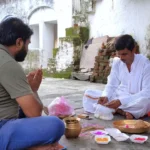
- Experienced Purohit at the Ghat — A senior pandit who is well-versed in the Shradh vidhi as per Vedic tradition, stationed at the ghat of your choice (Manikarnika, Dashashwamedha, or another ghat as per your preference)
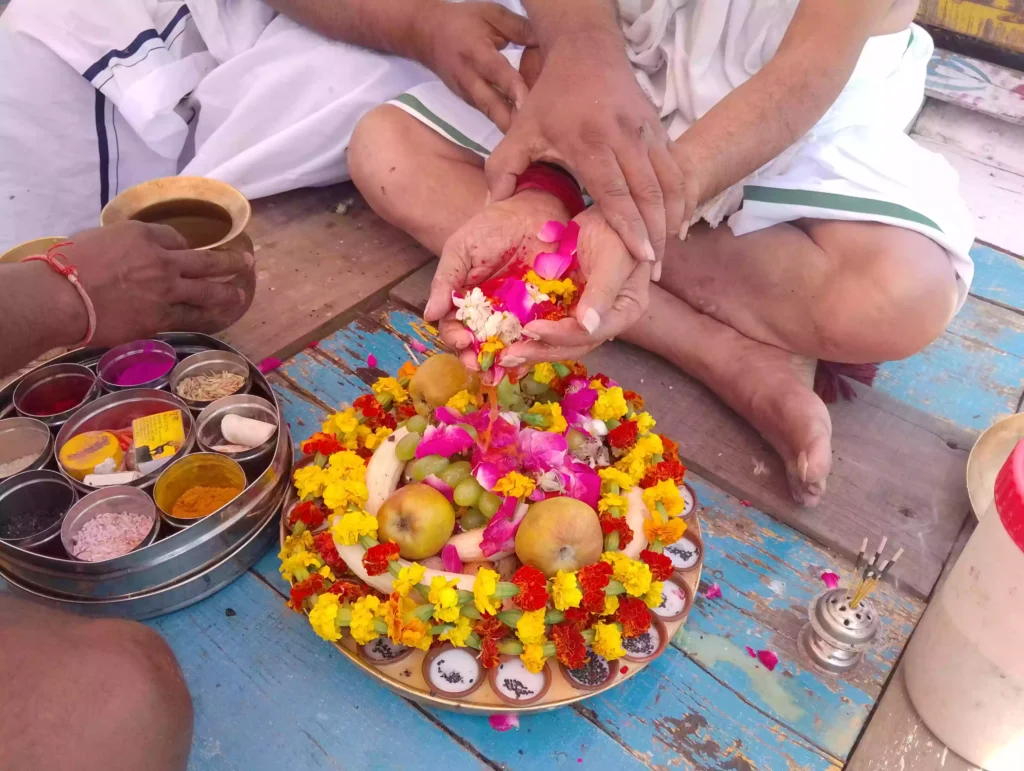
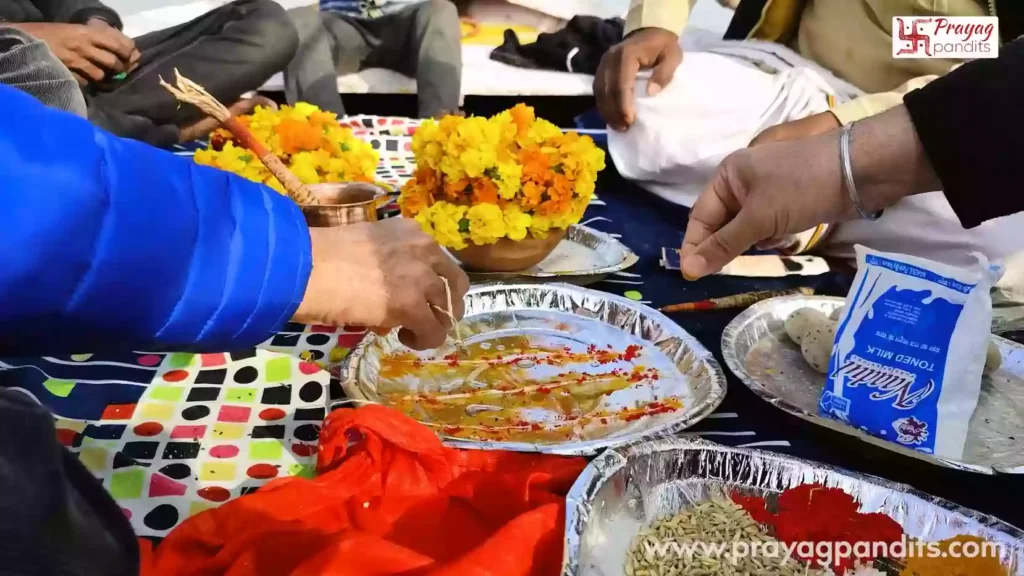
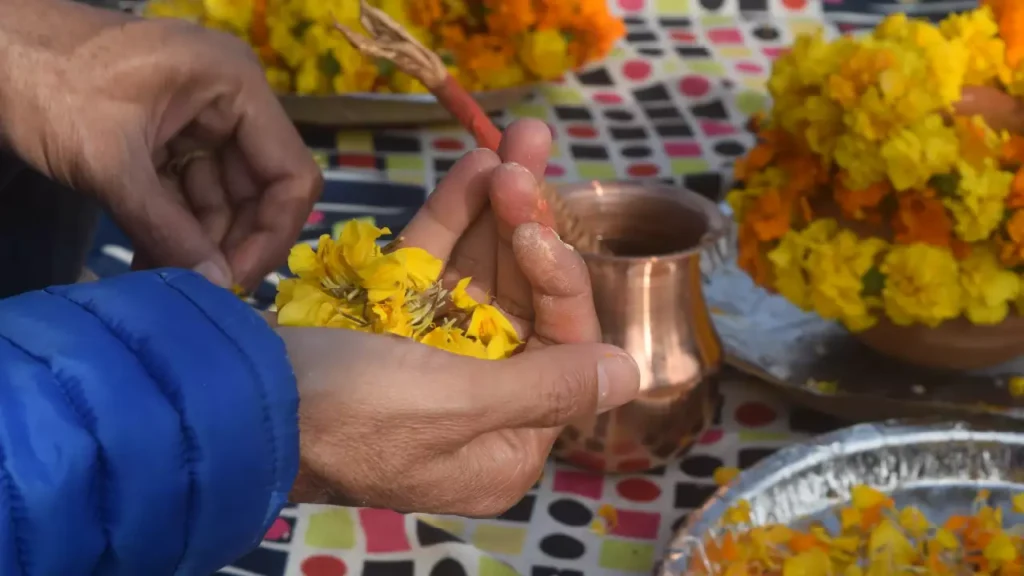
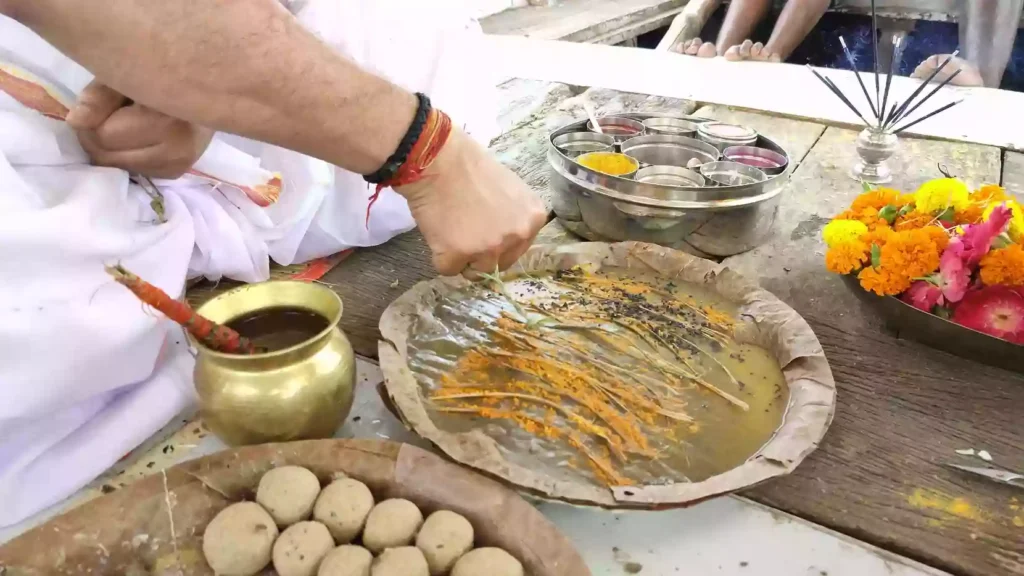
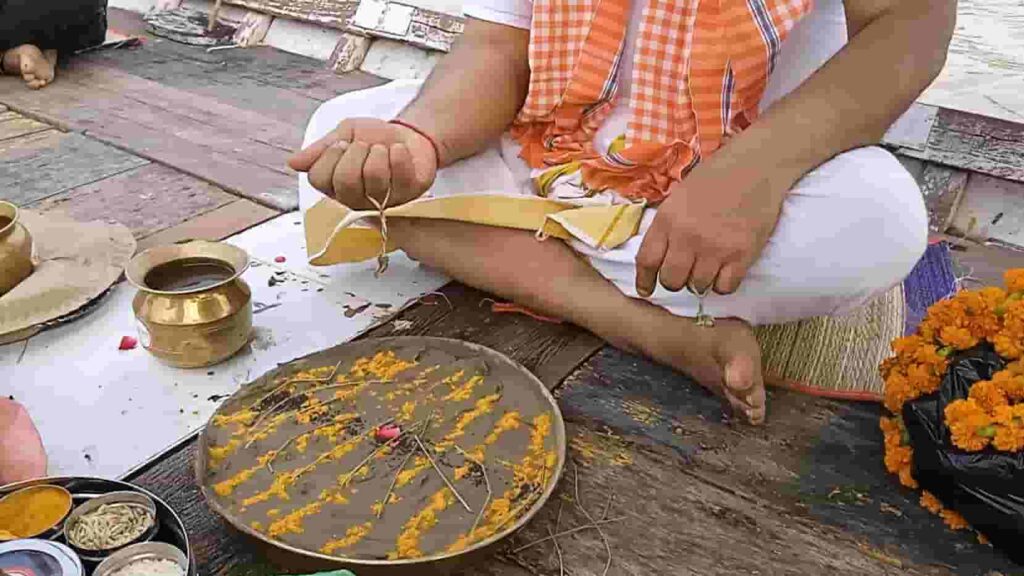
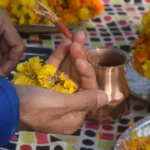
- Complete Puja Samagri — All ritual materials arranged by us: sesame (til), kusha grass, jau (barley), flowers, incense, ghee lamp, tarpan water vessels, pind materials (for Pind Daan if included), and all other required items as per the traditional vidhi
- Sankalp in Your Name — The formal declaration performed in your name, your father's name, and your family gotra, establishing the ritual before the Ganga
- Tarpan — Water offerings with sesame and kusha, made in the name of the deceased and other ancestors across three generations
- Pind Daan — Rice-ball offerings made at the Ganga bank as part of the full Shradh ceremony
- Brahmin Dakshina — The traditional offering to a brahmin in the name of the departed, fulfilling the scriptural requirement of feeding a brahmin as part of Shradh
- Local Guide — Assistance with navigating the ghats, understanding the ceremony, and any practical needs during your visit (for in-person attendees)
Step-by-Step: How Shradh Poojan Unfolds in Kashi
Knowing what to expect helps you arrive prepared — spiritually and practically. Here is how the ceremony typically unfolds:
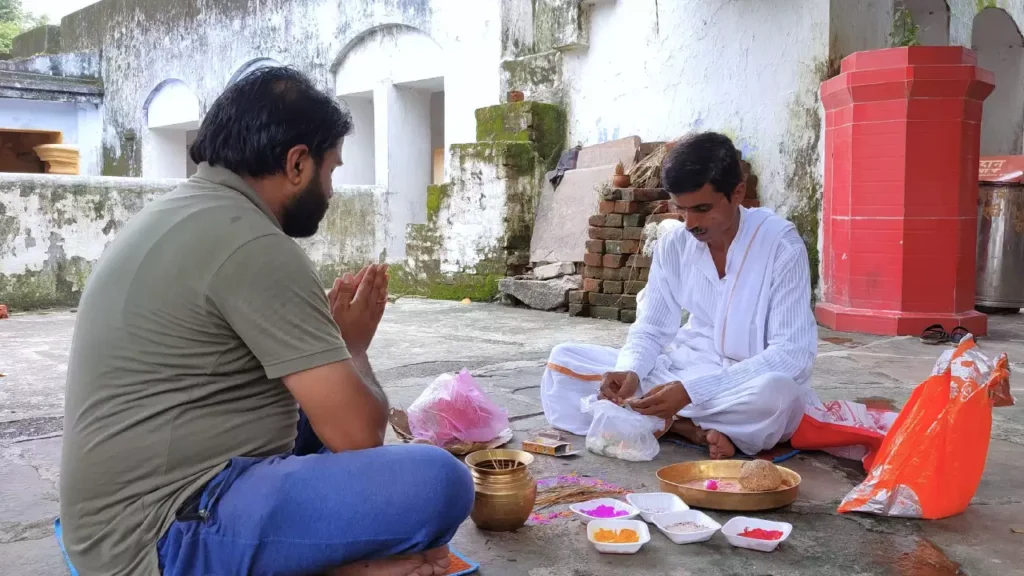
- Arrival and Orientation — Our team meets you at the ghat (or a nearby landmark) and guides you to the designated puja spot. The pandit introduces himself and briefly explains what will happen during the ceremony.
- Achaman and Purification — You and the pandit perform a brief purification ritual — sipping sacred water and reciting mantras — to prepare for the ceremony. If you have come to the Ganga, you may take a brief dip as part of your own purification.
- Sankalp — The most important step. The pandit leads you through the sankalp — a formal statement in Sanskrit in which you declare your name, your father's name, your gotra, the name of the deceased, the tithi of their passing (if known), and the purpose of the ritual. This establishes your intention and your relationship to the departed soul before the divine witnesses.
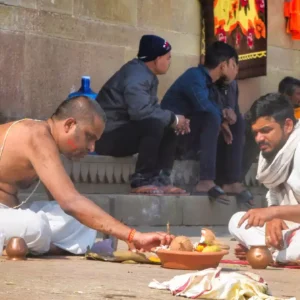
- Tarpan — You offer water mixed with sesame and kusha grass into the Ganga, once for each ancestor being honoured. The pandit recites the names and gotras while you pour. This is the moment when many families feel the most emotional connection to the ceremony.
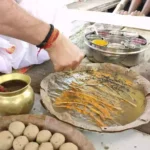
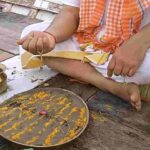
- Pind Daan — Rice balls (pind) prepared with sesame, honey, and ghee are offered at the water's edge in the name of the departed ancestors. The pind are then gently immersed in the Ganga.
- Dakshina and Brahmin Bhojan — A brahmin (in this case, our assisting pandit) receives dakshina on behalf of the deceased, fulfilling the Shradh tradition of feeding a brahmin.
- Prayers and Visarjan — Final prayers are offered for the peace of the departed soul. Any remaining ritual materials are respectfully immersed in the Ganga, and the ceremony formally concludes.
The entire ceremony typically takes between 90 minutes and 2.5 hours depending on the scope of the puja and the number of ancestors being honoured. We recommend arriving at least 30 minutes before the scheduled time, especially during Pitrupaksha when the ghats are busy.
Annual Shradh vs Pitrupaksha Shradh
Shradh can be performed at any time of year on the death anniversary (tithi) of the departed. However, the annual Pitrupaksha (Shradh Paksha) — a 16-day period in the dark fortnight of Ashwin month — is the most sacred time. During Pitrupaksha, the belief is that the ancestors are especially close to the world of the living, and offerings made during this period have multiplied merit. In 2026, Pitrupaksha runs from 26 September to 10 October.
Our Shradh service in Kashi is available year-round for annual Shradh on specific tithis, as well as during Pitrupaksha for the special seasonal observance. Many families choose to perform their annual Shradh locally throughout the year and come to Kashi once, during Pitrupaksha, for a particularly significant year — the first year after the death, the year of a major family event, or simply when they are finally able to make the journey.
To understand more about the different types of Shradh and which one might be most appropriate for your situation, we recommend reading our comprehensive guide on all you need to know about Pind Daan and Shradh.
Why Prayag Pandits for Shradh in Kashi
We understand that there are many pandit services available in Varanasi, and we also understand how important it is to choose wisely for a ceremony as personal as Shradh. Here is what sets Prayag Pandits apart:
- No Shortcuts — We perform the complete traditional vidhi. We do not compress the ritual or omit sections to save time. Every step — sankalp, tarpan, pind daan, dakshina — is done in full.
- Pre-Ceremony Guidance — Before the puja, our team explains everything to you: what each step means, what you need to bring, how to dress, and how to participate. You are not left confused or passive during the ceremony.
- Transparent Communication — We tell you exactly what is included in the price before you book. There are no surprise charges on the day of the puja.
- Experienced Purohits — Our pandits are not part-time performers of ceremonies. They are practicing purohits with deep knowledge of the scriptural basis for each ritual. They can answer your questions about the tradition, the significance, and the spiritual purpose of each step.
- Sensitive to Grief — Shradh is performed in the midst of loss. Our pandits approach every family with warmth, patience, and genuine understanding. They have guided many grieving families through these ceremonies and know how to hold space for emotion while maintaining the sanctity of the ritual.
If your family is also considering Pind Daan as part of the Shradh observance, you may want to explore our dedicated Pind Daan in Varanasi package, which can be combined with or performed alongside the Shradh Poojan.
Frequently Asked Questions
Is Shradh at Kashi the same as Pind Daan?
They are related but distinct. Shradh is the broader set of ancestral rites — it includes tarpan (water offerings), pind daan (rice-ball offerings), brahmin feeding, and prayers. Pind Daan is specifically the rice-ball offering, which is one important element within Shradh. Our Shradh Poojan package includes all these elements together, making it a complete ancestral ceremony. If someone recommends only Pind Daan, that is a shorter ceremony focused on the pind offering. If they recommend Shradh, they mean the full set of rites.
Do I need to travel to Kashi myself, or can it be done on my behalf?
Both options are available. If you can travel to Varanasi, we strongly encourage you to come in person — being physically present at the Ganga for your family member's Shradh is a deeply meaningful experience. However, if travel is not possible, our pandit can perform the ceremony as your pratinidhi (representative) with your sankalp given over a phone or video call. We will send you photographs and a video recording of the ceremony afterward.
Which ghat is best for Shradh in Varanasi?
Manikarnika Ghat is the most traditionally significant ghat for all death-related rites, including Shradh. However, it is also the city's primary cremation ground and may feel overwhelming or emotionally intense for some families. Dashashwamedha Ghat is another excellent option — equally sacred, slightly more accessible, and the site of the famous evening Ganga Aarti. Assi Ghat and Pishach Mochan Kund are also used for specific types of Shradh. Our pandit will recommend the most appropriate ghat based on your specific puja requirements.
On what days of the year can Shradh be performed in Kashi?
Shradh can be performed on the death anniversary (tithi) of the departed at any time of year. Additionally, every Amavasya (new moon day) is auspicious for ancestral rites. Pitrupaksha (16 days in September–October) is the most sacred period. Certain Amavasyas — particularly Somvati Amavasya (new moon on a Monday) — are considered especially powerful for Shradh and draw large gatherings at the Varanasi ghats.
How far in advance should I book?
For regular dates throughout the year, booking 5–7 days in advance is usually sufficient. During Pitrupaksha, we strongly recommend booking at least 3–4 weeks ahead, as this is the busiest period for all Shradh services in Kashi and slots fill up quickly. For Mahalaya Amavasya (the final and most important day of Pitrupaksha), booking 6–8 weeks in advance is advisable.
Shradh Poojan in Varanasi Cost — ₹10,999 All-Inclusive
Shradh ceremony in Varanasi (Kashi) costs ₹10,999 (regular price ₹19,999). This covers the experienced Kashi pandit, complete shradh samagri, pind offerings, tarpan, Brahmin bhoj, and full documentation. Varanasi is one of the seven moksha-giving cities — performing Shradh here carries deep spiritual merit.

 Book Pind daan Gaya Platinum Package with Gau Daan
1 × ₹18,100.00
Book Pind daan Gaya Platinum Package with Gau Daan
1 × ₹18,100.00 Book Pind daan Gaya Platinum Package with Gau Daan
  Online Shradh Poojan in Haridwar Pitrupaksha 2026
  Pind daan in Gaya for your ancestors this Pitrupaksha 2026
  Book Pind daan Gaya Platinum Package
  Online Shradh at Gaya this Pitrupaksha 2026
  Online Tripindi Shradh in Gaya Pitrupaksha 2026
  Varanasi Asthi Visarjan Package (2D/1N)