

No rituals selected yet.
Browse Pooja Packages →Key Takeaways
In This Article
In the entire cycle of the year, there is no month as pure and as dear to Lord Vishnu as the month of Karttika. It is a time when the gateways to the divine are wide open, and every small act of devotion is magnified a thousandfold. The crowning jewel of this sacred month — the most profound sacred ritual of Kartik Poornima — is the divine wedding ceremony known as Tulsi Vivah: the sacred marriage of the Tulsi plant to Lord Vishnu.
This beautiful ceremony brings immense blessings of prosperity, happiness, and liberation. But it is far more than a ritual — it is a re-enactment of one of the most poignant stories in the Puranic tradition, a story of devotion, divine love, and the blessing of sacred union. Whether you are in India, Singapore, Malaysia, the United Kingdom, or anywhere else in the world, this guide will help you understand this sacred tradition and participate in its blessings fully.
The Divine Bride — Who Is Tulsi Devi?
To understand the sacred ritual of Kartik Poornima fully, we must first know the bride. Tulsi is not merely a plant that we see in our courtyards. She is a living goddess — an embodiment of purity and auspiciousness — and the dearest devotee of Lord Vishnu. The Puranas describe her origins and her divine nature in remarkable detail.
A Manifestation of Goddess Lakshmi
Our scriptures tell us that the Tulsi plant is a direct manifestation of Goddess Lakshmi, the eternal consort of Lord Vishnu. She took this form on Earth for the well-being of all creation. The Padma Purana states beautifully that Lakshmi herself resides in Tulsi’s stem, all the holy rivers reside in her roots, and all the Devas and sacred tirthas reside in her branches. This means that a simple Tulsi plant in your home is a living pilgrimage site — a complete sacred universe in plant form.
The Most Beloved Plant of Lord Vishnu
A Tulsi leaf is considered the highest offering in the worship of Lord Vishnu. Any puja or offering of food (bhog) is considered incomplete without it. The Lord is described in the Vishnu Purana as saying: “I am more pleased with a single Tulsi leaf offered with devotion than with heaps of gold and jewels.” During the month of Karttika, this preference is amplified — the scriptures repeatedly emphasise that worshipping Lord Vishnu with Tulsi during this sacred month yields merit that no other offering can match.
The Ultimate Purifier — The Living Sacred Grove
The very presence of a Tulsi plant in a home transforms it into sacred ground. Its subtle energy keeps away negative vibrations and even the messengers of Yama (the God of Death). Merely seeing, touching, or nurturing the Tulsi plant is enough to wash away sins of thought, word, and deed. A family that tends a Tulsi plant with love and regularity is protected by the grace of both Tulsi Devi and Lord Vishnu himself.
The Tulsi plant holds this revered position not simply by tradition but because of a profound sacred story — the story of Vrinda, whose tapas (spiritual austerity) and devotion shaped the course of divine history. The sacred story of Tulsi Devi’s origins explains how this divine soul came to be worshipped in plant form and why her marriage to Lord Vishnu is the most important event of the Karttika month.
The Auspicious Timing — When Is the Sacred Ritual of Kartik Poornima Observed?
The marriage of Tulsi Devi to Lord Vishnu — the most celebrated sacred ritual of Kartik Poornima — is observed during a five-day window of extraordinary spiritual power in the holy month of Karttika. Understanding this timing is essential for performing the ritual at its most auspicious moment.
Prabodhini Ekadashi — The Awakening of Lord Vishnu
The four holy months of Chaturmasya end when Lord Vishnu awakens from his cosmic sleep on Prabodhini Ekadashi — the eleventh day of the bright half of Karttika. The universe itself rejoices at the Lord’s awakening. This day, also called Devutthana Ekadashi, marks the end of the period when marriages and auspicious ceremonies were suspended. In 2026, Prabodhini Ekadashi falls on November 26.
Dwadashi — The Most Widely Observed Day for Tulsi Vivah
The wedding ceremony of Tulsi is traditionally performed on Kartik Dwadashi — the twelfth day of the bright half. This is the most widely accepted day for the main Tulsi Vivah ritual. The ceremony performed on Dwadashi marks the formal end of the suspension of auspicious acts and invites the blessings of the divine couple into every household in the land. In 2026, this falls on November 27.
Kartik Poornima — The Grand Culmination
The entire period from Ekadashi to the full moon day — Kartik Poornima — is considered exceptionally holy. Kartik Poornima marks the grand finale of the month-long festivities and austerities. Performing any sacred act on this day yields immense and unending merit. Therefore, celebrating the Tulsi Vivah during this period, and especially as a sacred ritual of Kartik Poornima, is seen as the most powerful way to conclude one’s Karttika vows and receive the fullest blessings of the divine couple. In 2026, Kartik Poornima falls on November 30.
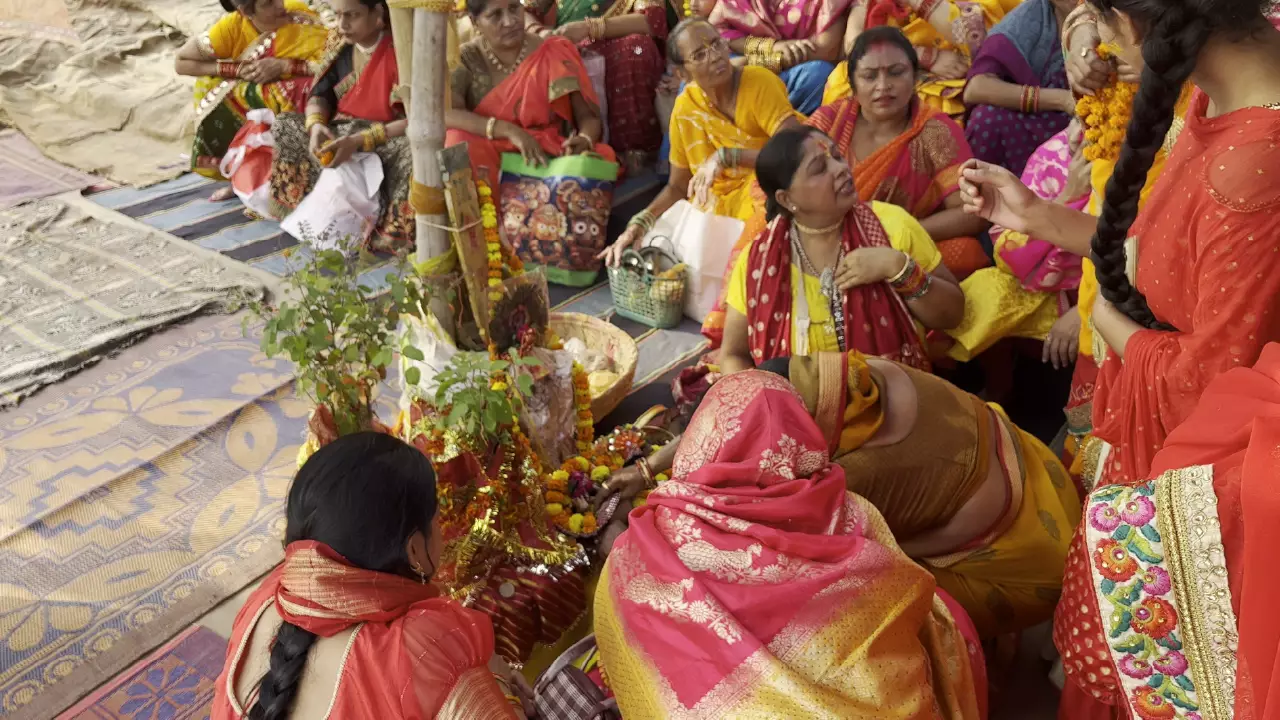
The Tulsi Vivah Ceremony — How the Sacred Ritual of Kartik Poornima Is Performed
Performing the Tulsi Vivah is said to bestow upon the devotee the same immense merit as performing Kanyadana — the sacred act of giving one’s daughter in marriage, which is counted among the highest forms of charity and devotion. The ceremony is performed with great joy and festivity, much like a human wedding, complete with decorations, music, and a sense of divine celebration.
Step 1 — Preparing the Sacred Space and the Bride
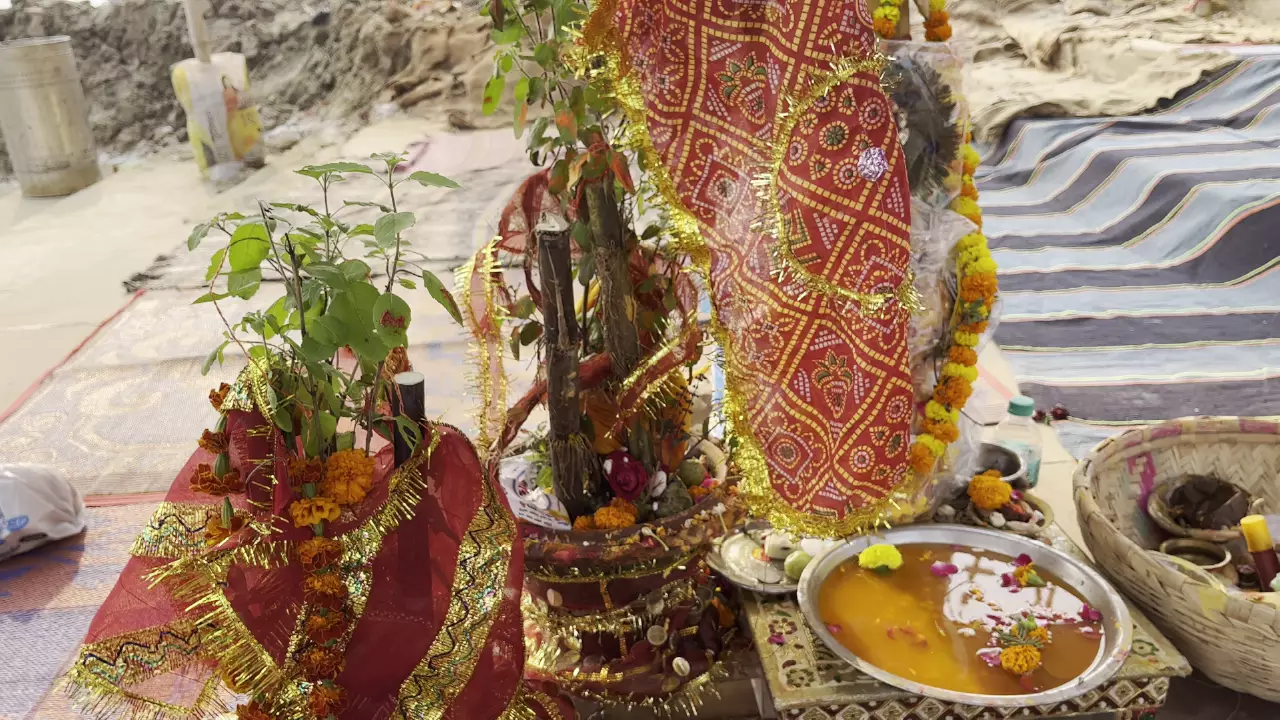
The Tulsi plant is beautifully adorned as a bride: a small sari is draped around the pot, bangles are placed at the base, turmeric paste is applied to the pot, and flowers are offered at the plant’s base. The entire setup is treated with the reverence due to a bride on her wedding day. Traditional homes string marigold garlands around the Tulsi plant and illuminate the puja space with rows of earthen lamps.
Step 2 — Setting the Vivah Mandap
The Tulsi pot is placed within a beautifully decorated mandap — the wedding canopy — traditionally constructed from freshly cut sugarcane stalks. Four sugarcane stalks form the four pillars of the mandap, symbolising the four aims of human life (Purusharthas): Dharma (righteousness), Artha (prosperity), Kama (desire fulfilled), and Moksha (liberation). An image or consecrated stone idol of Lord Vishnu (a Shaligrama — the sacred black stone held as a direct form of Lord Vishnu) is placed as the groom.
Step 3 — The Sankalpa and Pranapratishtha
The ceremony opens with the Sankalpa — the sacred vow. The performer (or the Pandit performing on your behalf) declares the purpose, the names of all family members for whom merit is sought, and the occasion. The priest then performs Pranapratishtha — the ritual infusion of divine life into the idol of Lord Vishnu — transforming the image into a living divine presence for the duration of the ceremony.
Step 4 — The Wedding Ceremony and Sacred Mantras
The wedding rituals mirror those of a traditional Hindu marriage. The Pandit chants the wedding Mantras, and a sacred thread (mauli) is wound around both the Tulsi plant and the Vishnu idol seven times, symbolising the seven sacred vows. The devotee performing the rite offers Tulsi to the Lord with the prayer: “O Lord, Protector of the Three Worlds, please accept this Tulsi Devi with all marital rites.”
Ghee lamps are lit during the ceremony, and the ceremony is performed in the evening to echo the timing of a traditional evening wedding. The Damodara Ashtakam and relevant wedding Mantras are chanted. The devotees gather to witness the divine union with joy and reverence.
Step 5 — Festivities, Night Vigil, and Prasad
The wedding celebration continues with devotional songs (kirtan), the recitation of the Vishnu Sahasranama, and the lighting of additional lamps around the home. Many devout families observe a night vigil (Jagarana) after the Tulsi Vivah, staying awake in devotional activity until dawn. The connection between Tulsi Vivah and the broader Tulsi Vivah tradition — with its specific regional variations across Maharashtra, Gujarat, and North India — makes this one of the most richly expressed ceremonies in Hindu domestic worship.
The next morning, wedding gifts are offered symbolically, and the ceremony is concluded. Tulsi leaves that have naturally fallen from the plant are consumed as sacred prasad, believed to eradicate all sins and grant the blessings of both Tulsi Devi and Lord Vishnu.
What Materials Are Needed for Tulsi Vivah?
• A healthy Tulsi plant (ideally one nurtured for at least a month)n• A Shaligrama stone or an idol of Lord Vishnun• Sugarcane stalks (4) for the mandapn• A small sari, bangles, and turmeric for adorning the Tulsin• Ghee, earthen diyas (at least 11), cotton wicksn• Fresh flowers — marigolds, jasmine, yellow flowers preferredn• Tulsi leaves (fallen naturally, not plucked)n• Puja samagri: incense, rice, vermillion, sacred thread (mauli)n• Fruits and milk sweets for naivedya (food offering)
The Deep Significance — Why Tulsi Vivah Is the Sacred Ritual of Kartik Poornima
The Tulsi Vivah is not merely a beautiful ceremony — it is a profound spiritual teaching contained within a ritual form. Every element of the ceremony carries layers of meaning that reflect the deepest truths of the Hindu understanding of love, devotion, and liberation.
The Reunion of Devotee and Lord
The story of Tulsi — originally the devoted wife Vrinda, whose purity and devotion were so complete that even Lord Vishnu could not act against her husband without a stratagem — is a story of the soul’s journey back to the divine. When Vrinda is revealed as having been deceived, her grief transforms into a curse and then into a blessing: she herself becomes the sacred plant that will be forever dear to the Lord. The Tulsi Vivah is the re-enactment of the eternal reunion of this devoted soul with her Lord — a reunion that every devotee can witness and participate in.
When we perform the Tulsi Vivah, we are not merely performing a wedding ceremony — we are celebrating the principle that sincere devotion always finds its way back to the divine. The ritual teaches us that the soul’s love for God is indestructible, and that even separation ultimately leads to a deeper, more eternal union.
The Resumption of Auspiciousness After Chaturmasya
On a more practical level, the Tulsi Vivah marks the end of Chaturmasya — the four months when the Gods are resting and auspicious ceremonies like marriages are suspended. When Lord Vishnu awakens and takes Tulsi as his bride, the entire cosmos is invited to resume its cycle of prosperity and new beginnings. This is why the Tulsi Vivah is considered the auspicious opener of the wedding season in Hindu culture — many families time their children’s marriages to begin after this sacred ceremony has been performed.
Connection to Deep Daan and the Light of the Sacred Month
The Tulsi Vivah ceremony is inseparable from the broader context of Karttika’s lamp-offering tradition. The ghee lamps lit during the ceremony are part of the same devotional stream as the Deep Daan offered on the Ganga ghats and the spectacular Dev Deepavali celebration at Varanasi. Together, they form a unified offering of light to the divine — light that purifies the home, lights the path for ancestors, and attracts the grace of Lord Vishnu and Goddess Lakshmi.
For Devotees in Singapore and Abroad — Perform This Sacred Ritual From Home
In today’s world, performing this beautiful and elaborate ceremony with all its precise injunctions can be a real challenge. You may live in an apartment in Singapore without a courtyard for a Tulsi plant, or in a country where finding authentic samagri (ritual materials) and a knowledgeable Pandit who knows your family’s specific traditions is genuinely difficult.
Your heart is filled with devotion, but your circumstances create barriers. How do you bridge this gap? How do you offer your reverence and receive the immense blessings of this sacred union?
Worry not. Where there is true devotion, the Lord always provides a way. Through our online puja services, we bring the temple to your home. You can now have the complete sacred ritual of Kartik Poornima — the Tulsi Vivah ceremony — performed on your behalf by learned Pandits in the holy land of Bharat, with your name in the Sankalpa and a live video link so you can participate from wherever you are.
Our Online Tulsi Vivah Ceremony — What It Includes
- Sankalpa in Your Name: The most crucial part of any puja — the formal statement of purpose recited in your name, your family members’ names, and your gotra, directing all blessings to you specifically.
- Experienced Pandits: Our learned Pandits, who have been performing the Tulsi Vivah and other Karttika rituals for generations, conduct the ceremony according to the sacred injunctions of the scriptures.
- All Authentic Samagri: We arrange all necessary materials — the Shaligrama stone, sugarcane mandap, sari and ornaments for the Tulsi, ghee diyas, flowers, and all puja items.
- Deep Daan: Ghee lamps are offered to Lord Vishnu and Mother Ganga as part of the ceremony, honoring the Karttika tradition of lamp-offering that runs through all the sacred rituals of this month.
- Brahmin Bhoj: A sacred meal is offered to a deserving Brahmin in your name — an act of charity that brings immense merit and directly pleases Lord Vishnu.
- Live and Interactive Ceremony: You receive a private video link to watch the entire ceremony in real time, follow the chants, and offer your prayers as a present participant.
- Prasad Sent to Your Home: After the puja, sacred prasad — including Tulsi leaves from the ceremony — is carefully packed and dispatched to your address in Singapore or wherever you reside.
Karttika Special
🌿 Online Tulsi Vivah — Sacred Ritual Package
Starting from
₹5,100
per person
The Immeasurable Blessings of Performing Tulsi Vivah
The Puranas are filled with descriptions of the infinite merit one gains from this sacred ritual of Kartik Poornima. These promises speak to every dimension of a devotee’s life — material well-being, family harmony, ancestral peace, and ultimate spiritual liberation.
- Liberation from Sins: The performance of this ritual absolves even the most grievous of sins. The Skanda Purana equates the merit of Tulsi Vivah with performing the great sacrifices of the Vedic tradition.
- Prosperity and Freedom from Distress: The divine couple blesses the devotee’s family with great worldly renown, abundant wealth, and freedom from poverty, sorrow, and anxiety.
- Family Well-being and Progeny: Families blessed by this ceremony receive the gift of sons and grandsons — the continuation of the lineage. Couples who have been seeking children find this ritual particularly potent.
- Marital Happiness: The Padma Purana states that a woman who performs or participates in this vow is blessed with a deeply happy married life, protected by the grace of Tulsi Devi and Goddess Lakshmi.
- Protection of the Home: A household where Tulsi Vivah is observed with sincerity receives Lord Vishnu’s direct protection from illness, misfortune, and untimely death for the coming year.
- Attaining Vaikuntha: Above all, one who worships Lord Vishnu with Tulsi, performs this sacred marriage with devotion, and observes the month of Karttika with purity attains salvation at the end of their earthly journey, going directly to the eternal abode of the Lord.
Frequently Asked Questions About Tulsi Vivah and Kartik Poornima
Do not let distance or circumstance prevent you from partaking in this divine celebration. This Kartik Poornima, join us as our Pandits in the sacred land of Bharat perform the Tulsi Vivah and all the associated rituals on your behalf. Let the sacred union of Tulsi and Vishnu illuminate your life with joy, prosperity, marital happiness, and the spiritual grace that is the deepest blessing of this ancient, beautiful tradition.
Hari Om Tat Sat.
Related Services by Prayag Pandits
- 🙏 Online Tulsi Vivah Package — Starting from ₹5,100
- 🙏 Deep Daan at Garh Mukteshwar (Kartik Mela) — Starting from ₹2,100
- 🙏 Satyanarayan Katha Poojan — Starting from ₹2,999
Frequently Asked Questions
Is Tulsi Vivah the same as the sacred ritual of Kartik Poornima?
Tulsi Vivah is the most celebrated and beloved of the sacred rituals of Kartik Poornima, though the full moon night itself encompasses several rituals including the holy bath, Deep Daan, Vishnu Puja, and night vigil. The Tulsi Vivah ceremony is performed from Ekadashi (Day 11) through Kartik Poornima (Day 15), with the most widely observed date being Kartik Dwadashi. Performing or commissioning the Tulsi Vivah during this five-day window is the quintessential expression of the Kartik Poornima sacred ritual.
Can Tulsi Vivah be performed from Singapore or abroad?
Yes. Prayag Pandits performs the complete Tulsi Vivah ceremony on behalf of devotees worldwide. Your name and gotra are recited in the Sankalpa, the ceremony is performed by experienced Pandits in Bharat, you receive a live video link to participate, and prasad is dispatched to your address. The scriptures support this form of proxy puja for devotees who are genuinely unable to be present due to distance or circumstance.
What happens if I don't know my gotra for the Sankalpa?
If you do not know your gotra, our Pandits can perform the ceremony using the Kashyapa gotra (the default gotra used when lineage is not known) or use the generic 'Vishnu Gotra' for Vaishnavas. Please inform us in advance when booking. Knowing your gotra is ideal but it is not a barrier to receiving the blessings of the ceremony.
What is the story behind Tulsi Vivah — why is this plant married to Lord Vishnu?
The origins of Tulsi Vivah lie in the story of Vrinda, a supremely devoted wife who was deceived by Lord Vishnu (in disguise) in order to defeat the demon Jalandhar. Feeling betrayed, Vrinda cursed the Lord to take the form of a stone (Shaligrama) and transformed herself into the Tulsi plant. Out of compassion and to honour her unparalleled devotion, Lord Vishnu declared that he would forever be worshipped alongside Tulsi, and that the Tulsi Vivah would be observed to celebrate their eternal spiritual union.
When should the Tulsi Vivah be performed in 2026?
In 2026, the Tulsi Vivah window extends from Prabodhini Ekadashi (November 26) to Kartik Poornima (November 30). The most widely observed date is Kartik Dwadashi (November 27). Performing the ceremony on Kartik Poornima (November 30) as the grand culmination of the month's observance also yields immense merit. Contact Prayag Pandits to confirm the auspicious muhurat for your ceremony.
Does Deep Daan form part of the Tulsi Vivah sacred ritual?
Yes. The offering of ghee lamps (Deep Daan) is integral to the Tulsi Vivah ceremony and to all the sacred rituals of Kartik Poornima. Lamps are lit during the wedding ceremony itself, placed around the Tulsi-mandap, and offered to the Ganga. The broader context of the lamp-offering tradition — from the Varanasi Dev Deepavali to the Deep Daan at Ayodhya — all flows from and converges on the Karttika month, of which the Tulsi Vivah is the sacred centrepiece.
Book Your Sacred Ritual
Authentic ceremonies performed by Veda-trained pandits with video proof at sacred sites across India.
2,263+ families served
Video proof included
Since 2019
