
No rituals selected yet.
Browse Pooja Packages →Key Takeaways
In This Article
Saptami Shradh — observed on the seventh tithi of Krishna Paksha during the sacred fortnight of Pitru Paksha — falls on Friday, October 2, 2026. The seventh lunar day, Saptami, is one of the spiritually potent days of the Hindu calendar, associated with the Sun (Surya) in Vedic astrology and believed to hold special power for ancestral liberation. On this day, Hindu families perform the time-honoured Shradh rituals to honour ancestors who departed this world on a Saptami date — in either the Shukla or Krishna Paksha of any month. With proper tarpan, pinda offerings, and Brahmin bhojan, the Saptami Shradh bridges the distance between generations, carrying the living family’s love and devotion to the souls of their departed elders.
What is Saptami Shradh?
Saptami Shradh is one of the sixteen Parvan Shradhas — the tithi-based ancestral ceremonies — performed during the sacred fortnight of Pitru Paksha. Each of the sixteen days corresponds to a specific lunar day (tithi) of the Hindu calendar, and ancestors who died on that tithi are the primary recipients of the Shradh performed on that day.
The number seven (sapta) carries deep Vedic significance. There are seven sacred rivers, seven sacred cities (Saptapuri), seven layers of existence (Sapta Loka), and seven rishis of the celestial sphere (Sapta Rishi Mandal). In the context of Shradh, the Saptami tithi is considered particularly auspicious because the seventh day’s energy facilitates the upward movement of the soul — through the seven planes of existence — toward liberation.
The Garuda Purana — the primary scriptural authority on death, afterlife, and ancestral rites in Hinduism — places great emphasis on Saptami Shradh as one of the essential observances. It explains that an ancestor who does not receive Shradh on their designated tithi remains in a state of longing and incompleteness, unable to progress to higher realms, until the ritual is eventually performed. Understanding our debt to our ancestors helps us appreciate why these rituals are not merely tradition but genuine spiritual acts of love.
Saptami Shradh 2026 Date and Muhurat
In 2026, Pitru Paksha spans from September 26 (Purnima Shradh) to October 10 (Sarva Pitru Amavasya). Saptami Shradh in 2026 falls on Friday, October 2, 2026.
The prescribed auspicious time windows for performing Saptami Shradh are:
- Kutup Muhurat — approximately 11:36 AM to 12:24 PM. The most sacred 48-minute window for ancestral rituals, occurring precisely at midday when the sun’s position is said to facilitate communication between the worlds of the living and the ancestors.
- Rohina Muhurat — approximately 12:24 PM to 1:12 PM. The secondary auspicious window, immediately following Kutup Muhurat and fully valid for all Shradh ceremonies.
- Aparahna Kala — the broader afternoon period extending to approximately 3:36 PM. Any part of this window may be used for Shradh if the primary windows are unavailable.
Friday (Shukravara) is traditionally associated with Venus (Shukra) in Vedic astrology — a planet governing relationships, harmony, and the domestic sphere. Performing Saptami Shradh on a Friday is considered especially auspicious for honouring female ancestors and for bringing peace to the domestic harmony of the performing family.
Saptami Shradh follows Shashthi Shradh (October 1) and precedes Ashtami Shradh (October 3). Families planning multi-day rituals can arrange continuous Shradh services at Prayagraj through Prayag Pandits.
Who Should Perform Shradh on Saptami Tithi?
The primary eligibility for Saptami Shradh belongs to those whose ancestors — fathers, mothers, paternal and maternal grandparents, great-grandparents, and other forebears — passed away on the seventh lunar day of any month. This includes the Saptami of all twelve months in both Shukla and Krishna Paksha.
The Dharmashastra texts outline the following specific categories for Saptami Shradh:
- Ancestors who died on Saptami Tithi in any month of the year
- Ancestors who were devoted to Lord Surya (the Sun God) — as Saptami is the Sun’s tithi and solar devotees are especially honoured on this day
- Elderly grandparents and great-grandparents for whom the specific death tithi may not be known, but who are known to have been born on or particularly revered this tithi
- Ancestors who were known scholars, teachers, or spiritual practitioners — as the seventh tithi is associated with wisdom and elevated consciousness
It is also traditional for families who have performed Pind Daan at sacred tirthas to offer supplementary Shradh on Saptami for all ancestors in the family tree — treating this day as an occasion for broad ancestral remembrance rather than limiting it only to those who died specifically on this tithi. At sacred locations like the Triveni Sangam, the spiritual energy of the tirtha itself extends the benefit of your Shradh to all your ancestors.
Saptami Shradh Rituals and Procedures
The complete Saptami Shradh follows the format of a Parvan Shradha — the full Shradh ceremony prescribed in the Dharmashastra for Pitru Paksha observances. Here is the step-by-step procedure:
1. Purificatory Bath at the Sacred River
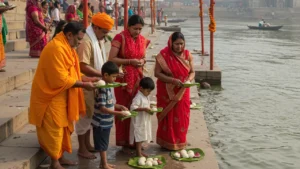
The day begins with a ritual bath, ideally at a sacred river or confluence. At Prayagraj, this means a holy dip at the Triveni Sangam before dawn or early morning. The performer should wear clean, white or unstitched dhoti (for men) or white saree (for women) and maintain physical and mental purity throughout the day.
2. Sankalpa — The Sacred Vow
The sankalpa is a formal Sanskrit declaration that opens every Shradh ceremony. The performing individual states their own name, their father’s name, their gotra (family lineage traced to a Vedic sage), the current year, month, tithi, nakshatra, and the names of the ancestors being honoured. The sankalpa is the ritual anchor — it ensures the spiritual merit flows to the intended recipients and not dispersed.
3. Tarpan — Water Offering to Ancestors
Tarpan is the core offering of water mixed with black sesame seeds (kala til), barley (jau), and Kusha grass. Standing at the riverbank with the feet partially in the water, the performer cups the water in both hands and allows it to flow from the right palm through the space between the thumb and index finger, reciting the ancestor’s name and the tarpan mantra with each offering. Three offerings are made per ancestor, addressing each in three modes: as a divine being, as an ancestral spirit, and as a human soul.
4. Pind Daan — Offering of Sacred Rice Balls
Following tarpan, the pandit prepares pindas — rice balls made from cooked rice kneaded with sesame seeds, honey, ghee, and sometimes barley flour and fragrant herbs. These pindas represent the physical body of the departed ancestor, and offering them at the riverbank is an act of symbolic nourishment. The significance of Pind Daan is elaborated at length in the Garuda Purana: the pinda provides the ancestral soul with a temporary subtle body through which it can receive the offering’s energy.
5. Brahmin Bhojan — Feeding the Sacred Guest
A qualified Brahmin pandit is hosted for a meal prepared without onion, garlic, or non-vegetarian ingredients. The meal typically includes dal, rice, sabzi, roti, sweets, and fruit. Before the Brahmin eats, a portion of the food is set aside as go-gras (for the cow), kaka bali (for crows), and portions for dogs and ants. After the meal, dakshina — a respectful monetary gift, along with a dhoti and sometimes other cloth — is offered to the Brahmin with both hands and genuine respect.
Saptami Shradh Ritual Tip
For Saptami Shradh, include an offering to Lord Surya (the Sun) during your morning prayers. Saptami is considered the Sun’s tithi, and a brief Sun worship (Surya Arghya) before the main Shradh ceremony is believed to strengthen the ritual’s power, especially if your ancestor was a solar devotee or was born in Simha or Mesha Rashi.
Significance in Hindu Scriptures
The Saptami Tithi’s spiritual importance is well-documented across multiple Puranic and Dharmashastra texts. The Surya Purana describes the seventh day as particularly sacred to the Sun, who in Vedic cosmology is the progenitor of the Manu dynasty — the original human ancestors from whom all of humanity descends. This solar connection gives Saptami Shradh an additional layer of cosmic significance: by performing Shradh on this day, the living connect not only to their immediate ancestors but to the primordial lineage of humanity itself.
The Garuda Purana states that among the Parvan Shradhas, those performed during the central days of Pitru Paksha — including Saptami — carry amplified merit because the ancestors are believed to be most accessible in these middle days of the fortnight. The first few days and the last day (Amavasya) have their own specific significance, but the seventh through ninth days are considered the spiritual peak of the ancestral fortnight.
The Matsya Purana adds that Saptami Shradh performed at a sacred tirtha (pilgrimage site) specifically liberates ancestors from the intermediate state and accelerates their journey toward moksha. This is why pilgrimage sites like Prayagraj, Gaya, and Varanasi see their highest visitor numbers during Pitru Paksha — devotees understand the extraordinary power of combining tirtha merit with ancestral rituals.
Do’s and Don’ts on Saptami Shradh
Do’s
- Recite the Pitru Stotra or Pitru Sukta from the Rigveda in the morning before commencing the Shradh ritual
- Use sesame seeds (til) generously — in tarpan water, in pinda preparation, and as part of the Brahmin’s meal
- Perform Surya Arghya (water offering to the Sun) in the morning, especially as Saptami is the Sun’s tithi
- Offer food to a minimum of three Brahmins if resources permit — the merit is multiplied proportionally
- Light a ghee lamp (ghrit diya) for your ancestors throughout the day — the light guides their souls
- Donate food, clothing, or money to the poor in your ancestors’ names after the main ceremony
Don’ts
- Do not eat before completing the Shradh ritual and ensuring the Brahmin has been fed
- Avoid all forms of luxury and indulgence during Pitru Paksha — this is a period of austerity and remembrance
- Do not use plastic or disposable items in the ritual — copper, brass, or earthen vessels are traditional and spiritually appropriate
- Avoid serving food with your left hand to the Brahmin — always use the right hand or both hands
- Do not begin new auspicious ventures (travel, property purchase, marriage arrangements) during Pitru Paksha
- Do not speak harshly to or disrespect any person on this day — the merit of the Shradh depends on the performer’s conduct throughout the day
Perform Saptami Shradh with Prayag Pandits
Prayagraj — where the Ganga, Yamuna, and invisible Saraswati meet — is described in the Prayag Mahatmya as the greatest of all tirthas for ancestral rites. The Triveni Sangam is specifically mentioned in ancient texts as the location where Shradh carries the power to grant complete liberation to the departed soul.
Prayag Pandits offers complete Saptami Shradh services at Prayagraj, Varanasi, and Gaya, performed by qualified Vedic pandits with expertise in ancestral ritual traditions. Whether you are performing Shradh for the first time or have done it for years, our pandits guide you through every step with proper Sanskrit mantras, correct ritual materials, and the full Brahmin bhojan and dakshina tradition.
Pitrupaksha 2026
🙏 Book Saptami Shradh at Prayagraj
Starting from
₹5,100
per person
Frequently Asked Questions about Saptami Shradh
For related Pitru Paksha observances, see our guides on Shashthi Shradh 2026 (October 1) and Ashtami Shradh 2026 (October 3). For the complete Pitru Paksha calendar and all sixteen days of ancestral observance, visit our Pitrupaksha Complete Ritual Guide.
Related Services by Prayag Pandits
- 🙏 Pind Daan in Gaya (Pitrupaksha) — Starting from ₹7,100
- 🙏 Shradh at Prayagraj — Starting from ₹7,100
- 🙏 Tarpan in Prayagraj — Starting from ₹5,100
Frequently Asked Questions
Why is Saptami considered a powerful tithi for Shradh?
Saptami (the seventh tithi) is associated with the Sun (Surya) in Vedic astrology, and the Sun is considered the progenitor of the Manu dynasty — the ancestral lineage of all humanity. This solar connection gives Saptami a special power for ancestral rites. Additionally, the Garuda Purana identifies the central days of Pitru Paksha (Saptami through Navami) as the period when ancestors are most spiritually accessible to offerings from the living.
Can Saptami Shradh be performed for a parent who died on a different tithi?
The primary Shradh for any ancestor should be performed on the tithi matching their death date. However, Saptami Shradh can be performed additionally for any ancestor as a supplementary offering. The main mandatory Shradh for your parent should be on their specific tithi, and you can include them in the Saptami offering as well without conflict.
Is there a specific food item associated with Saptami Shradh?
The Garuda Purana mentions that food preparations made with sesame seeds (til), rice, and ghee are universally appropriate for all Shradh tithis. For Saptami specifically, some regional traditions include offerings of khichdi (rice and lentil porridge), which is considered easy to digest and associated with simple, sattvik nourishment appropriate for ancestral offerings.
What happens if I miss Saptami Shradh?
If you are unable to perform Shradh on Saptami Tithi, the scriptures allow you to perform it on Sarva Pitru Amavasya (October 10, 2026) — the last day of Pitru Paksha, which serves as a universal Shradh day covering all tithis. Alternatively, you can perform the missed Shradh on any suitable day with guidance from a qualified pandit, though the Pitru Paksha window carries the highest merit.
How should I prepare emotionally for performing Shradh for a recently deceased parent?
It is completely natural to feel grief during Shradh, especially in the early years after a parent's death. The ritual itself is designed to channel that grief into devotional action. The Garuda Purana recommends approaching Shradh not as mourning but as a loving service — understanding that your parent's soul is present and aware of your love. Maintaining composure and devotion during the ritual, rather than being overcome with sorrow, is considered more beneficial for the ancestor's soul.
Book Your Sacred Ritual
Authentic ceremonies performed by Veda-trained pandits with video proof at sacred sites across India.
2,263+ families served
Video proof included
Since 2019
