Attend in person
Asthi Visarjan in Varanasi (Kashi)
4.8- 30–45 minutes
- For one deceased person
- Coordination at the ghat
- Samagri included
- Available year-round
On-ground support: We assist your family from the meeting near the ghat through the completion of the ceremony.
Watch ceremony & family reviewsOriginal price was: ₹11,550.00.₹5,355.00Current price is: ₹5,355.00.
Per pooja
Includes applicable taxes. Optional additions are separate.

Common questions
How is the ceremony arranged?
Book the pooja for your preferred date and time slot. You will receive confirmation by email. Twenty-four hours before arrival, you will receive the coordinator’s contact details. The coordinator guides and assists you throughout the ceremony and takes you to meet pandit ji.
What do we need to bring?
Bring the Asthi Kalash tightly wrapped in a clean white cloth, along with the full name and gotra of the deceased person. Please also bring your clothes. Your booking covers the necessary charges for the full ceremony listed in the inclusions, including pandit ji’s charges. If you wish, you may also bring daan items for pandit ji, Brahmins or people in need. This is entirely your choice.
Who stays in touch with us after booking?
Our team will contact you to confirm your arrival plans and other details. Twenty-four hours before arrival, you will receive the contact details of the ground team, coordinator or pandit ji.
Where will we meet pandit ji?
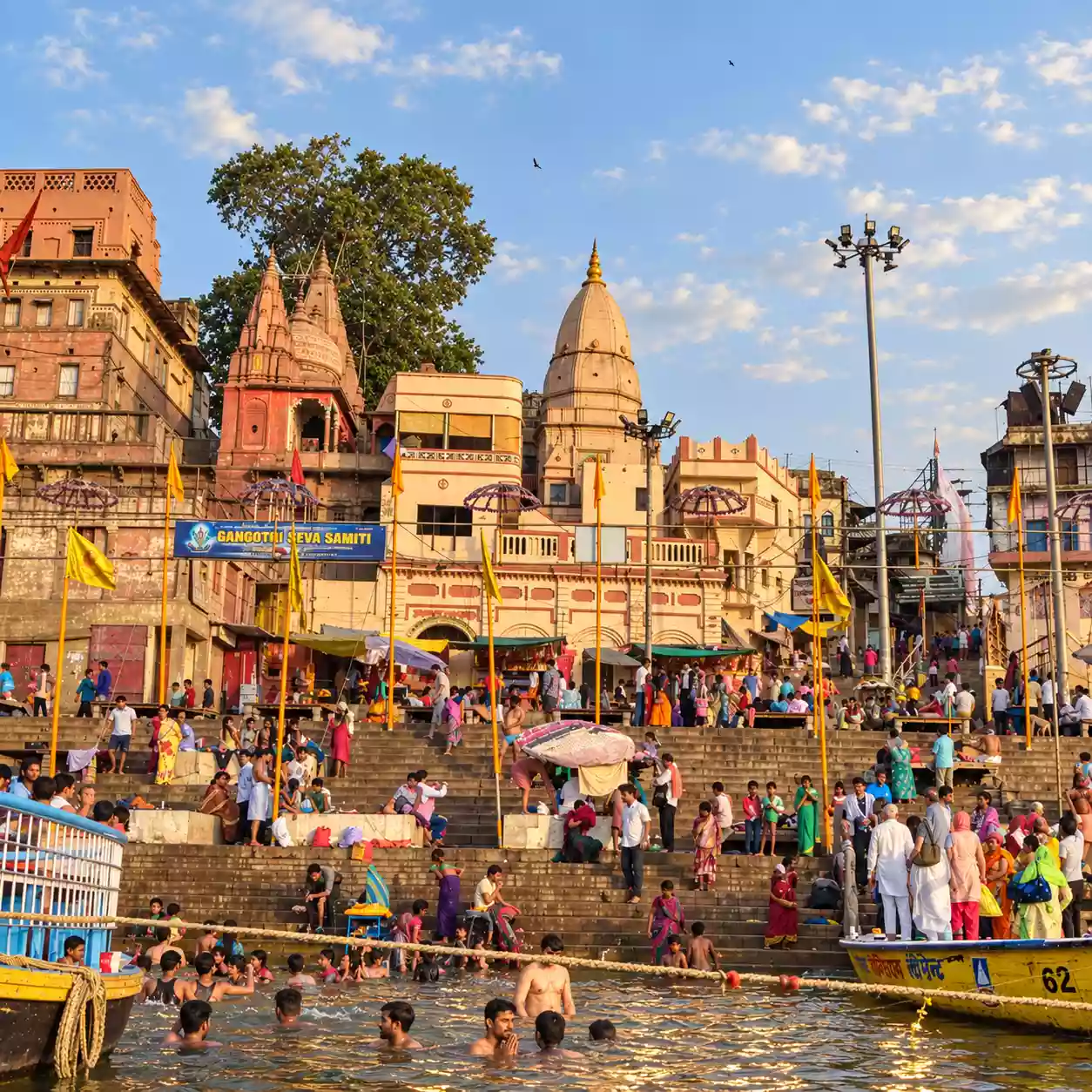
The coordinator guides you to the ghat area in Varanasi, where pandit ji meets you. The ceremony takes place at Ganga Ghat / Manikarnika Ghat. The meeting point near the ghat is coordinated with you by phone.
What happens when we reach the ghat?
You will meet pandit ji, who will have the pooja items ready. Pandit ji explains the process, and you sit together at the ghat, where the arrangements are ready for you.
What does this Asthi Visarjan package cost?
The current total for the package is ₹5,355.00, including applicable tax and the listed services. There are no hidden charges for those included services. Anything outside the stated inclusions costs extra; please ask about the amount before requesting it.
What is included in the price?
The price covers everything listed in the inclusions, including pandit ji’s charges, pooja materials and arrangements for ghat-based Asthi Visarjan. Tarpanam, Pind Daan, boat hire, photography and videography are not included. Pind Daan and a boat upgrade can be arranged at an additional charge.
What should we wear?
New or clean white or light-coloured traditional clothes are recommended, but not required. Men may wear a white dhoti, gamcha and baniyan, or a white kurta and pyjama. Women may wear a plain, light-coloured saree or salwar kameez; white is preferred.
How do we reach the pooja location?
You can reach the pooja location by local auto or cab. If you need assistance, we provide private AC cabs at an extra charge. Our ground team helps you with these arrangements.
When does the pooja start, and how long does it take?
Poojas usually begin from 6 am. The last pooja starts between 2 and 3 pm, and the ceremony must finish before sunset. Asthi Visarjan takes around 30–45 minutes. Allow additional time for your journey to the ghat; travel time is not part of the ritual duration.
Do we need to do snan?
Snan at Ganga Ghat or Manikarnika Ghat is auspicious and should be done. If snan is not possible, sprinkle Ganga water at the ghat on your head and body.
How do we arrange a naai for hair cutting?
Our ground team or coordinator arranges a naai at the ghat area. A boat arrangement applies only if you have separately arranged a boat. The naai’s charges are extra and will be explained in advance when you ask.
How can we arrange cabs or autos?
Autos are generally available throughout the city, including Varanasi Junction (BSB), Banaras Railway Station (BSBS), Varanasi City Railway Station (BCY) and the bus stands. You can also hire an auto easily if you are staying at a hotel in the city area. As the airport is far from the pooja area and hotels, a cab is preferable. Please tell us in advance if you need help arranging one. We operate our own private AC cabs, which cost extra in addition to your pooja package. We also have dedicated pooja packages with hotel stays and AC cabs, including the Asthi Visarjan at Varanasi 1N/2D package. Contact us for its booking details.
Can we arrange daan or a donation ceremony?
Please tell us in advance. Our ground team can arrange Brahmin Bhoj, Vastra Daan and Anna Daan; you only need to participate. Contact us beforehand for the details and arrangements.
We are arriving early. Can someone meet us?
If you arrive before 6 am, please wait at the airport or the station’s retiring room, or go to your hotel if you have arranged early check-in. Our ground team is available from 6 am and can assist you by phone. If needed, a coordinator may meet you at the station at this time, subject to availability. Please tell us 3 days in advance if you need this assistance. Requests made after arrival are subject to our decision.
This is our first visit. Who will meet us?
You will meet our coordinator at the pooja location and stay in touch by phone. After arriving at the station or airport, please reach the pooja area according to your chosen time slot. If you face any difficulty, contact us for help.
Is a boat included, and is the optional boat private?
Boat hire is not included in this ghat-based package. If you choose the separately paid boat upgrade, the boat is private.
Is the ceremony private, and who does one booking cover?
Pandit ji performs the pooja privately for your family. We do not provide group pooja services. One booking covers Asthi Visarjan for one deceased person. If you need rites for more than one person, discuss the required bookings with the team.
Is a pandit who speaks our language available?
In Varanasi, you may request Hindi, Tamil, Telugu, Kannada, Odia, Bengali or Marathi. For any other language, please contact us in advance. Pandit availability may change, and must be confirmed in advance. Please note that the full ritual vidhi is not performed in your native language.
Can we arrange temple visits or sightseeing in Varanasi?
We provide dedicated multilingual guide assistance at an extra charge. Please contact us in advance, as guides are subject to availability. We are a tour company registered with Uttar Pradesh Tourism. Our own tourism department handles sightseeing, 3-star, 4-star and 5-star hotel stays, private cabs and professional guides. Share your plans in Kashi/Varanasi, such as Kashi Vishwanath darshan, Mata Annapurna Devi Temple darshan, Kaal Bhairav Temple darshan, Sankat Mochan Temple darshan, BHU Temple darshan, Ganga Aarti by private boat or a Sarnath excursion, and ask for a complete quote.
What if our family cannot travel to Varanasi?
This is an in-person package. If you cannot travel, please review the separate Online Asthi Visarjan in Varanasi service and its arrangements. View Online Asthi Visarjan in Varanasi
What's Included
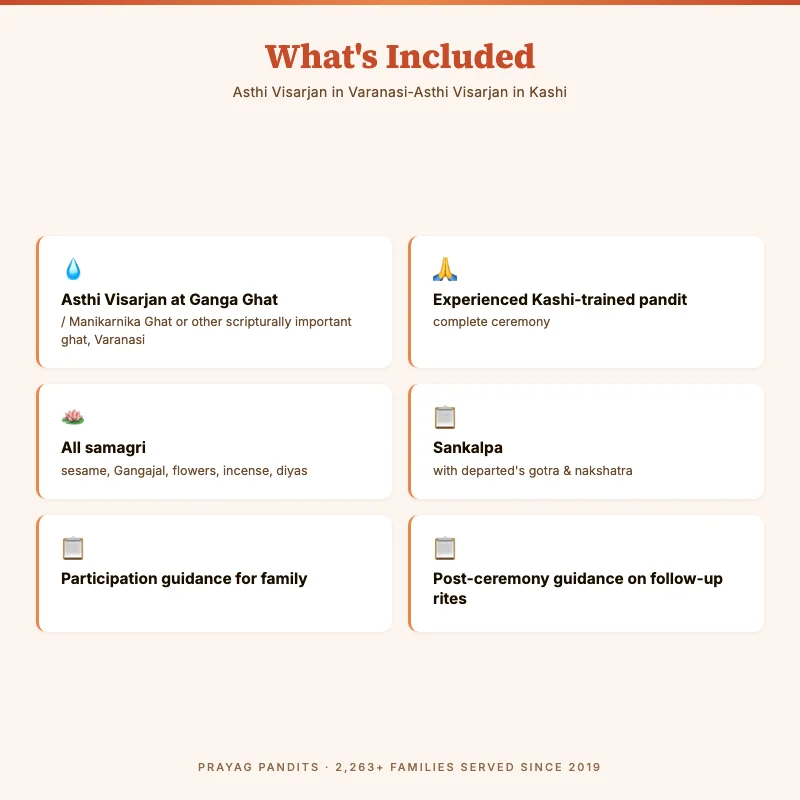
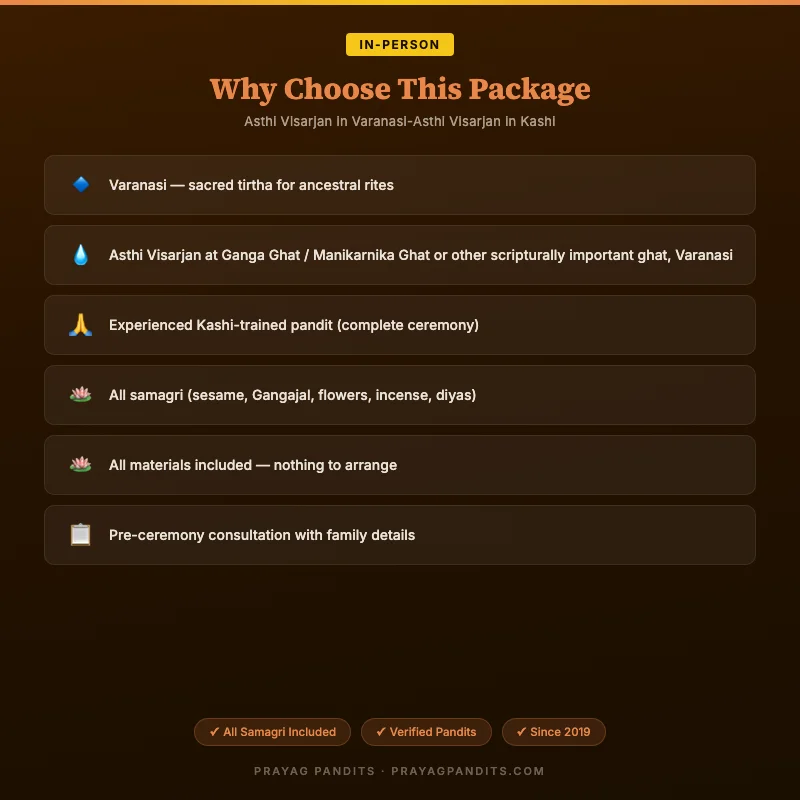
- Asthi Visarjan at Ganga Ghat / Manikarnika Ghat, Varanasi
- Experienced Kashi-trained pandit (complete ceremony)
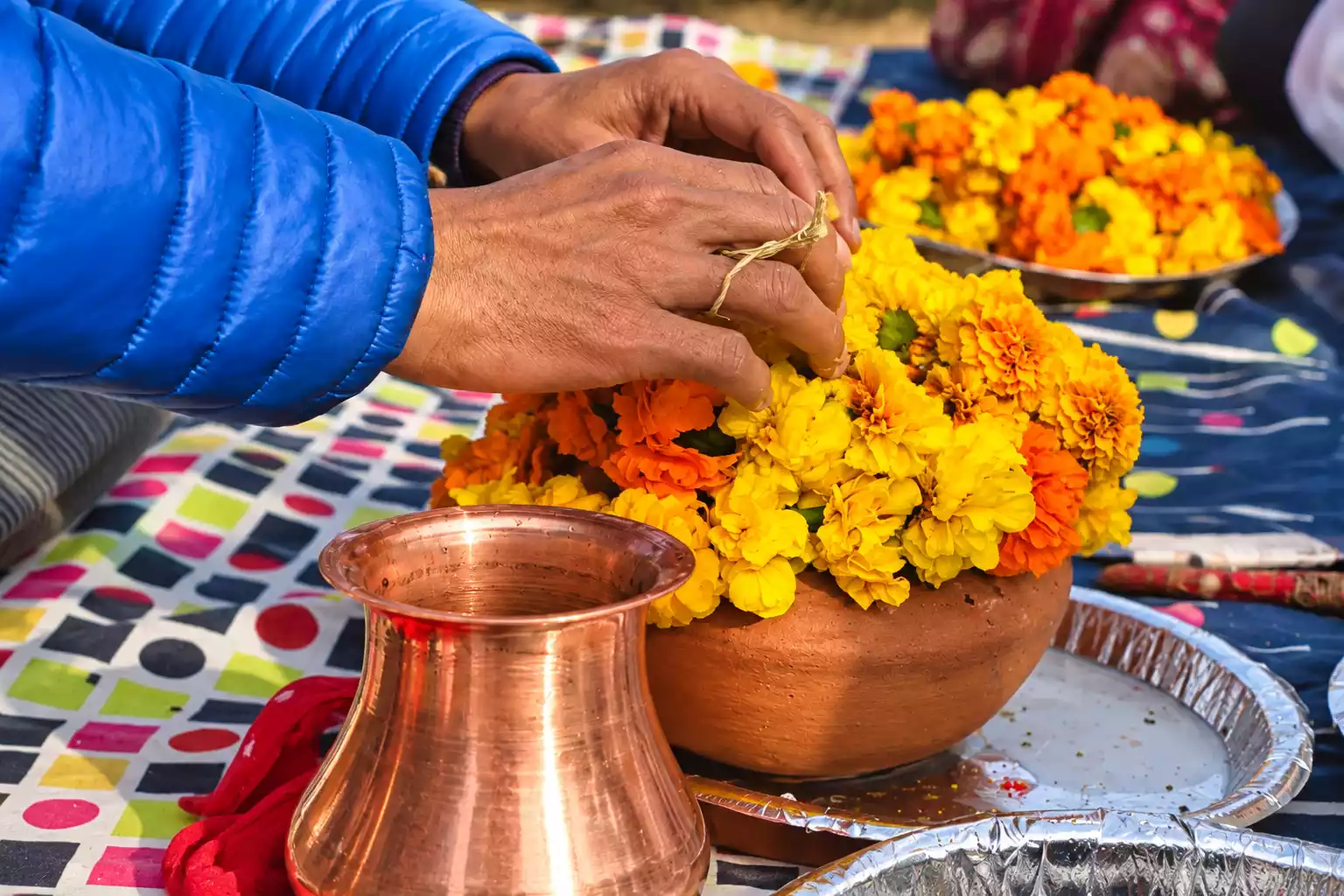
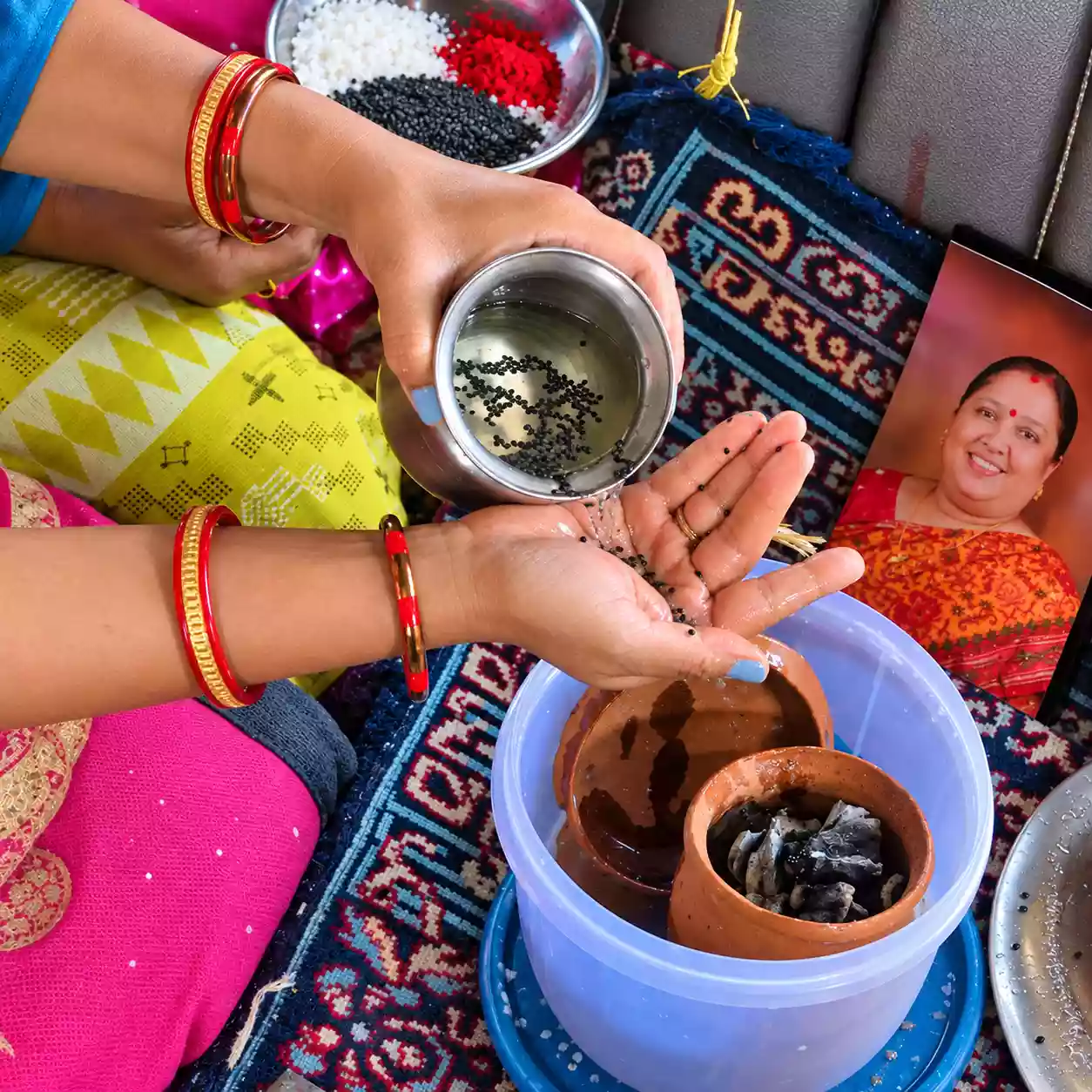
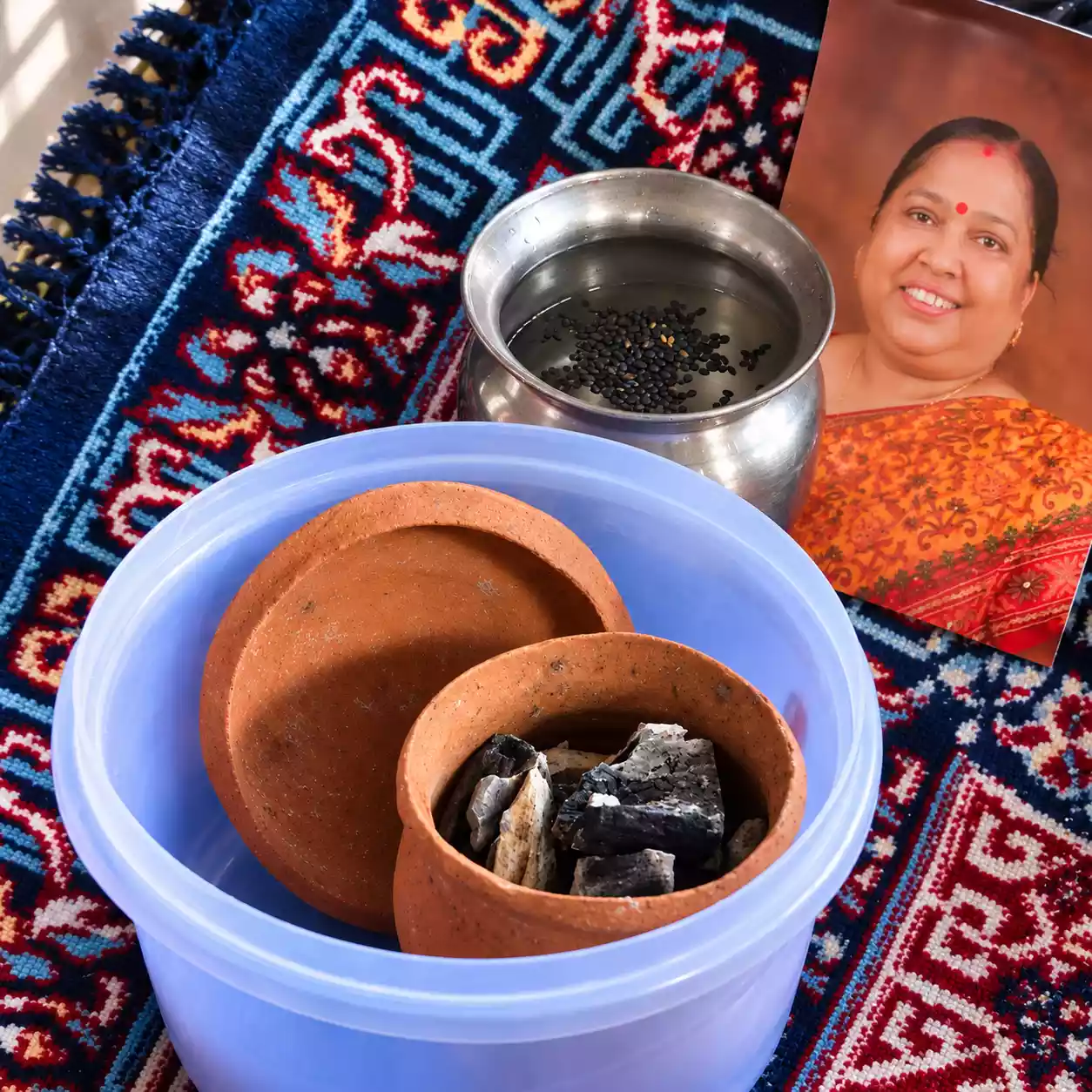
- All samagri (sesame, Gangajal, flowers, incense, diyas)
- Sankalpa with departed’s gotra & nakshatra
- Participation guidance for family
- Post-ceremony guidance on follow-up rites
Exclusions
- Travel & accommodation in Varanasi
- Boat hire (ghat-based ceremony; boat upgrade available at additional cost)
- Tarpanam
- Photography / videography
- Pind Daan (available as add-on)
- Shradh / full ancestral puja (separate service)
- Extra Dakshina/Gifts/Donations made to the Priest/Pandit
See the ceremony. Hear from families.
Watch 2 family reviews
Customer review · Prayagraj and Varanasi
A family’s Asthi Visarjan and Pind Daan experience
Watch on YouTube ↗Some reviews cover several cities and services. Boat hire, Pind Daan and travel are separate from this package. Photography and videography are not included.
Thoughtfully arranged, personally guided
Why Families Choose Us
Veda-Trained Pandits
Experienced pandits guide the ceremony with care for your family’s tradition.
WhatsApp Coordination
Stay in touch with our team for your booking details and ceremony arrangements.
Clear Package Inclusions
See what your selected package includes. Optional additions are shown separately.
Your Preferred Date & Time
Share the date and timing that suit you. Our team confirms the final arrangements.
Experiences shared by our families
What Families Say
28 family reviews20 for this pooja · 8 from across our services
We did asthi visarjan pooja at the manikarnika ghat with pandit ji. He did everything very calmly and did not hurry. Very good pandits these people have
The Asthi Visarjan service was conducted with dignity and proper Vedic rituals. The pandit explained the spiritual significance of each step. The team also helped with accommodation recommendations. Om Shanti.
Grateful for the service
Hassle free experience
Professional service for asthi and pind daan in kashi
HAR HAR MAHADEV GUD POOJA
Efficient, respectful, and deeply understanding of our emotions. Pujan was conducted beautifully.
It was a comforting experience during a difficult time. Would recommend this organisation to all
Taking their service again.This time for my grandmother. Supportive and humble team.
I recently used the Asthi Visarjan at Varanasi Package for my late father, and I must say the experience was beyond my expectations. The staff was incredibly respectful, and knowledgeable, and took care of all the rituals meticulously. They explained each step of the process, making it easier for us to understand the significance of the rituals. The boat ride to the middle of the Ganges was serene and gave us a sense of peace and closure. I highly recommend this service for anyone looking to perform Asthi Visarjan in Varanasi.
Participating in the Asthi Visarjan ceremony in Varanasi through Prayag Pandit was a deeply moving experience for my family and me. The pandit was incredibly knowledgeable and compassionate, guiding us through each step of the process with great care. It felt like a significant step in providing peace to my father’s soul. Highly recommended for those seeking to perform this sacred ritual
The Asthi Visarjan at Varanasi Package was overall a good experience. The team was professional and punctual, and they took care of all the arrangements, including the puja items and boat ride. My only concern was that it felt a bit rushed. I understand that there are time constraints, but a few more minutes for personal reflection would have been appreciated. Nonetheless, it was a spiritually fulfilling experience.
Accha service dete hai. Pandit ji ke helper ko tamil nahi aati thi. Pooja acchi hui
Prayag Pandits exceeded my expectations in conducting my grandmother’s asthi pooja. The process was explained clearly, and the ceremony was performed with great reverence. It was a profound experience and i felt a deep connection to my roots and traditions. Thank you for making this possible with such grace and respect.
Completing my brother’s asthi nimajjanam with the help of prayag pandits was a comforting experience during a difficult time. The pandits was very accommodating, ensuring that all rituals were performed according to our family traditions. It was a dignified ceremony, and I am grateful for the team’s support.
The Asthi Visarjan ceremony in Varanasi was conducted with utmost respect and care. The priests were knowledgeable and compassionate, making the process serene for our family.
Happy i came across this service. Last time i was cheated by a boatman at raja ghat. This time prayag pandit team was physically there and arranged everything.
Exceptional service and attention to detail. The priests made sure all rituals were performed meticulously, providing us with a sense of peace and closure.
Pandit was a bit late in making arrangements. Other than that, everything was best. I’ll suggest their service to others.
I was initially skeptical about arranging Asthi Visarjan online by this agency, but Prayag Pandits made the process seamless and respectful. The pooja was touching and allowed our entire family, spread across the globe, to be part of this important ritual. The dedication of the team to uphold our traditions is truly commendable.
Watching the pandit perform the rituals in real-time by the Falgu River, mentioning my father's name... it felt like we were truly there. Immense gratitude to the entire team.
Being in the USA, travelling to India just for Tarpan during Pitru Paksha was becoming very difficult. Prayag Pandits offered a well-coordinated solution.
I was skeptical about performing such a sacred ritual online from Canada. But honouring my parents in Kashi was important. They were very patient and answered all my questions.
Living in Singapore, we felt disconnected from these essential rituals. The live stream option for Tarpan at Prayagraj gave us a profound sense of connection and peace.
It was deeply important for us in Australia that the rituals were performed correctly. The ceremony reflected the authenticity we sought and was performed by a knowledgeable priest.
The Pind Daan at Kashi was handled carefully, with the pandit following every step diligently. Very reassuring.
Arranging Asthi Visarjan from Bhubaneswar seemed complex, but Prayag Pandits made it seamless. The pandit called us before the ceremony to explain every step. Very professional.
During Pitru Paksha, we booked Shradh at Prayagraj. The coordination was flawless - from date selection to the pandit assignment. Our family felt at peace after the ceremony.
Share your pooja experience
YOUR EXPERIENCE MATTERS
Help another family feel prepared.
Tell us about your ceremony and the support you received. Your email address will stay private.
From your first choice to your booking
How It Works
-
Choose your pooja
Review your package and any available additions, then add it to your booking.
-
Share your preferences
Enter your contact details, preferred date and time. Add ancestral details if you wish.
-
We coordinate with you
Our team confirms the arrangements and shares your coordinator’s details 24 hours before the pooja.
-
Arrive for your pooja
Our team guides you to the designated pooja area and helps you participate in the ceremony.
Know your ceremony
Asthi Visarjan in Varanasi — Prayer and Remembrance in Kashi
For many Hindu families, bringing a loved one’s asthi to Kashi brings together three deeply held associations: the sacred Ganga, the presence of Lord Shiva and the hope of moksha, or liberation. Asthi Visarjan is the immersion of the ashes and bone remains left after cremation. It is a physical act performed with prayer, through which the family honours the departed and entrusts the remains to sacred water.
Varanasi’s place in this tradition is closely connected with Shiva as Vishwanath, the Lord of the Universe. Devotees approach the city with faith in his compassion and guidance beyond death. The Ganga forms the setting for the rite, while the family’s remembrance gives it a personal meaning: a name spoken in Sankalpa, a familiar relationship recalled, and an offering made for someone who remains part of the family’s life.
This service is a ghat-based ceremony at Ganga Ghat / Manikarnika Ghat in Varanasi. An experienced Kashi-trained pandit conducts the rite and guides your family’s participation.
One booking covers the rite for one deceased person. The ceremony takes approximately 30–45 minutes and is available throughout the year.
This package is for Asthi Visarjan from the ghat. Tarpanam and boat hire are not included. If you wish to include Tarpanam, please see the separate Asthi Visarjan with Tarpanam in Varanasi package.
Varanasi and Kashi — Understanding the Sacred Identity of This City
Varanasi, Banaras and Kashi are names for the same city, but Kashi has a particular place in devotional language. Traditionally associated with light, the name carries the idea of spiritual illumination. For devotees, the city is a place to seek understanding of life, death and the soul’s onward journey in the presence of Shiva.
The Kashi Khanda of the Skanda Purana describes the sacred identity of Kashi through its association with Shiva, its tirthas and liberation. Another traditional name, Avimukta, expresses the belief that Shiva does not forsake this sacred place. These accounts help explain why families travel here for ancestral observances and why the city’s ghats are more than a riverfront in the religious imagination.
Bringing the ashes to Kashi belongs within that devotional understanding. Families may hold different customs, but the intention is one of reverence for the departed and prayer for their peace.
Manikarnika Ghat — Where the Fire Never Goes Out
Manikarnika is closely associated with cremation and the final rites of Kashi. The expression “where the fire never goes out” reflects its enduring place in the city’s life and its association with cremations taking place through the day and night. The ghat is a working place of mourning and ritual, where families and those serving them carry out solemn responsibilities.
The Skanda Purana describes Vishnu digging the sacred pond known as Chakrapushkarini and Shiva’s earring falling into it, giving the place its association with the name Manikarnika. This account connects the site with both Vishnu and Shiva, placing the ghat within a sacred history that extends beyond its role as a cremation ground.
Asthi Visarjan is distinct from cremation. A family may bring remains from a cremation performed elsewhere to immerse them in the Ganga here. The ceremony centres on those remains, the departed person and the family’s prayers.
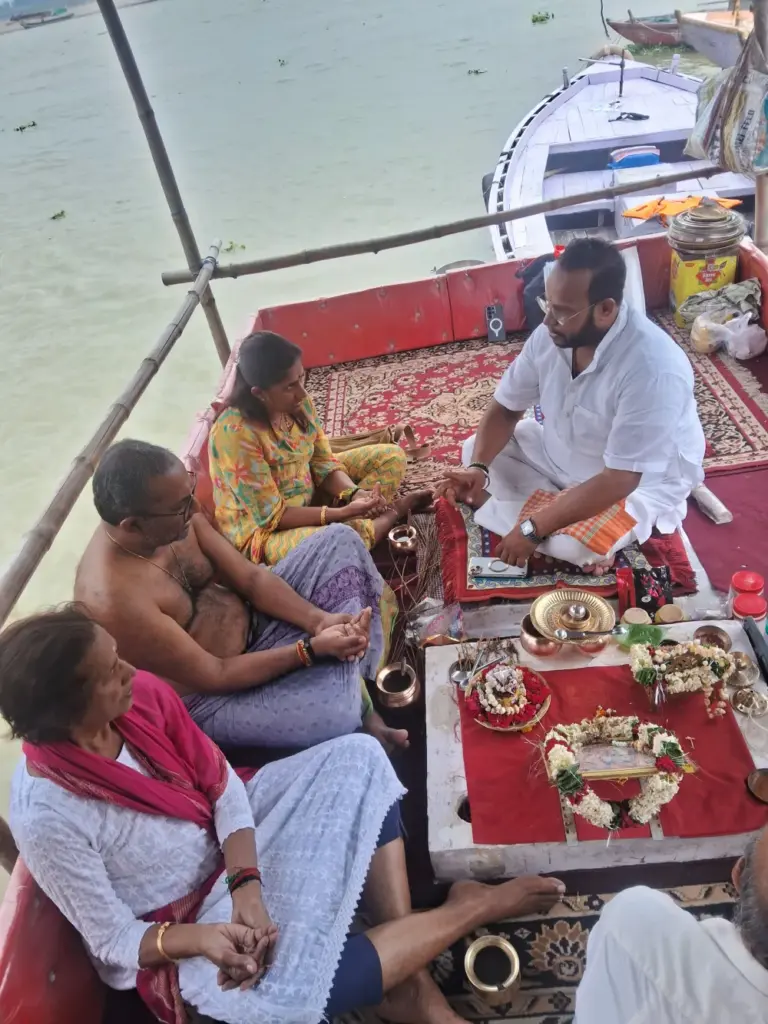
Meeting the pandit
The meeting point near the ghat area is coordinated with you over the phone.
The Ceremony — What Happens at the Ghat
The rite takes approximately 30–45 minutes, and one booking covers one deceased person. Your family is guided through these parts of the ceremony:
- Meeting and preparation: The meeting point near the ghat is coordinated by phone. The pandit guides your family in preparing to participate, so you do not need to know the procedure beforehand.
- Sankalpa: The ceremony’s purpose is stated through Sankalpa, with the departed person’s gotra and nakshatra. This places the observance in the context of the person your family has come to remember.
- Samagri and guidance: Sesame, Gangajal, flowers, incense and diyas are supplied. The pandit guides your participation in the rite with these materials.
- Asthi Visarjan: The remains are immersed in the Ganga under the pandit’s guidance. Your family takes part in this act of farewell and prayer.
- Follow-up guidance: After the ceremony, the pandit offers guidance on subsequent rites. This helps your family understand what may be arranged separately.
Tarpanam, boat hire, photography and videography are not included. Pind Daan is an optional add-on; Shradh or a full ancestral puja is a separate service.
The Role of Shiva’s Tarak Mantra
In the sacred traditions of Kashi, Shiva is believed to offer the departing soul the Tarak Mantra: an expression of divine guidance associated with crossing beyond worldly bondage. The Kashi Khanda of the Skanda Purana describes Shiva imparting knowledge of Brahman to beings at Manikarnika. For devotees, this is an assurance of divine compassion in the face of death.
This belief helps explain the close association between Kashi and moksha. It concerns Shiva’s grace and the soul’s journey; Asthi Visarjan is the family’s act of immersion and prayer. The family honours the departed through the rite while placing its hopes in divine grace. In this way, the practical act of immersion remains connected with the deeper devotional meaning that brings families to Kashi.
Choosing the services you need
A boat upgrade is available at an additional cost. Pind Daan is available as an add-on, while Shradh or a full ancestral puja is a separate service. Please discuss any additional ceremony before booking so the arrangements reflect what your family needs.
Photography and videography are not included in this package.
The current package price is shown in the booking panel. Travel and accommodation in Varanasi are separate, as are any extra dakshina, gifts or donations you choose to give the priest.