Ancestral rites · India

Asthi Visarjan

When a loved one leaves this world, the soul begins a new journey — and the family's final act of devotion is to ensure that journey begins well.

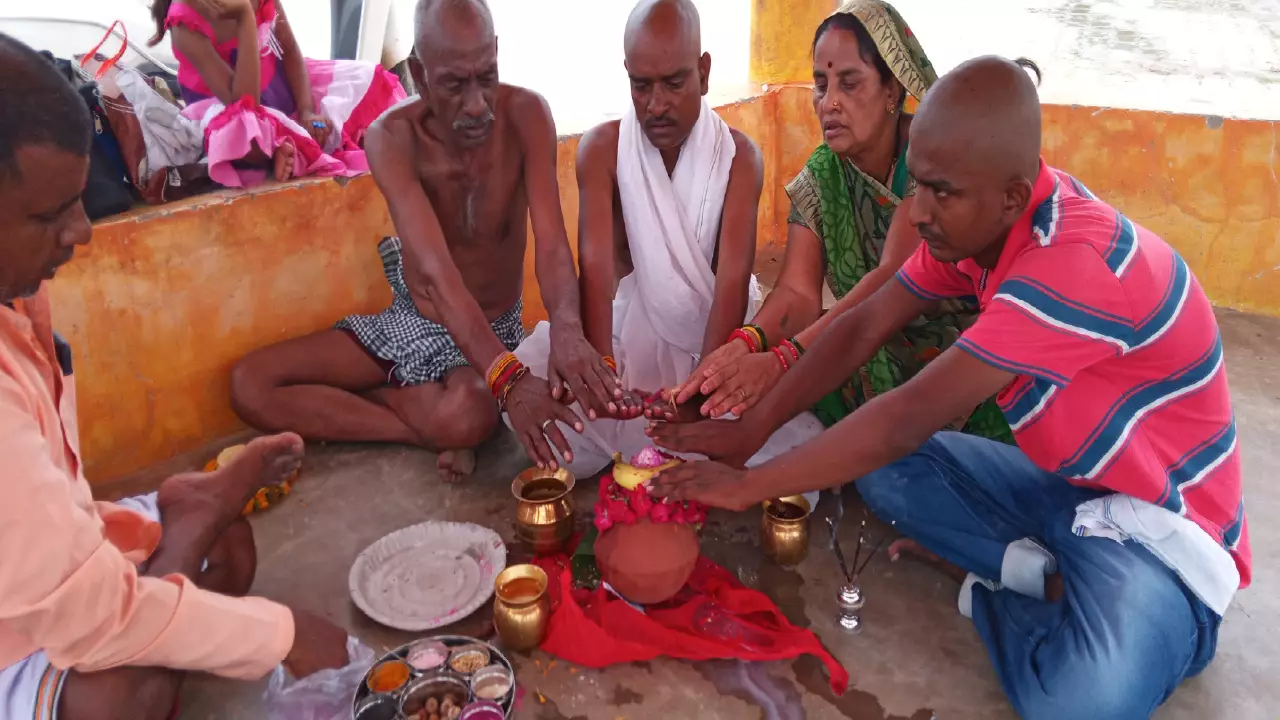
Family performing asthi visarjan at a sacred river in India
Across eleven sacred citiesThe last of the sixteen samskaras Verified arrangement
Booking pathsIn person, or performed on your behalf Choose the river

Asthi Visarjan, the sacred immersion of cremated remains in holy waters, is the concluding step of the Antyesti Sanskar — the sixteenth and last of the sixteen samskaras that mark a Hindu's life from conception to death. Performed at a sacred river by a qualified pandit with Vedic mantras, it releases the subtle body from its earthly ties and allows the departed soul to move forward toward liberation.

✓ Experienced Pandits ✓ All samagri brought ॐ Vedic procedure ✓ Late immersion handled
Day 3–10The ideal window
Years laterValid, with Prayaschitta
OnlineFor families unable to travel

A clear place to begin

Start from where your family is

Three situations bring families to this page, and each has a different first step.

Family at the Triveni Sangam preparing for asthi visarjan

Within the ten days

It has just happened

The window between the third and tenth day is the ideal one. Choose the sacred river first and we will arrange the rest around your arrival.

Compare the sacred places
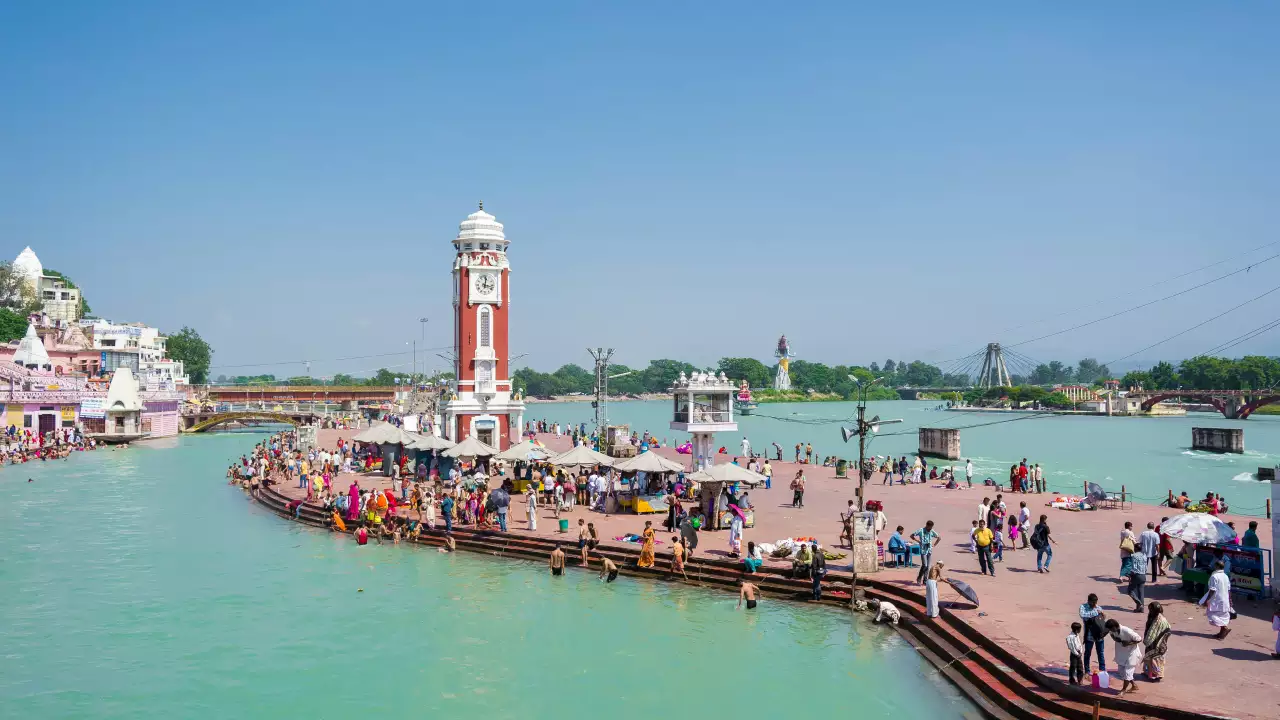
The Ganga at Har Ki Pauri, Haridwar

Beyond the window

The asthi have been kept

Late is never wrong. A short Prayaschitta rite restores the standing and the immersion proceeds as normal, years later if need be.

Read the timing guidance
Ceremony performed in India for a family joining remotely

Living abroad

We cannot travel

The rite is performed at the sacred river on your behalf with the Sankalp in your name, and the family joins by live video.

See the NRI arrangements
Family ancestral ceremony at the river
The sixteenth and last of the samskaras

Meaning and scriptural basis

What Is Asthi Visarjan?

The word comes directly from Sanskrit: Asthi (अस्थि) means bones or skeletal remains, and Visarjan (विसर्जन) means immersion or release. Together, the term refers to the ritual immersion of the ashes and bone fragments left after cremation into a sacred river or water body.

It is important to understand how asthi visarjan fits within the complete sequence of post-death rites:

  • Asthi Sanchayan — The collection of bone fragments and ashes from the cremation site, typically on the third day after death. The remains are washed with milk and Ganga Jal, placed in an earthen kalash, and covered with red cloth.
  • Asthi Kalash Sthapana — The kalash is kept in a clean, elevated place outside the main living area until the family can travel to the sacred site for immersion.
  • Asthi Visarjan — The actual immersion at the river, accompanied by Vedic mantras, tarpan, and often Pind Daan.
Where it sits in the post-death rites

This sequence mirrors the Pancha Mahabhuta (five great elements) cycle: the body, made of the five elements, returns fire to fire at cremation and water to water at visarjan. The Garuda Purana states clearly that the soul remains in the preta (transitional) state until the full Antyesti sequence is complete. Families who do not perform Asthi Visarjan risk incurring Pitru Dosha — an ancestral affliction that can affect multiple generations through illness, obstacles in marriage, or financial difficulty.

The window, and what happens after it

When to Perform Asthi Visarjan

The ideal window is between Day 3 and Day 10 after death. Here is the full post-death timeline:

DayRitual
Day 1Cremation (Antyeshti)
Day 3Asthi Sanchayan — collection of remains
Day 3–10Ideal window for Asthi Visarjan
Day 10Dashaah — mourning observances, followed by Tirth Shradh if visarjan is delayed
Day 12Sapindi Shraddha — the departed becomes a Pitru (ancestor)
Day 13Terahvin — mourning period ends, Brahmin feeding and dana

Can it be done later? Yes. The texts permit asthi visarjan even years after death, provided a short Prayaschitta (expiation) rite is performed before the immersion. Many NRI families and those living far from sacred rivers perform it months or years later. There is no spiritual penalty for delay — what matters is that it is performed correctly.

The full post-death timeline, and performing it later

The most auspicious occasions for asthi visarjan are:

If the immersion is being performed after Day 10, our pandit begins with a Tirth Shradh — a brief Shradh ceremony that formally acknowledges the delay and purifies the rite before proceeding.

  • Pitru Paksha — the sixteen-day fortnight of Ashwin Krishna Paksha, devoted entirely to ancestral rites. Its dates move each year with the tithi, so ask us and we will confirm them against the panchang. Learn about Pitru Paksha dates and significance.
  • Sarva Pitru Amavasya — the closing day of the fortnight, and the most powerful single day of the year for all ancestral rites, including for ancestors whose tithi is unknown.
  • Every monthly Amavasya (new moon)
  • The death anniversary (tithi) of the departed
  • Makar Sankranti, Ganga Dussehra, and other major Ganga festivals

Choose the sacred water

Best Places for Asthi Visarjan in India

While any flowing river is technically valid for asthi visarjan, the Puranas assign different degrees of merit to different locations. Here is a comparison of the most significant tirthas:

LocationSacred WaterBest ForUnique Significance
PrayagrajTriveni SangamComplete moksha, all familiesTirthraj — king of all tirthas; triple confluence
VaranasiGanga at ManikarnikaGuaranteed mokshaLord Shiva whispers the Taraka Mantra at death
HaridwarGanga at Har Ki PauriNorthern families, Himalayan pilgrimsBrahmakund with Vishnu's footprint; Ganga descends from the hills
GayaFalgu River / VishnupadPitru mukti, seven generationsLord Rama performed rites here for Dasharatha
RameshwaramAgniteertham (ocean)Southern families, Char Dham pilgrimsChar Dham + Jyotirlinga; ocean confluence
NasikGodavari at RamkundWestern and Deccan familiesDakshin Ganga; Asthivilay Kund dissolves remains naturally
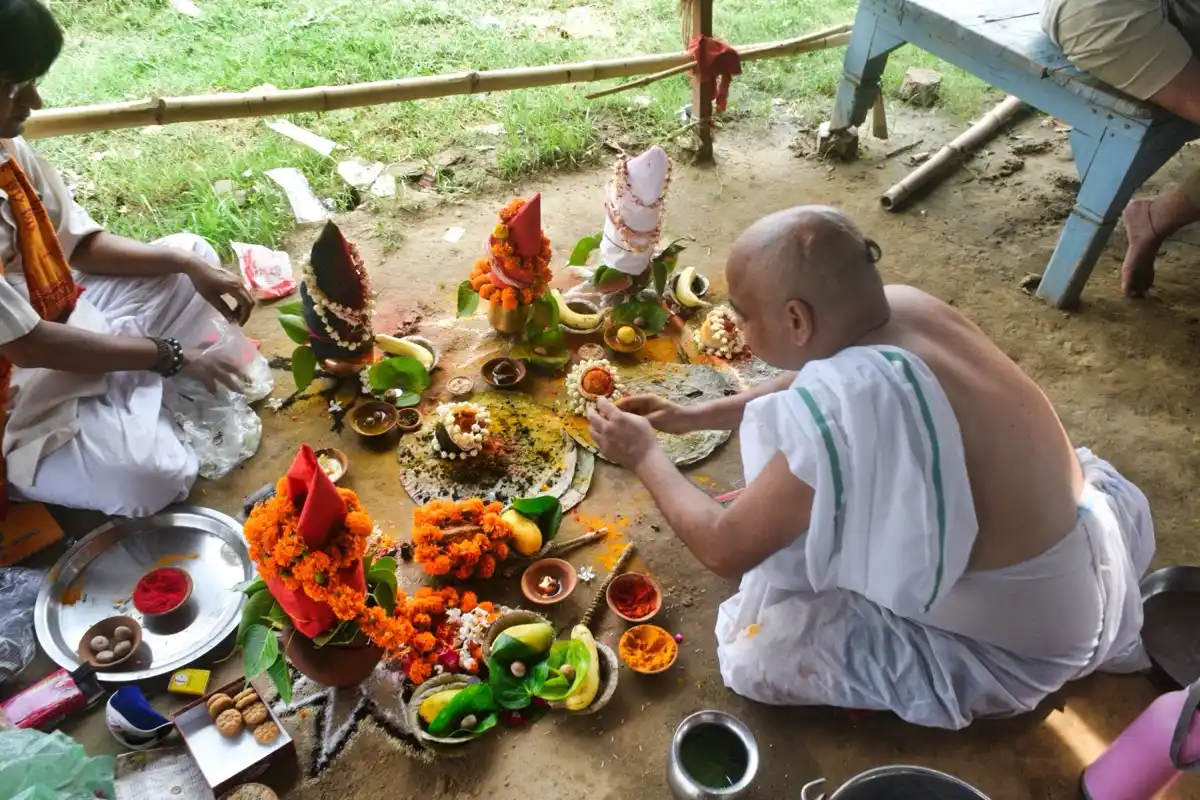
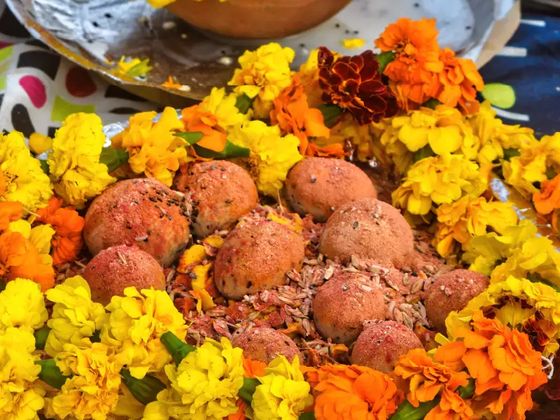
Ancestral offerings prepared at the Triveni Sangam, Prayagraj Sacred place

Prayagraj (Triveni Sangam) — Tirthraj, the Supreme Site

The Skanda Purana says: "Prayage Sangame Snaanam Mukti Daayakam" — bathing at the Prayag confluence grants liberation. For asthi visarjan, this is amplified: the remains are received by three sacred rivers simultaneously, and the combined sanctity of the Ganga, Yamuna, and Saraswati is considered unmatched by any single river in India.

Prayag Pandits has performed 33+ asthi visarjan ceremonies at Triveni Sangam. Our pandits know every ghat, every nuance of the ritual, and are available year-round — including during Pitru Paksha when demand is highest. Book Asthi Visarjan at Prayagraj from Rs 5,100.

The Ganga ghats of Varanasi at evening aarti Sacred place

Varanasi — Where the Lord Himself Grants Liberation

Kashi is said to be held on Lord Shiva's trident. The Kashi Khanda of the Skanda Purana states that anyone who dies in Varanasi — or whose ashes are immersed there — receives the Taraka Mantra from Shiva himself, which grants direct moksha regardless of past karma. Asthi Visarjan in Varanasi — Starting Rs 5,100.

Har Ki Pauri and the sacred Ganga at Haridwar Sacred place

Haridwar — Where the Ganga Meets the Plains

Har Ki Pauri in Haridwar is where the Ganga descends from the Himalayan foothills onto the plains. The Brahmakund here carries the imprint of Vishnu's footstep and is considered one of the most auspicious spots for pitru karma in northern India. Asthi Visarjan in Haridwar — Starting Rs 7,100.

What happens on the day

The Asthi Visarjan Ritual — Step by Step

Understanding the complete procedure helps the family participate meaningfully and ensures no step is missed. Our pandit guides you through each stage, but knowing what to expect brings peace during a difficult time.

Duration: 30 to 60 minutes for Asthi Visarjan alone. Two to two and a half hours when combined with Pind Daan and Tarpan.

Materials required (brought by our pandit): Earthen kalash, red cloth, raw milk, Ganga Jal, white and red flowers, til (sesame), kusha grass, barley, incense sticks, diya with ghee, chandan, akshat (unbroken rice), and puja thali.

  1. Asthi Sanchayan (Day 3 after cremation)

    The remaining bones and ashes are collected from the cremation ground, washed gently with raw milk and Ganga Jal, and placed in an earthen kalash. The kalash is wrapped in red cloth and stored in a clean, elevated location — never on the floor, never inside the main bedroom.

  2. Journey to the Sacred Site

    The kalash must not touch the ground during transport. It is carried by a family member or placed on a cushioned surface. The family should maintain mental quiet and avoid large gatherings or celebrations during this period.

  3. Arrival and Purification

    On reaching the ghat, all family members take a bath in the river before the ceremony. White or light-coloured traditional clothing is worn. Leather items — belts, bags, footwear — are set aside.

  4. Sankalp — The Sacred Declaration

    The pandit leads the primary mourner (karta) through the Sankalp — a formal declaration stating the departed's full name, gotra, tithi of death, and nakshatra. This dedicates the entire ceremony to the specific departed soul and connects it to your family lineage.

  5. Puja at the Ghat

    Flowers, incense, a diya, and chandan are offered. The pandit recites prayers to the Ganga and to the presiding deity of the ghat before the immersion begins.

  6. The Immersion (Visarjan)

    The karta wades into the river holding the kalash. Facing the direction of the river's flow, the ashes and bones are slowly released into the water while the pandit chants the specific mantras for asthi visarjan. Flowers and til (sesame) are scattered at the same time.

  7. Tarpan — Water Offering to Three Generations

    After immersion, the karta offers Tarpan — cupped-palm water offerings mixed with sesame — to the departed and to ancestors across three generations (father, grandfather, great-grandfather, and the corresponding maternal lines). This is performed facing the sun.

  8. Pind Daan (Optional, Commonly Combined)

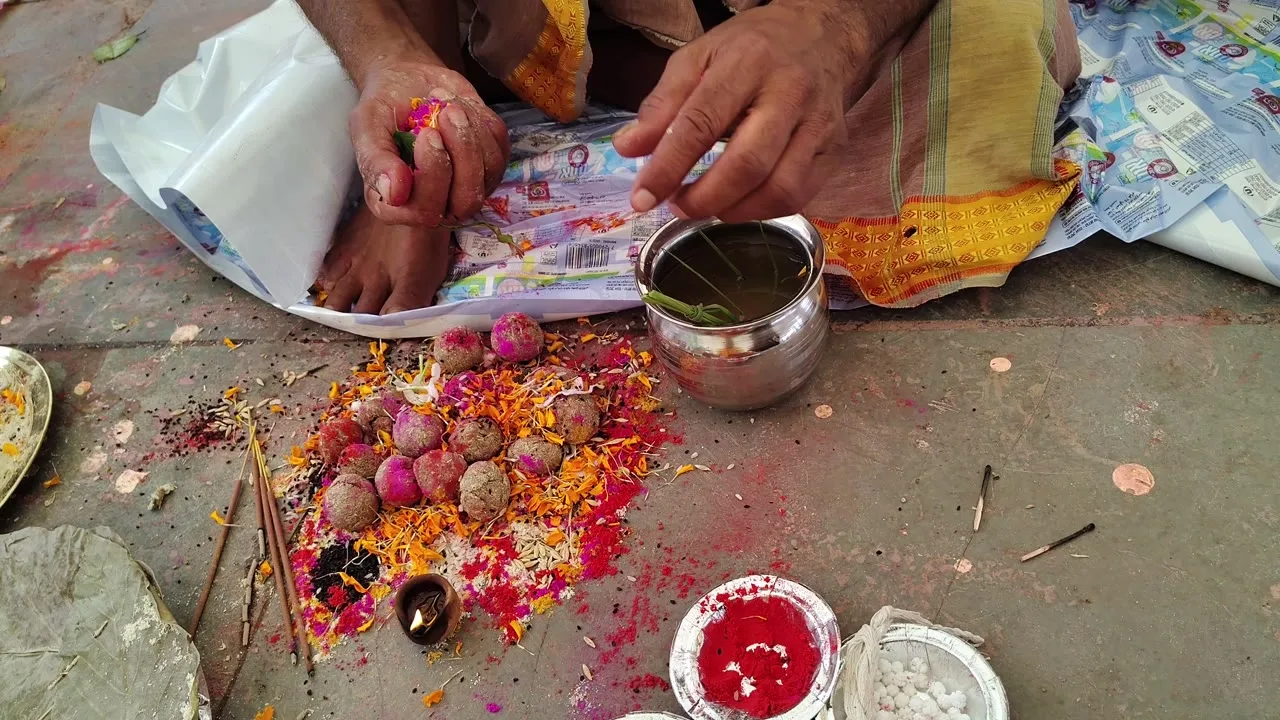
    Many families choose to perform Pind Daan at Prayagraj on the same day. Rice balls (pindas) mixed with sesame, honey, and barley are offered with specific mantras to the departed across three to seven generations. The combination of asthi visarjan and Pind Daan in one visit is the most complete form of pitru karma possible.

  9. Brahman Bhojan and Dana

    The ceremony concludes with feeding a Brahmin pandit and offering dana — a gift of cloth, grains, or dakshina. This seals the merit of the ceremony and transfers it to the departed.

Before you travel

What to Bring and How to Prepare

Preparation on the family's side is straightforward. Our pandit brings all ritual materials — you only need to bring the asthi kalash and the right mindset.

Storing the kalash, and what to wear

Storage of the asthi until visarjan:

On the day of the ritual:

  • Use an earthen pot (no plastic or metal containers)
  • Keep it in a clean room, elevated on a wooden platform or shelf
  • Place it outside the main sleeping area
  • Do not keep it near the kitchen or food preparation area
  • A diya or incense stick may be lit nearby each day
  • Wear white or off-white traditional clothing
  • Avoid leather items
  • Fast until after the ceremony if health permits, or have a light meal before leaving
  • The primary karta (eldest son or designated family member) leads; other family members participate in Tarpan
  • Bring a copy of the death certificate (for domestic travel, this is advisable but not mandatory)

Where we perform it

Cities Where We Perform Asthi Visarjan

We have experienced pandits stationed at all major sacred locations across India. You do not need to arrange anything locally — our pandit handles the complete ritual, from flowers and puja samagri to tarpan and final prayers.

  • Asthi Visarjan in Prayagraj

    Starting Rs 3,100. At the sacred Triveni Sangam, where the Ganga and Yamuna meet. Most requested location.

  • Asthi Visarjan in Varanasi

    Starting Rs 5,100. At Manikarnika or Assi Ghat in Kashi, the city of liberation.

  • Asthi Visarjan in Haridwar

    Starting Rs 7,100. At Har Ki Pauri, where the Ganga descends from the mountains.

  • Asthi Visarjan in Gaya

    Starting Rs 7,100. Combined with Pind Daan for complete pitru rites.

  • Asthi Visarjan in Garh Mukteshwar

    Starting Rs 5,100. Sacred Ganga ghat in western UP, especially important for families from Delhi-NCR.

  • Asthi Visarjan in Ujjain

    Starting Rs 7,100. At the Shipra River, home of Mahakaleshwar.

  • Asthi Visarjan in Kurukshetra

    Starting Rs 7,100. At the sacred kund of Kurukshetra, land of the Mahabharata.

  • Asthi Visarjan in Badrinath

    Starting Rs 11,000. At Alaknanda River, Brahmakund, high in the Himalayas (seasonal, April to November).

  • Asthi Visarjan from Delhi (Courier Service)

    For families unable to travel, we accept ashes by courier and perform the ritual on your behalf with live video documentation.

For families outside India

Asthi Visarjan for NRI and Overseas Families

For families living outside India, the question of how to perform asthi visarjan is often one of the most difficult parts of the mourning process. Long travel distances, visa requirements, work commitments, and the challenge of transporting cremated remains across borders make it hard to act within the traditional window.

Prayag Pandits has developed a complete NRI service that handles every aspect — from transport guidance to live-streamed ceremonies. Read the full guide to online Asthi Visarjan for NRIs.

  • Death certificate (apostilled or attested by the Indian Consulate)
  • Cremation certificate from the crematorium
  • Passport copy of the deceased (if available)
  • NOC (No Objection Certificate) from the Indian Consulate or Embassy in the country of death
  • Medical certificate confirming death was not from a contagious disease
  • Certificate of Packing from the crematorium
  • Use a wooden or clay urn — metal urns trigger additional screening and may be rejected
  • Carry-on is preferred over checked baggage to avoid handling damage
  • Inform the airline at least 48 hours in advance; most carriers (Air India, Emirates, British Airways) allow this with documentation
  • For courier: USPS (USA), Canada Post, and Royal Mail (UK) all accept cremated remains with proper documentation and packaging
  • Contact us and share the departed's details — we provide a shipping address and packaging instructions
  • We schedule the ceremony date and conduct a brief Sankalp video call with you so you can participate in the declaration
  • On the ceremony day, you join live via video call and witness the full asthi visarjan at Triveni Sangam
  • After the ceremony, we send you photographs, a ceremony report with the pandit's certification, and prasad if requested
Airline and courier rules, and how the remote service works

Documents required for international transport of cremated remains to India:

Airline and courier rules:

How our remote service works:

The in-person service starts at Rs 5,100. The NRI remote package with live streaming, documentation, and courier coordination is priced separately — contact us for details. Book here or call +91 7754097777.

International payment: PayPal checkout is available for overseas families.

Ceremony scope

What Is Included in Our Service

  • Qualified Vedic pandit with deep expertise in pitru karma and Antyesti rites

  • All puja samagri — flowers, sesame seeds (til), kusha grass, Ganga Jal, incense, diya

  • Recitation of the complete Asthi Visarjan mantras and Tarpan

  • Boat service at river ghats (where applicable)

  • Guidance on post-ritual observances and upcoming Shradh dates

  • Photos of the ceremony

  • NRI live-streaming service via video call

  • GST-registered service (GST: 09AZAPK2937R1ZR)

After the immersion

Post-Visarjan Rituals — What Comes Next

Asthi Visarjan is the culminating act, but the full cycle of grief and ancestral honour continues beyond it. Knowing the sequence helps families observe the complete tradition with clarity.

  1. Same day

    After the immersion, the family takes a full bath, attends the Ganga Aarti at the ghat (especially beautiful at Triveni Sangam and Har Ki Pauri), and visits the presiding temple. A small puja at the temple seals the ceremony.

  2. Day 12 — Sapindi Shraddha

    This is one of the most significant post-death rites. The preta (recently departed soul in transitional state) formally joins the ranks of the Pitrus — the lineage of honoured ancestors. A qualified pandit performs this at your home. Read the full guide to post-Asthi Visarjan rites.

  3. Day 13 — Terahvin

    The mourning period officially ends. Brahmin pandits are fed, and dana (gifts of cloth, grains, and dakshina) is given. The family returns to normal life.

  4. Monthly Masik Shradh

    In the first year after death, a monthly Shradh is performed on the same tithi as the death each month. This sustains the departed soul's journey during the first year.

  5. Annual Varshik Shradh

    Every year on the death anniversary, a Shradh is performed. This continues for life and is considered the ongoing duty of the karta toward the Pitrus.

  6. Pitru Paksha Shradh

    The annual 16-day Pitru Paksha period (September–October) is when all ancestral rites carry maximum merit. Performing Shradh, Tarpan, or Pind Daan at Prayagraj during this period is especially beneficial. Learn about Pitru Paksha dates and how to observe them correctly.

Evening Ganga aarti after the ceremony
The Ganga aarti, taken by many families the same evening

Questions families ask

Asthi Visarjan FAQs

Read the answers connected with this page, or browse the complete Asthi Visarjan FAQ collection.

See all Asthi Visarjan FAQs
What is Asthi Visarjan and why is it essential in Hindu tradition?

Asthi Visarjan is the sacred Hindu ritual of immersing the bone fragments (asthi) and ashes of a cremated relative into a holy river — ideally the Ganga. It is the final step of the funeral rites (Antyeshti) and is considered essential for the departed soul's liberation (moksha). According to the Garuda Purana (Preta Khanda 15.30-31), immersing remains in the Ganga within 10 days of death grants the deceased the exact same merit as dying directly on the banks of the Ganga. The ritual symbolises the return of the five elements — the body's earth, water, fire, air, and ether — back to the cosmic Self, and frees the soul from its final attachment to the material form.

Which is the most sacred place for Asthi Visarjan in India?

Prayagraj (Triveni Sangam), Varanasi (Manikarnika and Harishchandra ghats), and Haridwar (Har Ki Pauri) are traditionally considered the three most sacred tirthas for Asthi Visarjan in India. Prayagraj holds special significance as the confluence of the Ganga, Yamuna, and the mystical Saraswati rivers. Gaya is the preferred choice when Asthi Visarjan is combined with Pind Daan. For Maharashtrian families, Trimbakeshwar and Rameshwaram hold similar reverence. The "best" place often depends on your family tradition, the departed soul's last wishes, and the nearest accessible tirtha. Our pandits guide families to the site that best matches their lineage and customs.

What are the rules for Asthi Visarjan according to Hindu scriptures?

Hindu scriptures lay down clear rules for Asthi Visarjan. The Garuda Purana (Preta Khanda 15.30-31) prescribes that the sixth pinda must be offered at the time of bone collection, and that the bones should be immersed in the sacred Ganga within 10 days of cremation — this grants the deceased the same merit as dying on the banks of the Ganga itself. Key rules include: (1) collecting bones on the 2nd or 3rd day after cremation per the Antyakarmadipaka, (2) avoiding Sundays, Tuesdays, and Saturdays for bone collection per Yama as cited in the Nirnayasindhu, (3) avoiding even-numbered tithis and the performer's own birth nakshatra, and (4) maintaining strict purity of the urn during travel to a distant tirtha. Our pandits ensure every ceremony follows these scriptural rules precisely.

Which mantras are recited during Asthi Visarjan?

Hindu scriptures prescribe specific mantras for each stage of Asthi Visarjan. Upon arriving at the water body, the performer must face the South and recite **"Namo Astu Dharmaya"** (Salutations to Dharma). Then, while entering the water and releasing the urn, the performer recites **"Sa me Prito Bhavatu"** (May he be pleased with me). After exiting the water, the performer looks at the Sun and offers Dakshina to Brahmins. The specific Sanskrit mantras for sankalpa, invocation, and immersion vary slightly between Shakha traditions (Shukla Yajurveda, Krishna Yajurveda, Rig Veda, etc.), and our pandits use the correct mantras for your family's tradition. If your gotra or shakha is unknown, the universally accepted Kashyap gotra and Yajurveda mantras are used.

How many days after death should Asthi Visarjan be performed?

The ideal window for Asthi Visarjan is within 10 days of cremation, before the Dasha Karma ceremony, as prescribed in the Antyakarmadipaka and related smriti texts. Bone collection itself should happen on the 2nd day, the 3rd day, or as soon as the pyre has completely cooled. If immersion within 10 days is impossible due to travel, weather, or other constraints, the ritual remains valid if performed later — within 3 months, within a year, or even after several years. When significantly delayed, the ceremony is often combined with Shraddha and Pind Daan to restore spiritual balance for the departed soul.

Can Asthi Visarjan be performed after 1 year or longer?

Yes, Asthi Visarjan can be performed after 1 year, 5 years, or even decades after cremation. While the 10-day window is ideal, scriptures recognise that circumstances often prevent immediate immersion. For significantly delayed cases, the ceremony is typically combined with Shraddha (annual ancestral offering) and Pind Daan to fully resolve the delayed observance. The ashes, if preserved correctly in a clean urn or container, remain spiritually valid for the immersion. Many of our clients arrive with ashes preserved for years — we conduct the full combined ceremony with proper scriptural procedure, ensuring the delayed Asthi Visarjan carries full merit.

Can a daughter perform Asthi Visarjan if there is no male heir?

Yes. While Vedic tradition traditionally designates the eldest son as the primary performer (Karta) of the ritual, the Dharmashastra texts also permit daughters, sons-in-law, and other close relatives to perform Asthi Visarjan when a direct male heir is not available. Prayag Pandits has extensive experience conducting ceremonies performed by daughters and daughters-in-law. The most important factor is the sincerity and faith of the performer — not their gender.

Is tonsure (head shaving) mandatory for Asthi Visarjan?

Tonsure (mundan) is traditionally mandatory for male mourners performing the ceremony. Female family members are not required to undergo tonsure. If you have concerns or specific family customs around this, discuss with our pandit before the ceremony — accommodations can be made based on your tradition.

Speak before you book

Book Asthi Visarjan

Prayag Pandits has guided families from across India and over 15 countries through this final act of devotion. Since 2019, we have served 2,263+ families across 11 sacred cities. Our pandits are trained in Vedic traditions and approach each ceremony with the care and dignity that this moment deserves.

We understand that families reaching out for asthi visarjan are often grieving. We make the process simple: one phone call is enough to get started. You share the details of your loved one, we advise on the best date and location, and we handle everything from there — including the puja samagri, the ritual, the documentation, and the post-ceremony guidance.

  • 33+ Asthi Visarjan ceremonies completed at Prayagraj alone
  • Serving families across 11 sacred cities in India
  • NRI live-streaming with photo and video documentation
  • GST-registered, transparent pricing
  • Available year-round, including Pitru Paksha
What we have done, in numbers

To arrange the ritual, call or WhatsApp us at +91 7754097777. You can also book online and a pandit will contact you within a few hours.

Talk to a Pandit — Free Guidance Call

Your Booking

🙏 Add ₹10,000 more for priority scheduling

No rituals selected yet.

Browse Pooja Packages →
Need help booking? Chat with us on WhatsApp