Key Takeaways
- What Is Asthi Visarjan and Why Can It Never Be Postponed?
- How Covid-19 Disrupted the Sacred Duty of Asthi Visarjan
- Courier Asthi Visarjan: How the Asthi Kalash Travels Safely to the Holy Ganga
- Online Asthi Visarjan: The Digital Tirtha — Spiritually Valid, Practically Essential
In This Article
What Is Asthi Visarjan and Why Can It Never Be Postponed?
In Sanatan Dharma, the journey of the soul does not end with cremation. The moment the pyre is lit, a sacred responsibility falls upon the family — the responsibility of performing Asthi Visarjan, the immersion of the mortal remains (ashes and bone fragments, or asthi) in a holy river, most importantly the Ganga.
The Valmiki Ramayana, in the 43rd chapter of Balkand (Shloka 41), records Sage Vishwamitra’s words to Lord Ram during the narration of the descent of Ganga (Ganga Avtaran):
“O Ram, you are the greatest in the Raghu Dynasty — as soon as Ganga’s waters touched the ashes of the sixty thousand sons of King Sagara, their souls obtained heaven. For all sins of the soul are cleared with the mere touch of the sacred Ganga.”
This is not merely tradition — it is a scriptural injunction rooted in thousands of years of Vedic understanding. The belief holds that the atma (soul) of the departed cannot achieve moksha (liberation) until the asthi are immersed in a sacred tirtha. The Garuda Purana elaborates at length on the suffering that befalls a soul whose last rites remain incomplete — a state of limbo between worlds, neither at rest nor liberated.
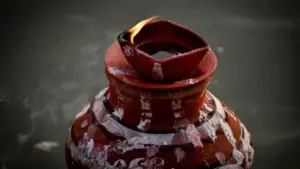
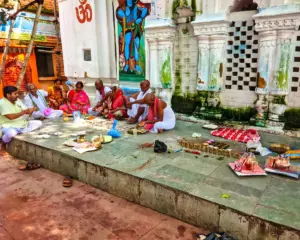
Traditionally, family members carry the asthi kalash (the urn containing the remains) to one of the great teertha sthals — Prayagraj (Triveni Sangam), Varanasi (Manikarnika or Harishchandra Ghat), Haridwar (Har Ki Pauri), or Gaya (Falgu River) — and a qualified purohit performs the poojan before the immersion. However, when crises arise — as the Covid-19 pandemic catastrophically demonstrated — this physical journey becomes impossible for thousands of grieving families.
The question then becomes urgent: what happens to the departed soul when the living cannot complete the rites? The answer, found in both scripture and modern compassionate practice, is that the ritual itself carries the merit — and it can be performed by a trusted pandit on the family’s behalf, with the family witnessing it through live video. This is the core of what Asthi Visarjan by courier/post and remote services offer.
How Covid-19 Disrupted the Sacred Duty of Asthi Visarjan
The Covid-19 pandemic arrived with a cruelty unique to its nature: it took lives rapidly, isolated families at the moment of greatest grief, and shut down the very systems — transport, pilgrimage, public gatherings — that Hindu last rites depended upon. Hospitals were overrun. Crematoriums worked around the clock. And in thousands of homes across India and the world, families were left with an asthi kalash and no way to reach the Ganga.
For the Hindu diaspora — families in Mauritius, Malaysia, the United Kingdom, the United States, Singapore, Canada, and across the Gulf — the barriers multiplied. International borders were sealed. Flights were cancelled. Even those who lived in India found their cities under lockdown, pilgrim towns closed to outsiders, and pandits inaccessible. The rituals that give a Hindu death its sacred completion were suddenly, terrifyingly, out of reach.
The consequences were felt deeply. Families reported acute distress — not merely the grief of loss, but the compounded anguish of knowing the soul of their loved one was waiting, the last rite unperformed. In Hindu theology, this is not a minor concern. It is a crisis of cosmic proportion for the family involved. The Pitru (ancestors) cannot be fully propitiated, the family cannot fully grieve, and the departed cannot fully move forward.
At Prayag Pandits, we witnessed this crisis firsthand. Calls and emails arrived from across India and the world — families who had lost loved ones in the first and second waves of Covid, who held ash urns in their homes for weeks, sometimes months, not knowing what to do. It was in direct response to this suffering that we formalized our Asthi Visarjan in Prayagraj remote service and partnered with the Postal Department to enable courier Asthi Visarjan across India.
Courier Asthi Visarjan: How the Asthi Kalash Travels Safely to the Holy Ganga
One of the most meaningful innovations during the pandemic era was the formal use of India Post Speed Post to transport the asthi kalash (the sealed urn) to the teertha sthal of the family’s choice. This service, developed through collaboration between Prayag Pandits and postal authorities, made it possible for families anywhere in India — or even NRIs sending through a trusted relative in India — to ensure the asthi reached Prayagraj, Varanasi, Haridwar, or Gaya safely.
The process of Asthi Visarjan by courier/post follows a careful, sanctified procedure:
- Initial Contact and Booking: The family contacts Prayag Pandits via phone, WhatsApp, or the website booking form. We gather the name, gotra, and details of the departed soul, as well as the preferred teertha sthal for the immersion.
- Packing Instructions: Prayag Pandits provides specific packing guidelines to ensure the asthi kalash is sealed appropriately for transit. The package must be clearly labeled with our address and marked with the words “Prayag Pandits — Asthi Kalash.”
- Speed Post Dispatch: The family dispatches the package via India Post Speed Post. The speed post barcode number must be shared with our team upon dispatch so we can track the arrival.
- Receiving and Confirmation: Upon receiving the asthi kalash, our pandits inform the family immediately. A date and time for the poojan are confirmed together.
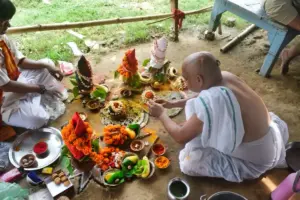
- Live Poojan via Video Call: The family joins a Zoom or WhatsApp video call at the scheduled time. Our pandit conducts the full Asthi Visarjan Poojan live from the ghat — the Sankalpa is taken in the departed soul’s name, the mantras are recited, and the immersion is performed while the family watches and participates remotely.
- Post-Poojan Documentation: After the live pooja, the family receives a full video recording of the ceremony — a sacred keepsake that confirms the rites were performed with proper Vedic procedure.
This service is available for immersions at Triveni Sangam Prayagraj, Varanasi’s sacred ghats, Haridwar’s Har Ki Pauri, and Gaya’s Falgu River. For guidance on the specific spiritual significance of each location, read our comprehensive guide to Asthi Visarjan in Prayagraj.
Online Asthi Visarjan: The Digital Tirtha — Spiritually Valid, Practically Essential
Beyond the courier model, Prayag Pandits also offers fully online Asthi Visarjan where the family does not send the asthi at all — instead, a small portion of the asthi is retained symbolically, and our pandits perform the full poojan at the teertha sthal while the family participates live. This is particularly suited to:
- NRI families abroad who cannot travel to India and cannot easily arrange courier dispatch
- Families where the asthi have already been at home for months and the urgency is high
- Cases where travel is medically inadvisable for senior family members
- Families seeking Asthi Visarjan at Varanasi who can explore our dedicated online Asthi Visarjan in Varanasi service
The theological basis for this practice is firmly rooted in the Vedic principle that Sankalpa — the sacred intention — carries the full weight of the ritual. Our pandits take the Sankalpa on behalf of the family, naming the departed soul, the family gotra, and each member of the family who participates via video. This Sankalpa is the ritual acknowledgment that places the departed soul at the center of the ceremony, making the rite spiritually complete regardless of physical proximity.
Many learned Vedic scholars, including those affiliated with Kashi Vidvat Parishad, have affirmed that proxy rituals conducted by a qualified purohit, with proper Sankalpa, are fully valid according to Dharmashastra — particularly when circumstances make physical participation impossible.
What Happens Spiritually When Asthi Visarjan Is Delayed?
This is perhaps the most anxious question that grieving families ask us. If the asthi have been kept at home for weeks, months, or even longer — is the soul suffering? Has the opportunity for moksha been lost?
The Garuda Purana teaches that the soul remains in a transitional state (pretavastha) until all sixteen Samskaras of the final rites — including Asthi Visarjan — are completed. Keeping the asthi at home extends this period of limbo. However, the tradition also teaches that it is never too late to perform the rites — and that performing them, even belatedly, brings the soul the relief and merit it is seeking. The Pitru are understood to be patient and compassionate; they await the completion of their rites with grace.
This is why, at Prayag Pandits, we never tell a family that time has run out. Whether the rites need to be performed one month after cremation or two years later, our pandits conduct them with the same reverence, the same Vedic procedure, and the same heartfelt Sankalpa. We have helped families complete Asthi Visarjan for loved ones who passed years before — and the relief and peace that families feel after the rites are completed is testament to their spiritual power.
Importantly, Asthi Visarjan during Pitrupaksha (the 16-day ancestral fortnight) carries special merit. If the asthi are still awaiting immersion as Pitrupaksha approaches, this is an excellent time to complete the rites, as the spiritual energy during this period is believed to hasten the soul’s journey. Read about the significance of Pitrupaksha and related rites to understand this connection more deeply.
Where to Perform Asthi Visarjan: The Sacred Teertha Sthals
Prayag Pandits conducts Asthi Visarjan at four primary teertha sthals, each carrying its own scriptural significance:
Prayagraj — Triveni Sangam
The confluence of Ganga, Yamuna, and the mystical Saraswati at Prayagraj is considered the supreme teertha — Tirthraj, the king of all pilgrimages. The Matsya Purana, Padma Purana, and Brahma Purana all extol Prayag as the place where Brahma himself performed the first yagna. Asthi Visarjan here is believed to liberate the soul across multiple generations. Read our complete guide to Asthi Visarjan in Prayagraj for detailed procedure guidance.
Varanasi — Manikarnika and Harishchandra Ghats
Kashi is the city of Shiva’s grace, where it is said that the Lord himself whispers the Taraka Mantra into the ears of those who die within its boundaries, granting them instant liberation. The ghats of Manikarnika and Harishchandra have been the site of cremations and Asthi Visarjan for millennia. Explore the stepwise guide to Asthi Visarjan in Varanasi for complete information on the procedure at each ghat.
Haridwar — Har Ki Pauri
Haridwar, where the Ganga descends from the Himalayas onto the plains, is the gateway to the divine. Har Ki Pauri — “the steps of Lord Hari” — is where the Ganga aarti lights the evening sky and where Asthi immersion carries the grace of Vishnu’s footprint. Our guide to the best places for Asthi Visarjan in India provides a comparative overview of all major locations.
Gaya — Falgu River
Gaya is unique in that it is the land of Vishnu’s footprint — where Lord Vishnu himself granted the boon that Pind Daan and ancestral rites performed here would yield liberation for twenty-one generations of ancestors. Combining Asthi Visarjan with Pind Daan at Gaya creates a complete ancestral rite of exceptional merit. Read more about Gaya as a pilgrimage destination.
After Asthi Visarjan: The Next Steps in Completing the Final Rites
Asthi Visarjan is one essential element in the broader arc of Hindu funeral rites. Families who perform it remotely — whether during Covid or otherwise — often ask us about what other rites should be performed to ensure the soul’s complete liberation. Here is a brief guide to the complete sequence:
- Antim Samskara (Cremation): The first and most urgent rite — liberating the gross body through fire.
- Asthi Sanchayan: The collection of bone fragments from the cooled pyre, typically on the third day.
- Asthi Visarjan: Immersion of the collected remains in a sacred river, ideally within 13 days — though it can be done later as circumstances require.
- Shradh and Pind Daan: Offered during the first year after death (particularly on Pitrupaksha), these rites nourish the soul on its journey and help it progress through the post-death planes.
- Narayan Bali or Tripindi Shradh: In cases of premature or sudden death (Akal Mrityu), these special rites may be required to give the soul additional peace. Read about Narayan Bali poojan for detailed information.
For families who performed Asthi Visarjan during Covid but were unable to conduct the proper Shradh and Pind Daan, it is not too late. Prayag Pandits can arrange these rites now — at Gaya, Prayagraj, or Varanasi — either in person or remotely. The soul awaits, and the living can still fulfill this sacred duty.
Post-Pandemic Guidance: What Families Who Missed the Rites Should Do Now
The Covid-19 era left a specific category of unfinished spiritual business for many Hindu families. Some families lost multiple members in quick succession. Some had asthi in urns at home for months before help was available. Some conducted partial rites but could not complete Pind Daan or Shradh. And some families — particularly NRIs — are still carrying guilt about loved ones whose rites were never properly completed.
If your family falls into any of these categories, please know: the remedy is available, the tradition provides for it, and our pandits are ready to help. Here is our practical guidance for post-pandemic ancestral rite completion:
- If the asthi are still at home: Contact us immediately to arrange Asthi Visarjan by courier or online service. Do not wait for a “perfect” time — every day brings the soul one day closer to its rest once the rites begin.
- If Asthi Visarjan was done but Shradh/Pind Daan was not: These can be performed now. Pitrupaksha is the ideal time (September 26 – October 10, 2026), but they can also be performed on monthly Amavasya (new moon day) or at any time with proper Sankalpa.
- If the soul is believed to be in distress (recurring family troubles, bad dreams, Pitru Dosh): Consider Narayan Bali or Tripindi Shradh in addition to regular Pind Daan. Our pandits can assess the situation and recommend the appropriate rites.
- For NRI families needing complete remote services: See our full range of poojan services for NRIs in India for end-to-end ancestral rite packages conducted on your behalf.
Understanding Asthi Visarjan: The Deeper Spiritual Meaning
At its deepest level, Asthi Visarjan is an act of surrendering the last physical trace of the beloved — returning what was earth to the sacred water that carries all things to the divine. The Ganga is not merely a river in the Hindu worldview; she is Devi Ganga, the daughter of the Himalayas and the consort of Lord Shiva, whose sacred waters are described in the Puranas as capable of washing away the accumulated karma of countless lifetimes.
When the asthi touch the Ganga, the soul — which has been waiting in the liminal space between death and liberation — receives the divine touch of these sacred waters through a mystical connection that transcends physical proximity. This is why even a remote or online Asthi Visarjan, conducted with proper Sankalpa by a qualified pandit at the actual teertha sthal, carries genuine spiritual efficacy. The Ganga does not distinguish between a family member who stands on the ghat and a family member who watches from ten thousand miles away — what matters is the sincerity of the Sankalpa and the correctness of the ritual.
Understanding this principle helps families who are physically distant release their guilt and receive peace. You are not failing your loved one by watching from afar. You are honoring them across any distance the world may place between you. The sacred river carries your love as faithfully as it carries the asthi — both toward liberation.
For a deeper exploration of the ritual significance of sacred bathing and immersion in Hinduism, read about the importance of Snan in Hindu mythology. And for the complete picture of the best locations for these rites across India, our comprehensive guide to the best places for Asthi Visarjan in India is essential reading.
🙏 Book Asthi Visarjan — Remote or In-Person
Frequently Asked Questions About Asthi Visarjan During Crises
Related Services by Prayag Pandits
- 🙏 Online Asthi Visarjan in Prayagraj — Starting from ₹9,999
- 🙏 Online Asthi Visarjan in Varanasi — Starting from ₹7,100
- 🙏 Online Asthi Visarjan in Haridwar — Starting from ₹7,100
Book Your Sacred Ritual
Authentic ceremonies performed by Veda-trained pandits at sacred sites across India.