What is Sapindikarana and when should it be performed?
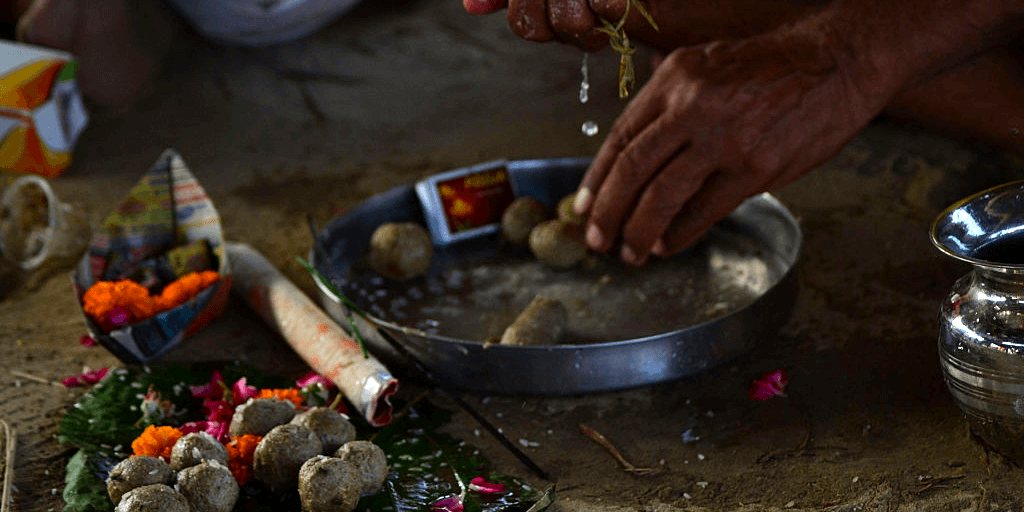
Sapindikarana is the Shraddha ceremony where the deceased Pinda is merged with the Pindas of the father, grandfather, and great-grandfather. This transforms the soul…
Questions about All Shradh

Sapindikarana is the Shraddha ceremony where the deceased Pinda is merged with the Pindas of the father, grandfather, and great-grandfather. This transforms the soul…
Yes. Brahmin Bhoj is a core component of Shradh, not optional. The Vishnu Purana explicitly states that food served to a qualified Brahmin during…
Yes. We perform online Shradh ceremonies for NRI families in Malaysia, Singapore, UK, USA, Canada, Australia, UAE, and other countries. The ceremony is conducted…
Pitrupaksha 2026 runs from September 26 to October 10, 2026. September 26 is Purnima Shradh and October 10 is Sarva Pitru Amavasya. The 16-day…
The Vishwamitra Smriti identifies eight sacred Kutapa elements: (1) the eighth muhurta of the day (approximately 11:36 AM to 12:24 PM); (2) Khadgapatra (ritually…
The Garuda Purana and Markandeya Purana describe ancestors who receive no Shradh as being in a state of severe hunger and distress in Pitru…
Yes. While the traditional primary responsibility falls to the eldest son, daughters can and do perform Shradh for their parents when no male heir…
The Vishwamitra Smriti and Bhavishya Purana together enumerate twelve types of Shradh: Nitya (daily), Naimittika (occasion-specific), Kamya (desire-fulfilling), Vriddhi or Nandi (for auspicious occasions),…
Shradh is the overall ancestral ceremony, encompassing multiple components: Sankalp (the formal vow), Pind Daan (rice ball offerings), Tarpan (water offerings), Brahmin Bhoj (feeding…
Yes. Performing Sumangali Pooja for a Sumangali ancestor (a married woman who predeceased her husband) is a special form of Shraddha particularly emphasised in…
Showing 10 of 217 questions