



Veda-Trained Pandits
Experienced pandits guide the ceremony with care for your family’s tradition.
Pooja booking
Original price was: ₹11,100.00.₹7,100.00Current price is: ₹7,100.00.
Per pooja
Applicable taxes are shown in your booking. Optional additions are separate.
Exclusions
Thoughtfully arranged, personally guided
Experienced pandits guide the ceremony with care for your family’s tradition.
Stay in touch with our team for your booking details and ceremony arrangements.
See what your selected package includes. Optional additions are shown separately.
Share the date and timing that suit you. Our team confirms the final arrangements.
Experiences shared by our families
8 family reviews0 for this pooja · 8 from across our services
Watching the pandit perform the rituals in real-time by the Falgu River, mentioning my father's name... it felt like we were truly there. Immense gratitude to the entire team.
Being in the USA, travelling to India just for Tarpan during Pitru Paksha was becoming very difficult. Prayag Pandits offered a well-coordinated solution.
I was skeptical about performing such a sacred ritual online from Canada. But honouring my parents in Kashi was important. They were very patient and answered all my questions.
Living in Singapore, we felt disconnected from these essential rituals. The live stream option for Tarpan at Prayagraj gave us a profound sense of connection and peace.
It was deeply important for us in Australia that the rituals were performed correctly. The ceremony reflected the authenticity we sought and was performed by a knowledgeable priest.
The Pind Daan at Kashi was handled carefully, with the pandit following every step diligently. Very reassuring.
Arranging Asthi Visarjan from Bhubaneswar seemed complex, but Prayag Pandits made it seamless. The pandit called us before the ceremony to explain every step. Very professional.
During Pitru Paksha, we booked Shradh at Prayagraj. The coordination was flawless - from date selection to the pandit assignment. Our family felt at peace after the ceremony.
YOUR EXPERIENCE MATTERS
Tell us about your ceremony and the support you received. Your email address will stay private.
From your first choice to your booking
Review your package and any available additions, then add it to your booking.
Enter your contact details, preferred date and time. Add ancestral details if you wish.
Our team confirms the arrangements and shares your coordinator’s details 24 hours before the pooja.
Follow the participation and joining arrangements described in your package and shared by your coordinator.
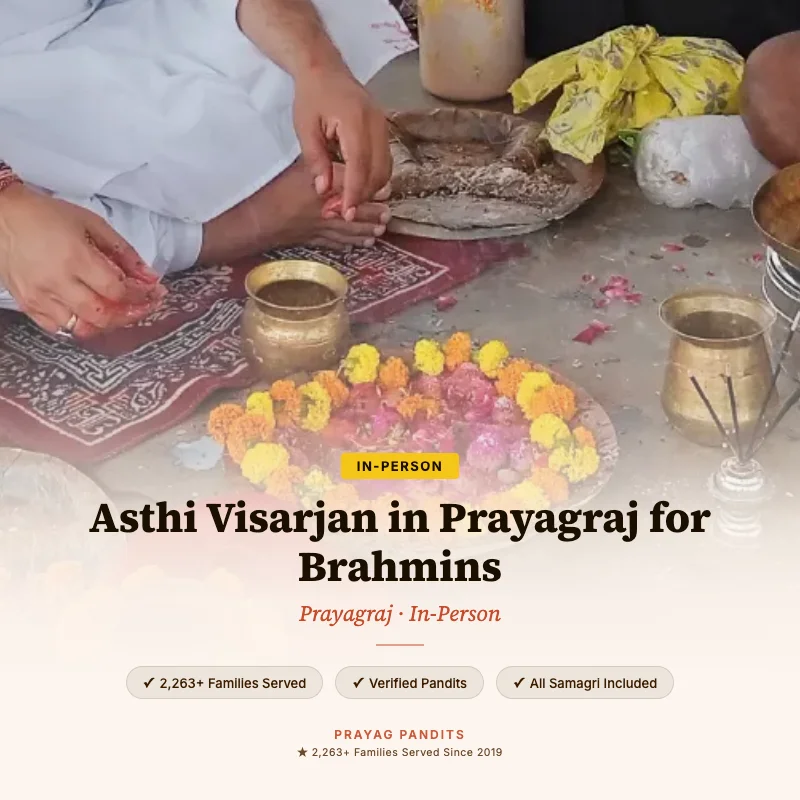
If you are looking for Asthi Visarjan in Prayagraj for Brahmins — a ceremony performed with the correct Veda-specific mantras, proper gotra-pravara identification, and the ritual precision that your family’s lineage demands — you are in the right place. Brahmin families carry a particular weight when it comes to the final rites of a loved one. The expectations are higher — not from the world, but from within. When a Brahmin elder passes, the family knows instinctively that the Asthi Visarjan cannot be approximate. It must be exact.
This is the service we have built for you. Our Asthi Visarjan for Brahmins in Prayagraj package — priced at Rs 7,100 — is performed by a senior Brahmin pandit who understands the specific requirements of Brahmin Antyesti traditions: the Veda-aligned mantras (whether your family follows Rigveda, Yajurveda, or Samaveda traditions), the correct Sankalp with your full gotra, pravara, and shakha identification, and the ritual sequence as prescribed in the Dharmasutras and Grihyasutras that govern Brahmin last rites.
The ceremony is performed at the Triveni Sangam — the confluence of the Ganga, Yamuna, and the unseen Saraswati — which the Matsya Purana describes as an akshay teerth, a place where the spiritual merit of any sacred act is multiplied beyond measure. For Brahmin families, whose ancestors are traditionally honoured with the highest standard of Vedic rites, performing Asthi Visarjan at this most sacred of confluences fulfils both the scriptural requirement and the family’s duty to the departed soul in the most complete way possible.
Why Brahmin Families Trust Prayag Pandits
Every Hindu family deserves a proper Asthi Visarjan. But the ritual requirements for Brahmin families have specific elements that a general-purpose ceremony may not address correctly. Here is what differs:
Gotra, Pravara, and Grammatical Precision: A Brahmin Sankalp is not complete with just the gotra name. The pravara — the lineage of Rishis from whom your gotra descends — must be correctly identified and recited. The Skanda Purana is specific about this: the gotra must be grammatically modified based on the ritual phase — it ends with a Svara (vowel) during the Tarpan, is pronounced as Gotraya during the Sankalp, and is uttered as Gotrasya during the Akshayya Dapana. The departed’s name must be appended with the title Sharman (the honorific designation for Brahmins), with its case ending changing depending on whether Arghya, vegetables, or water is being offered. Getting these inflections wrong weakens the precision of the rite. Our pandit is trained in these exact distinctions.
Veda-Specific Mantras: The Agni Purana and Skanda Purana mandate that the priests perform recitations corresponding to their Vedic branch. A follower of the Rigveda recites hymns like Trisukta, Pavamani, and Purusha-sukta. A follower of the Samaveda chants melodies like Jyesthasaman and Rathantara. A follower of the Yajurveda recites the Rudra, Kusmanda, and Sivasankalpa mantras. This is not a cosmetic difference — the mantras are the vehicle through which the ritual’s spiritual power is transmitted, and using the correct Vedic tradition ensures that the ceremony aligns with your family’s spiritual lineage going back generations.
Brahmin-Specific Ashaucha Period: The scriptures decree that the period of ritual impurity (Ashaucha) for a Brahmin family lasts exactly 10 days — compared to 12 days for Kshatriyas, 15 for Vaishyas, and one month for Shudras. During this period, the Gayatri mantra must be chanted only mentally, without the standard Pranayama mantras. Our pandit advises your family on the correct observances during and after this period.
Ritual Sequence per Dharmasutra: The order in which the Sankalp, Tarpan, and Visarjan are performed follows the prescriptions of the Paraskara Grihyasutra and other Dharmasutras — Apastamba, Baudhayana, or Gautama depending on the family’s tradition. A pandit who understands these distinctions ensures that the ceremony is not just emotionally meaningful but ritually precise in the way that Brahmin families expect and deserve.
Brahmin families have historically maintained the most rigorous standards for where and how ancestral rites are performed. Prayagraj — called Tirthraj, the king of all pilgrimages — is the location that the Puranas themselves recommend most strongly for post-death rites.
The Skanda Purana states: Asthi Sangame visarjayan, pitrun mukti prayacchati — by immersing the remains at a Sangam, one grants liberation to the ancestor. The Padma Purana describes this as the place where Brahma himself performed the first Yagna. The Garuda Purana — the primary text governing Hindu death rites — repeatedly emphasises the Sangam as the ideal location for ash immersion, noting that what enters the Ganga’s waters ascends with her toward the divine realm.
The Padma Purana and Garuda Purana both emphasize that the precise mention of the departed’s name and gotra during the ceremony at a sacred tirtha acts as a homing beacon — taking the offerings directly to the specific ancestor, regardless of what form or species they have assumed in their next life. At Triveni Sangam, this spiritual transmission is at its most powerful.
For Brahmin families who follow the Dharmasutra prescriptions closely, performing Asthi Visarjan for Brahmins at Triveni Sangam is not merely a good choice — it is the choice that fulfils the highest standard of the tradition. To understand the full significance of this sacred geography, read our detailed guide: Triveni Sangam — The Tirtharaj of India.

From arrival at the ghat to the closing blessings
Pandit greets your family, confirms gotra, pravara, Veda, and shakha. Helps trace lineage if unknown.
Achamana and Gangajal sprinkling to purify body and mind before the sacred ceremony begins.
Detailed Sankalp with Sharman suffix, gotra (Gotraya inflection), pravara, Veda, shakha, tithi, and nakshatra.
Puja to Triveni with flowers and ghee lamps. Tarpan facing South with Veda-specific mantras for your tradition.
Ashes immersed with Namo Astu Dharmaya invocation and Moksha mantras as the remains join the Triveni waters.
Final blessings, Sapindikarana guidance, annual Shraddh dates, and shakha-specific follow-up advice.
When you arrive at the designated ghat, the pandit greets your family and begins by confirming the essential details: the departed’s name, your gotra, pravara, Veda, and shakha. If you are unsure of any of these, the pandit can help determine your lineage based on your family’s known traditions, surname, and region of origin. For families where the gotra is entirely untraceable (what the Skanda Purana calls Nastavamsa), the pandit will use Kashyapa Gotra with the designation Dasoham — as prescribed in the texts — while ensuring the rest of the ceremony is conducted with full correctness.
The performing family member undergoes Achamana (ritual sipping of water) and is sprinkled with Gangajal for purification. This prepares the body and mind for the sacred act that follows.
The Sankalp is recited with full detail — your name, the departed’s name with the Sharman suffix (the Brahmin designation), your gotra with the correct grammatical inflection (Gotraya for the Sankalp phase), your pravara naming the founding Rishis of your lineage, your Veda and shakha, the current tithi and nakshatra, and the formal statement of purpose. Note: if the Sapindikarana has not yet been performed, the texts mandate that the term Preta is used in the Sankalp rather than the gotra or Sharman title — our pandit follows this prescription exactly.
Puja is offered to the Triveni Sangam — flowers, incense, diya, and prayers honouring the sacred confluence. Following this, Tarpan is performed: the family faces South as prescribed, and water mixed with sesame and barley is offered to the departed soul and to the Pitrus (ancestors). The gotra inflection shifts here — ending with a Svara (vowel) during the Tarpan phase — and the Veda-specific mantras appropriate to your family’s tradition are recited throughout.
The performing family member faces South, recites “Namo Astu Dharmaya”, and enters the sacred waters. The mortal remains are gently released into the Triveni with the invocation “Sa me Prito Bhavatu” — as the Dharmasutra texts prescribe. The pandit recites the Moksha mantras as the ashes join the confluence of three sacred rivers. Family members may add flower petals as the remains flow into the waters. After the immersion, the performer looks at the sun — completing the prescribed sequence.
The ceremony concludes with prayers for the departed soul’s onward journey and blessings for the living family. The pandit then provides detailed guidance on the follow-up rites: the Sapindikarana ceremony (which unites the Preta with the Pitrs of your gotra — performed by splitting the Preta-pinda into three parts and merging them with the ancestral pindas), the correct dates for annual Shraddh, and any traditions specific to your shakha.
The Agni Purana and Brahma Purana state that the bones of a Brahmin should be collected on the fourth day after death, though the Garuda Purana also allows collection on the first, third, seventh, or ninth day. Ideally, the immersion should be completed within the 10-day Ashaucha period — before the Dwadasha (12th day) Shraddh. However, practical constraints often make this timeline difficult, and the rite remains valid and complete whenever it is performed.
Certain periods are considered especially auspicious for this rite:
For a complete understanding of the ceremony, its rituals and their meanings, read our detailed guide: Asthi Visarjan Poojan — All You Need to Know. To understand why Triveni Sangam is the most powerful location for this rite, see our article on the best places to perform Asthi Visarjan in India.
To book this service, call or WhatsApp us at +91 7754097777 or click the Add to Cart button on this page. Our team will contact you within a few hours to confirm the date, collect details about the departed and your family’s Vedic tradition, and answer any questions.