






अभी तक कोई अनुष्ठान नहीं चुना गया।
पूजा पैकेज देखें →




Online Tarpan in Gaya
₹11,000
₹15,000
27% off
प्रति परिवार · सब शामिल
सत्यापित पंडित
2019 से
सभी सामग्री शामिल
निःशुल्क रद्दीकरण
यह पूजा बुक करें
पहले हमें व्हाट्सएप करें
No hidden charges · Cancel up to 48hrs · GST invoice provided
परिवार हमें क्यों चुनते हैं
यह कैसे काम करता है
1
Book & Confirm Your Date
Select your preferred date and complete the booking. Our team calls you within 2 hours to confirm details.
2
Share Family Details
Provide gotra, departed soul's name, and any requirements. Don't know your gotra? Our pandits will help.
3
Ritual Performed at Sacred Site
A Veda-trained pandit performs the complete ceremony as per shastra at the designated holy teerth.
4
Confirmation & Documentation
Booking confirmation on WhatsApp. Digital documentation available on select poojas within 48 hours.
क्या शामिल है
- Poojan samagri
- Pandit ji dakshina
- Pratinidhi Charges
- Tarpan Poojan
- Any extra offerrings to the priest.
- Pick and drop charges from station/airport.
इस अनुष्ठान के बारे में
Pitrupaksha Tarpan in Gaya — Online, From Wherever You Are
Every year, for fifteen days in the fortnight of Ashwin Krishna Paksha, the boundary between the world of the living and the world of the ancestors grows thin. Hindu scripture calls this period Pitrupaksha — the fortnight of the forefathers. During these days, ancestors who have passed on return, in a subtle sense, waiting for their descendants to remember them, to offer water, and to release them from whatever burdens they still carry.
The single most auspicious place to perform Tarpan during Pitrupaksha is Gaya in Bihar — specifically on the banks of the Phalgu River, in the shadow of Vishnupad Mandir. The Brahma Purana states plainly: Tarpan offered at Gaya during Pitrupaksha brings prosperity and liberation not just to the individual ancestor, but to the entire lineage — across seven generations upward and seven generations downward. That is the weight of what happens when water is offered here, at this time, with proper intention.
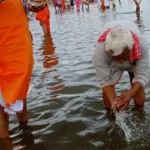
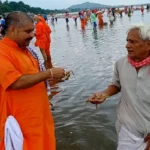
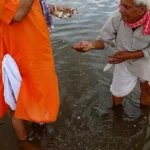
Yet travel to Gaya is not always possible. Work, health, distance, family obligations — these are real. This is why our Online Tarpan in Gaya for Pitrupaksha was created. A learned pandit performs the complete Tarpan ritual on the Phalgu River bank in Gaya, on your behalf. You join the ceremony live via Zoom or WhatsApp video call. A trained pratinidhi — a representative — sits physically beside the pandit, standing in for you at the river, so the ritual has both material and spiritual presence.
Why Pitrupaksha Is the Most Powerful Time for Tarpan
In the ordinary course of the year, Tarpan can be offered on Amavasya (new moon), on a death anniversary, or at pilgrimage sites. These are all valid. But Pitrupaksha is categorically different.
During this fortnight, the sun transits into Virgo (Kanya Rashi). Vedic astrology holds that this particular solar position opens a channel — called Pitru Dwar — between this world and the Pitru Loka (realm of ancestors). Offerings made through this channel reach ancestors directly, without the usual delays and conditions that apply to ordinary ritual offerings.
The Garuda Purana elaborates: those who have departed without receiving proper rites, or who departed under sudden or violent circumstances, are particularly helped by Pitrupaksha Tarpan. The water and sesame seeds offered during Tarpan do not merely satisfy a ritual obligation — they provide the ancestor with nourishment in a subtle sense, easing their onward passage.
The specific tithi within Pitrupaksha on which a person's Tarpan should be performed depends on the lunar phase on which their ancestor died:
- Those who died on Pratipada — Tarpan on Krishna Pratipada
- Those who died on Panchami — on Panchami (also called Kunwara Panchami)
- Mothers who died while their children were very young — on Navami (Matru Navami)
- Those whose tithi is unknown — on Sarva Pitru Amavasya, the final day, when all ancestors are remembered together
Our pandits at Gaya perform on the correct tithi within Pitrupaksha based on the details you provide about your ancestor.
What Is Tarpan — and What Does It Actually Do
Tarpan is one of the five Pancha Maha Yagyas (five great offerings) that a householder is obligated to perform. The word itself comes from the Sanskrit root tarp — to satisfy, to nourish, to make content. The ritual involves offering water mixed with sesame seeds, barley, flowers, or milk, while reciting the names and gotra of the ancestors being remembered.
The act of physically cupping water in the palms and allowing it to flow outward toward the ancestors while speaking their names is deeply intentional. It is not symbolic — Hindu philosophy holds that water carries memory and intent, and that the sound of a person's name, spoken by a descendant with a sincere heart, creates a real connection across planes of existence.
The Brahma Purana specifies the number of anjali (palmfuls of water) to be offered to each category of beings:
- To the Devas (gods): 1 anjali, offered with the sacred thread over the ring finger, facing east
- To the Rishis (sages and seers): 2 anjali, facing north
- To Pitrus (paternal ancestors — father, grandfather, great-grandfather): 3 anjali each, facing south, with the sacred thread in apasavya position
- To the Matrutrayi (mother, maternal grandmother, maternal great-grandmother): 3 anjali each, also facing south
Each offering is accompanied by the correct gotra, name, and relationship of the ancestor being remembered. Our pandit will ask you for these details in advance and will recite them correctly during the ceremony.
What Is Pitru Dosha — and Does Tarpan Remove It
Pitru Dosha is a specific configuration in a birth chart (Kundli) that indicates unresolved karma toward ancestors. It typically appears when the Sun, Moon, or Lagna lord is afflicted by Rahu, Ketu, or Saturn in particular houses — especially the 5th, 9th, or the house of forefathers.
Signs that Pitru Dosha may be present:
- Repeated obstacles in progeny — difficulty conceiving, or children facing health issues
- Financial troubles that persist despite effort
- Unexplained illness or mental distress recurring in the family
- Marriages breaking down across generations
- The sense that something in the family is stuck — that progress is somehow blocked
Tarpan — especially when performed at Gaya during Pitrupaksha — is one of the primary remedies for Pitru Dosha cited in the Garuda Purana and Vishnu Purana. It does not erase karma mechanically. Rather, it creates a sincere act of remembrance and propitiation that, over time, shifts the energetic weight that the dosha represents.
For deeper Pitru Dosha remedy, Pind Daan in Gaya is typically combined with Tarpan. Our team can guide you on whether both are needed based on your specific situation.
Who Should Perform Tarpan
According to Dharmashastra:
- The eldest son is the primary karta (performer) of Tarpan for both paternal and maternal ancestors
- If the eldest son is deceased, the next eldest son performs
- If there are no sons, the wife may perform Tarpan for her deceased husband
- A daughter may perform when there is no son or wife surviving
- A grandson may perform if no direct children survive
- For those with no living descendants at all, a sapinda (family member within a defined degree of relation) may perform
When multiple family members wish to participate — say, both sons of the deceased — they may each perform separately, or the eldest performs as the primary karta while others assist.
For those who prefer to be physically present at Gaya themselves, we also offer in-person Tarpan in Gaya where you travel to the site and perform the ritual yourself with pandit guidance.
How the Online Tarpan Ceremony Works
The process from booking to ceremony is straightforward:
- Book your date: Select a date within the Pitrupaksha period (Ashwin Krishna Pratipada to Sarva Pitru Amavasya). We will confirm the correct tithi based on your ancestor's date of passing.
- Provide ancestor details: Submit the names, gotra, and relationship of the ancestors for whom Tarpan is to be performed. If you are unsure of the gotra, our pandit will advise on the appropriate fallback.
- Share your schedule: We will send a confirmed time for the ceremony, typically at sunrise or during the morning hours — the auspicious time for Tarpan.
- Join via video call: On the scheduled morning, log in to WhatsApp or Zoom. You will see the pandit and the pratinidhi at the Phalgu River bank in Gaya.
- Participate in real time: The pandit recites the mantras and performs each anjali offering while naming your ancestors. You follow along, repeating sankalpas as guided. The pratinidhi performs the physical offering movements simultaneously on your behalf.
- Receive the video recording: A recording of the complete ceremony is shared with you afterward via WhatsApp.
The entire ceremony typically takes 60 to 90 minutes depending on the number of ancestors for whom Tarpan is performed.
What Is Included in This Package
- Complete Tarpan ritual performed by an experienced Gaya pandit on the Phalgu River bank
- Pratinidhi (representative) seated alongside the pandit, performing physical offerings on your behalf
- Sankalpa taken in your name and the names of all ancestors specified
- All ritual materials: sesame seeds, barley, kusha grass, flowers, milk, and Phalgu River water
- Live video streaming via WhatsApp or Zoom
- Complete ceremony recording sent to you afterward
- Pre-ceremony guidance call to collect all required details
- Support for listing up to 7 ancestors by name (additional names can be accommodated)
Preparing for the Ceremony
Even though you are joining from home, a few preparations on your side make the ceremony more meaningful:
- Bathe and wear clean, preferably white or light-colored clothing
- Sit in a clean, quiet place where you can see the video clearly
- Keep a glass of water nearby — you may be guided to perform a symbolic anjali from your side
- Have the names, gotra, and relationship of all ancestors written down and ready
- If possible, place a photograph of the deceased ancestor near where you are seated
- Observe a light vegetarian diet on the day of the ceremony
Frequently Asked Questions
Is online Tarpan spiritually valid, or is physical presence required?
Physical presence at Gaya is of course ideal. But the Dharmashastra tradition has always recognized the pratinidhi system — the concept that a qualified representative can perform a ritual on behalf of the yajamana (the patron). What matters is the sankalpa (intention), the correct mantra, the correct materials, and the correct location. All of these are present in our online ceremony. Many scholars and traditional pandits confirm that Tarpan performed at Gaya by a pandit with a pratinidhi, while the karta joins via video, carries full spiritual validity.
What if I do not know the gotra of my ancestor?
This is more common than you might expect. If the gotra is not known, the pandit uses Kashyapa gotra as a universal fallback — this is the established traditional practice and is considered fully valid.
Can I perform Tarpan for ancestors whose names I have partially forgotten?
Yes. Even a partial name, combined with the correct relationship (e.g., "my paternal grandfather") and the gotra, is sufficient. You may also perform Tarpan for unnamed ancestors using the phrase "ye kechit" — all those in my lineage whose names I do not know.
Is one Tarpan sufficient, or should it be performed every Pitrupaksha?
One Tarpan does not permanently discharge the obligation. Traditional practice calls for Tarpan every year during Pitrupaksha, or at minimum on Sarva Pitru Amavasya each year. Think of it as an annual act of remembrance — its value compounds over time, both spiritually and as a personal practice of gratitude.
Can women perform Tarpan?
Yes. While the eldest son is the traditional primary karta, the Dharmashastra tradition clearly permits wives and daughters to perform Tarpan when no male heir is present or available. Several texts — including the Rig Veda itself — mention women offering Tarpan. There is no scriptural basis for excluding women from this ritual.
परिवार क्या कहते हैं 4.4
చాలా మంచి సేవ. పండిట్ జీ చాలా అనుభవజ్ఞుడు. సంతృప్తిగా ఉన్నాం.
बहुत भरोसेमंद और professional टीम है। अगली बार भी इन्हीं से सेवा लेंगे।
पंडित जी समय पर आए, सारी सामग्री लाए और पूरी श्रद्धा से पूजा करवाई। बहुत खुश हूँ।
We booked Pind Daan for our late father's shradh ceremony. The pandits were very knowledgeable and performed all rituals with proper Vedic mantras. The whole family felt at peace after…
Booked this for my mother-in-law's teerth yatra. The arrangements were perfect from pickup to drop. The pandit performed all mantras correctly and with devotion. The poojan materials were all arranged…
After losing my father suddenly we needed guidance on the proper rituals. Prayag Pandits team was very compassionate and helped us through every step. The Pind Daan brought us immense…
We had been wanting to perform Pind Daan for years but couldn't travel to India. This online service was a blessing. The entire ritual was done as per shastras. Thank…
We booked this for our grandfather's annual shradh. The ceremony was performed with great reverence. Pandit ji even shared stories from the Garuda Purana which were very enlightening for the…
Smooth experience from start to finish. The live video call gave us peace of mind that everything was done correctly.
हमने अपने पिता जी के श्राद्ध के लिए यह सेवा बुक की थी। पंडित जी बहुत अनुभवी थे और सभी विधि-विधान शास्त्रोक्त तरीके से करवाए। सामग्री की व्यवस्था भी उन्होंने…