



Veda-Trained Pandits
Experienced pandits guide the ceremony with care for your family’s tradition.
Attend in person
Original price was: ₹7,999.00.₹5,100.00Current price is: ₹5,100.00.
Per pooja
Applicable taxes are shown in your booking. Optional additions are separate.
Exclusions
Thoughtfully arranged, personally guided
Experienced pandits guide the ceremony with care for your family’s tradition.
Stay in touch with our team for your booking details and ceremony arrangements.
See what your selected package includes. Optional additions are shown separately.
Share the date and timing that suit you. Our team confirms the final arrangements.
Experiences shared by our families
28 family reviews20 for this pooja · 8 from across our services
बहुत भरोसेमंद और professional टीम है। अगली बार भी इन्हीं से सेवा लेंगे।
Booked this for my mother-in-law’s teerth yatra. The arrangements were perfect from pickup to drop. The pandit performed all mantras correctly and with devotion. The poojan materials were all arranged by them. Very satisfied with the service. Dhanyavaad.
हमने अपने पिताजी के लिए यह पूजा करवाई। सब कुछ बहुत अच्छे से हुआ। पंडित जी बहुत अनुभवी थे।
Very professional service. The pandit ji explained every step of the ritual which helped us understand the significance. Everything was arranged well including the samagri. We are grateful to Prayag Pandits for making this spiritual journey meaningful.
We came from Delhi specifically for this puja. The whole process was smooth and the pandit ji guided us patiently. Highly recommend.
আমার বাবার জন্য এই পূজা করিয়েছিলাম। সব কিছু ঠিকঠাক হয়েছে। পণ্ডিত জি খুব অভিজ্ঞ।
First time performing Pind Daan and was nervous about the process. But the team guided us well. They explained what to wear, what to bring, and what mantras to recite. Everything went smoothly. Jai Shri Ram.
We are settled abroad and wanted to perform the puja in Prayagraj. Prayag Pandits made it possible. Grateful.
অনলাইন বুকিং করেছিলাম, তবে সেবা অসাধারণ ছিল। ধন্যবাদ প্রয়াগ পণ্ডিতস।
ప్రయాగ్ పండిట్స్ సేవ అద్భుతంగా ఉంది. మా పూర్వుల కోసం ఈ పూజ చేయించాం. చాలా సంతోషంగా ఉన్నాం.
बहुत संतोषजनक सेवा। पंडित जी का वेद-शास्त्र का ज्ञान अद्भुत था। उन्होंने गरुड़ पुराण के श्लोकों का पाठ किया जो बहुत मार्मिक था। पूरा परिवार भावुक हो गया। Jai Shri Ram.
हमारे पूर्वजों की आत्मा की शांति के लिए यह पूजा करवाई। पूरा परिवार संतुष्ट है।
My family performed Pind Daan through Prayag Pandits and it was a deeply spiritual experience. The location was serene and the pandit’s chanting was beautiful. We felt connected to our ancestors throughout the ceremony. Dhanyavaad.
We had been wanting to perform Pind Daan for years but couldn’t travel to India. This online service was a blessing. The entire ritual was done as per shastras. Thank you Prayag Pandits team for your dedication. 🙏
First time performing Pind Daan and was nervous about the process. But the team guided us well. They explained what to wear, what to bring, and what mantras to recite. Everything went smoothly. Dhanyavaad.
Outstanding service for Pind Daan. The pandit arrived early, set up everything neatly, and began the ceremony right on time. His pronunciation of Sanskrit shlokas was impeccable. Very authentic experience. Jai Shri Ram.
हमने अपने पिता जी के श्राद्ध के लिए यह सेवा बुक की थी। पंडित जी बहुत अनुभवी थे और सभी विधि-विधान शास्त्रोक्त तरीके से करवाए। सामग्री की व्यवस्था भी उन्होंने ही की। बहुत अच्छा अनुभव रहा।
We booked this for our grandfather’s annual shradh. The ceremony was performed with great reverence. Pandit ji even shared stories from the Garuda Purana which were very enlightening for the younger generation.
We booked Pind Daan for our late father’s shradh ceremony. The pandits were very knowledgeable and performed all rituals with proper Vedic mantras. The whole family felt at peace after the poojan. Highly recommended for anyone looking for authentic rituals.
We are NRI family based in USA. We booked online poojan and it was conducted very sincerely. The video quality was good and we could see everything clearly. The team sent us photos and videos after the ceremony too. 🙏
Watching the pandit perform the rituals in real-time by the Falgu River, mentioning my father's name... it felt like we were truly there. Immense gratitude to the entire team.
Being in the USA, travelling to India just for Tarpan during Pitru Paksha was becoming very difficult. Prayag Pandits offered a well-coordinated solution.
I was skeptical about performing such a sacred ritual online from Canada. But honouring my parents in Kashi was important. They were very patient and answered all my questions.
Living in Singapore, we felt disconnected from these essential rituals. The live stream option for Tarpan at Prayagraj gave us a profound sense of connection and peace.
It was deeply important for us in Australia that the rituals were performed correctly. The ceremony reflected the authenticity we sought and was performed by a knowledgeable priest.
The Pind Daan at Kashi was handled carefully, with the pandit following every step diligently. Very reassuring.
Arranging Asthi Visarjan from Bhubaneswar seemed complex, but Prayag Pandits made it seamless. The pandit called us before the ceremony to explain every step. Very professional.
During Pitru Paksha, we booked Shradh at Prayagraj. The coordination was flawless - from date selection to the pandit assignment. Our family felt at peace after the ceremony.
YOUR EXPERIENCE MATTERS
Tell us about your ceremony and the support you received. Your email address will stay private.
From your first choice to your booking
Review your package and any available additions, then add it to your booking.
Enter your contact details, preferred date and time. Add ancestral details if you wish.
Our team confirms the arrangements and shares your coordinator’s details 24 hours before the pooja.
Our team guides you to the designated pooja area and helps you participate in the ceremony.
There are places in this world where the distance between the living and the dead seems to collapse. Varanasi is one such place — perhaps the most profound one. Here, on the banks of the Ganga, in the city that Lord Shiva himself calls home, ancestors receive what you offer with a directness and completeness that no other location can match.
Tarpan in Varanasi is not simply an ancestral offering performed beside a river. It is an act placed at the feet of Mahadev himself, offered in the city where he promised — as the Kashi Khand of the Skanda Purana records — that every soul departing within Kashi’s bounds receives moksha directly from his own lips. When your Tarpan rises from the Ganga’s banks in this city, it rises in the presence of that divine promise.
Our service is priced at ₹5,100 (regular price ₹7,999) and includes a trained Vedic pandit and all ritual materials. This is an opportunity to fulfil your ancestral duty in the most spiritually charged city on earth.
In Sanskrit, tarpan comes from the root tarp — to satisfy, to nourish, to please. The ritual is exactly that: an act of nourishing the souls of those who have departed, through the medium of sacred water offered with specific ingredients and mantras.
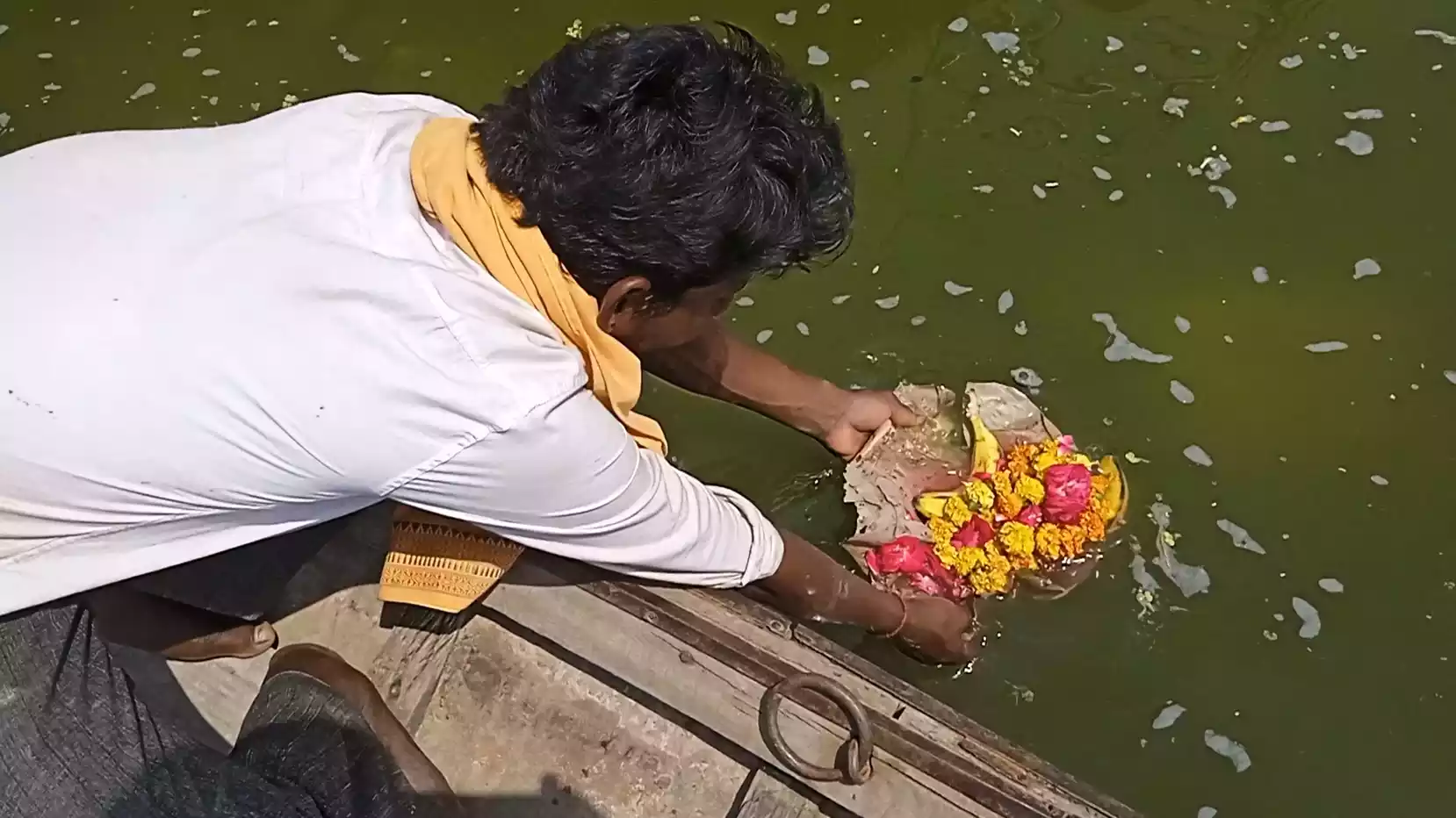
The Tarpan offering is made from water mixed with sesame seeds (til), barley (jau), and kush grass (darbha). Sesame is particularly sacred in Pitr Karma — the Garuda Purana states that sesame is the most pleasing food-offering a son can make to his ancestors, and that it repels negative forces from the ritual space. Barley represents abundance. Kush grass purifies both the performer and the offering.
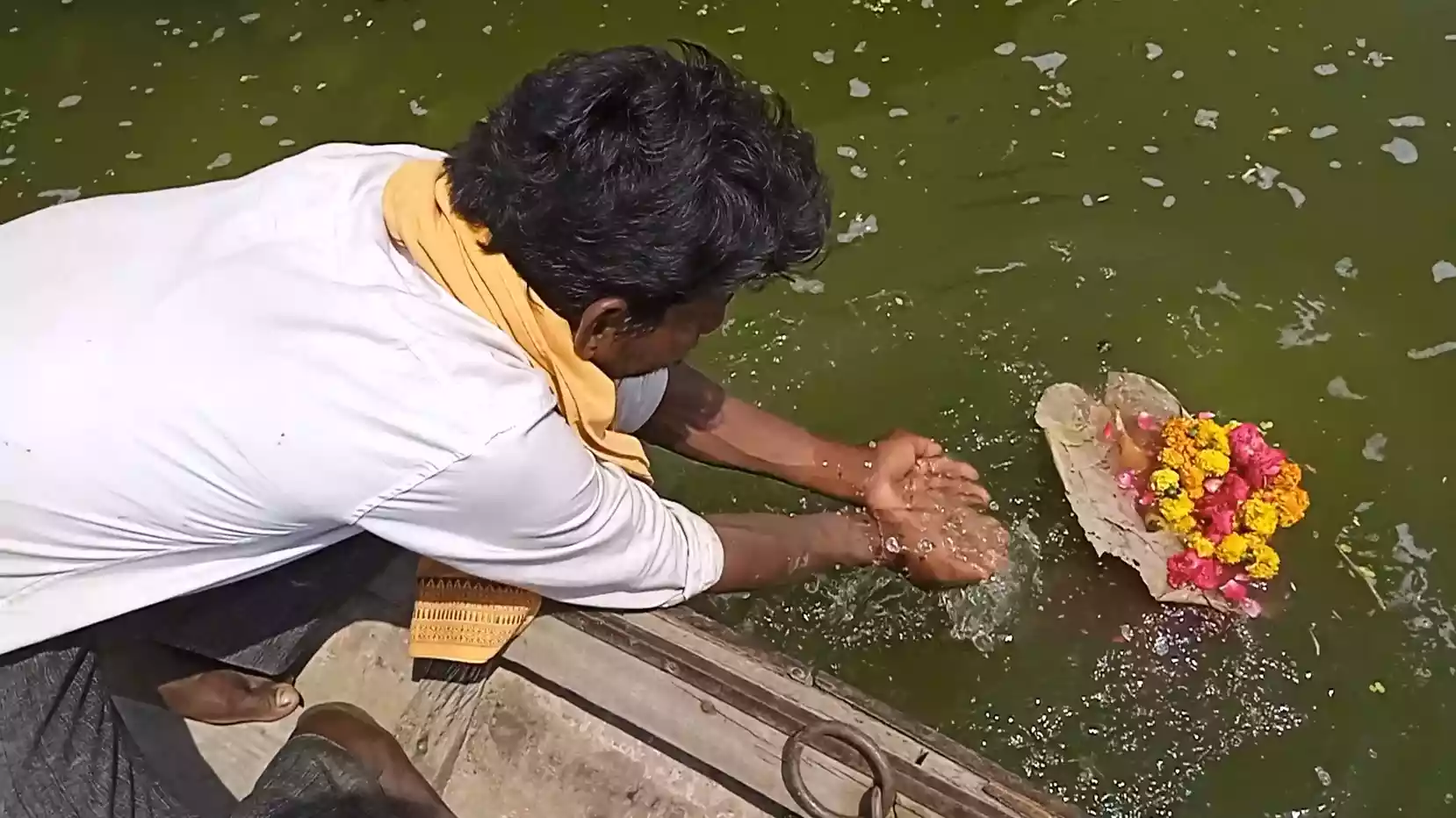
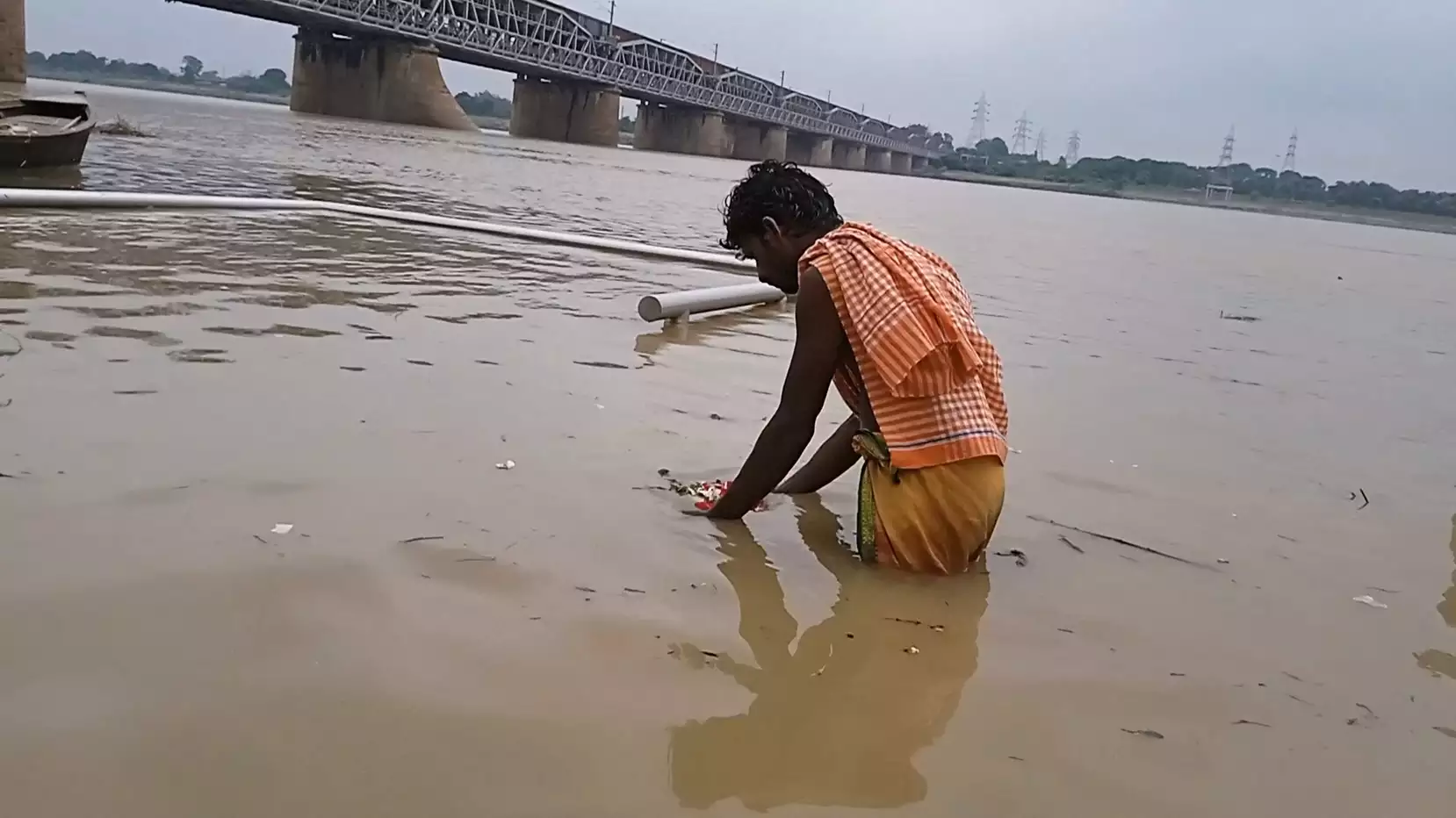
Facing south — the direction of Yama and the realm of the ancestors — the performer cups this water in both palms and allows it to flow through the fingers as an offering to each ancestor by name. The moment the water leaves the hands, it is said in the texts to reach the pitr being honoured, nourishing them wherever they reside between births.
The Pitr Rinn — the debt to one’s ancestors — is among the three foundational debts that every Hindu carries. Tarpan is the primary means of discharging this debt for those who have departed. Neglecting it leaves the ancestors unsatisfied and, according to the Dharmashastra texts, creates what is known as Pitr Dosha — ancestral displeasure that manifests as recurring obstacles in the lives of descendants.
The Kashi Khand of the Skanda Purana — an entire Purana section dedicated to Varanasi — makes a declaration that stands alone in all of Hindu scripture. Lord Shiva says: “In Kashi, I myself whisper the Taraka Mantra — the mantra of liberation — into the ear of every dying soul.” This is the promise that makes Varanasi Kashi: the city where Shiva personally administers the final rite of liberation to every soul that departs within its sacred geography.
This has a direct bearing on Tarpan. When you offer Tarpan in Kashi, you are not simply offering water to the Ganga. You are offering it in the city that is the abode of both Shiva and Parvati, where the Ganga itself flows backward — from south to north, which is considered spiritually significant as the river turning to face the divine source. You are offering it in a city where the entire geography is considered a living deity, where every ghat, every lane (gali), and every stone is imbued with thousands of years of uninterrupted worship.
The Kashi Khand also states that Tarpan performed in Kashi liberates ancestors across fourteen generations — far beyond what most texts ascribe to Tarpan performed at ordinary locations. The concentration of Shiva’s grace in this city acts as a divine multiplier on every act of devotion performed here.
For a deeper understanding of the ghat most intimately connected to death and liberation in Varanasi, read our detailed guide: Manikarnika Ghat — Where Death Meets Divinity.
Varanasi has 84 ghats along the Ganga, each with its own history, deity, and spiritual character. For Tarpan and ancestral rites, certain ghats carry particular significance.
The most central and well-known of Varanasi’s ghats, Dashashwamedh is where Lord Brahma is said to have performed the Dashashwamedha Yajna — ten horse sacrifices — to welcome Shiva back to Kashi. It is a place of extraordinary accumulated merit, and Tarpan performed here benefits from the continued energy of thousands of daily rituals and the famous Ganga Aarti held every evening. For those coming to Varanasi primarily for Tarpan, this is often the first choice.
The most sacred of all Varanasi’s ghats for matters of death and liberation, Manikarnika is where the fires have burned continuously for thousands of years. It is considered the primary cremation ghat of Kashi and is directly associated with Shiva’s promise of liberation. Tarpan performed at Manikarnika is considered to carry the full force of Shiva’s presence and is particularly recommended for souls who may have departed under difficult circumstances or whose liberation is uncertain.
As the name suggests, Panchganga Ghat is the confluence of five sacred rivers — the Ganga, Yamuna, Saraswati, Dhutapapa, and Kirana. Much like the Triveni Sangam at Prayagraj, the convergence of rivers at a single point creates an amplified field of spiritual merit. Tarpan at Panchganga is considered especially effective for reaching ancestors who may not have received proper last rites.
Located at the southern end of the ghat sequence, Assi Ghat is where the Assi river meets the Ganga. It is associated with the goddess Durga and carries an energy of protective strength alongside its ancestral significance.
Our pandit will recommend the most appropriate ghat for your specific situation and the nature of the ancestors you are honouring.
The 15-day fortnight of Pitrupaksha in the Ashwin month (September-October) is the most important period for all ancestral rites. During Pitrupaksha, the ancestors are said to descend toward the earthly realm, and offerings reach them with extraordinary speed and completeness. Varanasi during Pitrupaksha becomes a city of ancestral worship, with ghats filled with families performing Shraddh, Tarpan, and Pind Daan simultaneously. The collective energy during this period is immense.
Each new moon day is considered a day of the pitrs. Regular Tarpan on Amavasya maintains the ancestral connection through the year and gradually dissolves Pitr Dosha. In Varanasi, Amavasya rituals at the ghats are performed in large numbers, creating an atmosphere of concentrated ancestral devotion.
The specific lunar date on which your ancestor departed is considered the most powerful day for individual Tarpan directed to that ancestor. Many families make a point of coming to Varanasi at least once on a parent’s death tithi to perform Tarpan in Shiva’s city.
Makar Sankranti, Ganga Dussehra, and certain other auspicious dates are also considered powerful times for Tarpan. The pandit can advise on the most beneficial timing for your specific circumstances.
Tarpan is traditionally the responsibility of the eldest son, but any member of the family who wishes to honour their ancestors may perform it with the pandit’s guidance. Varanasi is particularly recommended for:
Your pandit will meet you at the designated ghat. After introductions and confirmation of the ancestors to be honoured, you will perform ritual bathing in the Ganga or at minimum achamana — the three-sip purification — to prepare for the ceremony.
The ritual begins formally with the Sankalpa — a declaration in Sanskrit of your name, gotra, location, the current planetary time, and your intention. The pandit recites; you repeat the key phrases. This declaration focuses the ritual’s energy precisely toward your ancestors.
Before reaching the Pitr Tarpan, the ritual first offers water to the gods and to the sages. This is a brief but important preliminary that opens the channel of offering.
Facing south, you cup water with both palms along with sesame, barley, and kush grass. As the pandit recites each ancestor’s name and lineage, you allow the water to flow from your hands. This is done three times for each ancestor, covering the paternal lineage, the maternal lineage, and then teachers and other honoured souls.
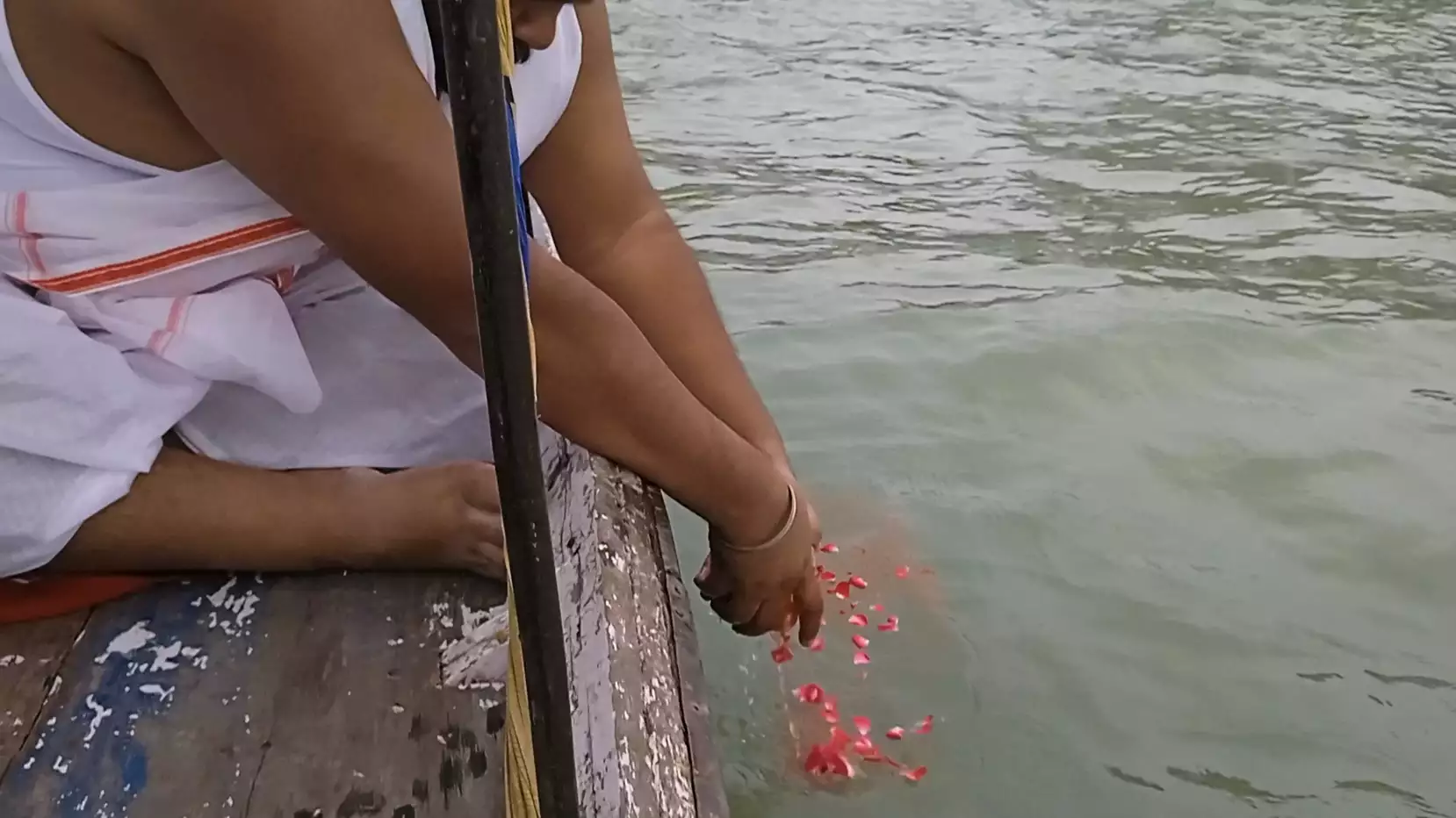
The ritual closes with prayers to Ganga Mata, to Yama, and to Shiva himself — asking Mahadev to bless the departed with liberation and the living with peace. The pandit offers final blessings and the ceremony concludes.
The Kashi Khand is explicit: those who perform Tarpan in Kashi cause their ancestors to ascend immediately to higher realms, regardless of the nature of their karma. This is the grace that Shiva’s presence bestows on this city — a grace that overrides the ordinary accounting of karma when ancestral rites are performed sincerely here.
For the performer, Tarpan in Varanasi generates merit that protects across multiple lifetimes. The Pitr Dosha that underlies so many family difficulties — inexplicable health problems, financial struggles, delayed marriages — begins to dissolve as the ancestors are truly satisfied. Families who regularly perform Tarpan at sacred teerths report a gradual but unmistakable lightening of the burdens they carry.
Home Tarpan on Amavasya is valid and recommended as a regular practice. However, Tarpan at a sacred teerth — and particularly in Kashi, where Shiva’s presence is understood to amplify all ritual actions — generates far greater merit and reaches ancestors with greater force. The Kashi Khand specifically states that one act of Tarpan at Kashi equals millions performed at ordinary locations.
Yes. This is actually one of the most important applications of Tarpan in Varanasi. For souls who departed suddenly, whose cremation was incomplete, or who did not receive proper Shraddh after death, Tarpan in Kashi — particularly at Manikarnika Ghat — is considered among the most effective remedies. Shiva’s promise covers all souls departing in Kashi, and the merit of Tarpan here extends even to those who left before receiving proper rites.
A standard Tarpan pooja takes approximately 30 to 40 minutes. If combined with additional rites such as Shraddh or Pind Daan, the time increases accordingly. Our pandit will give you an accurate estimate when you book.
The ritual is designed for those within the Hindu tradition. However, the spirit of honouring and remembering one’s ancestors is universal. Those from other backgrounds who wish to participate respectfully are welcome, and our pandits are experienced in adapting the ritual framing where appropriate.
Yes. Tarpan and Pind Daan can be performed together for a more complete ancestral rite. Visit our full services page to explore our Varanasi Pitru Karma packages, or speak with our team about a customised ceremony that meets your family’s needs.
Tarpan in Varanasi costs ₹5,100 (regular price ₹7,999). The ceremony is performed at the sacred Ganga ghats of Kashi by an experienced pandit. Covers: pandit fees, complete tarpan samagri, Vedic mantra recitation, water offering ceremony, and documentation. No hidden charges.