Key Takeaways
- Understanding the Sacred Rites at Prayagraj
- Planning Your 2-Night / 3-Day Itinerary for NRI Shradh Puja Prayagraj
- Travel Logistics: Flying from Malaysia to Prayagraj
- Accommodation, Travel, Food & Miscellaneous Expenses
In This Article
For devotees in Malaysia seeking to fulfill their ancestral duties, Prayagraj holds a place of supreme importance. Known as Tirtha Raj (the King of Holy Places), it is one of the most powerful sites for performing Pind Daan, Shradh, and Asthi Visarjan. This comprehensive guide provides detailed information on the scriptural significance of these rites, a practical travel itinerary, and flight logistics for planning a successful NRI shradh puja Prayagraj.
Understanding the Sacred Rites at Prayagraj
Tirtharaja: The Confluence of Divine Energies
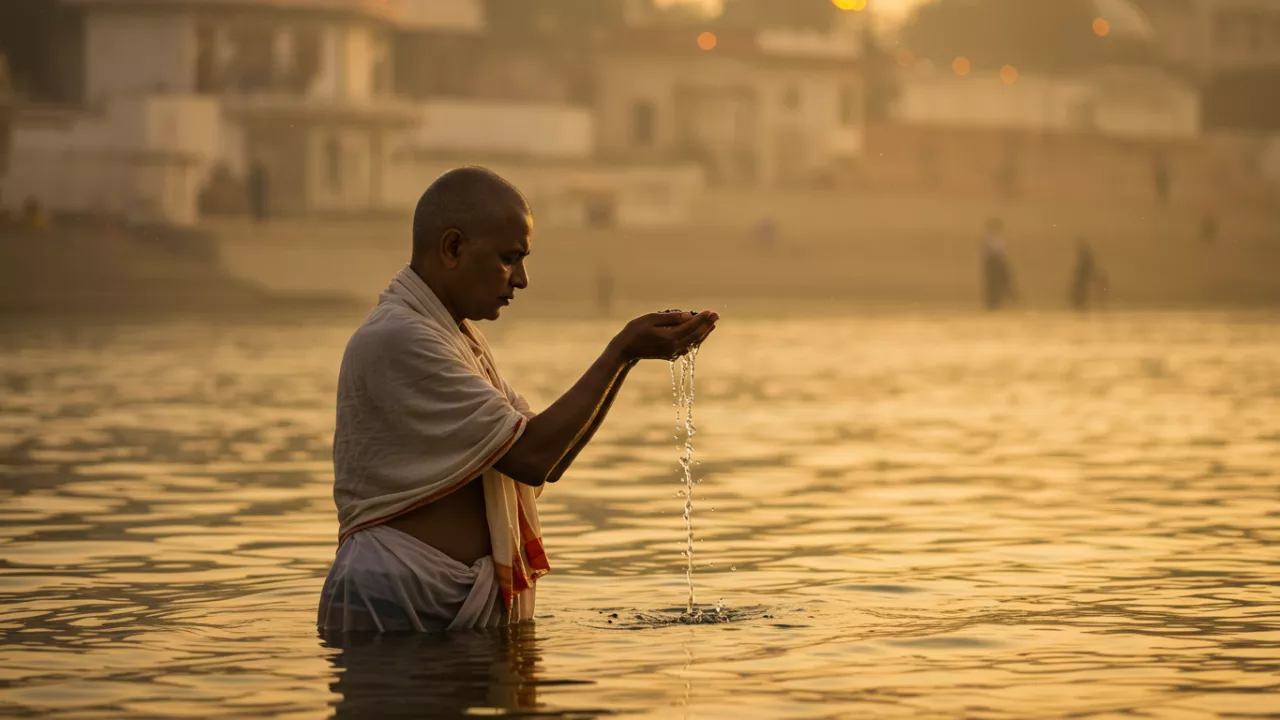
- The power of Prayagraj comes from the sacred Sangam. The Ganga is seen as representing Sattva Guna (purity, light), the Yamuna as Tamas Guna (inertia, darkness), and the unseen Saraswati as Rajas Guna (activity, energy). Their meeting point is a place of profound spiritual equilibrium and immense power.
- The Skanda Purana declares that Prayaga is superior to all other holy spots, even Kurukshetra, and its pilgrimage yields fruit ten times more meritorious. It is where the spiritual energies of Bharat converge.
Akshaya Punya: The Blessing of Undecaying Merit
- This is the key to Prayagraj’s role in the trinity. The Agni Purana states unequivocally that any charity (Daan), ancestral rites (Shraddha), or chanting of divine names (Japa) done at Prayaga yields undecaying merits (Akshaya Punya).
- What does this mean? It means the positive effects of the ritual do not diminish over time. The Punya generated becomes a perpetual spiritual bank account for the ancestors and the family.
- Therefore, performing Ancestral Rituals in Prayagraj ensures that the peace, satisfaction, and positive energy generated for the Pitris are not a temporary boost but a permanent state. It empowers the redemptive acts of Gaya with the quality of eternity. The Sangam’s sacred waters wash away sins and make the benefits of the Shraddha everlasting.
The Core Concept of Shradh
Shradh is the umbrella term for rituals performed with deep faith (shraddha) for the Pitrs (ancestors). The primary goal is to help the soul, which exists as a disembodied and suffering ghost (pret) after death, transition into a venerated ancestor (pitr).
- Ekoddishta Shradh: This rite is performed for a single, recently deceased individual, focusing solely on their passage.
- Parvana Shradh: This is performed for a collective of three generations of ancestors.
- Tirtha Shradh: This is a Shradh performed at a sacred pilgrimage site like Prayagraj. The scriptures state that a Tirtha Shradh yields everlasting and undiminishing spiritual fruits (punya). This is the most powerful form of NRI shradh puja Prayagraj.
- Auspicious Time: The most potent time for these rites is the Pitri Paksha (“fortnight of the ancestors”), the dark half of the month of Ashvin (September-October), when ancestors are believed to be closest to the earthly realm.
Pinda Daan: The Offering of Rice Balls
Pinda Daan is the central act of the Shradh ritual, involving the offering of pindas (balls made of rice, barley flour, or milk solids).
- Dual Purpose: The pindas serve two critical functions. First, they provide spiritual nourishment to the pret on its year-long journey to the ancestral realm. Second, they symbolically construct a transitional body for the soul. It is taught that different ingredients offered form different parts of this new body.
- The Sequence of Offerings: The full sequence involves multiple sets of offerings, often condensed in modern practice.
- Khat Pind (Six Pinds): Offered on the day of cremation at six key locations related to the death and funeral procession.
- Dasgattr Pinds (Ten Body Pinds): Offered over the first ten days to symbolically build the ten parts of the pret’s new body, mirroring the ten lunar months of gestation.
- Uttam Shodashi (Highest Sixteen): Sixteen offerings made on the 11th or 12th day to sustain the soul on its journey.
- Sapindikarana (The Final Union): This is the climactic rite, typically performed on the 12th day, that merges the soul of the recently deceased with the collective of ancestors. It involves ritually combining the pinda of the pret with the pindas of the three preceding generations (father, grandfather, great-grandfather). This rite is crucial, as it elevates the pret to a pitr and allows the chief mourner to resume normal religious duties. A successful NRI shradh puja Prayagraj often incorporates this rite.
Asthi Visarjan: The Immersion of Sacred Remains
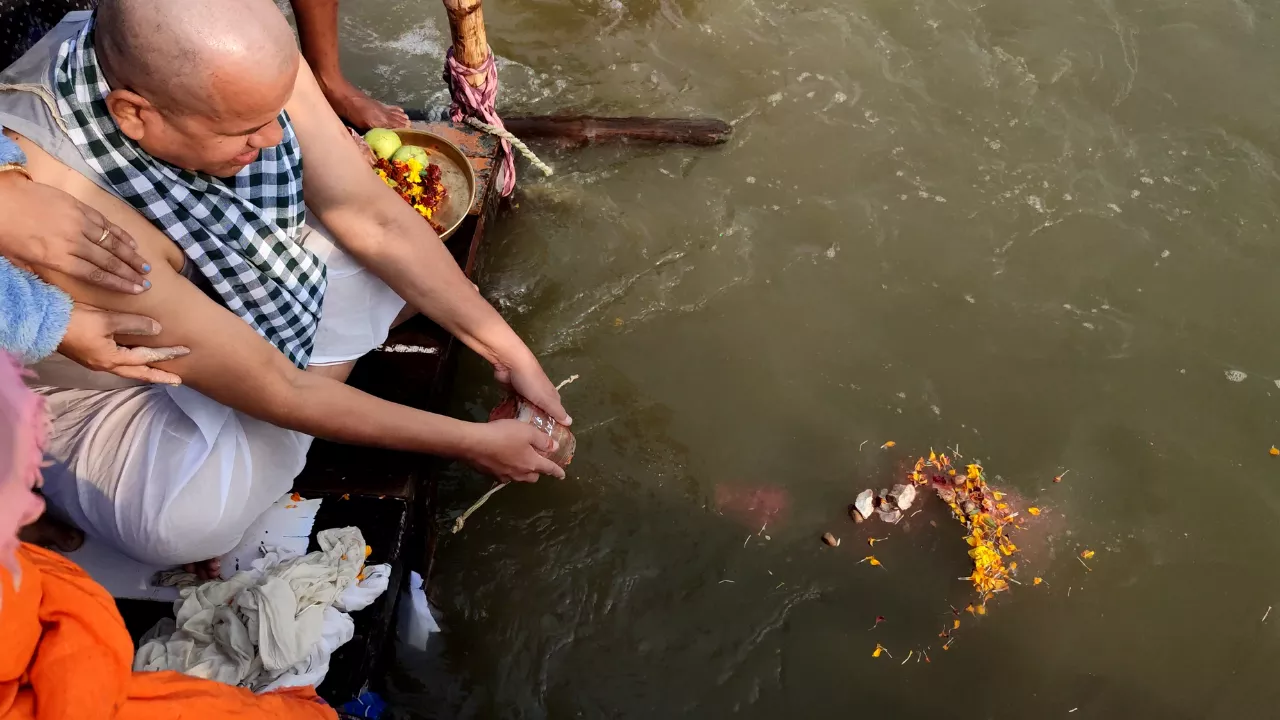
Asthi Visarjan is the final act of returning the physical remains to the elements via holy water.
- Asthi-sanicayana (Collection of Bones): The unburnt bone fragments, respectfully called ‘flowers’ (phul), are collected from the cremation pyre. The day of collection varies by community, but it is typically done on the 4th, 5th, 7th, or 9th day.
- The Immersion Ritual: The chief mourner, after a purificatory bath and often a tonsure (ritual head-shaving), takes the ashes to the holy river. At Prayagraj, this means going to the Triveni Sangam. The priest guides the mourner in prayers, inviting the soul to reside in the holy tirtha before the ashes are immersed. Immersing ashes at the Sangam is believed to grant instant and final liberation, making it a primary objective for any NRI shradh puja Prayagraj.
Notes for Tamil and South Indian Families
While the core tenets of these rituals are universal, there are regional nuances that are respected by the priests at Prayagraj.
- Priestly Lineage: There are priestly communities, such as the Panch Dravids, who have historically specialized in serving pilgrims from South India, ensuring that specific family and regional customs are understood.
- Ritual Variations: South Indian traditions may include specific practices, such as performing the circumambulation of the pyre in an anti-clockwise direction (apsavya or vapradasina), which differs from some North Indian customs.
- Offerings and Gifts: The division of gifts (dan) to the ritual functionaries at the cremation ground (ghats) can also be handled according to specific community traditions.
Planning Your 2-Night / 3-Day Itinerary for NRI Shradh Puja Prayagraj
A focused itinerary is essential for a pilgrimage from Malaysia. This 3-day plan allows for the completion of all necessary rites with devotion and peace of mind.
Day 1: Arrival and Spiritual Acclimatization
- Morning/Afternoon: Arrive at Prayagraj’s Bamrauli Airport (IXD). You will be met by a pre-arranged service for transfer to your hotel.
- Evening: After settling in, visit the banks of the Triveni Sangam. Spend time in quiet contemplation, absorbing the spiritual energy of the confluence. This prepares you mentally for the rituals of the following day. This initial step is vital for a meaningful NRI shradh puja Prayagraj.
Day 2: The Day of the Sacred Rites
- Early Morning: Begin the day with a purificatory bath. Proceed to the designated area at the Triveni Sangam where you will meet your assigned priest (pandit).
- Morning Rituals: The priest will guide you through the primary ceremony. This will be the Pinda Daan, Tirtha Shradh, or Asthi Visarjan ritual, depending on the purpose of your visit. All necessary materials (samagri) will be arranged. This ritual is the core of your NRI shradh puja Prayagraj.
- Afternoon: After the rites are completed and you have offered daan (charity), you can proceed for darshan at other important temples. This includes:
- Bade Hanuman Ji Temple: Visit the unique temple with the reclining statue of Lord Hanuman.
- Alopi Devi Shanktipeeth: A revered temple where a part of Goddess Sati is believed to have fallen.
- Anand Bhawan & Swaraj Bhawan: Explore the ancestral homes of the Nehru family, now museums of historical importance.
- Evening: Return to your hotel for rest and reflection. This day marks the successful completion of your main duty.
Day 3: Final Prayers and Departure
- Morning: After breakfast, you may choose to revisit the Sangam for final prayers or to collect holy Ganga water to take back home.
- Afternoon: You will be transferred to Prayagraj Airport (IXD) for your flight, concluding your spiritually fulfilling NRI shradh puja Prayagraj. This focused plan ensures that your NRI shradh puja Prayagraj is conducted without stress.
Travel Logistics: Flying from Malaysia to Prayagraj
Arranging travel is the first practical step for your NRI shradh puja Prayagraj. Since there are no direct flights from Kuala Lumpur (KUL) to Prayagraj (IXD), you will need to book a connecting flight.
Flights from Malaysia to Prayagraj
| Booking Service | Airline(s) | Price Range (RM) | Booking Link |
|---|---|---|---|
| Skyscanner | AirAsia X, IndiGo | RM 961 – RM 2163 | Link |
| MakeMyTrip | IndiGo | RM 1009 – RM 2540 | Link |
| GoIbibo | IndiGo | RM 986 – RM 2403 | Link |
| EaseMyTrip | Multiple carriers | RM 1177 | Link |
| ixigo | Multiple carriers | RM 937 – RM 2019 | Link |
Airlines and Common Routes
- Major Airlines: The most frequent carriers on this route are IndiGo, AirAsia, Vistara, Air India, and Malaysia Airlines.
- Common Stopover Hubs: Your flight from Kuala Lumpur will connect through a major Indian city. The most common and convenient hubs for reaching Prayagraj are:
- New Delhi (DEL)
- Mumbai (BOM)
- Bengaluru (BLR)
- Total Journey Duration: Depending on the airline and the layover time, your total travel time will likely be between 10 and 18 hours.
Booking Tips for Your Flight
- Book in Advance: To secure the most reasonable fares for your NRI shradh puja Prayagraj, it is highly recommended to book your flights at least 2 to 3 months before your intended travel date.
- Compare Airlines: Use online travel portals to compare prices across different airlines. Sometimes, booking separate tickets (e.g., KUL-DEL and DEL-IXD) can be more economical, but ensure you leave ample time for the connection.
- Travel Light: For a short, focused pilgrimage, traveling with only cabin baggage can make transfers smoother and quicker.
By carefully planning the rituals, itinerary, and travel, your pilgrimage to perform this most sacred of duties will be a peaceful, focused, and spiritually rewarding experience. The completion of an NRI shradh puja Prayagraj brings immeasurable blessings to both the ancestors and their descendants.
Accommodation, Travel, Food & Miscellaneous Expenses
These are the average prices which can help you in giving a complete idea about the expenses. Please note, prices may vary from city to city.Accommodation
- Budget Guesthouses/Dharamshalas: RM 70 – RM 120 per night
- Mid-range Hotels (2-3 star): RM 150 – RM 220 per night
- Luxury Hotels (4-5 star): RM 340-800 per night
Local Transportation
- Inter-city Travel (Private Car): RM 330 – RM 500 per day
- Within the City (Auto-rickshaws): RM 40 – RM 70 daily
Food (Bhojan)
Estimated Daily Budget: RM 25 – RM 60 per person for wholesome meals.
Miscellaneous Expenses: Daan, Dakshina, and Souvenirs
Budget at least RM 150 – RM 350 for additional charity and personal expenses.
Final Word
Remember that while these numbers help you plan, the true offering is your shraddha—your faith, sincerity, and devotion. The ancestors do not look at the amount of money spent; they feel the love in your heart and see the purity of your effort.
Plan your journey well so your mind is at ease. Choose a path that is comfortable for you and your family. Once you are here, at the banks of the Ganga or on the soil of Gaya, let your heart do the talking. Your presence, your prayers, and your remembrance are the most precious Pind Daan of all.
May your pilgrimage be blessed and fulfilling.
Hari Om.
🙏 Book Online Puja from Abroad
Book Your Sacred Ritual
Authentic ceremonies performed by Veda-trained pandits at sacred sites across India.