Key Takeaways
- How many brahmins, by ceremony
- How the ancestors are held to receive it
- What to cook, and what must not be served
- When it falls in the cycle
In This Article
Brahmin bhoj is the feeding of brahmins in an ancestor’s name, and the number is smaller than most families assume: the Manu Smriti sets a maximum of three for the thirteenth-day rite, and one devout brahmin is enough where three is not possible. Larger numbers belong to the barsi and to Pitru Paksha, not to the days immediately after a death. This page gives the number for each ceremony, the menu, the dakshina, and what it costs at a tirtha.
How many brahmins, by ceremony
The number varies because different rites address different classes of ancestor. It is prescribed, not a matter of generosity, and more is not better — inviting beyond the prescribed number for an ekoddishta rite is simply not what that rite is.
| Ceremony | Prescribed | The minimum, and what the number is doing |
|---|---|---|
| Terahvi, the 13th day | 1–3 | One devout brahmin where three is not possible. A maximum of three per the Manu Smriti — the rite is dedicated to the newly deceased alone, and more is not prescribed |
| Monthly masik shradh | 1–3 | One is sufficient. Twelve of these fall in the first year, so the number is kept low by design |
| Barsi, the first anniversary | 5–11 | An odd number, by the family’s capacity. The Garuda Purana asks for many to be fed here specifically, because this is the rite that moves the departed into the ancestors |
| Pitru Paksha and Sarva Pitru Amavasya | 5–11 | Addressed to all the ancestors together rather than one. Odd numbers again |
How the ancestors are held to receive it
The reasoning behind the rite is specific rather than vague, and it is worth understanding because it explains every rule that follows. The Garuda Purana describes the departed in this period as occupying a subtle form made of prana — a body with appetite and the capacity to suffer, but no mouth to eat with. The food cannot be taken directly.
So it is routed. The invited brahmin, once seated and honoured within the rite, becomes the channel: the offering is made to him and its essence is held to reach the ancestor through him. The texts put it plainly — the ancestors eat through the mouth of the brahmin. That is the whole mechanism, and it is why the quality of the brahmin and of the food are treated as part of the ritual rather than as hospitality.
What to cook, and what must not be served
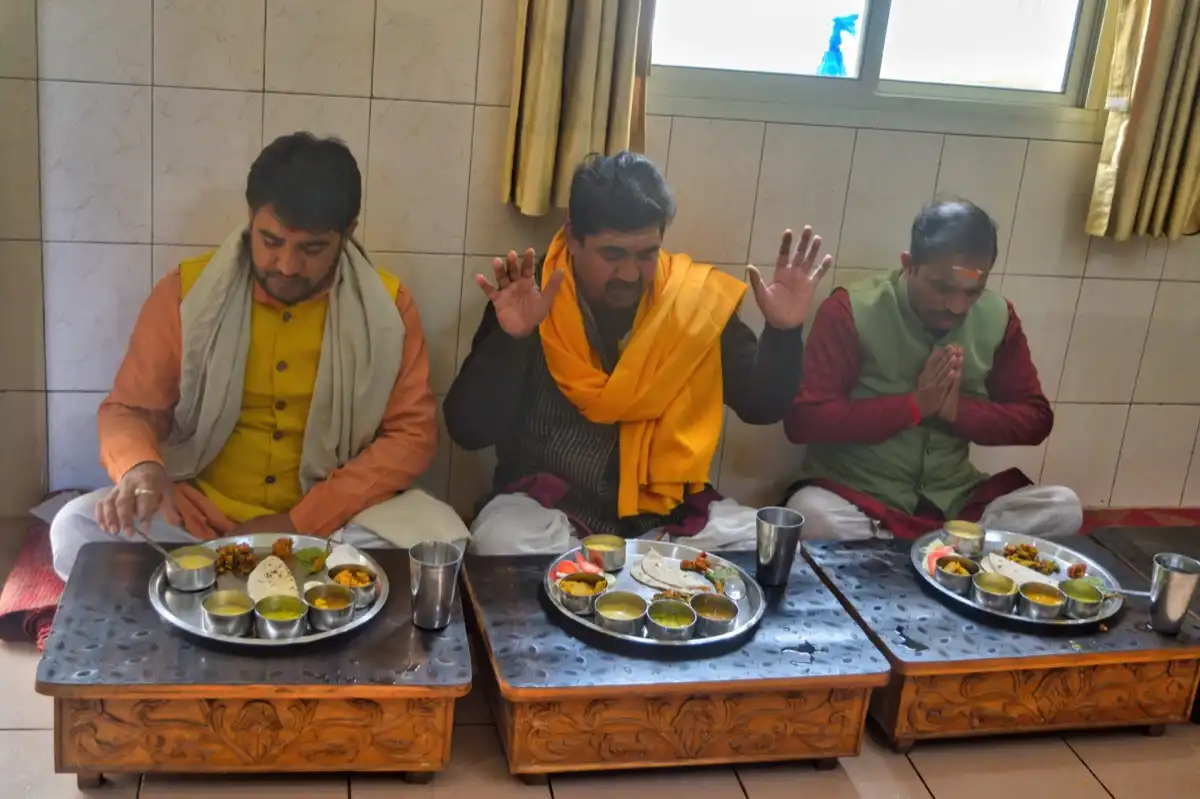
The menu is sattvic and freshly made. Kheer above all — the Garuda Purana singles out payasam as most pleasing to the ancestors — with rice, dal, seasonal vegetables, ghee, and black sesame worked in somewhere. Nothing should be more than about three hours old when it is served.
Not served at any shradh meal: onion and garlic, named in the Manu Smriti; masoor dal and arhar dal, under the Vishwamitra Smriti prohibition; black salt; brinjal, radish and drumstick; and meat, fish and eggs.
The texts are firm that incorrectly prepared food does not carry — the offering made is not the offering received. Read that as a reason to cook carefully rather than as a reason to cook expensively. Plain rice and kheer, made properly by someone in the family, does everything the rite asks. An elaborate meal made carelessly does not.
When it falls in the cycle
Day thirteen, the terahvi, is the one that is not optional — it closes the main mourning and the bhoj is part of how it closes. Monthly through the first year, alongside each masik shradh, in the smallest form. At the barsi, which is the largest of them and where the Garuda Purana specifically asks for many to be fed. And during Pitru Paksha, offered to all the ancestors at once rather than to one.
Dakshina — what is given before they leave
The meal alone does not complete the rite. Each brahmin is given dakshina before leaving, and in the fuller form the Garuda Purana names for ancestral rites: a new set of clothing, brass or copper vessels, an umbrella, and bedding. These stand for the comforts the departed is held to need, given through the brahmin as proxy.
The amount is not fixed anywhere and depends on the family’s means. What matters is that it is given willingly and before they leave, not haggled over afterwards — where we arrange the bhoj, dakshina is inside the price you were quoted and nothing is asked for on the day.
Who qualifies to be invited
The Vishwamitra Smriti sets conditions, and they are about competence and conduct rather than status. A brahmin fit to be invited keeps daily sandhyavandanam, knows at least the basic ancestral mantras, does not take dakshina from an unclean livelihood, and is not carrying an infectious illness on the day.
The disqualifications are more pointed, and worth reading as what they are — an old warning against exactly the thing families still run into. The text rules out those who sell the Vedas commercially, and those who perform rites for money without genuine learning. If someone at a ghat offers to supply brahmins for your bhoj at a price and cannot say what will be recited, that is the person the Smriti is describing.
On mrityu bhoj, and not going into debt for it
This needs saying on a page like this one. In much of north and western India the death feast — mrityu bhoj — has grown into something the scriptures do not describe: a village-scale meal for hundreds, held in the days after a death, often paid for with borrowed money by a family that has just lost its earner. Several states have campaigned against it for decades. The criticism is sound.
It is worth being clear that this is custom, not scripture. The Manu Smriti caps the thirteenth-day rite at three brahmins. Not three hundred, and not the community. The table at the top of this page is the scriptural position, and the gap between it and a four-hundred-person feast is the gap between what is prescribed and what social pressure has added.
None of which is an argument against brahmin bhoj. It is an argument for doing the rite the texts actually prescribe, at a scale the family can carry, with the attention put into the quality of the food and the competence of the person reciting rather than into the headcount. Why the rite matters at all is covered separately in why brahmin bhoj is considered so important.
At the tirthas, and what it costs
Performed at a tirtha the bhoj is folded into the shradh rather than booked on its own, and these are what we charge. Each figure covers the puja, the brahmins, the meal, dakshina and the ghat arrangements — nothing is added on the day.
| Where | Price | What it includes |
|---|---|---|
| Prayagraj, Triveni Sangam | ₹21,000 | Complete shradh puja with five brahmin bhoj and dakshina, and a live video link. Regular price ₹31,000 |
| Gaya, with pind daan | ₹14,500 | Pind daan at the 48 ritual sites followed by brahmin bhoj, with video streaming. Regular ₹16,500 |
| Haridwar, Har Ki Pauri | ₹24,999 | Complete Haridwar pind daan with five pandits, full brahmin bhoj and prasad dispatch. Regular ₹31,999 |
| Garh Mukteshwar | ₹21,000 | Shradh puja, pind daan and brahmin bhoj at the Ganga ghats. The usual choice from Delhi NCR. Regular ₹25,000 |
Which tirtha depends on what the family is seeking. Prayagraj where the death was natural and the family wants the ancestor carried forward — the Matsya Purana holds shradh there to be ten times what it is elsewhere. Gaya where the aim is moksha, which is what the Vishnupada rite is for. Garh Mukteshwar where travel is the constraint and the Ganga is still wanted.
🙏 Shradh with Brahmin Bhoj at the Sangam
- Five brahmins invited, fed and given dakshina — all inside the price
- The full sattvic menu, cooked fresh on the day to the prescribed rules
- Complete shradh puja with sankalpa, pinda and tarpan
- Live video link and a written record for families who cannot travel
Families settled abroad have the bhoj performed in their name with a video link for the sankalpa and photographs afterwards — NRI puja services sets out how that works. If an ancestor has gone years without rites and you are unsure whether a bhoj alone is what is owed, tell us the circumstances; sometimes the answer is something else entirely, and a pandit will say so rather than sell you this.
Book Your Sacred Ritual
Authentic ceremonies performed by Veda-trained pandits at sacred sites across India.