No rituals selected yet.
Browse Pooja Packages →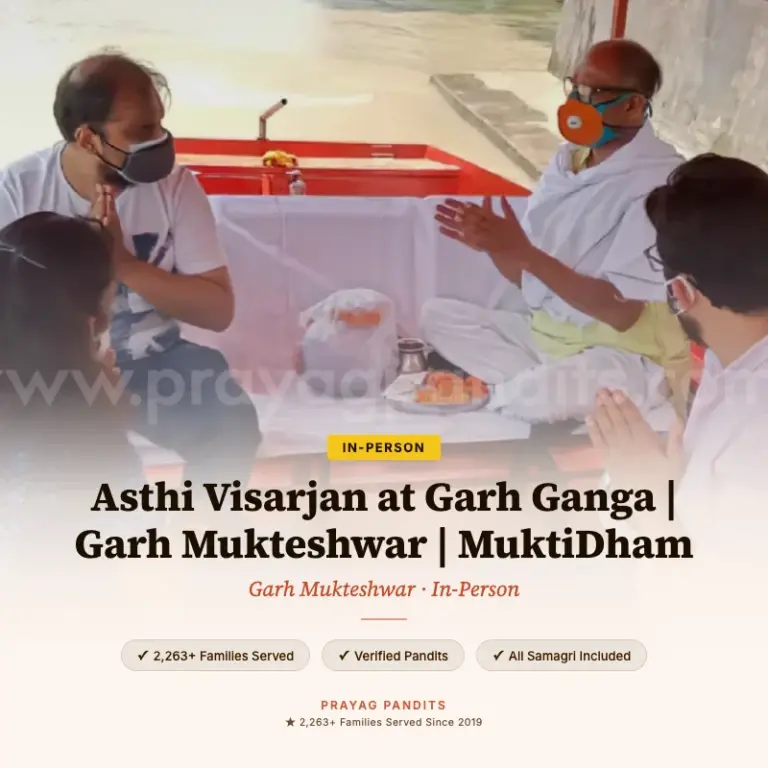 Save 28%
Garh Ganga | Garh-Mukteshwar
Asthi Visarjan at Garh Ganga
Experienced Tirth Purohit at Garhmukteshwar Complete samagri (til, barley, kusha, tulsi, flowers,...
from
₹5,100
₹7,100
The Garuda Purana Preta Khanda prescribes bone immersion before the 10th day after cremation. The Mahabharata Vana Parva names the Brij-Ganga among the Gangetic visarjan tirthas, anchored on the Mukteshwar Shiva temple. Garh-Mukteshwar is the closest major Ganga ghat for Delhi-NCR families — same-day distance keeps the rite within the scriptural window.

Tell us your situation — we will suggest the package that fits the family. No booking pressure; we will explain the choice on WhatsApp first if needed.
Every package includes an experienced Vedic pandit and the required puja samagri. The difference is in boat, location, stay, and tradition.
Save 28%
Experienced Tirth Purohit at Garhmukteshwar Complete samagri (til, barley, kusha, tulsi, flowers,...
 Save 28%
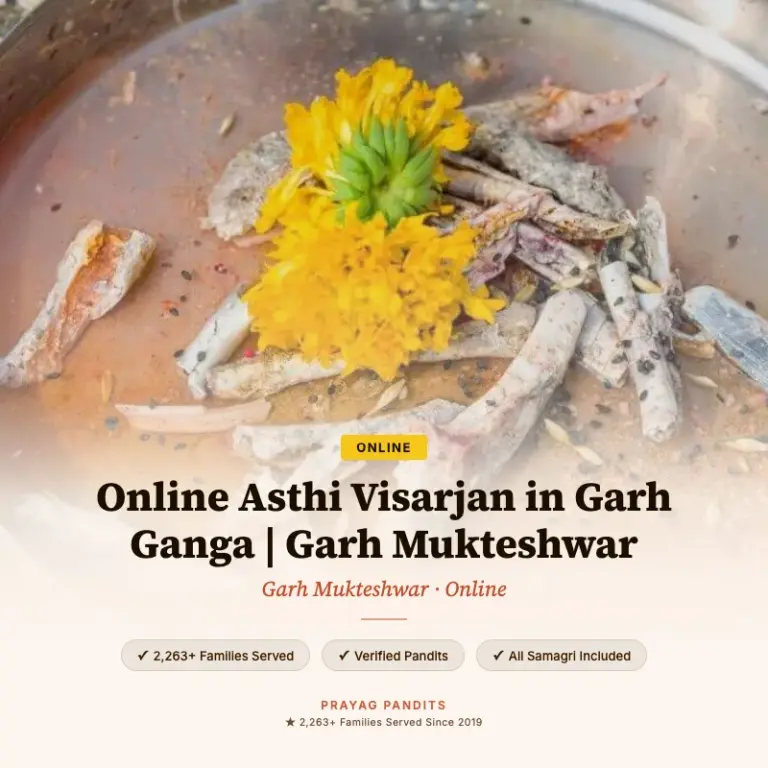
Online Asthi Visarjan at Brij Ghat, Garh Mukteshwar Experienced pandit at Brij...
No packages match this filter. Talk to a family advisor →
What's included
We've seen too many families face hidden boat fees, samagri costs, and "dakshina" pressure on the day. Here's exactly what's covered, and what isn't.
Included
Tirth Purohit qualified in the Garh-Mukteshwar asthi-visarjan tradition, with gotra-pravara verified. The Brahmins of the Brij-Ganga ghat lineage carry the Vedic instruction required for the visarjan Sankalpa, the prescribed asthi-immersion mantras, and the post-immersion Prayaschitta where applicable.
Included
Til, kusha, gangajal, kalash, white cloth, dhoop, sindoor, sandalwood, kshira — all the materials prescribed for the asthi-visarjan vidhi, prepared in advance and ready before the family arrives at the ghat.
Included
Optional upgrades: Brij-Ganga boat upgrade carrying the immersion to the central Ganga current (extra), Mukteshwar temple darshan as the closing devotional act, combined asthi-visarjan + shradh + tarpan day-trip packages for families completing multiple ancestral rites on the same visit.
Included
One person on WhatsApp through your entire booking — fluent in Hindi, English, and major regional languages — before and after the ceremony. Available for last-minute timing adjustments given the asthi-visarjan day-10 window urgency.
Included
WhatsApp message from the pandit the same evening of the ceremony, with details of all offerings made on your behalf, the visarjan moment, and the Prayaschitta performed if applicable for late asthi.
Included*
Direct vidhi at the Brij-Ganga ghat — the primary Brij-area asthi-visarjan location held in long sthala-parampara tradition (no specifically-named Puranic catalogue entry per NLM 2026-05-20 verification). The Mukteshwar Shiva temple complex is the central anchor; many families combine the visarjan with a Mukteshwar temple darshan before or after the ghat rite.
Not included
Road travel (3-4 hours from Delhi NCR via NH-9 / Eastern Peripheral Expressway). No direct rail/air — closest rail is Garh Junction; closest airport is Delhi IGI. We can recommend trusted operators for the day-trip itinerary.
Not included*
Most families perform Garh-Mukteshwar asthi-visarjan as a same-day trip from Delhi NCR — the proximity advantage is the city's practical-accessibility value. Stay-inclusive options available on request for families coming from outside the NCR region.
Not included
We coordinate the asthi-visarjan rite only; cremation is conducted separately at your local cremation ground before the family travels. The Brij-Ganga visarjan is the post-cremation immersion of the collected asthi.
Step 03 · How it works
From your first call to same-day confirmation — we handle every coordination, so the family can focus on what matters.
Choose a package and complete payment online. Our team calls within 2 hours to confirm details. For families within the Garuda Purana day-10 window, we prioritise same-day or next-day slots.
~ 5 minutes
Provide gotra, the departed soul's name, cremation date, the date the asthi was collected (Day 3/7/9 per the Garuda Purana Preta Khanda), and any special vidhi requirements. Late-asthi cases get the Prayaschitta added automatically.
~ 10 minutes
Pandit performs the complete asthi-visarjan vidhi at the Garh-Mukteshwar Ganga ghat — Sankalpa, mantra recitation per the asthi-immersion vidhi, samagri offering, and immersion of the asthi in the Brij-Ganga at the ghat (boat upgrade to central current available as add-on). Optional Mukteshwar temple darshan as the closing devotional act.
45–120 min
Pandit sends a same-evening WhatsApp confirmation with offerings detail. Photos and video available as opt-in add-ons (default for the Online variant). For Online: gangajal couriered within 5-7 days.
Same day
When to perform
The Garuda Purana Preta Khanda prescribes bone collection on the 3rd, 7th, or 9th day after cremation, with immersion before the 10th. At Garh-Mukteshwar — the primary Brij-area Gangetic asthi-visarjan tirtha, named in the Mahabharata Vana Parva's Tirthayatra catalogue and anchored on the Mukteshwar temple — the visarjan carries the universal Ganga-water purification merit (Padma / Agni Purana doctrine) combined with the practical-accessibility of a same-day Delhi-NCR trip. For asthi preserved beyond this window through inherited custody, NRI distance, or partition-era displacement, a short Prayaschitta (expiation) rite restores the offering and the visarjan carries full merit at any time of year. Garh-Mukteshwar is not in the moksha trinity — for the highest single-verse Mahatmya merit, see our asthi-visarjan pages for Prayagraj, Varanasi, or Haridwar.
Performed by Tirth Purohits at Triveni Sangam since 2019
Two ways to perform
Performed by your own hands at the Brij-Ganga ghat under a Garh-Mukteshwar Tirth Purohit — pandit recites the visarjan vidhi mantras; the karta releases the asthi into the Brij-Ganga at the ghat. Optional boat upgrade carries the immersion to the central Ganga current. Optional Mukteshwar temple darshan as the closing devotional act.
Starts at ₹5,100
For families abroad or unable to travel. Sankalpa recited remotely; pandit performs the asthi-visarjan at the Brij-Ganga ghat with live video proof; gangajal couriered to the family after the rite. The Angirasa Smriti and Nirnaya Sindhu Pratinidhi-nirnayah describe Pratinidhi Karma (authorised-pandit rite-by-proxy) as fully valid.
Starts at ₹5,100
Complete guide
An editorial reference covering the ritual, the place, eligibility, timing, and what to keep ready — written for families weighing the decision.
Select your package and complete booking. Our team calls within 2 hours to confirm details.
Provide your gotra, departed soul's name, and any special requirements.
Experienced pandit performs the complete ceremony at the sacred site.
The family receives ceremony updates on WhatsApp after completion.
Garh-Mukteshwar is the primary Brij-area Gangetic asthi-visarjan tirtha — the closest major Ganga ghat for families in Delhi-NCR, Western UP, Haryana, and the Brij belt. The Brij-Ganga stretch carries a long sthala-parampara tradition of ancestral rites — note: this is folk and pilgrimage tradition rather than a specifically-named Puranic prescription per NLM 2026-05-20 verification. The city is named after the Mukteshwar Shiva temple ("Mukteshwar" = lord of liberation), the central anchor of the local Shaiva tradition. The Padma Purana (Srishtikhanda Chapter 62) and Agni Purana (Chapters 110 and 112) establish the universal Ganga-water purification doctrine: water and offerings into any Ganga current carry the ancestral-elevation merit and the ash-purification effect described therein. Garh-Mukteshwar is not in the moksha trinity (Prayagraj / Kashi / Gaya) or in Sapta Puri — it is a regional Gangetic tirtha valued for its same-day Delhi-NCR accessibility, especially critical given the Garuda Purana Preta Khanda's day-10 window urgency.
The eldest son holds the first authority to conduct asthi-visarjan with Sankalpa and immersion per the Garuda Purana Preta Khanda. After marriage, the son performs the rite with his wife. If the eldest son is deceased, the younger son carries out the visarjan. In the absence of a son, the grandson (son's son); in the absence of male issue, the brother; if the departed had only daughters, the daughter's son holds the right. In modern practice, when no male issue is available, daughters and daughters-in-law perform the full rite under Tirth Purohit guidance and the rite is fully valid per the Angirasa Smriti and Nirnaya Sindhu Pratinidhi-nirnayah on Pratinidhi Karma.
Asthi Visarjan at Garh-Mukteshwar is performed at the Brij-Ganga ghat — the city's main ancestral-rite location on the Ganga banks. The Mukteshwar Shiva temple, from which the city takes its name, is the central darshan-anchor; many families combine the visarjan with a Mukteshwar temple darshan before or after the ghat rite. For families who prefer the central Ganga current (the deepest stream of the river), a boat from the ghat is available as a package add-on; the asthi is released into the current with the prescribed mantras.
The Garuda Purana Preta Khanda prescribes asthi-visarjan within the 10-day window after cremation — specifically, bone collection on day 3, 7, or 9, with immersion before day 10. This is the scriptural ideal. For asthi preserved beyond the 10-day window through migration, war, or generations — a common situation for NRI families and historical asthi held by Delhi-NCR families — a short Prayaschitta (expiation) rite is added at the start of the visarjan, restoring the offering and the rite carries full merit at any time of year. Garh-Mukteshwar's 3-4 hour same-day-trip distance from Delhi NCR is the critical practical advantage for the day-10 window urgency.
Three related but doctrinally distinct rites at the same Brij-Ganga ghat. Asthi Visarjan is the one-time post-cremation rite — immersion of the collected bones in the Ganga per the Garuda Purana Preta Khanda day-10 window. Shradh is the annual ancestral institution — tarpan + dakshina + Brahmin Bhoj on the death-anniversary Tithi and during Pitrupaksha. Pind Daan is the pinda-offering rite. At Garh-Mukteshwar, many Delhi-NCR families perform asthi-visarjan immediately post-cremation, then return annually for shradh + tarpan during Pitrupaksha. See our Shradh at Garh-Mukteshwar and Pind Daan at Garh-Mukteshwar pages.
Late asthi is fully accepted at the Brij-Ganga ghat with a Prayaschitta (expiation) rite added at the start of the visarjan. The Garuda Purana Preta Khanda day-10 window is the scriptural ideal but not an absolute deadline — the dharmashastra tradition has always provided for delayed rites through Prayaschitta, recognising that war, migration, NRI distance, or inherited asthi from previous generations make timely immersion impossible. The Prayaschitta is performed by the Tirth Purohit before the main Sankalpa; the visarjan then carries full merit. We have performed visarjan for asthi held by families across generations, including partition-era inherited kalashas and NRI families returning years later — the rite is valid; the merit is whole.
Most Delhi-NCR families drive directly from the cremation ground (or their home, if the kalash is being held) to Garh-Mukteshwar — the 3-4 hour journey via NH-9 / Eastern Peripheral Expressway is feasible as a same-day round trip. We coordinate the timing with the Brij-Ganga ghat slot so the family arrives, performs the rite, and returns in a single day. For families without their own vehicle, we recommend trusted day-trip operators familiar with the asthi-kalash sanctity protocols (the kalash should travel covered, on the lap of a family member or in a designated front-seat position, not in the boot). For families coming from outside the NCR region or unable to travel, the Online variant is the fully-valid Pratinidhi Karma alternative.
A rare but real scenario — when the death is in late August or early September, the Garuda Purana day-10 window may overlap with Pitrupaksha (Sep 26 — Oct 10, 2026). In this case, the asthi-visarjan takes scriptural priority and is performed first at the Brij-Ganga ghat; the shradh + tarpan can then be performed on the same day or scheduled for the subsequent Pitrupaksha tithi. Many families combine the rites in a single Garh-Mukteshwar day-trip, completing asthi-visarjan in the morning and shradh + Brahmin Bhoj in the afternoon — both rites carry independent scriptural merit. See our Shradh at Garh-Mukteshwar page for the shradh-specific schedule.
Yes. Online Asthi Visarjan is performed by a Brij-Ganga Tirth Purohit at the Garh-Mukteshwar ghat with live video proof — the karta recites Sankalpa remotely (over Zoom or WhatsApp), and the purohit, acting as Pratinidhi (authorised proxy), performs the asthi-immersion vidhi with the prescribed mantras and releases the asthi into the Brij-Ganga on the karta's behalf. The immersion moment is shown on video, and gangajal is couriered to the family after the rite. The Angirasa Smriti and the Nirnaya Sindhu (Pratinidhi-nirnayah, citing Skanda Purana and Katyayana) describe Pratinidhi Karma — a rite performed by an authorised pandit on the family's behalf, anchored on the karta's sincere Sankalpa — as fully valid when physical presence is impossible. For NRI families holding inherited asthi or who cannot travel within the Garuda Purana day-10 window, online visarjan with Prayaschitta is the canonically-grounded alternative. Online Asthi Visarjan at Garh-Mukteshwar is priced at ₹7,100, the same as the in-person variant.
Both cities are valid Gangetic asthi-visarjan tirthas with different profiles. Haridwar is in the moksha-class register: the Skanda / Agni / Garuda / Vayu Puranas all name Har-ki-Pauri as Gangadvara (R33 doctrine), and the Sapta Puri shloka names Mayapuri (Haridwar) among the seven moksha cities. Haridwar carries higher single-verse Mahatmya merit and is the doctrinally stronger choice when family logistics allow. Garh-Mukteshwar is the practical-accessibility choice: 3-4 hours from Delhi NCR vs Haridwar's 5-6 hours, making same-day visarjan feasible within the Garuda Purana day-10 window — a window that often constrains families with urgent post-cremation logistics. The same Ganga flows through both. We recommend Haridwar where logistics permit and Garh-Mukteshwar when the day-10 window or family travel constraints make the closer ghat necessary. See our Asthi Visarjan in Haridwar page for the higher-Mahatmya alternative.
Drawn from puranic references and pandit consultations — for families who want to understand the ritual's meaning before booking.
Voices from families
The team was very sensitive to our emotions during this difficult time. The pandit performed every ritual with care and explained the significance in simple language. Truly grateful for this service.
Booked online Asthi Visarjan from Canada. The team arranged everything perfectly. We watched the entire ceremony via video call. It was emotional but the pandit's prayers brought comfort to the whole family.
Being abroad makes it difficult to perform these rituals in person. The online asthi visarjan option was perfect for our family. We could participate from three different countries via the video call. 🙏
First time booking online for a religious ceremony. Was skeptical but the service exceeded expectations.
Booked this service for my uncle's asthi visarjan. Everything was arranged from our pickup at the station to the ceremony at the ghat. Smooth and hassle-free experience.
Frequently asked
Compiled from 2,263+ family conversations on WhatsApp and over the phone.
Garhmukteshwar is one of the 14 most sacred Asthi Visarjan sites in India, specifically praised in the Skanda Purana and Brahma Purana. The name "Garh Ganga" refers to the ancient fort (garh) where the Ganga first enters the plains — making it the westernmost point where Ganga water retains its Himalayan purity. The site is believed to be where King Bhagirath first performed ancestral rites for his 60,000 cursed ancestors (the story of Ganga's descent). The adjacent Mukteshwar Mahadev Temple is said to be the spot where Shiva himself accepted the Ganga on his head. Asthi Visarjan at Garh Ganga is considered especially powerful for families in North India who cannot travel to Varanasi or Prayagraj — the spiritual merit is considered equivalent.
Brijghat is the primary and most famous ghat at Garh Ganga (Garhmukteshwar), named after Lord Krishna (Brij = Vrindavan region) who is believed to have visited the spot. It is the widest and most accessible ghat, with a large bathing area and dedicated Asthi Visarjan platform. Mukteshwar Ghat, adjacent to the Mukteshwar Mahadev Temple, is also highly sacred — it is believed to be the exact spot where King Bhagirath's ancestors were liberated. Shiv Ghat and Hanuman Ghat are smaller but quieter alternatives for families seeking a less-crowded ceremony. Our pandits can guide you to the ghat that best suits your preference and the specific time of day. All four ghats are equally valid scripturally for Asthi Visarjan.
Garhmukteshwar is located in Hapur district, Uttar Pradesh, approximately 100 km east of Delhi and 50 km from Meerut. It sits on the western bank of the Ganga river where the Ganga emerges into the plains from the lower Himalayan foothills. How to reach: (1) By train — nearest station is Garhmukteshwar (GMS), well-connected from Delhi, Moradabad, and Lucknow, (2) By road — 2-3 hour drive from Delhi via NH-9 (the Delhi-Meerut Expressway then NH-9), (3) By car/taxi — Delhi to Garhmukteshwar costs ₹2,500-₹4,000 one-way. The town is small but well-signposted. From the railway station or bus stand, it is 2-3 km to the main ghats. Our Garh Ganga Asthi Visarjan packages include pickup arrangements from Delhi or Meerut.
Garh Ganga is one of the most economical options for Asthi Visarjan. Our basic Asthi Visarjan packages start from ₹5,100 per day, including: pandit dakshina, all puja samagri (rice, sesame, kusha grass, cow milk), the complete scriptural vidhi at Brijghat or the Mukteshwar Ghat, Ganga Aarti participation. Standard packages with Brahmin Bhoj for 5 Brahmins, extended Tarpan, range from ₹8,100 to ₹11,000. If combined with Pind Daan, the combined ceremony ranges from ₹7,100 to ₹15,000. For Delhi-based families, Garh Ganga offers significant savings compared to Haridwar or Varanasi while providing full scriptural legitimacy.
Yes. Garh Ganga is one of the most convenient day-trip Asthi Visarjan destinations from Delhi. The typical day-trip timeline: Depart Delhi 6:00 AM (avoid peak traffic), Arrive Garh Ganga 9:00-9:30 AM, Ghat arrival and preparation 30 minutes, Complete Asthi Visarjan ceremony 1-2 hours, Brahmin Bhoj (if included) 30-45 minutes, Depart Garh Ganga 1:00 PM, Arrive back in Delhi 3:00-4:00 PM. Total day duration: ~9-10 hours. Many Delhi-based families specifically choose Garh Ganga for this reason — they can complete the entire sacred observance in a single day without overnight travel. Our day-trip package includes pandit coordination, samagri, and ritual documentation.
Yes, Pind Daan can be performed at Garh Ganga either alongside Asthi Visarjan or as a standalone ceremony. The Mukteshwar Mahadev Temple area and the Shiv Ghat are scripturally acceptable sites for Pind Daan. Combined Asthi Visarjan + Pind Daan packages at Garh Ganga typically range from ₹7,100 to ₹15,000 depending on Brahmin Bhoj and package depth. However, for major Pind Daan ceremonies aimed at liberating seven generations (Sapta Pitri), Gaya remains the scripturally-preferred site. Garh Ganga is best suited for: Asthi Visarjan (primary), annual Shraddha, Tarpan, and family ancestral offerings. For comprehensive Pind Daan with bahi tracing, travel to Gaya is recommended.
Hindu tradition recommends performing Asthi Visarjan as early as possible — ideally within the first year after death. The ashes should be collected on the 1st, 4th, 7th, or 9th day after cremation. If circumstances prevented earlier immersion, the ritual can still be performed years later and remains fully valid. Do not let the passage of time stop you from fulfilling this duty.
Yes, a daughter, wife, daughter-in-law, or other female relative can perform Asthi Visarjan when a son is unavailable. Scriptural texts restrict bone collection by lineage (kula) rather than by gender — the performer must belong to the mother's or father's family line. The Garuda Purana and later Smritis explicitly acknowledge female participation when the male line is absent. We regularly guide daughters, wives, and granddaughters through the complete Asthi Visarjan ceremony at Prayagraj, Varanasi, Haridwar, and Gaya. The ritual's spiritual efficacy is identical regardless of the performer's gender, provided the correct gotra, sankalpa, and mantras are invoked.
Free consultation
We’ll listen, understand your family’s situation, and recommend the right package — never push. Reply within 10 minutes on WhatsApp, every day.