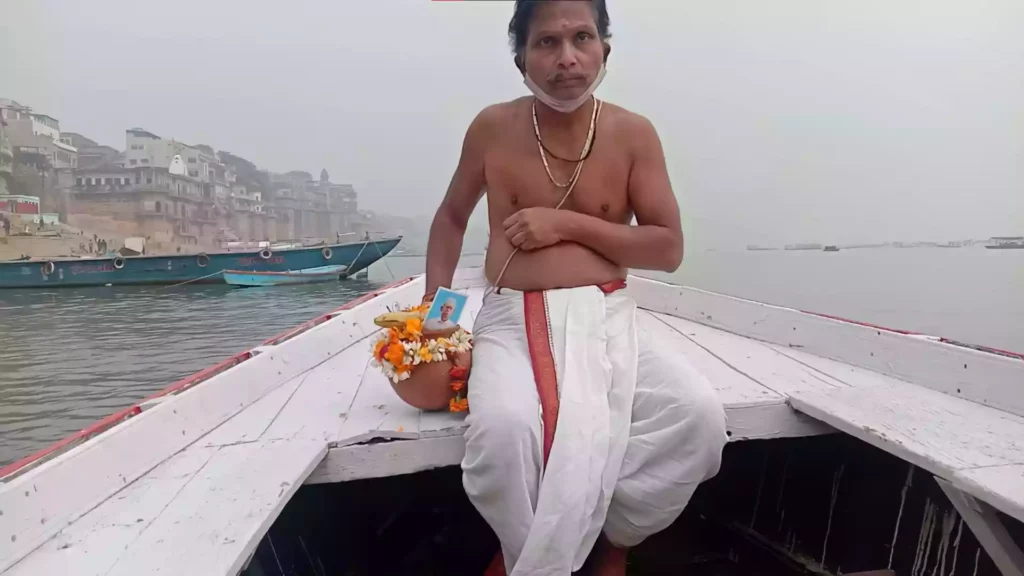
Families have a duty to pay honour to ancestors and follow the intentions of their dearly departed loved ones, according to Hindu faith.Β
Asthi Visarjan is a Hindu religious rite that helps the soul achieve redemption and serenity in the afterlife, thereby fulfilling the aspirations of the departed.Β
It is the responsibility of the living family to do the Asthi Visarjan rite for their dearly departed family member.Β
As specified by Hindu holy texts and sacred customs, this is accomplished by immersing and dispersing the cremated ashes and bones of the departed relative or family member in any of Indiaβs flowing holy rivers.Β
This is also a way for Hindus to pay respect to their forefathers and mothers. The holy waters are thought to cleanse the soul of sins, allowing it to achieve moksha, or salvation, as well as a proper seat in the presence of the Supreme Power. Lets see where we can do Asthi Visarjan in Delhi.
For people looking for asthi visarjan places near delhi, here are our recommended holy places and their importance-
If you have any questions or would like to perform asthi visarjan in these places, please chat with us, we are 24 hours live.

Experience - The Asthi Visarjan Services are extremely important since it is the final farewell to your loved one. For a soulful departure, the Pandit performs the necessary havans and pujas. We will supply you with the most knowledgeable Pandit to perform each ceremony according to your caste. They also give some helpful insights that will assist you in healing and praying.
Puja Preparation and Samagri - It is necessary to use holy and auspicious samagri because the Asthi Visarjan Services is a religious rite. Our team will make sure that all the samagri is organised well in advance so you can have a calm ceremony. All our things are of high-quality and packing.Β
As soon as the asthi reaches its final destination, we assign it a pandit. At the Ghat, the allocated helper gathers all of the things for asthi visarjan and transfers the ashes from the bag to the clay pot (kalash) (kalash). To conclude the asthi visarjan, one of our pandits will do Asthi pujan at Ganga ghat.
After completing the preparation for the poojan, pandit begins the poojan by reciting all the mantras mentioned in the hindu holy texts and customs. The person performing the asthi visarjan is requested to recite some of the mantras as told by the pandit. During this procedure, poojan samagri is offered to the asthi kalash. Before the immersion of asthis in ganga river, pandit ji asks the almighty to accept the poojan and provide moksha to the departed.
Why to Perform Asthi Visarjan in Garh Ganga?Asthi visarjan can be performed by the son, daughter, brother, sister, wife or husband of the departed soul. In case there is no one available in the family to carry out the poojan, then a friend or a pratinidhi can perform the rituals with the help of pandit. With the growth of digital age, one can perform the asthi visarjan poojan online, without even visiting at the poojan place physically. Prayag Pandits excels in providing online asthi visarjan poojan to anyone from any country.
Who can perform Asthi Visarjan in Garh Ganga?Asthi visarjan can be performed by the son, daughter, brother, sister, wife or husband of the departed soul. In case there is no one available in the family to carry out the poojan, then a friend or a pratinidhi can perform the rituals with the help of pandit. With the growth of digital age, one can perform the asthi visarjan poojan online, without even visiting at the poojan place physically. Prayag Pandits excels in providing online asthi visarjan poojan to anyone from any country.
Where to Perform Asthi Visarjan at Garh Ganga?Generally, at Brijghat, the Asthi Visarjan Poojan is done on the river Ganga’s banks. But at Prayag pandits, we perform the asthi visarjan poojan over the ganga river itself via a motorboat.
On which day asthi visarjan should be done?There are different days in different castes and states. Generally, it is best to perform it as soon as possible. Asthi visarjan laws are different in Orissa, when compared to north india. But as per the holy texts, the asthis must be collected and put in a kalash on the 3rd day, 7th day, 9th day. Before the 10th day, asthi visarjan should be performed.
How long does asthi visarjan takes?The poojan takes anywhere from 45 minutes to 120 minutes.
Where should i keep the asthi of the dead person?You should never keep the asthi inside your home. Rather, you should bury the asthi kalash in your garden, nearby empty land area or a patio.
Which place is best for asthi visarjan?Any nearby place where holy river ganga flows. For people living in or near Delhi, they can go Garh Mukteshwar or Haridwar. For People belonging to Northern India, they can visit Prayagraj, Varanasi or Mathura.Β
Can asthi visarjan be done only in river ganga?No, although river ganga is considered to be the most preferred when it comes to asthi visarjan, but any flowing water body is suitable for asthi visarjan.
Can i do online asthi visarjan?Yes, if you are unable to visit physically, you can opt for online asthi visarjan. It is completely fine and is considered the preferred choice for many.
Select your package and complete booking. Our team calls within 2 hours to confirm details.
Provide your gotra, departed soul's name, and any special requirements.
Experienced pandit performs the complete ceremony at the sacred site.
Full ceremony video on WhatsApp within 24 hours. Digital certificate shared via email.
Yes. Garh Ganga is one of the most convenient day-trip Asthi Visarjan destinations from Delhi. The typical day-trip timeline: Depart Delhi 6:00 AM (avoid peak traffic), Arrive Garh Ganga 9:00-9:30 AM, Ghat arrival and preparation 30 minutes, Complete Asthi Visarjan ceremony 1-2 hours, Brahmin Bhoj (if included) 30-45 minutes, Depart Garh Ganga 1:00 PM, Arrive back in Delhi 3:00-4:00 PM. Total day duration: ~9-10 hours. Many Delhi-based families specifically choose Garh Ganga for this reason β they can complete the entire sacred observance in a single day without overnight travel. Our day-trip package includes pandit coordination, samagri, and ritual documentation.
Garhmukteshwar is located in Hapur district, Uttar Pradesh, approximately 100 km east of Delhi and 50 km from Meerut. It sits on the western bank of the Ganga river where the Ganga emerges into the plains from the lower Himalayan foothills. How to reach: (1) By train β nearest station is Garhmukteshwar (GMS), well-connected from Delhi, Moradabad, and Lucknow, (2) By road β 2-3 hour drive from Delhi via NH-9 (the Delhi-Meerut Expressway then NH-9), (3) By car/taxi β Delhi to Garhmukteshwar costs βΉ2,500-βΉ4,000 one-way. The town is small but well-signposted. From the railway station or bus stand, it is 2-3 km to the main ghats. Our Garh Ganga Asthi Visarjan packages include pickup arrangements from Delhi or Meerut.
Prayagraj (Triveni Sangam), Varanasi (Manikarnika and Harishchandra ghats), and Haridwar (Har Ki Pauri) are traditionally considered the three most sacred tirthas for Asthi Visarjan in India. Prayagraj holds special significance as the confluence of the Ganga, Yamuna, and the mystical Saraswati rivers. Gaya is the preferred choice when Asthi Visarjan is combined with Pind Daan. For Maharashtrian families, Trimbakeshwar and Rameshwaram hold similar reverence. The "best" place often depends on your family tradition, the departed soul's last wishes, and the nearest accessible tirtha. Our pandits guide families to the site that best matches their lineage and customs.
Asthi Visarjan costs depend on the location, the type of ceremony, and whether additional rituals are included. At Prayagraj, basic Asthi Visarjan packages typically start around βΉ3,500, with premium private-boat ceremonies at βΉ11,000 or more. Varanasi and Haridwar follow similar pricing. Garh Ganga offers economical packages starting around βΉ5,100. When combined with Pind Daan at Gaya, the combined ceremony ranges from βΉ7,100 to βΉ21,000+ depending on duration. All our packages include pandit dakshina, puja samagri, boat arrangements where required, and video documentation. Visit our city-specific Asthi Visarjan service pages for transparent current pricing.
Hindu tradition recommends performing Asthi Visarjan as early as possible β ideally within the first year after death. The ashes should be collected on the 1st, 4th, 7th, or 9th day after cremation. If circumstances prevented earlier immersion, the ritual can still be performed years later and remains fully valid. Do not let the passage of time stop you from fulfilling this duty.
Yes, a daughter, wife, daughter-in-law, or other female relative can perform Asthi Visarjan when a son is unavailable. Scriptural texts restrict bone collection by lineage (kula) rather than by gender β the performer must belong to the mother's or father's family line. The Garuda Purana and later Smritis explicitly acknowledge female participation when the male line is absent. We regularly guide daughters, wives, and granddaughters through the complete Asthi Visarjan ceremony at Prayagraj, Varanasi, Haridwar, and Gaya. The ritual's spiritual efficacy is identical regardless of the performer's gender, provided the correct gotra, sankalpa, and mantras are invoked.
Asthi Visarjan is the sacred Hindu ritual of immersing the bone fragments (asthi) and ashes of a cremated relative into a holy river β ideally the Ganga. It is the final step of the funeral rites (Antyeshti) and is considered essential for the departed soul's liberation (moksha). According to the Garuda Purana (Preta Khanda 15.30-31), immersing remains in the Ganga within 10 days of death grants the deceased the exact same merit as dying directly on the banks of the Ganga. The ritual symbolises the return of the five elements β the body's earth, water, fire, air, and ether β back to the cosmic Self, and frees the soul from its final attachment to the material form.
Hindu scriptures lay down clear rules for Asthi Visarjan. The Garuda Purana (Preta Khanda 15.30-31) prescribes that the sixth pinda must be offered at the time of bone collection, and that the bones should be immersed in the sacred Ganga within 10 days of cremation β this grants the deceased the same merit as dying on the banks of the Ganga itself. Key rules include: (1) collecting bones on the 2nd or 3rd day after cremation per the Antyakarmadipaka, (2) avoiding Sundays, Tuesdays, and Saturdays for bone collection per Yama as cited in the Nirnayasindhu, (3) avoiding even-numbered tithis and the performer's own birth nakshatra, and (4) maintaining strict purity of the urn during travel to a distant tirtha. Our pandits ensure every ceremony follows these scriptural rules precisely.