Can women perform Tarpan in Gaya?
Traditional views often restricted women, particularly from performing the main rites alone. However, there's growing acceptance and scriptural basis (like Garuda Purana referencing instances…
Questions about All Tarpan

Traditional views often restricted women, particularly from performing the main rites alone. However, there's growing acceptance and scriptural basis (like Garuda Purana referencing instances…
Tarpan is typically offered for three preceding generations (father, grandfather, great-grandfather; mother, paternal grandmother, paternal great-grandmother) and maternal ancestors (maternal grandfather, etc.). Specific Tarpan…
Traditionally, the eldest son is the primary person authorized (adhikari) to perform Tarpan and Shraddha for parents and ancestors. If the eldest son is…
The specific act of Tarpan itself might take around 30-60 minutes. However, when performed as part of the standard one-day Pind Daan ritual in…
The cost (Dakshina given to the priest) varies widely. If performed as a standalone ritual, it might be less, perhaps in the range of…
Many Gayawal Pandas have established 'gaddis' (offices/establishments) near the Vishnupad Temple and Phalgu riverbanks.Some families have traditional Pandas serving them for generations (jajmans), whose…
The rituals are traditionally conducted by Gayawal Pandas (also called Gayawal Brahmins or Brahma Kalpit Brahmins). They are a specific subcaste of Brahmins holding…
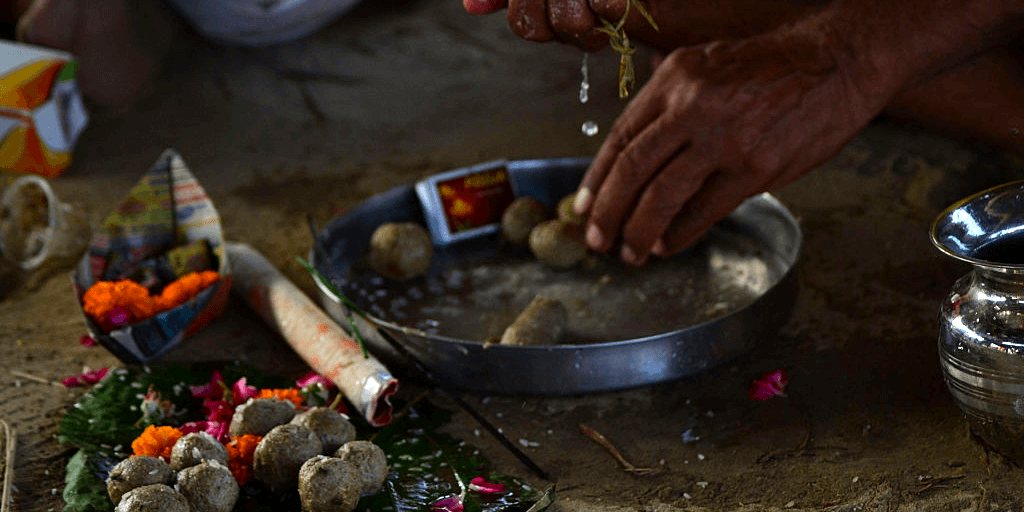
Essential materials include: Water (preferably from the Phalgu river) Black sesame seeds (kala til) Barley (Jau) Kusha grass (sacred grass for purification and as…
Under the guidance of a Gayawal Panda (priest), the performer (Karta), after a purificatory bath (often in Phalgu) and wearing clean attire, faces south…
The Vishnupad Temple, housing Lord Vishnu's footprint, is the spiritual epicenter of Gaya. While Tarpan itself is mainly performed by the Phalgu river, the…
Showing 10 of 66 questions