अभी तक कोई अनुष्ठान नहीं चुना गया।
पूजा पैकेज देखें →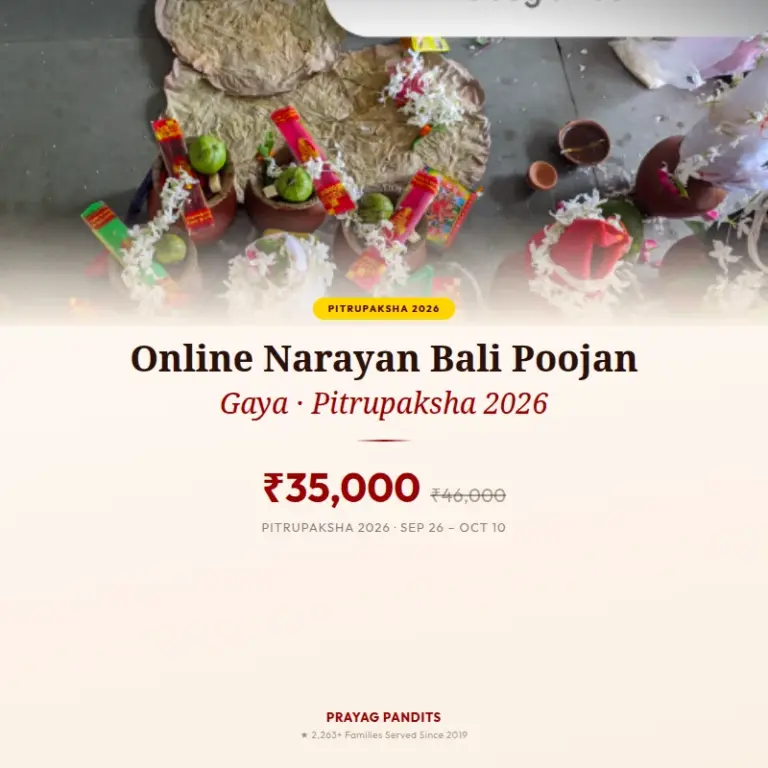 Save 24%
Gaya
Online Narayan Bali Poojan in Gaya Pitrupaksha 2026
Online Narayan Bali Poojan is a ritual described in Garuda Purana which...
from
₹35,000
₹46,000
In 2025, Pitrupaksha will commence on 7th September, and conclude with Mahalaya Amavasya on 21st September. Each day of this period is dedicated to performing Tarpan for different family members.
Here are the dates:
| Date | Name | Occasion |
|---|---|---|
| September 7 | Purnima Shraddha | Bhadrapada, Shukla Purnima |
| September 8 | Pratipada Shraddha | Ashwina, Krishna Pratipada |
| September 9 | Dwitiya Shraddha | Ashwina, Krishna Dwitiya |
| September 10 | Tritiya Shraddha | Ashwina, Krishna Tritiya |
| September 10 | Chaturthi Shraddha | Ashwina, Krishna Chaturthi |
| September 11 | Maha Bharani | Ashwina, Bharani Nakshatra |
| September 11 | Panchami Shraddha | Ashwina, Krishna Panchami |
| September 12 | Shashthi Shraddha | Ashwina, Krishna Shashthi |
| September 13 | Saptami Shraddha | Ashwina, Krishna Saptami |
| September 14 | Ashtami Shraddha | Ashwina, Krishna Ashtami |
| September 15 | Navami Shraddha | Ashwina, Krishna Navami |
| September 16 | Dashami Shraddha | Ashwina, Krishna Dashami |
| September 17 | Ekadashi Shraddha | Ashwina, Krishna Ekadashi |
| September 18 | Dwadashi Shraddha | Ashwina, Krishna Dwadashi |
| September 19 | Trayodashi Shraddha | Ashwina, Krishna Trayodashi |
| September 19 | Magha Shraddha | Ashwina, Magha Nakshatra |
| September 20 | Chaturdashi Shraddha | Ashwina, Krishna Chaturdashi |
| September 21 | Sarva Pitru Amavasya | Ashwina, Krishna Amavasya |
| Pind Vedi Name | Place |
|---|---|
| Brahma pad | VishnuPad Temple Circile |
| Dakshinaagni pad | VishnuPad Temple Circile |
| Garhyapatyaagni pad | VishnuPad Temple Circile |
| Aahwanyaragni pad | Sambhyaagni pad |
| Awasthayaagni pad | VishnuPad Temple Circile |
| Surya pad | VishnuPad Temple Circile |
| Kartikya pad | VishnuPad Temple Circile |
| Indra pad | VishnuPad Temple Circile |
| Agast pad | VishnuPad Temple Circile |
| Kanwan pad | VishnuPad Temple Circile |
| Chandra pad | VishnuPad Temple Circile |
| Ganesh pad | VishnuPad Temple Circile |
| Kaach pad | VishnuPad Temple Circile |
| Maatang pad | VishnuPad Temple Circile |
| Kasyap pad | VishnuPad Temple Circile |
| Gajakarna pad | VishnuPad Temple Circile |
| Sitakund | On the Bank of Falgu River (East side) in front of Deoghat |
| Ramgaya | On the Bank of Falgu River (East side) in front of Deoghat |
| Gaya seer | VishnuPad Samshan Ghat |
| Gaya kup | VishnuPad Temple Circile |
| Mund Pristha | On Karsili Hill |
| Aadi gaya | On Karsili Hill |
| Dhaut Pad | Dakshin Gate |
| Waitrani | Dakshin Gate |
| Bheem Gaya | Manglagauri |
| Goprachar | Manglagauri |
| Akshay wat | Maranpur |
| Gadalol | Near akshay Wat |
| Gaytri Ghat | Near Brahmni Ghat |
| Rudra pad | VishnuPad Temple Circile |
| Pind Vedi Name | Place |
|---|---|
| Punpun | Punpun Ghat Station in Gaya – Patna Railway |
| Godawari | On the Way to Manglagauri |
| Falgu River | From Dev Ghat to Pitamaheswar |
| Pretseela | Underneath of Pretshila Hill |
| Brahmakund | Underneath of Pretshila Hill |
| Ramsheela | Near Panchayati Akhara |
| Kakwali | Near Ramsheela Hill |
| Uttarmanas | Pitamaheswar Mohalla |
| Dakhinmanas | Surya Kund in Vishnupad Area |
| Udichi | Surya Kund in Vishnupad Area |
| Kankhal | Surya Kund in Vishnupad Area |
| Jihwal | On the bank of Falgu River near Vishnupad Temple |
| Gadhadhar Vedi | VishnuPad Temple Circile |
| Sharswati Vedi | East side of Amba village in Gaya – Bodhgaya road |
| Matangwapi | Bodhgaya |
| Dharmarnaya | Bodhgaya |
| Bodhitaru | Bodhgaya |
| Brahma Sarowar | Maranpur |
| Kaakbali | Maranpur |
| Aamrasechan | Near Manglagauri Temple |
| Tarakbarahm | Near Manglagauri Temple |
| Name of Sarowar |
|---|
| Brahma Sarowar |
| Waitarani Sarowar |
| Rukmini Talab |
| Suryakund |
| Pitamaheswar |
| Godawari |
| Ramsheela |
| Pretsheela |
| Pind Vedi Name | Place |
|---|---|
| Brahma pad | VishnuPad Temple Circile |
| Dakshinaagni pad | VishnuPad Temple Circile |
| Garhyapatyaagni pad | VishnuPad Temple Circile |
| Aahwanyaragni pad | Sambhyaagni pad |
| Awasthayaagni pad | VishnuPad Temple Circile |
| Surya pad | VishnuPad Temple Circile |
| Kartikya pad | VishnuPad Temple Circile |
| Indra pad | VishnuPad Temple Circile |
| Agast pad | VishnuPad Temple Circile |
| Kanwan pad | VishnuPad Temple Circile |
| Chandra pad | VishnuPad Temple Circile |
| Ganesh pad | VishnuPad Temple Circile |
| Kaach pad | VishnuPad Temple Circile |
| Maatang pad | VishnuPad Temple Circile |
| Kasyap pad | VishnuPad Temple Circile |
| Gajakarna pad | VishnuPad Temple Circile |
| Sitakund | On the Bank of Falgu River (East side) in front of Deoghat |
| Ramgaya | On the Bank of Falgu River (East side) in front of Deoghat |
| Gaya seer | VishnuPad Samshan Ghat |
| Gaya kup | VishnuPad Temple Circile |
| Mund Pristha | On Karsili Hill |
| Aadi gaya | On Karsili Hill |
| Dhaut Pad | Dakshin Gate |
| Waitrani | Dakshin Gate |
| Bheem Gaya | Manglagauri |
| Goprachar | Manglagauri |
| Akshay wat | Maranpur |
| Gadalol | Near akshay Wat |
| Gaytri Ghat | Near Brahmni Ghat |
| Rudra pad | VishnuPad Temple Circile |
| Pind Vedi Name | Place |
|---|---|
| Punpun | Punpun Ghat Station in Gaya – Patna Railway |
| Godawari | On the Way to Manglagauri |
| Falgu River | From Dev Ghat to Pitamaheswar |
| Pretseela | Underneath of Pretshila Hill |
| Brahmakund | Underneath of Pretshila Hill |
| Ramsheela | Near Panchayati Akhara |
| Kakwali | Near Ramsheela Hill |
| Uttarmanas | Pitamaheswar Mohalla |
| Dakhinmanas | Surya Kund in Vishnupad Area |
| Udichi | Surya Kund in Vishnupad Area |
| Kankhal | Surya Kund in Vishnupad Area |
| Jihwal | On the bank of Falgu River near Vishnupad Temple |
| Gadhadhar Vedi | VishnuPad Temple Circile |
| Sharswati Vedi | East side of Amba village in Gaya – Bodhgaya road |
| Matangwapi | Bodhgaya |
| Dharmarnaya | Bodhgaya |
| Bodhitaru | Bodhgaya |
| Brahma Sarowar | Maranpur |
| Kaakbali | Maranpur |
| Aamrasechan | Near Manglagauri Temple |
| Tarakbarahm | Near Manglagauri Temple |
| Name of Sarowar |
|---|
| Brahma Sarowar |
| Waitarani Sarowar |
| Rukmini Talab |
| Suryakund |
| Pitamaheswar |
| Godawari |
| Ramsheela |
| Pretsheela |
Pitrupaksha, also known as Mahalay, is a 15-day period dedicated to paying respects to the deceased souls of loved ones and ancestors.
It is a time to offer respect to the departed souls, considered an integral part of Hindu families, through rituals and ceremonies.
The nomenclature of lunar months differs, but both North and South Indians perform Shraddha rituals on similar days.
The legend involves the warrior King Karna from Mahabharata, who was allowed to return to Earth for 15 days to donate food in memory of his ancestors
Shradh marks an important time to perform the ritual of Tarpan, a way of remembering and honoring departed souls by making offerings of their favorite vegetarian food.
Rituals performed during Shradh appease the departed souls, ensuring their blessings and protection for the living.
Pitrudosh is a negative astrological alignment created when Rahu is placed in certain houses of a horoscope, potentially hindering success despite talent and abilities.
By performing Shradh rituals with honesty, dedication, love, and respect, one can appease ancestors, ensuring their blessings and protection.
Tarpan helps in seeking blessings, assisting ancestors in attaining peace, and removing the effects of unnatural or untimely deaths.
Tarpan helps in seeking blessings, assisting ancestors in attaining peace, and removing the effects of unnatural or untimely deaths.
Performing Shradh rituals and appeasing ancestors during Pitrupaksha can help mitigate the effects of Pitrudosh.
Pitrupaksha is observed during the dark half of Ashwina (September-October) in the Hindu lunar calendar.
Food is offered as a token of respect to the departed souls, ensuring their blessings and protection.
Tarpan is a ritual of remembering and giving thanks to departed souls, ensuring their blessings and protection.
It’s preferred to perform Shradh on the death anniversary of departed family members. If the date is unknown, rituals can be performed on the last day of Pitrupaksha.
Unnatural deaths can prevent souls from attaining peace. Performing Tarpan during Shradh can help these souls find divine peace.
Devotees believe that ancestors shield them from life’s challenges and bestow blessings, ensuring protection from evil energies.
Pitrupaksha or Shradh Paksha comes right before Sharad Navratri in the Hindu calendar.
Pitrupaksha, also known as Mahalay, is a 15-day period dedicated to paying respects to the deceased souls of loved ones and ancestors.
It is a time to offer respect to the departed souls, considered an integral part of Hindu families, through rituals and ceremonies.
The nomenclature of lunar months differs, but both North and South Indians perform Shraddha rituals on similar days.
The legend involves the warrior King Karna from Mahabharata, who was allowed to return to Earth for 15 days to donate food in memory of his ancestors
Shradh marks an important time to perform the ritual of Tarpan, a way of remembering and honoring departed souls by making offerings of their favorite vegetarian food.
Rituals performed during Shradh appease the departed souls, ensuring their blessings and protection for the living.
Pitrudosh is a negative astrological alignment created when Rahu is placed in certain houses of a horoscope, potentially hindering success despite talent and abilities.
By performing Shradh rituals with honesty, dedication, love, and respect, one can appease ancestors, ensuring their blessings and protection.
Tarpan helps in seeking blessings, assisting ancestors in attaining peace, and removing the effects of unnatural or untimely deaths.
Tarpan helps in seeking blessings, assisting ancestors in attaining peace, and removing the effects of unnatural or untimely deaths.
Performing Shradh rituals and appeasing ancestors during Pitrupaksha can help mitigate the effects of Pitrudosh.
Pitrupaksha is observed during the dark half of Ashwina (September-October) in the Hindu lunar calendar.
Food is offered as a token of respect to the departed souls, ensuring their blessings and protection.
Tarpan is a ritual of remembering and giving thanks to departed souls, ensuring their blessings and protection.
It's preferred to perform Shradh on the death anniversary of departed family members. If the date is unknown, rituals can be performed on the last day of Pitrupaksha.
Unnatural deaths can prevent souls from attaining peace. Performing Tarpan during Shradh can help these souls find divine peace.
Devotees believe that ancestors shield them from life's challenges and bestow blessings, ensuring protection from evil energies.
Pitrupaksha or Shradh Paksha comes right before Sharad Navratri in the Hindu calendar.
Looking for other ritual services in Gaya? Browse all our pandit services in Gaya — including Pind Daan, Asthi Visarjan, Tarpan, Shradh, and Narayan Bali with experienced Tirth Purohits.
Select your package and complete booking. Our team calls within 2 hours to confirm details.
Provide your gotra, departed soul's name, and any special requirements.
Experienced pandit performs the complete ceremony at the sacred site.
Full ceremony video on WhatsApp within 24 hours. Digital certificate shared via email.
Save 24%
Online Narayan Bali Poojan is a ritual described in Garuda Purana which...

Narayan Bali Pooja is a ritual described in Garuda Purana which is...
The primary purpose is to provide liberation (Moksha) and peace (Shanti) to the souls of ancestors who died unnaturally. It aims to fulfill their lingering desires, release them from a state of suffering or wandering, prevent them from causing distress (Pitru Dosha) to their living descendants, and secure their blessings for the family's well-being, prosperity, and harmony.
Gaya is one of the most sacred Hindu pilgrimage sites (Teertha Kshetras) and is especially renowned as a 'Mukti-Sthal' (place of salvation). It's believed that souls of the departed wander here, awaiting rituals from their descendants. Lord Vishnu himself is said to have granted salvation to Gayasur here, blessing the place for ancestral rites. Furthermore, Lord Rama performed Pind Daan for his father Dasharatha in Gaya. Due to these divine associations and its inherent sanctity, performing Narayan Bali in Gaya is believed to yield exceptionally potent results for the liberation of troubled souls.
While Narayan Bali can technically be performed in Gaya throughout the year (365 days), certain periods are considered more auspicious:
Costs can vary significantly based on:
Estimates range widely:
The procedure is complex and best performed by experienced pandits. Key steps typically include:
Pind Daan: This is a general ancestral rite performed for all deceased ancestors (usually annually during Pitru Paksha or upon death) to nourish and appease them, ensuring their peaceful journey. It involves offering rice balls (pindas). It is a fundamental duty for Hindus.
Narayan Bali: This is a specific ritual performed primarily for ancestors who died an unnatural or untimely death, or whose funeral rites were not performed correctly. Its main aim is liberation from the troubled state (Pret Yoni) caused by such deaths and alleviation of resulting Pitru Dosha. While Pind Daan might be part of the Narayan Bali process, Narayan Bali addresses a specific type of death and associated problems.
Yes, several service providers now offer online Narayan Bali puja performed in Gaya on your behalf. They conduct the ritual with pandits in Gaya, often providing video recordings or live streaming options. This is convenient for those unable to travel.
Performing this ritual, especially in the potent kshetra of Gaya, is believed to bring numerous benefits: