



Veda-Trained Pandits
Experienced pandits guide the ceremony with care for your family’s tradition.
Pooja booking
Original price was: ₹5,500.00.₹5,100.00Current price is: ₹5,100.00.
Per pooja
Applicable taxes are shown in your booking. Optional additions are separate.
Exclusions
Thoughtfully arranged, personally guided
Experienced pandits guide the ceremony with care for your family’s tradition.
Stay in touch with our team for your booking details and ceremony arrangements.
See what your selected package includes. Optional additions are shown separately.
Share the date and timing that suit you. Our team confirms the final arrangements.
Experiences shared by our families
24 family reviews16 for this pooja · 8 from across our services
We came from Delhi specifically for this puja. The whole process was smooth and the pandit ji guided us patiently. Highly recommend.
Affordable and authentic poojan services. We compared several providers before choosing Prayag Pandits and we made the right choice. The quality of service matched what was promised.
प्रयाग पंडित्स की सेवा से पूर्णतया संतुष्ट हूँ। उनकी टीम बहुत पेशेवर है और पंडित जी का ज्ञान गहन है। दूसरों को भी सिफारिश करूँगा।
Worth every rupee. The puja was conducted exactly as per tradition. Family is very happy.
Very satisfied with the service. The pandit arrived on time and had all the materials ready. The ceremony was conducted as per proper Vedic traditions. The team followed up after the poojan as well.
Booked this for my late father. Everything was arranged perfectly. The team was professional and respectful throughout.
प्रयाग पंडित्सची सेवा उत्तम आहे. सगळं व्यवस्थित झालं. नक्की पुन्हा बुक करेन.
बहुत अच्छी सेवा। पंडित जी ने पूरी विधि से पूजा करवाई। बहुत संतुष्ट हूँ।
The ceremony was conducted at the right muhurat time as promised. The pandit’s knowledge of the shastras was evident. We received photos and a certificate after the poojan. Very professional. Jai Shri Ram.
प्रयाग पंडित्स से दूसरी बार पूजा करवाई। दोनों बार अनुभव शानदार रहा। उनकी टीम पुराने ग्राहकों को याद रखती है और व्यक्तिगत ध्यान देती है।
The pandit ji recited the mantras perfectly and explained the significance of each ritual. Deeply moving experience.
অত্যন্ত ভালো সেবা। পণ্ডিত জি সবকিছু যত্ন সহকারে করেছেন। আমরা সন্তুষ্ট।
Booked this service on recommendation from a friend. Was not disappointed at all. The entire process from booking to ceremony completion was smooth. The pandit was very experienced.
हमारे परिवार ने पहली बार ऑनलाइन पूजा करवाई। शुरू में थोड़ा संशय था लेकिन अनुभव बहुत अच्छा रहा। वीडियो कॉल की गुणवत्ता अच्छी थी और पंडित जी ने हमें पूजा में शामिल किया। Dhanyavaad.
बहुत अच्छी सेवा। पंडित जी समय पर आए और सभी पूजन सामग्री लेकर आए। मंत्रोच्चार बहुत शुद्ध था। कुल मिलाकर एक संतोषजनक अनुभव रहा। Dhanyavaad.
The online poojan option is great for people living abroad. We could participate from our home in the UK. The video was clear and the pandit made us feel included in every step of the ceremony. Dhanyavaad.
Watching the pandit perform the rituals in real-time by the Falgu River, mentioning my father's name... it felt like we were truly there. Immense gratitude to the entire team.
Being in the USA, travelling to India just for Tarpan during Pitru Paksha was becoming very difficult. Prayag Pandits offered a well-coordinated solution.
I was skeptical about performing such a sacred ritual online from Canada. But honouring my parents in Kashi was important. They were very patient and answered all my questions.
Living in Singapore, we felt disconnected from these essential rituals. The live stream option for Tarpan at Prayagraj gave us a profound sense of connection and peace.
It was deeply important for us in Australia that the rituals were performed correctly. The ceremony reflected the authenticity we sought and was performed by a knowledgeable priest.
The Pind Daan at Kashi was handled carefully, with the pandit following every step diligently. Very reassuring.
Arranging Asthi Visarjan from Bhubaneswar seemed complex, but Prayag Pandits made it seamless. The pandit called us before the ceremony to explain every step. Very professional.
During Pitru Paksha, we booked Shradh at Prayagraj. The coordination was flawless - from date selection to the pandit assignment. Our family felt at peace after the ceremony.
YOUR EXPERIENCE MATTERS
Tell us about your ceremony and the support you received. Your email address will stay private.
From your first choice to your booking
Review your package and any available additions, then add it to your booking.
Enter your contact details, preferred date and time. Add ancestral details if you wish.
Our team confirms the arrangements and shares your coordinator’s details 24 hours before the pooja.
Follow the participation and joining arrangements described in your package and shared by your coordinator.
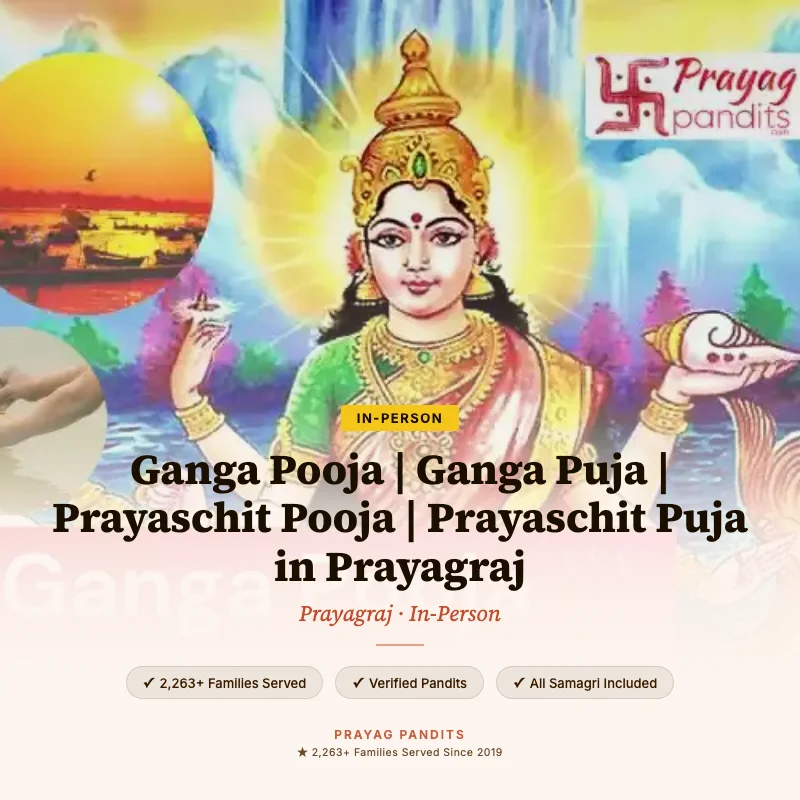
At the confluence of the Ganga, Yamuna, and the invisible Saraswati — the sacred Triveni Sangam of Prayagraj — there is a ceremony that has been performed for thousands of years by those seeking both divine blessing and inner purification. The Ganga Pooja and Prayaschit Pooja offered by Prayag Pandits is a ceremony of two interwoven traditions: the worship of Maa Ganga as a living goddess, and the ancient ritual of Prayaschit — atonement and release from the burden of past wrongs.
At ₹5,500, our package brings you a complete ceremony conducted on an exclusive boat ride to the Triveni Sangam, guided by an experienced teerth purohit (pilgrimage priest) who knows the Prayagraj ghats and their significance as intimately as one knows one’s own home.
No body of water in the world holds the same place in a civilization’s spiritual consciousness as the Ganga holds in Hindu dharma. She is not merely a river. She is Ganga Mata — a goddess, one of the daughters of Himalaya, and by the Puranic account, the third wife of Lord Vishnu who was sent to earth at the prayer of King Bhagiratha to liberate his sixty thousand ancestors from a curse that had reduced them to ashes.
The Devi Bhagavata Purana describes Maa Ganga in these terms: “She who flows from the foot of Vishnu, who was caught in the matted hair of Shiva, who flows northward through Kashi — she is the purifier of all the three worlds. Even the sight of the Ganga destroys sin. Even remembering her name removes Pitru Dosha. The touch of her waters grants what five sacrifices cannot.”
The Ganga’s power is said to be especially concentrated at Prayagraj, where she meets the Yamuna and the underground Saraswati at the Triveni Sangam. Tirtharaj Prayag — the King of all Tirthas — is the name given to this confluence by the Puranas. The Matsya Purana declares that all tirthas are present at Prayag, and that any act of worship, any bath, any offering made here carries merit equal to a thousand times the same act performed elsewhere.
Prayaschit — from the Sanskrit roots pra (before or away) and yaschit (that which burns or purifies) — is the Hindu system of conscious atonement for actions, spoken words, or thoughts that have caused harm, violated dharma, or created karmic debt. Unlike guilt, which is an emotion, Prayaschit is a structured ritual act designed to actually neutralize the karmic consequence of a specific wrong.
The system of Prayaschit is laid out in detail in the Manu Smriti, the Yajnavalkya Smriti, and in the Dharmashastra texts. The tradition distinguishes between different types of wrongdoing and prescribes proportionate atonement rituals. At its heart, Prayaschit rests on three elements:
Without all three elements, Prayaschit is incomplete. Our teerth purohit guides you through the Sankalpa — the formal statement of intent — that constitutes the first two, before performing the ritual acts that constitute the third.
The tradition describes Prayaschit as appropriate in several situations. You do not need to have committed any dramatic transgression for Prayaschit to be meaningful — it is, in essence, a ceremony of spiritual hygiene and renewal:
In Prayagraj, the combination of Ganga Pooja and Prayaschit Pooja at the Triveni Sangam is particularly powerful because the site itself is associated with spiritual liberation and cleansing on the grandest scale. The Kumbh Mela — the world’s largest human gathering — is held here for this precise reason: nowhere else offers the same completeness of purification.
The word Triveni means “three braids” — the interwoven meeting of three sacred rivers. At the Triveni Sangam in Prayagraj, the Ganga flows from the north-east, the Yamuna from the north-west, and the Saraswati flows invisibly from below. Where they meet, the water carries the qualities of all three rivers simultaneously.
The Saraswati is no longer visible because, according to the Puranas, she withdrew underground at a time when humanity’s sins had increased to the point where she could not bear to flow openly through a contaminated world. But she remains present in her subtle form at Prayagraj, flowing beneath the earth. The three rivers together — seen and unseen — create a confluence of spiritual energy unmatched in the Hindu world.
To understand the full depth of the Triveni Sangam’s significance, read our guide: Triveni Sangam — The Land of Moksha.
Performing Ganga Pooja and Prayaschit specifically at the Sangam — rather than at any other ghat — carries the blessing of all three rivers, the presiding deity of Prayagteetha, and the accumulated tapas of every saint and sage who has worshipped here across millennia.
You meet our teerth purohit at the designated ghat. He introduces himself, explains the sequence of the ceremony in brief, and collects your details — name, gotra, and the specific purpose of your Prayaschit — before the Sankalpa. This is also the moment for any questions you have.
Before boarding the boat, a brief ritual bath is taken at the ghat edge. The purohit recites the Ganga Smarana shloka — the hymn of remembrance of Maa Ganga — while you immerse yourself. Even this initial immersion is an act of purification in itself.
The private boat carries you and your family directly to the Triveni Sangam. The boatman knows the exact point of the confluence. You will see the visible meeting of the greenish-blue Yamuna waters and the reddish-brown Ganga waters — and the point where they merge into one is where the ceremony is performed.
Seated in the boat at the Sangam, the purohit takes the Sankalpa — the formal statement of intent — in your name. He recites the time, date, place, your identity, your gotra, and the specific purpose of the ceremony. This is the moment the ritual becomes yours.
The complete Shodashopachara puja of Maa Ganga is performed — all sixteen forms of service offered to the goddess who is physically present in the water surrounding you. Flowers, incense, camphor, and food offerings are made with Sanskrit mantras. The purohit recites the Ganga Stuti — the hymn of praise — and the Ganga Ashtakam during the puja.
The Prayaschit portion of the ceremony follows. The purohit recites the prescribed atonement mantras while you hold the kusha grass and make your offerings into the sacred waters. The act of releasing the offerings into the Sangam water symbolizes — and ritually enacts — the release of the karmic weight you are carrying. This is the heart of the atonement.
The ceremony concludes with the Ganga Aarti, performed on the boat at the Sangam. The lamp is lit and waved in the traditional manner of the ghat aartis. Prasad is distributed, and the purohit recites final blessings for your household.
The aarti of Maa Ganga is one of the most moving spiritual experiences in the Hindu world. The tradition of performing a formal aarti at the river’s edge — with ghee lamps, conch shells, and bells — is ancient and finds its roots in the concept of treating the river as a living, conscious being who appreciates worship and responds with grace.
At Haridwar, the Ganga Aarti draws tens of thousands of visitors every evening. At Prayagraj, the aarti performed at the Sangam carries the added significance of the triple confluence. For more on the Ganga Aarti tradition, read our article on the Ganga Aarti at Haridwar, which explains the history and significance of this extraordinary ritual.
To see all the ceremonies and pilgrim services we offer at the Prayagraj Sangam and across other sacred tirthas, visit our complete services page.
Yes, without any restriction. Maa Ganga is the universal mother — she does not distinguish between communities, castes, or regional traditions. Any sincere devotee who approaches her with genuine intention may worship her and perform Prayaschit at the Sangam. Our purohit is experienced in adapting the ceremony appropriately for devotees from all backgrounds, including those less familiar with Sanskrit or specific ritual customs.
The morning hours — ideally between 6:00 and 11:00 AM — are traditionally the most auspicious for worship at the Sangam. The pre-noon period (called Poorvahna in Sanskrit) is specifically associated with Ganga Pooja in the Dharmashastra texts. If morning is not possible, an afternoon slot can also be arranged. Evening ceremonies are possible but less conventional for this specific puja.
The Sangam boat rides are conducted by experienced local boatmen who know the river currents well. Our boats are stable and appropriate for family groups including children and elderly members. We recommend wearing light clothing that can get wet if needed (particularly during the ritual bath), keeping valuables in a dry bag, and informing us in advance if any family member cannot swim, so we can take extra precautions. The ceremony itself is conducted while seated in the boat, so it is comfortable for everyone.
At the Prayagraj ghats, many pilgrims perform simple self-directed prayers, water offerings, or a brief dip in the Sangam. These are meaningful and meritorious acts. However, a complete Shodashopachara Ganga Pooja and Prayaschit ceremony performed by a qualified teerth purohit carries a different order of spiritual weight. The Sankalpa — the formal statement of intent — the mantra recitations, and the specific ritual sequence are what transform a spontaneous act of devotion into a full and scripturally complete ceremony. The purohit’s knowledge and the completeness of the procedure make the difference.
Yes, and it is particularly meritorious to do so. Ganga Pooja on Purnima (full moon day), Amavasya (new moon day), or during Pitrupaksha carries amplified merit. The combination of Ganga Pooja and Prayaschit during Pitrupaksha is one of the most powerful ancestral and karmic remedies available at this tirtha. Please contact us in advance for special tithi dates, as these days are more in demand.
Yes. If you have ashes or bone fragments (asthi) of a departed family member that you wish to immerse in the Sangam, this can be combined with the Ganga Pooja and Prayaschit ceremony in a single visit. Asthi Visarjan is one of the most important final rites in Hindu tradition and the Triveni Sangam is one of the holiest places for it. Please inform us at the time of booking so we can allocate the additional time and coordinate the correct sequence of ceremonies.