



No rituals selected yet.
Browse Pooja Packages →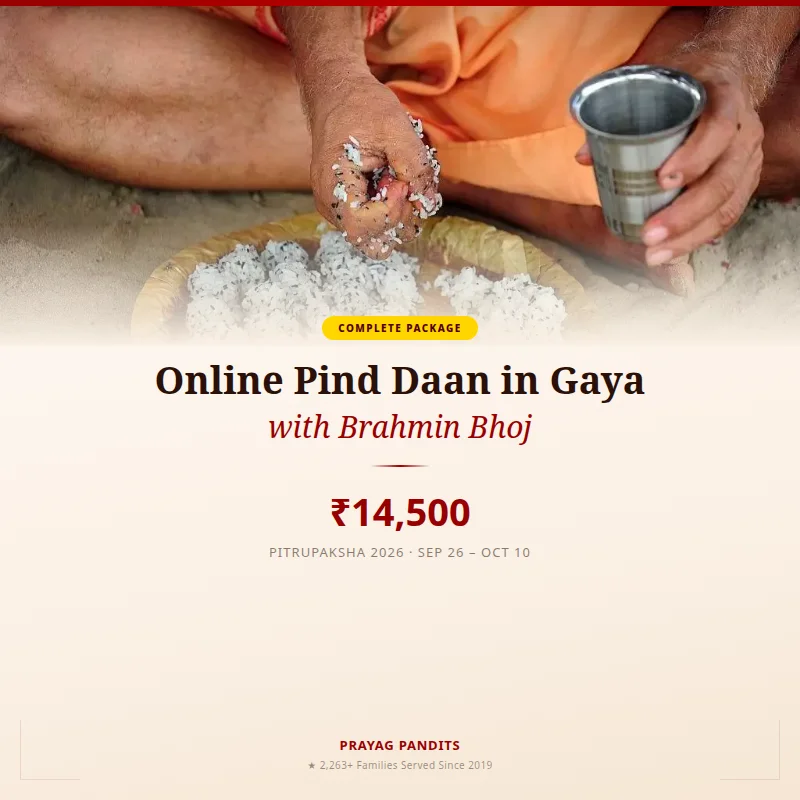




Online Pind Daan in Gaya with Brahmin Bhoj — Pitrupaksha 2026
₹14,500
₹16,500
12% off
per family · all-inclusive
Verified Pandits
Since 2019
All Samagri Included
Free Cancellation
Why Families Choose Us
How It Works
1
Book & Confirm Your Date
Select your preferred date and complete the booking. Our team calls you within 2 hours to confirm details.
2
Share Family Details
Provide gotra, departed soul's name, and any requirements. Don't know your gotra? Our pandits will help.
3
Ritual Performed at Sacred Site
A Veda-trained pandit performs the complete ceremony as per shastra at the designated holy teerth.
4
Confirmation & Documentation
Booking confirmation on WhatsApp. Digital documentation available on select poojas within 48 hours.
About This Ritual
Online Pind Daan in Gaya with Brahmin Bhoj — The Complete Ancestral Rite for Pitrupaksha 2026
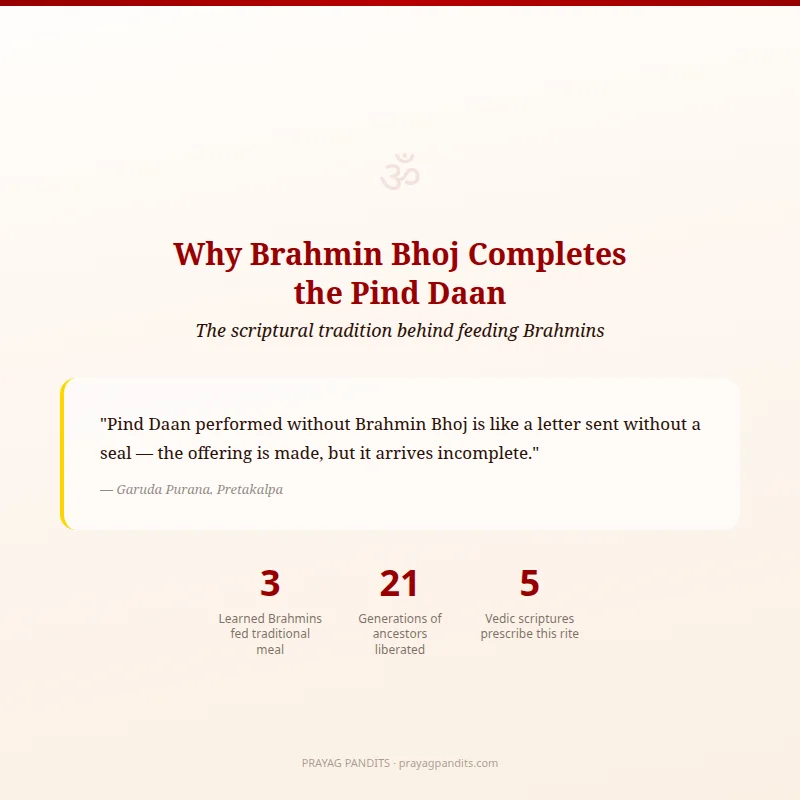
Among all the ancestral rites described across the breadth of Hindu scripture, Pind Daan at Gaya occupies a position no other ceremony holds. The Vayu Purana, the Agni Purana, and the Mahabharata each speak of Gaya as the location where ancestors achieve moksha — liberation from the cycle of death and rebirth — through a single, correctly performed Pind Daan. This is not a regional belief or a later addition to the tradition. It is woven into the foundational texts of Hinduism at every level.But there is a second part to this that families often overlook, and the scriptures are equally clear about it. The Garuda Purana — the text that contains the most precise account of the soul's journey after death and the mechanics of ancestral rites — states that Pind Daan performed without Brahmin Bhoj is like a letter sent without a seal. The offering is made, but it arrives incomplete. The Manu Smriti goes further, placing Brahmin Bhoj above pinda offerings in its description of the merit generated at a Shradh ceremony. Feeding a learned Brahmin in the name of a departed ancestor is understood not as a social formality but as the mechanism through which the pinda's merit is fully activated and transmitted to the Pitru Loka.This package brings both together. The complete Pind Daan at Gaya — performed at the sacred Vedis during Pitrupaksha 2026 — followed by Brahmin Bhoj in which 3 learned Brahmins are served a full traditional meal in your ancestors' names, with the specific mantras that direct the meal's merit toward your lineage. Everything is performed live at Gaya and witnessed by you on a video call from wherever you are.Pitrupaksha 2026 runs from September 26 to October 10. Slots for ceremonies at Gaya during this fortnight are limited. This page explains everything about the ceremony, what is included, how the online format works, and how to prepare.For a broader understanding of Pind Daan procedure and significance, read our guide: How to Perform Pind Daan Poojan.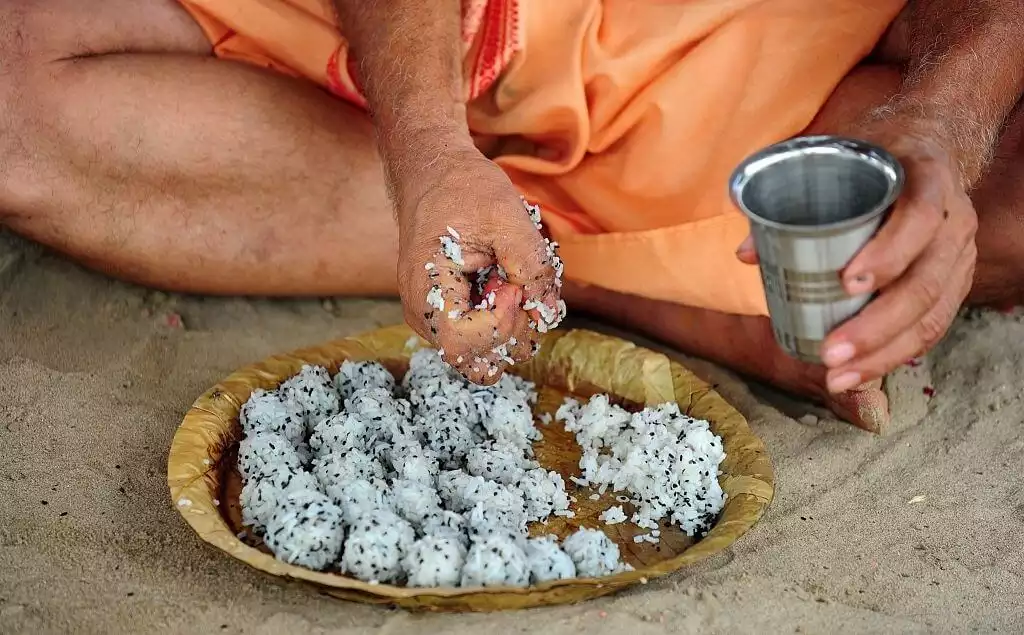
What Is Pind Daan — and How It Differs from Tarpan
These two ceremonies are often mentioned together but serve distinct purposes. Understanding the difference helps families make the right choice for their specific situation and also explains why Pind Daan — when combined with Brahmin Bhoj — represents the most complete ancestral rite available.Tarpan — The Offering of Water
Tarpan is the offering of water, typically mixed with sesame seeds, to the ancestors while reciting their names and the prescribed mantras. It is a recurring ritual — performed daily by some, on Amavasya, during Pitrupaksha, or on the death anniversary of a specific ancestor. The Vedic understanding of Tarpan is that it nourishes the subtle body of the ancestor in whatever realm they currently inhabit. It keeps them sustained and spiritually connected to their descendants. It is an ongoing act of care and remembrance, like sending provisions to someone living far away.Tarpan is important, and families who cannot perform Pind Daan should absolutely perform Tarpan. But it does not carry the liberating function that Pind Daan does. It sustains; it does not liberate.Pind Daan — The Offering of a Subtle Body
Pind Daan operates at a different level entirely. The pinda — a ball formed from cooked rice, sesame seeds, honey, ghee, and milk — represents a subtle body offered to the ancestor through the sankalpa and mantras. When offered at a powerful Tirth with correct procedure and sincere intention, the pinda provides the ancestor with a vehicle through which they can receive the concentrated merit of the ceremony and, at sites like Gaya, be released from whatever condition they are currently in.The Gaya Mahatmya texts, which form part of the Vayu Purana's treatment of Gaya Tirth, describe the specific mechanism: the pindas offered at Gaya's Vedis are received by the Pitra Devatas who oversee ancestral welfare, and these divine custodians then use the merit generated by the correct performance to grant liberation to the named ancestors. The promise attached specifically to Gaya Pind Daan — of liberation reaching back twenty-one generations in some accounts — is not made about any other Tirth in the same terms.Brahmin Bhoj — The Completing Act
The Garuda Purana and the Manu Smriti both describe Brahmin Bhoj as the act that completes and seals the merit of the Pind Daan. The Brahmin, through years of Vedic study and tapas, carries a spiritual current that serves as a direct channel into the Pitru Loka. When a Brahmin is fed in a deceased person's name, at a sacred place, with the appropriate mantras, the ancestors receive a sustenance in the Pitru Loka that the scriptures describe as superior to even the pinda offering itself.The two ceremonies together — Pind Daan followed by Brahmin Bhoj — form the complete act of ancestral propitiation as described in the Dharmashastra tradition. This is the ceremony that the Gaya Mahatmya and the Garuda Purana describe as generating the fullest possible merit for the welfare of departed ancestors.For the complete online option focused specifically on Pind Daan at Gaya without Brahmin Bhoj, see: Online Pind Daan in Gaya this Pitrupaksha 2026.Why Gaya Holds This Unique Place in the Ancestral Tradition
Gaya in Bihar is the site that appears in every major treatment of ancestral rites in Hindu literature. Lord Vishnu's sacred footprint is enshrined at the Vishnupad Temple, and the Gaya Mahatmya describes how Lord Vishnu himself promised liberation to ancestors offered pindas at this location. The specific guarantee attached to Gaya Pind Daan — that the ceremony liberates the named ancestors, not merely sustains them — is the reason families across India and from the Hindu diaspora worldwide make the journey to Gaya specifically for this ceremony.The Ramayana provides one of the most vivid accounts of Gaya's significance. When Lord Rama, accompanied by Sita Devi and Lakshmana, arrived at Gaya to perform Pind Daan for his father King Dasharatha, the Phalgu River refused to yield water at the moment of the offering. Sita Devi herself formed pindas from the river sand and offered them, and King Dasharatha appeared to receive them — his liberation was granted through Sita's offering. The event is cited across the tradition as evidence of Gaya's power: liberation was granted at Gaya even under extraordinary circumstances, because the place itself holds a divine promise.The sacred Vedis of the Gaya Kshetra — the Vishnupad Vedi, the Phalgu River Vedi, the Akshayavata Vedi, and others — each carry specific scriptural promises for different categories of ancestors. A ceremony that covers the key Vedis ensures the widest possible ancestral benefit.During Pitrupaksha specifically, thousands of families perform simultaneous ceremonies at Gaya, and the priests of the Gaya tradition conduct continuous rites across all the major Vedis. The concentrated spiritual energy of this convergence — the most auspicious period at the most powerful ancestral Tirth — creates conditions that the tradition regards as optimal for ancestral liberation.For families planning to visit Gaya in person, our in-person package is available at: Pind Daan in Gaya.Why Brahmin Bhoj Completes the Pind Daan
The Three Brahmins — Why This Number
The number three carries specific significance in the Shradh tradition. The Manu Smriti and the Apastamba Dharmasutra both specify offerings to three groups of ancestors: the recently deceased (those within three generations), the intermediate ancestors, and the remote ancestors (beyond three generations). When three Brahmins are fed at a Shradh, the tradition understands them as representing these three tiers of ancestral lineage, each receiving the merit of the feeding through the corresponding Brahmin. This is why Brahmin Bhoj for Pind Daan has historically been performed with a minimum of three Brahmins in most regional traditions.In this package, 3 learned Brahmins are served a complete traditional meal — prepared fresh, sattvic (pure vegetarian), without onion or garlic — with the specific Brahmin Bhoj mantras recited throughout the feeding. The meal follows the traditional format: rice, dal, sabzi, roti, sweet item, and fresh fruit — the same format used for Brahmin Bhoj in the Gaya tradition for centuries.Pitrupaksha 2026 — Dates, Tithis, and Why This Fortnight Matters
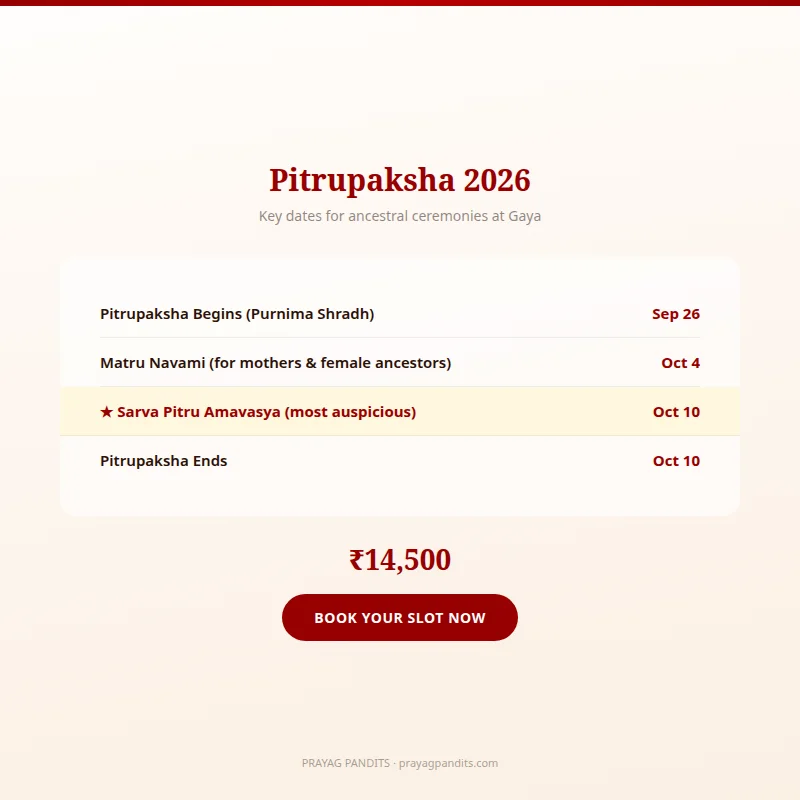
Pitrupaksha 2026 begins on September 26 with the Purnima Shradh and concludes on October 10 with Sarva Pitru Amavasya. These fifteen days are set aside entirely for ancestral rites in the Hindu calendar, and the tradition regards them as the single most auspicious period of the year for any ceremony related to departed ancestors.The key dates within the fortnight carry specific significance:- September 26 — Purnima Shradh: The first day of Pitrupaksha, for ancestors who departed on a Purnima (full moon) tithi
- October 4 — Matru Navami: The specific tithi for mothers, grandmothers, and all female ancestors on the maternal side. Families performing ceremonies primarily for mothers and maternal lineage ancestors choose this day.
- October 10 — Sarva Pitru Amavasya: The most significant day of the entire fortnight. The day for all ancestors — particularly those whose tithi of departure is unknown, and those who may have been missed in previous years' ceremonies. Every ancestor receives the merit of rites performed on Sarva Pitru Amavasya, which is why it is the most sought-after day at every major Tirth during Pitrupaksha.
How the Online Ceremony Works
The online format makes the merit of Gaya Pind Daan with Brahmin Bhoj accessible to families everywhere. The scriptural validity of this format rests on a principle the Dharmashastra texts have always upheld: the Sankalpa — the ritual declaration of intent made with one's full name, gotra, and conscious resolve — is the anchor of any Hindu ceremony. When the Sankalpa is made sincerely and correctly, the physical performance of the ceremony on behalf of the declared person is as meritorious as their own physical participation. This principle of representation by an authorized pandit, called Pratinidhi Karma, is documented in the Parashar Smriti and the Yajnavalkya Smriti.Here is the complete process from booking to ceremony completion:After Booking
Our team contacts you within 24 hours of booking to collect all the details needed for the Sankalpa: your full name, your father's name, your family gotra (lineage), and the names of the ancestors to be included in the ceremony. We also confirm your preferred date within Pitrupaksha and the video call platform you are comfortable with (WhatsApp, Zoom, or Google Meet). Sometimes due to network surge and other logistical issues, we work with available video call options. If your gotra is unknown, this is not an obstacle — our pandits are experienced in constructing the Sankalpa with the information available and have procedures for families where full ancestral details have been lost.Ceremony Day — Morning
On the day of the ceremony, the pandit begins the preparatory rituals. All puja samagri — the cooked rice for the pindas, til (sesame), honey, ghee, milk, kusha grass, flowers, incense — has been prepared specifically for your ceremony. The video call is initiated at the confirmed time. You join the call and are greeted by the pandit at the Gaya Kshetra.Sankalpa
The ceremony begins with the Sankalpa — the formal declaration of intent. The pandit recites the time, place, your name, your gotra, your father's name, and the names of each ancestor being offered the ceremony. You are present on the video call to witness this declaration. At this moment, according to the Dharmashastra tradition, the ceremony is formally linked to your lineage and your specific ancestors. Everything that follows from this point carries merit for the named individuals.Pind Daan at the Sacred Vedi (Phalgu/Vishnupad Vedi)
The pandit moves to the sacred Vedi of Gaya — the key offering platforms where the pindas are received, according to the scriptural tradition, by the Pitra Devatas. You watch this in real time. At the Vedi, the pindas are prepared and offered with the specific mantras from the Gaya tradition. The pandit explains each step as it occurs so you understand what is being done and why. The camera is positioned to show both the Vedi and the pandit performing the ceremony.The Phalgu River pinda offering is included — the same river where Sita Devi offered pindas for Dasharatha in the Ramayana account. This portion of the ceremony, performed at the water's edge, is often the most moving for families watching on the call.Brahmin Bhoj
After the Pind Daan is complete, the ceremony moves to the Brahmin Bhoj. Three learned Brahmins who have been invited and prepared for this ceremony are seated. The meal — prepared fresh that morning, sattvic throughout — is served with the recitation of the Brahmin Bhoj mantras. These mantras, drawn from the Shradh Kalpa texts, specifically direct the merit of the feeding to your ancestral lineage as established in the Sankalpa.You watch the Brahmin Bhoj in real time on the video call. When the Brahmins are served and the mantras are complete, they offer their blessings — for the peace of your ancestors and for the welfare of your family. This blessing, offered by Brahmins at Gaya after a properly conducted Brahmin Bhoj, is considered one of the most auspicious events in the tradition of ancestral rites.Closing and Documentation
The ceremony closes with the pandit's final blessings and a summary of what was performed. The complete video recording (if possible. For whatsapp video call, only portions of the screen recording without voice can be shared) of the ceremony — from the first Sankalpa through the conclusion of Brahmin Bhoj — is shared with you via WhatsApp or Google Drive within 48 hours.The total ceremony duration, from Sankalpa through Brahmin Bhoj and closing, is typically between 90 minutes and 2 hours.What Is Included
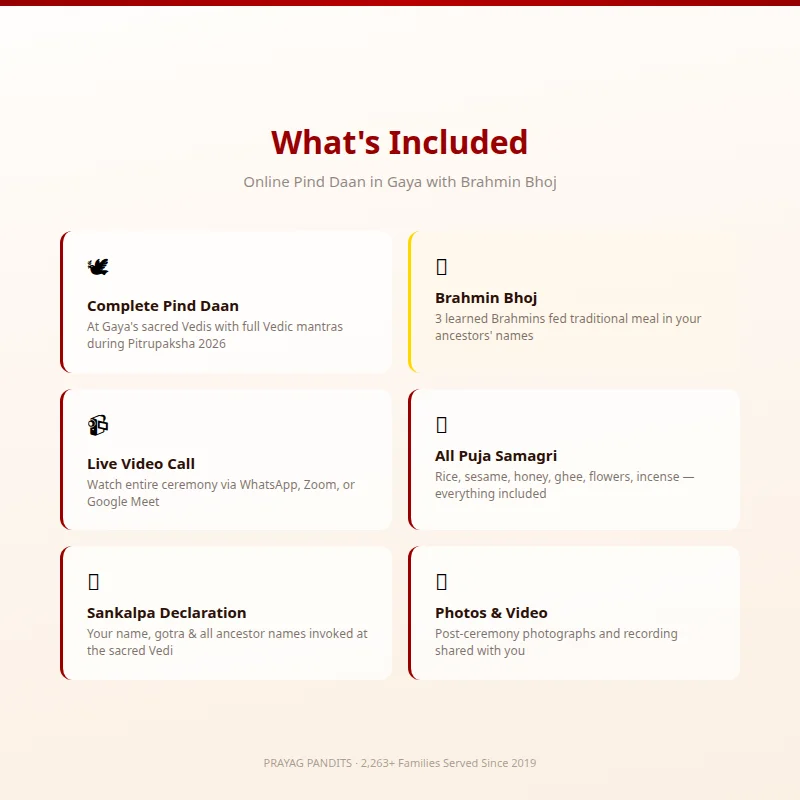
Pind Daan at Gaya
- Complete Pind Daan covering the key Vedi (Phalgu Vedi/Vishnupad Vedi) of the Gaya Kshetra during Pitrupaksha 2026
- Pandit with full knowledge of the Gaya Kshetra tradition and Gaya Mahatmya texts
- All pinda preparation materials: cooked rice, sesame (til), ghee, honey, milk, kusha grass
- All puja samagri: fresh flowers, incense, lamp, ritual items specific to Gaya tradition
- Phalgu River pinda offering included
- Sankalpa with your full name, gotra, and all specified ancestor names
Brahmin Bhoj
- Ritual feeding of 3 learned Brahmins in the Gaya tradition
- Complete traditional meal — rice, dal, sabzi, roti, sweet, fruit — freshly prepared, fully sattvic
- Brahmin Bhoj mantras recited through the feeding, directing merit to your lineage
- Brahmins' blessings for ancestral peace and family welfare at ceremony close
Online Participation and Documentation
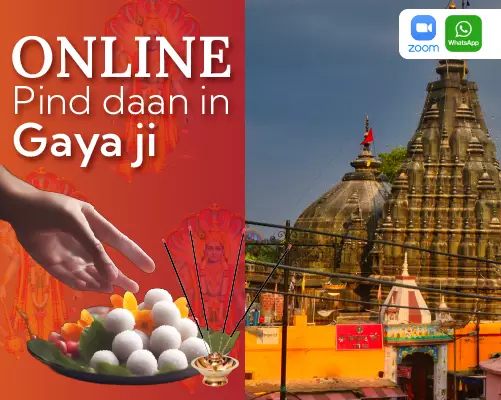
- Live video call for the entire ceremony (WhatsApp, Zoom, or Google Meet)
- Full ceremony video recording shared within 48 hours of completion (as mentioned above)
- Pre-ceremony consultation with ancestor detail collection
- Post-ceremony availability for any questions about the ceremony
What Is Not Included
- Physical presence at Gaya (this is the online package; in-person packages are linked below)
- Tarpan — a separate ceremony; families wishing to add Tarpan at Gaya can book alongside this package
- Gau Daan (cow donation) — available as an add-on
- Narayan Bali or Tripindi Shradh — separate ceremonies for specific ancestral situations involving untimely death or disrupted lineage
- Travel or accommodation at Gaya
- 3-city Pind Daan (Gaya, Prayagraj, Varanasi) — available as a separate combined package
Who Should Book This Package
This is the right ceremony for families in any of the following situations:Families who want the complete ceremony, not just the pinda offering. If your intention is to honor your ancestors as fully as the tradition allows — and you have read the scriptural context above — this package gives you both the Pind Daan and the Brahmin Bhoj that the Garuda Purana and Manu Smriti describe as the complete ancestral rite.NRI families and those living far from Gaya. Distance is the most common reason families miss this ceremony. The online format removes that barrier entirely. Families in the United States, United Kingdom, Canada, Australia, Malaysia, Singapore, and throughout the Gulf regularly book ceremonies through us during Pitrupaksha. The video call format has been used successfully by families in time zones ranging from Pacific Standard to Australian Eastern. For families in Western time zones where the morning IST ceremony corresponds to late night locally, we record the entire ceremony and share it in full — you do not miss a moment.Families performing Pind Daan for the first time. Many families carry a long-standing obligation — ancestors for whom Pind Daan was never performed, or was performed only partially. The scriptures make no distinction between a Pind Daan performed immediately after death and one performed years or decades later. The ceremony is equally valid and the merit equally complete whenever it is performed with sincere intention.Families who have already performed local Shradh and want the specific merit of Gaya. The Gaya Tirth carries a unique promise that local ceremonies, however sincerely performed, do not carry. Many families who already perform annual Shradh in their home city add a Gaya Pind Daan once in their lifetime or during significant ancestral occasions. This package, which adds Brahmin Bhoj, is the version of this ceremony the scriptures describe as fully complete.For NRI families seeking a complete guide to online ancestral rites, read: Online Pind Daan for Non-Resident Indians.Related Gaya Packages
Depending on your family's specific situation, one of these related packages may be more appropriate or may serve alongside this one:- Pind Daan in Gaya (In-Person) — For families who can travel to Gaya and wish to be physically present for the ceremony
- Online Pind Daan in Gaya (without Brahmin Bhoj) — The base package at a lower price point, for families who want the Pind Daan alone
- Online Tripindi Shradh in Gaya — For ancestors who died an untimely death (akal mrityu) or under circumstances that left the death rites incomplete
- Online Narayan Bali Poojan in Gaya — For specific ancestral difficulties that Narayan Bali is prescribed to resolve
- 3-in-1 Online Pind Daan — Prayagraj, Varanasi and Gaya — The comprehensive package covering all three major Pind Daan Tirths
Preparing for the Ceremony
To ensure the Sankalpa is precise and every ancestor is honoured correctly, please gather the following information before our team contacts you after booking:- Your full name and father's name — as they should be declared in the Sankalpa
- Your family gotra — the lineage name tracing back to a Vedic sage (e.g., Kashyap, Bharadwaj, Vashisht). If unknown, inform us and we will work with what is available.
- Names of ancestors to be included — father, mother, paternal grandfather and grandmother, maternal grandfather and grandmother, and any others. Both paternal and maternal lineage can be included.
- Hindu calendar tithi of departure for each ancestor — if known. This helps us select the most auspicious day within Pitrupaksha for each ancestor. If not known, Sarva Pitru Amavasya (October 10) covers all ancestors regardless of tithi.
- Your preferred date within Pitrupaksha — or we will recommend the most appropriate date based on the information provided.
Frequently Asked Questions
Is Brahmin Bhoj necessary along with Pind Daan, or can Pind Daan be done alone?
Pind Daan performed alone is valid and meritorious — our base package at Gaya covers exactly this. However, the Garuda Purana and the Manu Smriti both describe Brahmin Bhoj as the act that fully activates and seals the merit of the pinda offering. When a Brahmin is fed in an ancestor's name at a sacred Tirth with the appropriate mantras, the scriptures say the ancestors depart fully satisfied. Without Brahmin Bhoj, the offering reaches the ancestors but the ceremony's completion as described in the Shradh Kalpa texts is not achieved. For families who want to perform the ceremony as fully as the tradition prescribes, this combined package is the right choice.What exactly do the 3 Brahmins receive during Brahmin Bhoj?
The three Brahmins are served a complete traditional meal prepared fresh on the morning of the ceremony. The food is fully sattvic — vegetarian, without onion, garlic, or other tamasic ingredients. The standard meal in the Gaya tradition includes rice, dal, two vegetable preparations, fresh roti, a sweet item (typically kheer or halwa), and fresh fruit. The meal is served with the Brahmin Bhoj mantras recited throughout. After eating, the Brahmins offer their formal blessings for your ancestral lineage and your family's welfare.Can Brahmin Bhoj be performed for ancestors from both paternal and maternal lineage together?
Yes. Both lineages are included in a single Sankalpa. The ceremony structure in the Gaya tradition covers ancestors from both the paternal and maternal sides. You provide the names and gotra for both sides when you fill in the ceremony details after booking, and the pandit constructs the Sankalpa to address all named ancestors.We performed Pind Daan for our father last year but did not include Brahmin Bhoj. Can we do Brahmin Bhoj separately this Pitrupaksha?
Yes. Brahmin Bhoj can be performed as a standalone offering or alongside a new Pind Daan. There is no requirement that they be performed in the same calendar year. If you wish, this package performs both together — the Pind Daan and Brahmin Bhoj — as a complete ceremony this Pitrupaksha. Most families in this situation choose the combined package and receive the full merit of both ceremonies together.How is Pind Daan at Gaya different from Pind Daan at Prayagraj or Varanasi?
All three are among the most powerful Pind Daan sites in Hindu tradition. Prayagraj's Triveni Sangam carries the Matsya Purana's description of liberating seven generations on both lineages. Varanasi's Manikarnika Ghat is the site where death itself is considered liberation. Gaya's unique distinction is the specific promise made by Lord Vishnu at the Vishnupad Temple — that ancestors offered pindas at Gaya would be liberated from the cycle of rebirth. The Gaya Mahatmya texts describe this promise in greater detail than the promises associated with any other single Tirth. For families who can only choose one Pind Daan location and want the maximum depth of ancestral liberation, Gaya is the scriptural prescription. See our complete guide to Pind Daan in Gaya for a full comparison.We are based abroad and the ceremony is in the morning IST, which is the middle of the night for us. How does this work?
We record every online ceremony in full and share the complete video with you via WhatsApp or Google Drive within a few hours of the ceremony's conclusion. For families in North America, Australia, or other time zones where the IST morning ceremony is inconvenient, the recording is available the same day. The Sankalpa was declared at the ceremony with your name and your ancestors' names, which anchors the merit to your lineage regardless of whether you watch live or via recording. If you prefer to join live at whatever the IST morning corresponds to in your location, you are welcome to do so — we support both formats fully.Is there a difference between this package and booking a local pandit at Gaya independently?
The video call format provides two things that booking through unverified local channels does not: confirmed performance with full documentation, and a pandit whose credentials and knowledge of the Gaya Kshetra tradition our team has verified. Families booking through contacts they cannot oversee have no way of knowing whether the ceremony was performed at the correct Vedis, with the correct mantras, or whether the Brahmin Bhoj involved Brahmins genuinely versed in the tradition. The full video recording we share after the ceremony — showing every step from Sankalpa through the conclusion of Brahmin Bhoj — is your verification that the ceremony was performed completely and correctly.What Families Say 4.9
Last year during Pitrupaksha we had requested Prayag Pandits to arrange Brahmin Bhoj along with the online Pind Daan as a custom package. They did it beautifully but the pricing…
We are from Bhubaneswar and have been doing Pind Daan through Prayag Pandits for 2 years now. Last Pitrupaksha we asked them to add Brahmin Bhoj after the ceremony because…
पिछले पितृपक्ष में प्रयाग पंडित्स से ऑनलाइन पिंडदान करवाया था। उस समय ब्राह्मण भोज अलग से करवाना पड़ा था और खर्चा ज्यादा आया था। इस बार यह नया पैकेज देखा…
We are based in Dubai and performed online Pind Daan last year. This year we wanted Brahmin Bhoj too and found this package. The time difference was managed well —…
Second year booking with Prayag Pandits. Last year the Pind Daan at Gaya was performed very well but we had to arrange Brahmin Bhoj separately through the pandit — it…
हम पिछले साल कस्टम पैकेज से पिंडदान और ब्राह्मण भोज दोनों करवाए थे। इस बार यह पैकेज देखा तो खुशी हुई — कीमत भी कम है और सब कुछ शामिल…
First time doing Pind Daan for my late mother. I did not know about Brahmin Bhoj until the Prayag Pandits team explained its importance from the Garuda Purana. They said…