


Personally Coordinated
Our team guides you through the arrangements described in your selected package.
Performed on your behalf
Price range: ₹5,100.00 through ₹21,000.00
Per pooja
Applicable taxes are shown in your booking. Optional additions are separate.
Exclusions
Thoughtfully arranged, personally guided
Our team guides you through the arrangements described in your selected package.
Stay in touch with our team for your booking details and arrangements.
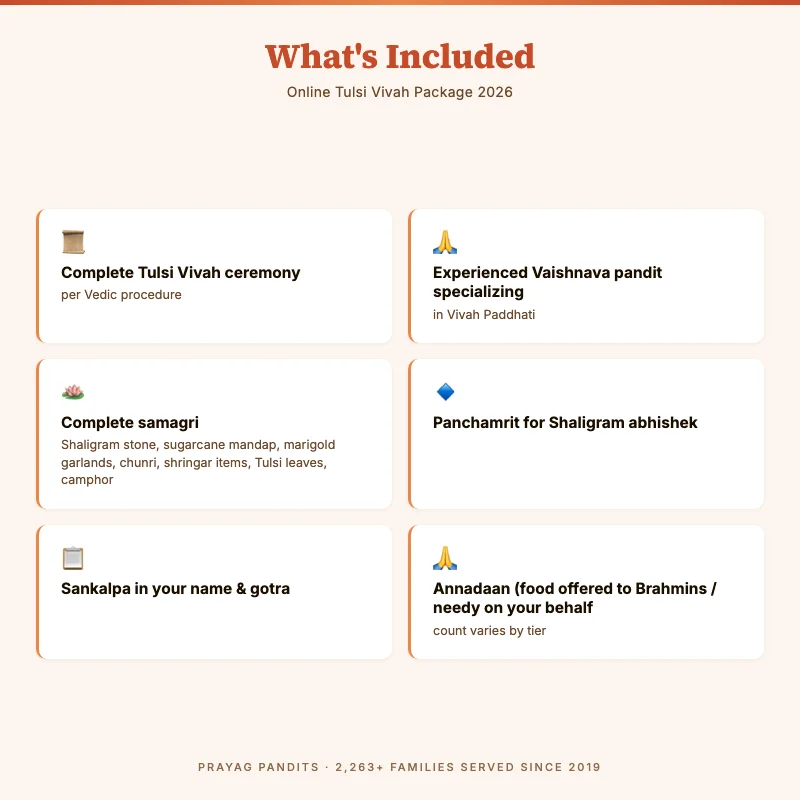
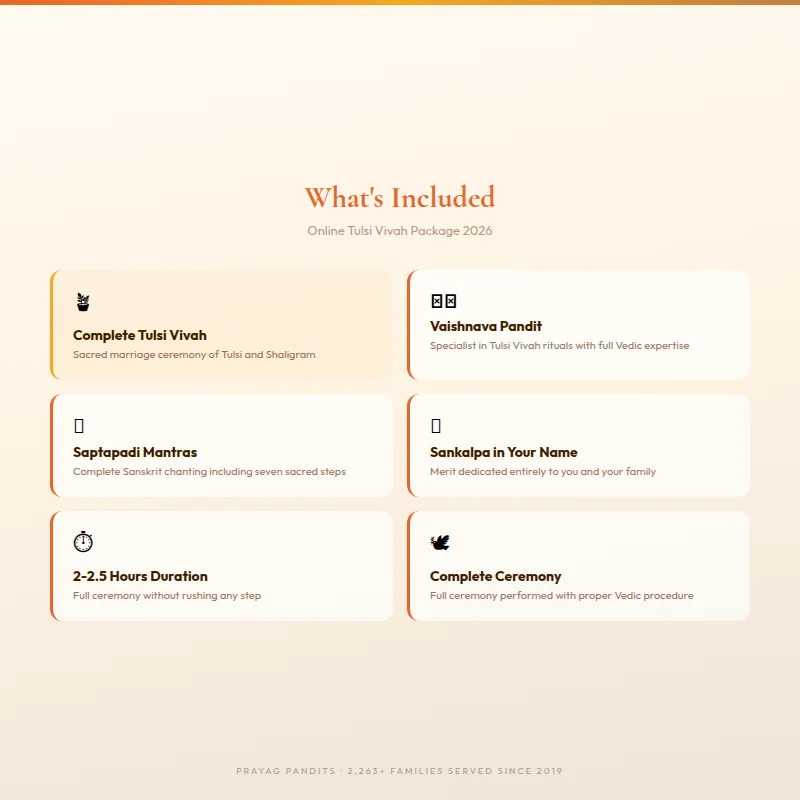
See what your selected package includes. Optional additions are shown separately.
Share your preferences with our team. Final arrangements are confirmed with you.
Experiences shared by our families
26 family reviews18 for this pooja · 8 from across our services
खूप छान सेवा. पंडितजींनी सर्व विधी व्यवस्थित केली. अतिशय समाधानी आहे.
Very satisfied with the service. The pandit arrived on time and had all the materials ready. The ceremony was conducted as per proper Vedic traditions. The team followed up after the poojan as well. 🙏
ऑनलाइन बुकिंग आसान थी। व्हाट्सएप पर जवाब तुरंत मिला। पूजा शुभ मुहूर्त में शुरू हुई और सही समय पर पूर्ण हुई। मूल्य भी उचित है। Om Shanti.
చాలా మంచి సేవ. పండిట్ జీ చాలా అనుభవజ్ఞుడు. సంతృప్తిగా ఉన్నాం.
प्रयाग पंडित्स की सेवा से पूर्णतया संतुष्ट हूँ। उनकी टीम बहुत पेशेवर है और पंडित जी का ज्ञान गहन है। दूसरों को भी सिफारिश करूँगा। Jai Shri Ram.
Had a wonderful experience. The booking process was easy and the ceremony was conducted with full devotion.
Good service by Prayag Pandits. The booking was easy and the team was responsive. The pandit was well versed and performed the poojan with sincerity. Would definitely use their services again. Dhanyavaad.
Simple booking process. Good communication on WhatsApp. The pandit was punctual and well prepared. The ceremony was performed with devotion. Fair pricing. Would recommend to anyone looking for authentic poojan services. Om Shanti.
पंडित जी ने बहुत अच्छे से समझाया और पूजा करवाई। परिवार को बहुत शांति मिली।
We were looking for reliable pandit services online and found Prayag Pandits. The experience exceeded our expectations. Professional team, knowledgeable pandits, and transparent pricing.
We were looking for reliable pandit services online and found Prayag Pandits. The experience exceeded our expectations. Professional team, knowledgeable pandits, and transparent pricing.
Had a wonderful experience with Prayag Pandits. The team is very organized and the pandits are genuine. They don’t rush through the ceremonies like some other services do. Quality work. Dhanyavaad.
Booked this for my late father. Everything was arranged perfectly. The team was professional and respectful throughout.
ऑनलाइन बुकिंग आसान थी। व्हाट्सएप पर जवाब तुरंत मिला। पूजा शुभ मुहूर्त में शुरू हुई और सही समय पर पूर्ण हुई। मूल्य भी उचित है। 🙏
The online poojan option is great for people living abroad. We could participate from our home in the UK. The video was clear and the pandit made us feel included in every step of the ceremony.
Booked this service on recommendation from a friend. Was not disappointed at all. The entire process from booking to ceremony completion was smooth. The pandit was very experienced. 🙏
The ceremony was conducted at the right muhurat time as promised. The pandit’s knowledge of the shastras was evident. We received photos and a certificate after the poojan. Very professional. 🙏
प्रयाग पंडित्स से दूसरी बार पूजा करवाई। दोनों बार अनुभव शानदार रहा। उनकी टीम पुराने ग्राहकों को याद रखती है और व्यक्तिगत ध्यान देती है। 🙏
Watching the pandit perform the rituals in real-time by the Falgu River, mentioning my father's name... it felt like we were truly there. Immense gratitude to the entire team.
Being in the USA, travelling to India just for Tarpan during Pitru Paksha was becoming very difficult. Prayag Pandits offered a well-coordinated solution.
I was skeptical about performing such a sacred ritual online from Canada. But honouring my parents in Kashi was important. They were very patient and answered all my questions.
Living in Singapore, we felt disconnected from these essential rituals. The live stream option for Tarpan at Prayagraj gave us a profound sense of connection and peace.
It was deeply important for us in Australia that the rituals were performed correctly. The ceremony reflected the authenticity we sought and was performed by a knowledgeable priest.
The Pind Daan at Kashi was handled carefully, with the pandit following every step diligently. Very reassuring.
Arranging Asthi Visarjan from Bhubaneswar seemed complex, but Prayag Pandits made it seamless. The pandit called us before the ceremony to explain every step. Very professional.
During Pitru Paksha, we booked Shradh at Prayagraj. The coordination was flawless - from date selection to the pandit assignment. Our family felt at peace after the ceremony.
YOUR EXPERIENCE MATTERS
Tell us about your ceremony and the support you received. Your email address will stay private.
From your first choice to your booking
Review your package and any available additions, then add it to your booking.
Share your contact details and booking preferences. Our team coordinates the arrangements with you.
Our team contacts you to confirm the arrangements described in your selected package.
A recording of key moments is provided within 72 hours. Live streaming is not included.
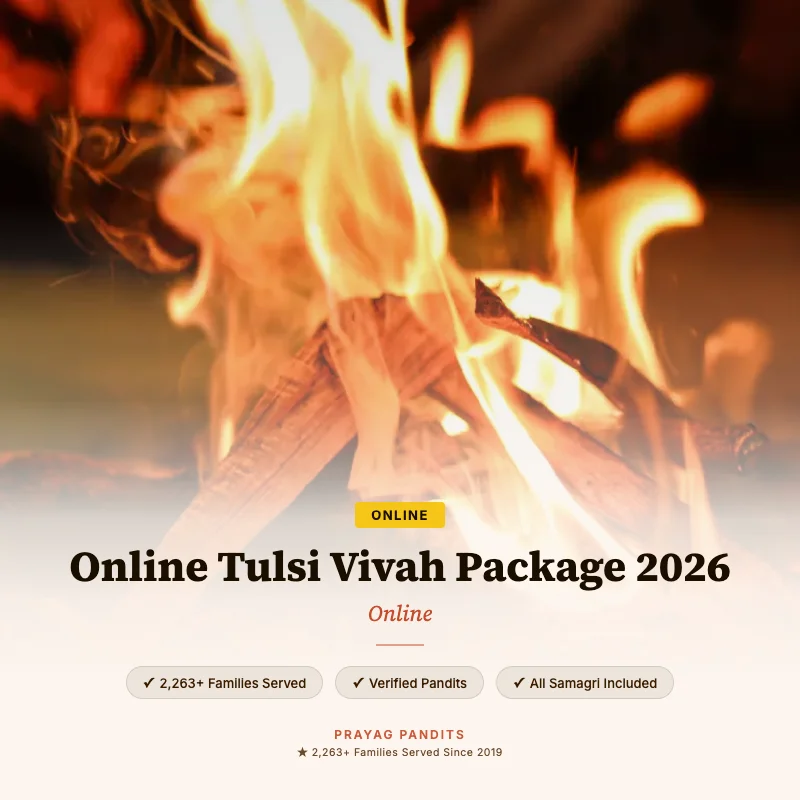
There is a moment each year when Lord Vishnu stirs from his four-month cosmic sleep, and the world rejoices. That moment is Devuthani Ekadashi — and across Hindu homes, it is marked with one of the most beautiful ceremonies in the Vaishnava calendar: Tulsi Vivah. Our Online Tulsi Vivah Package 2026 at ₹21,000 brings this auspicious wedding ceremony directly to your home, conducted by an experienced Vaishnava pandit, so every sacred moment is performed with full Vedic authenticity.
Tulsi Vivah is the ritual marriage of the Tulsi plant — Vrinda Devi, the most beloved devotee of Vishnu — to Lord Shaligram, the sacred form of Vishnu worshipped in black ammonite stone. This ceremony is not symbolic theater. According to the Padma Purana and Skanda Purana, Tulsi Devi herself desired this union with her Lord, and performing this marriage in one’s home is said to carry the merit of a thousand Ashwamedha yagnas and to fulfill the deepest longings of the heart, including the blessing of a good marriage for eligible family members.
The story of Tulsi Vivah is rooted in the Bhagavata and Padma Puranas. Vrinda Devi, the devoted wife of the demon king Jalandhar, was so pure in her chastity that no force could defeat her husband as long as her virtue held. When her chastity was broken by divine intervention, she cursed Vishnu — and in atonement, Vishnu granted her the boon of residing eternally as the Tulsi plant and becoming his most beloved. She remains the only plant worshipped as a goddess in Vedic tradition, and her marriage to Shaligram — performed annually — is the fulfilment of her divine love story.
This ceremony carries several layers of significance:
The Padma Purana explicitly states that performing Tulsi Vivah is equivalent to the merit of Kanya Daan — the gifting of a daughter in marriage — which is considered the highest act of generosity in Hindu dharma. The purana declares: whoever performs the marriage of Tulsi with Shaligram on Devuthani Ekadashi attains merit equal to marrying off a thousand daughters, and the sins of seven lifetimes are destroyed.
This equivalence matters deeply for several groups of devotees:
Because Maa Tulsi is considered a form of Maha Lakshmi herself, her Vivah carries blessings of prosperity, marital harmony, and household abundance to every family that performs it with sincerity.
The tradition is consistent and clear in its enumeration of benefits. These are not vague spiritual promises — they represent the accumulated understanding of saints and scholars across many centuries:
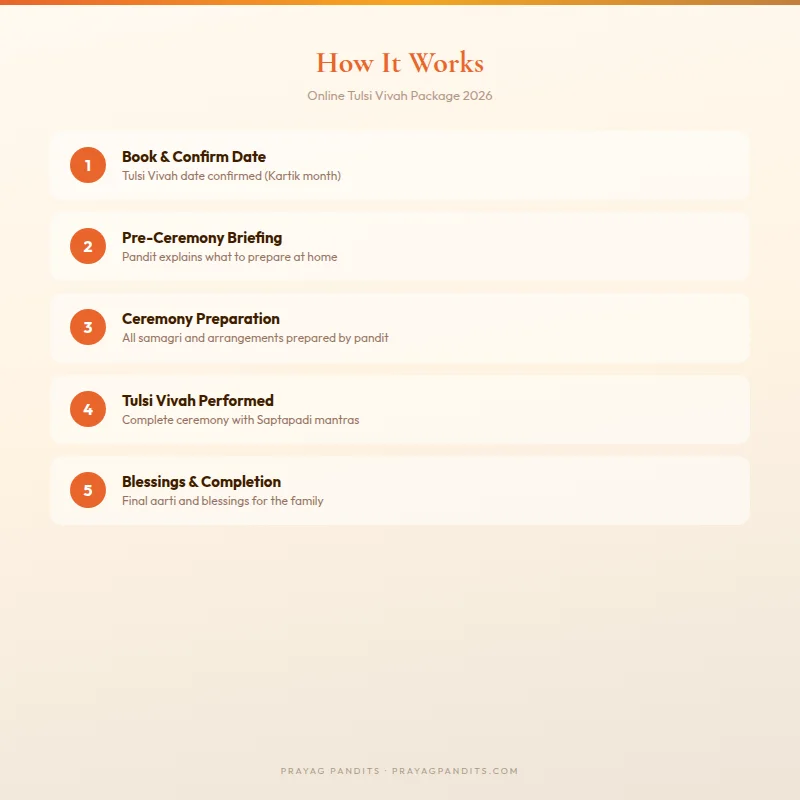
On the morning of Devuthani Ekadashi, your Tulsi plant is bathed and adorned with fresh clothes. The Shaligram is placed near the Tulsi, and sugarcane sticks are arranged around them to form the traditional wedding canopy (mandap). Our pandit guides this setup over a brief preparatory call before the ceremony begins.
The main ceremony opens with the worship of Lord Ganesha to remove all obstacles. A sacred Kalash — a pot filled with water, mango leaves, and coconut — is established as a symbol of divine presence. All invocations are performed with Sanskrit mantras by the pandit performing the ceremony.
The Shaligram is bathed with Panchamrit — the five sacred substances — while Vishnu Sahasranama or Shaligram-specific stotras are recited. This purification prepares the Lord to receive his bride.
This is the heart of the ceremony. The pandit recites the wedding mantras from the Vivah Paddhati as you perform the symbolic actions — offering flowers to Tulsi, circling the mandap, and taking the seven sacred steps with Tulsi and Shaligram together. This is the moment of the actual marriage.
A sacred thread is tied around the Tulsi plant as the mangalsutra, and sindoor is applied — mirroring the customs of a traditional Hindu wedding. The pandit recites the Mangalashtaka blessings during this step.
The ceremony concludes with the Tulsi Aarti and Vishnu Aarti performed together. Prasad is distributed to all family members present, and the pandit concludes with direct blessings for your household.
Tulsi Vivah brings blessings to entire households, but it holds particular meaning for certain situations:
To explore all our online puja services, visit our complete services page where we list every ceremony we offer.
Online ceremonies require a different kind of care than in-person rituals. Our pandits are specifically experienced in conducting virtual ceremonies with the same reverence and completeness they bring to physical ones.
We have performed online Tulsi Vivah ceremonies for hundreds of families across India and abroad. The digital medium does not diminish the sanctity — what matters is the sincerity of devotion and the correctness of the ritual, both of which we ensure in full.
Devuthani Ekadashi in 2026 falls in October or November based on the lunar calendar. Once you book, our team confirms the exact Ekadashi tithi and helps you select the appropriate muhurta within that day. We announce the confirmed date several months in advance.
Yes, ideally you should have a living Tulsi plant (Ocimum tenuiflorum) in your home — the living plant is central to this ritual. If you do not have one, our team can advise on sourcing a small plant ahead of the ceremony. We do not perform the ceremony with symbolic substitutes.
A Shaligram stone is part of what we coordinate for the ceremony. If your family already owns a Shaligram that you regularly worship, you are welcome to use yours — simply inform us at the time of booking so we can adjust accordingly.
Generally, auspicious ceremonies like Tulsi Vivah are not performed during Sutak — the ritual mourning period following a death in the family, typically 10 to 13 days. If your mourning period overlaps with Devuthani Ekadashi, please discuss your situation with our pandit before booking. In some traditions, exceptions are made for specific circumstances.
After Tulsi Vivah, the plant is regarded as a married member of the household. The primary ongoing duties are: watering her daily, lighting a diya in front of her each evening, and offering fresh water with a small prayer each morning. The Tulsi plant should not be touched on Sundays, Ekadashi tithis, and during eclipse periods. Our pandit explains these observances in full at the close of the ceremony.
We take this possibility seriously and always have a backup plan in place. If your internet connection fails or you experience technical difficulties, contact us immediately. The ceremony is recorded in full regardless, and we schedule a brief recap call after the ceremony so your pandit can recite blessings directly to you and answer any questions you have. The Sankalpa having been taken in your name ensures the merit reaches you regardless of technical interruptions.