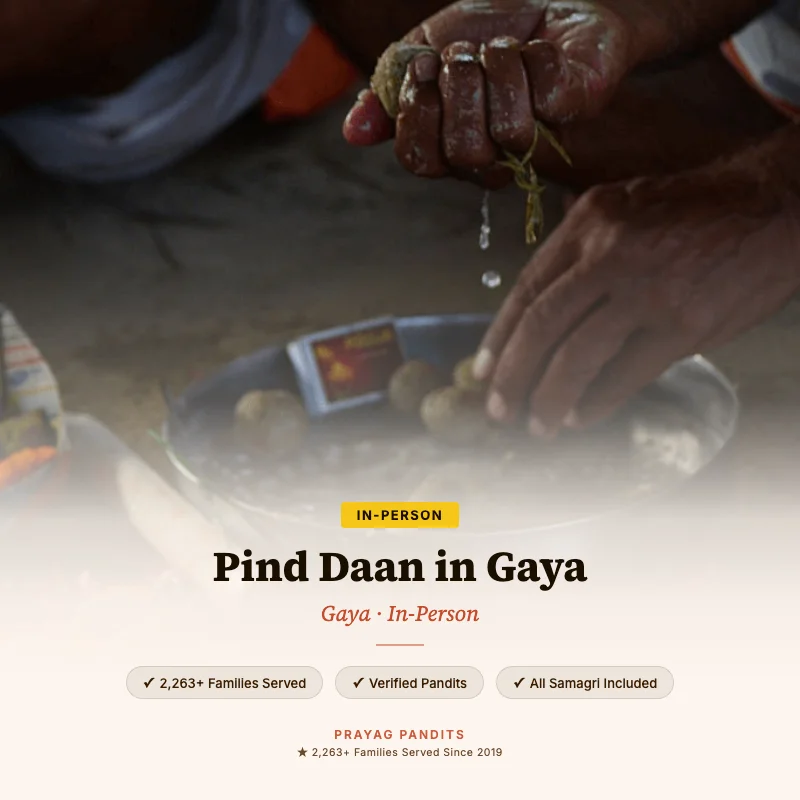

Pind Daan in Gaya

3581 Devotees have booked this package!

994 in stock

Select Currency

Original price was: ₹11,000.00.Current price is: ₹7,100.00.

994 in stock

100% Secure Payment

Gaya, Bihar is the top preferred place by Hinduism to perform Pind Daan here. Purohits/Pandas over the bank of the river perform pind daan here. Book your priest now, to get the poojan service over Gaya at a fixed price.

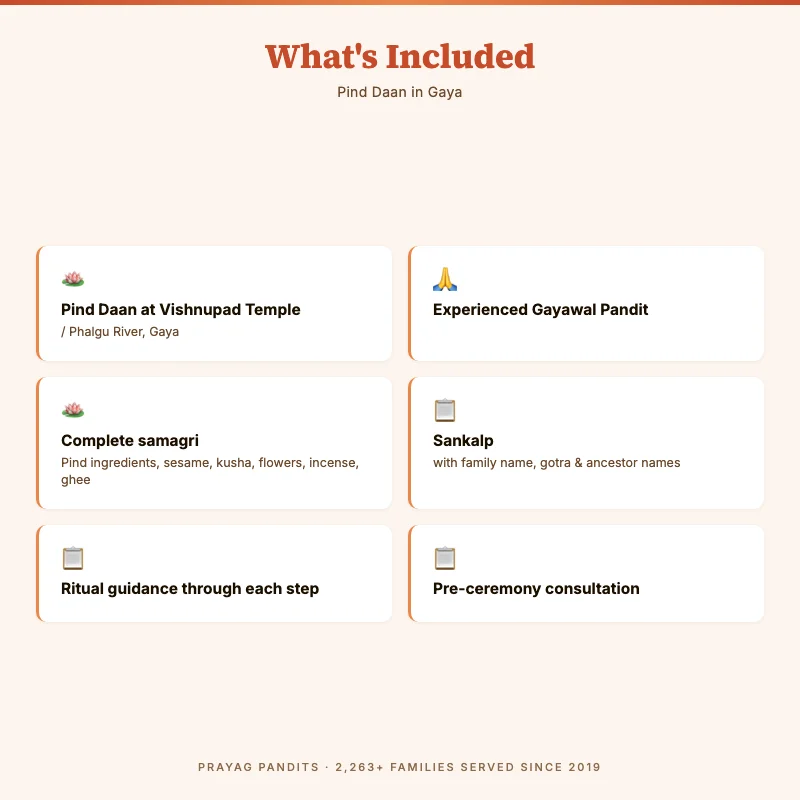
Here are the following things included in the poojan package:-

  • Pind Daan at Vishnupad Temple/Phalgu River
  • Priest Charges
  • Poojan Material
  • Guide support

Exclusions:-

  • Any extra offerings to the priest.
  • Pick and drop charges from the station/airport.

Note: The pooja will be conducted over the bank of the Phalgu river in Gaya.

Pind Daan in Gaya is among the most sacred ancestral rites a Hindu family can perform. For thousands of years, the city of Gaya in Bihar has been the foremost destination for pitru karma — the rituals performed to release departed souls from the cycle of rebirth and lead them toward moksha. Our Prayag Pandits team arranges pind daan in Gaya with experienced Gayawal Brahmin pandits, complete puja samagri, and full coordination of rituals at Vishnupad Temple and the sacred ghats of the Phalgu River. If your elders have passed on and you wish to fulfil your dharmic duty toward them, this is the service that brings that intention to life.

Gaya holds a distinction that no other pilgrimage site can claim: Lord Vishnu Himself left His divine footprint here, sanctifying this earth as a tirtha (sacred crossing) for all souls seeking liberation. The Garuda Purana states directly that every step taken toward Gaya earns the pilgrim merit that moves the souls of ancestors toward heaven. This is not mythology alone — it is a living tradition observed by millions of families every year, especially during Pitrupaksha.

What Is Pind Daan?

Pind Daan is the offering of rice balls — called pindas — to the souls of deceased ancestors. The word “pinda” comes from Sanskrit, meaning a round object or body. Each pinda offered during the ritual is considered a symbolic nourishment provided to the ancestral soul, giving it strength for its onward journey.

The roots of Pind Daan go back to the Vedic period. The Rigveda contains early references to ancestral worship, while the Garuda Purana dedicates extensive chapters to explaining the exact procedure, the significance of each offering, and the merit gained by performing the rite at different sacred locations. The concept rests on the idea of pitru rin — the debt owed to ancestors. Every person is born carrying three fundamental debts: to the gods (deva rin), to the sages (rishi rin), and to the ancestors (pitru rin). Pind Daan is the primary means of repaying pitru rin.

The ritual involves preparing pindas from cooked rice mixed with sesame seeds, barley, honey, and flowers. These are offered on specific altars called vedis while the officiating pandit chants Vedic mantras. Tarpan — the offering of water mixed with sesame seeds and kusha grass — accompanies pind daan as a libation for the ancestors. Together, these acts form the complete shradh karma that gives an ancestral soul the peace it needs to move forward.

For a deeper understanding of the ritual, visit our guide: Pind Daan 101 — Comprehensive Guide to Meaning, Significance and Benefits.

Why Gaya Is the Holiest Place for Pind Daan

Of all the sacred places for performing pind daan in India, Gaya stands alone. The Vayu Purana, Vishnu Purana, and Garuda Purana all single out Gaya as the supreme kshetra (sacred field) for ancestral rites. The reasons are rooted in both mythology and the concentrated spiritual energy of the land itself.

The Story of Gayasura

Long ago, a demon named Gayasura performed such intense tapasya (austerities) that even the gods became concerned. Lord Vishnu, pleased with his penance, granted him a boon: that the very touch of Gayasura’s body would grant moksha to any soul. Vishnu then pressed His divine foot onto Gayasura’s head to stop the liberation of undeserving souls — and that divine footprint became the Vishnupad Temple, the beating heart of Gaya’s spiritual power.

This legend is the reason pind daan performed at Vishnupad is considered infinitely more meritorious than the same ritual performed elsewhere. The land itself carries the imprint of Vishnu’s grace.

Lord Brahma’s Yagna at Gaya

The Mahabharata and the Vayu Purana describe how Lord Brahma himself performed a great yagna (fire sacrifice) at Gaya. During this yagna, all the sacred tirthas of the world gathered here, making Gaya into a confluence of all holy rivers and pilgrimage sites. This is why pind daan at Gaya is equivalent to performing the ritual at every major tirtha simultaneously.

The Sacred Phalgu River

The Phalgu River flowing through Gaya carries its own extraordinary significance. According to tradition, Mata Sita — Lord Rama’s consort — performed pind daan for King Dasaratha on the banks of the Phalgu. The river’s sand retains the power to accept ancestral offerings even when the surface water runs dry. Tarpan and pind daan at the Phalgu ghat are considered among the most potent acts of pitru karma anywhere in the Hindu tradition.

The 360 Vedis of Gaya Kshetra

Gaya Kshetra is not a single spot but an entire sacred region containing over 360 vedis — designated altars at which ancestral rites can be performed. Each vedi is associated with a different deity, sacred site, or scriptural injunction. Performing pind daan at the principal vedis — particularly Vishnupad, Akshayavat, Pretshila, Ram Gaya, and Sita Kund — is said to liberate not just the immediate ancestors but generations going back seven births on both the paternal and maternal sides.

This extraordinary range is why our package coordinates rituals at multiple significant locations within Gaya Kshetra, not just a single ghat.

Read more about the Vishnupad Temple Gaya and its history and architecture.

Who Should Perform Pind Daan in Gaya?

Pind Daan is a duty, not merely a choice. Hindu scripture makes it clear that performing this ritual is an obligation for every householder whose parents or elders have passed away. However, there are specific situations in which visiting Gaya becomes especially important:

  • After the death of parents or grandparents — Performing pind daan at Gaya within a year of a parent’s death, or during the first Pitrupaksha after their death, is considered highly auspicious and fulfils the primary obligation of pitru rin.
  • During Pitrupaksha every year — Even families who have performed initial rites may choose to visit Gaya during the annual Pitrupaksha period (the 16 days of the dark fortnight in Bhadrapada month) to continue offerings for all departed ancestors.
  • When Pitru Dosha is present — If your family’s horoscope contains Pitru Dosha (also written as Pitra Dosha), performing pind daan at Gaya is among the most effective remedies. Symptoms may include persistent financial struggles, repeated delays in marriage proposals, unexplained health problems, or difficulty having children. Our post on Pitru Dosha Nivaran explains the signs in detail.
  • For unmarried or childless ancestors — The souls of ancestors who died unmarried, without children, or under difficult circumstances need special rites. Gaya is one of the few places where these souls can receive complete liberation. Learn more about who performs pind daan for childless or unmarried ancestors.
  • Annual shradh obligation — Every year, on the tithi (lunar date) of a family member’s death, shradh should be performed. Performing this at Gaya periodically gives cumulative benefit to all ancestral souls in the lineage.

What Is Included in Our Pind Daan in Gaya Package

Our service is end-to-end. You do not need to arrange anything separately. Here is exactly what is covered when you book with us:

  • Experienced Gayawal Brahmin Pandit — All pind daan in Gaya is traditionally performed by Gayawal Brahmins, a hereditary priestly community whose families have served pilgrims at Gaya for generations. We arrange a qualified, learned Gayawal who knows the full Vedic procedure and will guide you throughout.
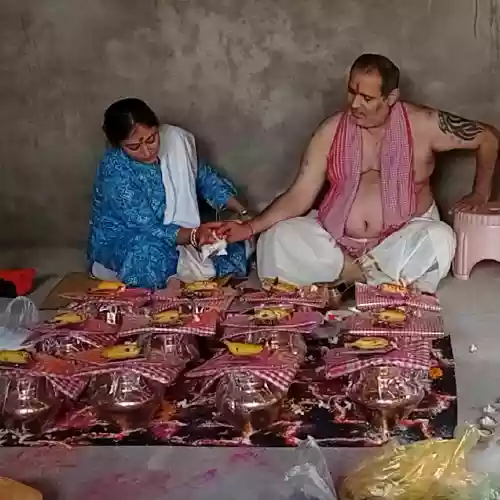
  • Complete Puja Samagri — All ritual materials are arranged on your behalf: rice flour (for pindas), sesame seeds, barley, honey, flowers, kusha grass, gangajal, incense, diyas, and all other items specified in the shradh vidhi.
  • Sankalp Ceremony — The ritual formally begins with a sankalp, in which you state your name, gotra (lineage), the names of ancestors for whom you are performing the rite, and your intention. Our pandit guides you through this in a clear and correct manner.
  • Tarpan at Phalgu River Ghat — Water offerings (tarpan) for all departed ancestors are performed at the designated ghat on the Phalgu River, following the correct mantras for each ancestral generation.
  • Pind Daan at Vishnupad Temple Vedi — The central ritual: offering of pindas at the vedi within Vishnupad Temple complex or at the designated spot on the Phalgu ghat, as prescribed by scriptural tradition.
  • Rituals at Additional Key Vedis — Depending on the scope of your package, rites may be extended to Akshayavat, Ram Gaya, and other significant vedis within the Gaya Kshetra.
  • Guidance Throughout — Our pandit will explain each step of the ritual as it is performed. You will understand what you are doing and why — not just go through motions.
  • Coordination and Logistics Support — Our team handles all logistics: scheduling with the pandit, arranging materials, managing the sequence of rituals, and communicating with you before and during the service.

If you would like a more comprehensive package that also includes Gau Daan (cow donation), see our Pind Daan Gaya Platinum Package with Gau Daan. For a 3-day extended ritual, our Pitrupaksha Special Pind Daan Poojan in Gaya (3 Days) is available as well.

Step-by-Step Process: How Pind Daan in Gaya Is Performed

Understanding the ritual helps you participate meaningfully and experience its full spiritual benefit. Here is the sequence followed:

Step 1: Arrival and Preparation

Pilgrims arrive at Gaya and ideally take a purifying bath at the Phalgu River ghat before the ritual begins. Wearing fresh, clean, preferably white clothing is the tradition. Our pandit will meet you at the designated location.

Step 2: Sankalp

The Sankalp is the formal declaration of intent. You sit with the pandit, who guides you in stating your name, your gotra, and the names of the ancestors for whom you are performing the rite. The sankalp is chanted in Sanskrit and establishes the spiritual contract of the ritual.

Step 3: Tarpan at Phalgu River

Standing at the river’s edge or ghat, you offer tarpan — water mixed with sesame seeds and kusha grass — to ancestors on the paternal side (pitru paksha) and maternal side (matru paksha) while the pandit chants the appropriate mantras. Each water offering is specifically dedicated to a generation of ancestors.

Step 4: Pinda Preparation

The pandit prepares the rice pindas according to the correct ritual specifications: cooked rice mixed with sesame, barley, and honey, shaped into round balls of specific sizes. These pindas represent the physical nourishment given to the ancestral soul.

Step 5: Pind Daan at Vishnupad Vedi

The pindas are placed on the sacred vedi at Vishnupad or the designated spots on the Phalgu ghat while Vedic mantras are chanted. You place the pindas with your own hands, guided by the pandit — this physical act of offering is essential to the ritual’s validity.

Step 6: Brahmin Bhoj (Optional)

After the ritual, feeding a qualified Brahmin is considered an integral part of shradh. This may be arranged as an add-on to the standard package. Read about why Brahmin Bhoj is considered so important.

Step 7: Concluding Prayers and Prasad

The ritual closes with prayers for the liberation and peace of the ancestral souls. The pandit leads a final prayer asking that the departed receive the benefit of the offering and attain sadgati — the upward journey of the soul toward moksha.

Important Vedis and Sacred Locations in Gaya

Gaya is a city of ritual geography. Each location within it holds a specific spiritual function. Our rituals are conducted at the appropriate locations based on the service you book:

  • Vishnupad Temple — The most sacred location in Gaya. Houses the 40-cm footprint of Lord Vishnu embedded in solid rock. The vedi here is considered the most potent for pind daan. Only Hindus are permitted entry.
  • Phalgu River Ghats — The ghats along the Phalgu are the primary site for tarpan and initial pind offerings. The river carries the blessing of Mata Sita’s ancestral offerings and the collective merit of millions of pilgrims across centuries.
  • Akshayavat (Undying Banyan Tree) — Inside Vishnupad Temple precinct stands the Akshayavat, an ancient banyan tree under which Lord Rama and Mata Sita are said to have performed pind daan for King Dasaratha. Offerings made here are considered “akshaya” — inexhaustible in their merit. Learn more about the vital role of Akshayavat in Gaya Shradh.
  • Pretshila Hill — A hill located a few kilometres from central Gaya, considered the resting place of ancestral spirits awaiting liberation. Pind offerings at Pretshila are especially significant for souls who died a difficult or untimely death.
  • Ram Gaya (Ram Shila Hill) — Associated with Lord Rama’s visit to Gaya to perform pind daan for his father. A pind offering here connects your karma to the lineage of Ram’s devotion.
  • Mangla Gauri Temple — One of the 18 Shakti Peethas, this temple dedicated to Goddess Mangla Gauri sits atop a hill in Gaya. Worship here is considered essential for overall auspiciousness during the Gaya yatra.

Best Time to Perform Pind Daan in Gaya

While pind daan in Gaya can be performed at any time of year, certain periods carry heightened spiritual merit:

Pitrupaksha — The Most Sacred Period

The 16-day period of Pitrupaksha (Shradh Paksha), falling in the dark fortnight of the Hindu month of Bhadrapada, is the most auspicious time for all ancestral rites. During this period, the boundary between the world of the living and the realm of ancestors is considered thin, and offerings made reach departed souls with exceptional clarity.

Pitrupaksha 2026 dates: September 26 to October 10, 2026.

Gaya sees its largest influx of pilgrims during Pitrupaksha. Lakhs of families from across India and the world come to perform pind daan during these 16 days. Booking your service in advance is essential during this period.

See our complete guide: Pitrupaksha 2026 — Complete Guide to Dates, Rituals and Regional Practices.

Amavasya (New Moon) Days

Every Amavasya throughout the year is considered auspicious for ancestral offerings. Performing pind daan at Gaya on any Amavasya carries significant merit. Sarva Pitru Amavasya — the final day of Pitrupaksha (October 10, 2026) — is the most significant of all Amavasya dates for this purpose.

Death Anniversary (Masik Shradh)

Performing pind daan at Gaya on the tithi (lunar date) corresponding to an ancestor’s death is particularly meaningful. It directly fulfils the annual shradh obligation for that specific soul.

Year-Round Availability

Our service is available throughout the year. If you cannot travel during Pitrupaksha, any auspicious date works — we coordinate with the Gayawal Brahmin pandit to determine the best muhurat based on your travel dates and family requirements.

How to Reach Gaya

Gaya is well-connected to major Indian cities. Here is how to plan your journey:

By Train

Gaya Junction (station code: GAYA) is on the main Grand Chord railway line between Delhi and Kolkata. Express trains run from Delhi (approximately 12-14 hours), Varanasi (approximately 3-4 hours), Kolkata (approximately 5-6 hours), and Patna (approximately 2 hours). The station is roughly 1 km from Vishnupad Temple — auto-rickshaws and taxis are readily available.

By Air

Gaya International Airport (GAY) is located about 8 km from the city centre. It connects to Delhi, Kolkata, and several international Buddhist pilgrimage destinations (Bangkok, Colombo, Rangoon). The airport is also a gateway to Bodhgaya, located 13 km away.

By Road

  • From Patna: Approximately 100 km via NH 83 — roughly 2 to 2.5 hours by road.
  • From Varanasi: Approximately 250 km — roughly 4 to 5 hours. Many pilgrims combine visits to both cities.
  • From Kolkata: Approximately 480 km — roughly 8 hours on NH 19.
  • From Delhi: Approximately 1,000 km — best reached by train or flight.

For local transport within Gaya, cycle-rickshaws, auto-rickshaws, and taxis are available. The main pilgrimage sites (Vishnupad Temple, Phalgu ghats, Akshayavat) are all within a walkable or short-ride distance from each other.

How to Book Your Pind Daan in Gaya

Booking with us is straightforward. Here is what to do:

  1. Add to Cart and Place Your Order — Select this product and complete the order. You will receive a confirmation by email.
  2. Call or WhatsApp Us — Once your order is placed, reach our team on +91 7754097777 to confirm your travel dates and share the details we need for the sankalp.
  3. Share the Required Details — We will need: the full name and gotra (family lineage) of the person booking, the names of ancestors for whom pind daan is to be performed, your preferred date of ritual, and any specific requests (e.g., adding Brahmin Bhoj or extending to additional vedis).
  4. We Coordinate Everything — Our team arranges the Gayawal Brahmin pandit, all ritual materials, and scheduling on your behalf. You simply arrive at the meeting point on the agreed date.

If you cannot travel to Gaya in person, consider our Online Pind Daan in Gaya — performed on your behalf by our pandit at Vishnupad, with a live video call so you can witness and participate remotely. We also offer Tarpan in Gaya as a standalone service.

For families wishing to perform ancestral rites at multiple sacred locations, our 3-in-1 Pind Daan Package at Prayagraj, Varanasi and Gaya is an excellent option.

Frequently Asked Questions

Can Pind Daan be done without going to Gaya in person?

Yes. We offer a fully managed Online Pind Daan in Gaya service where our pandit performs the complete ritual at Vishnupad and the Phalgu ghat on your behalf. You join via live video call, participate in the sankalp, and witness the ritual in real time. This option is particularly useful for NRIs and families who are unable to travel. The ritual carries full scriptural validity when performed with correct mantras and materials by a qualified Gayawal Brahmin.

How many days does Pind Daan in Gaya take?

A standard pind daan in Gaya — including tarpan and pind offerings at Vishnupad and Phalgu ghat — is completed in a single day, typically in 3 to 5 hours. However, if you wish to perform rites at additional vedis within Gaya Kshetra (Pretshila, Ram Gaya, Akshayavat), or include Brahmin Bhoj and visits to temples like Mangla Gauri, plan for 2 full days. Our 3-day Pitrupaksha Special package covers the most comprehensive circuit of Gaya’s sacred sites.

What should I carry for Pind Daan in Gaya?

We arrange all ritual materials (puja samagri). From your side, you should carry: a photo of the deceased ancestor if available, your family gotra name (ask elderly relatives if you are unsure), spare white or light-coloured clothing for the ritual, any specific items the deceased was particularly fond of (these can sometimes be included in the offerings at the pandit’s discretion), and your own water bottle and snacks for the journey. We handle everything else.

Can women perform Pind Daan in Gaya?

Yes. Women can and do perform Pind Daan in Gaya. The tradition itself is rooted in Mata Sita’s pind daan for King Dasaratha at the Phalgu River — one of the most celebrated instances of this ritual in all of Hindu scripture. In fact, daughters performing pind daan for their parents is considered especially meritorious. Our Gayawal Brahmin pandit will guide women through every step of the procedure with full respect and care.

What is the best month to perform Pind Daan in Gaya?

The best period is Pitrupaksha — the 16 days of the dark fortnight in Bhadrapada month (August–September). In 2026, Pitrupaksha runs from September 26 to October 10. After Pitrupaksha, Amavasya dates throughout the year are the next most auspicious. Gaya also sees pilgrims during Chaitra and Kartik months. That said, pind daan at Gaya carries merit at any time of year — the sanctity of the kshetra is not limited to any single season.

Can NRIs book the Pind Daan in Gaya service remotely?

Absolutely. We have served families from Singapore, Malaysia, the United Kingdom, the United States, Canada, Australia, and many other countries. For in-person visits, we assist with scheduling and logistics. For remote bookings, our Online Pind Daan in Gaya package is specifically designed for NRI families. You book online, provide the required details, and our team handles everything at Gaya while you participate via video call from anywhere in the world. Contact us on +91 7754097777 or WhatsApp for a conversation about your specific situation.

18 reviews for Pind Daan in Gaya

  1. Megha Bhandari

    Very professional service. The pandit ji explained every step of the ritual which helped us understand the significance. Everything was arranged well including the samagri. We are grateful to Prayag Pandits for making this spiritual journey meaningful. Jai Shri Ram.

  2. Ramesh Dubey

    Third time booking with Prayag Pandits. Always reliable service. The pandits are well versed in the scriptures and perform rituals with full devotion. The pricing is fair and transparent. No hidden charges.

  3. Kiran Nair

    Good service overall. The pandit was on time and well prepared. He guided us through each step of the ceremony. The booking process was simple and the team was responsive on WhatsApp. Would recommend to others. Om Shanti.

  4. Neha Srivastava

    Smooth experience from start to finish. The live video call gave us peace of mind that everything was done correctly.

  5. Deepa Shukla

    We had been wanting to perform Pind Daan for years but couldn’t travel to India. This online service was a blessing. The entire ritual was done as per shastras. Thank you Prayag Pandits team for your dedication.

  6. Pankaj Bajpai

    Performed Pind Daan here during Pitrapaksha. The entire process was smooth. Pandit ji was very cooperative and explained the mantra meanings. The prasad distribution was also well organized. A truly fulfilling experience. Om Shanti.

  7. Bhavna Hegde

    हमने अपने पिता जी के श्राद्ध के लिए यह सेवा बुक की थी। पंडित जी बहुत अनुभवी थे और सभी विधि-विधान शास्त्रोक्त तरीके से करवाए। सामग्री की व्यवस्था भी उन्होंने ही की। बहुत अच्छा अनुभव रहा। Om Shanti.

  8. कविता अग्रवाल

    बहुत भरोसेमंद और professional टीम है। अगली बार भी इन्हीं से सेवा लेंगे।

  9. Priya Gupta

    We are settled abroad and wanted to perform the puja in Prayagraj. Prayag Pandits made it possible. Grateful.

  10. Ravi Shankar

    We came from Delhi specifically for this puja. The whole process was smooth and the pandit ji guided us patiently. Highly recommend.

  11. Sanjay Gupta

    Outstanding service for Pind Daan. The pandit arrived early, set up everything neatly, and began the ceremony right on time. His pronunciation of Sanskrit shlokas was impeccable. Very authentic experience. 🙏

  12. Harish Dixit

    Smooth experience from start to finish. The live video call gave us peace of mind that everything was done correctly.

  13. Satish Upadhyay

    हमने गया जी में पिंडदान करवाया। पंडित जी ने विष्णुपद मंदिर से लेकर फल्गु नदी तक सभी स्थानों पर विधि-विधान से पूजा करवाई। बहुत शांति मिली।

  14. विकास गुप्ता

    हमने अपने पिताजी के लिए यह पूजा करवाई। सब कुछ बहुत अच्छे से हुआ। पंडित जी बहुत अनुभवी थे।

  15. Garima Thapa

    We booked this for our grandfather’s annual shradh. The ceremony was performed with great reverence. Pandit ji even shared stories from the Garuda Purana which were very enlightening for the younger generation. Om Shanti.

  16. संजय तिवारी

    ऑनलाइन video call पर पूजा हुई, सब कुछ सही तरीके से हुआ। बहुत अच्छा अनुभव।

  17. Lalita Tripathi

    We had been wanting to perform Pind Daan for years but couldn’t travel to India. This online service was a blessing. The entire ritual was done as per shastras. Thank you Prayag Pandits team for your dedication. 🙏

  18. दीपा मिश्रा

    पंडित जी ने बहुत अच्छे से समझाया और पूजा करवाई। परिवार को बहुत शांति मिली।

Add a review

Your email address will not be published. Required fields are marked *

Pind Daan in Gaya
0

No products in the cart.