




No rituals selected yet.
Browse Pooja Packages →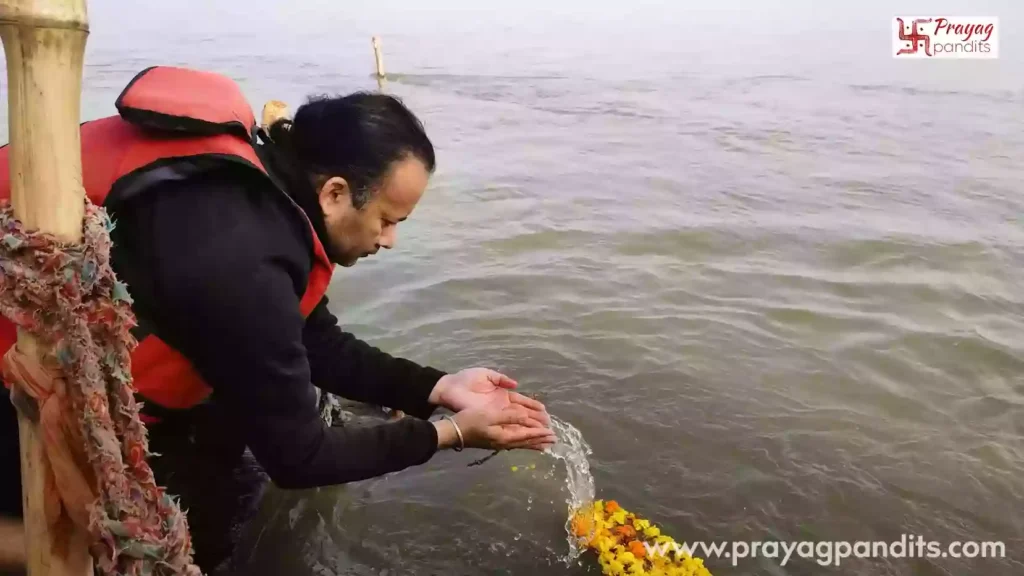






Tarpan in Prayagraj
₹5,100
₹8,999
43% off
per family · all-inclusive
Verified Pandits
Since 2019
All Samagri Included
Free Cancellation
Why Families Choose Us
How It Works
1
Book & Confirm Your Date
Select your preferred date and complete the booking. Our team calls you within 2 hours to confirm details.
2
Share Family Details
Provide gotra, departed soul's name, and any requirements. Don't know your gotra? Our pandits will help.
3
Ritual Performed at Sacred Site
A Veda-trained pandit performs the complete ceremony as per shastra at the designated holy teerth.
4
Confirmation & Documentation
Booking confirmation on WhatsApp. Digital documentation available on select poojas within 48 hours.
What's Included
- Poojan samagri
- Pandit ji dakshina
- Tarpan Poojan
- Guide Support
- Any extra offerings to the priest.
- Pick and drop charges from the station/airport.
About This Ritual
At the meeting point of three sacred rivers — the Ganga, the Yamuna, and the invisible Saraswati — lies one of the holiest acts a son or daughter can perform for their departed ancestors. Tarpan at the Triveni Sangam in Prayagraj is not merely a ritual. It is an act of love, of duty, and of deep faith rooted in thousands of years of Hindu tradition.
The Matsya Purana declares Prayagraj the Teerthraj — the king of all pilgrimages. Every sacred text that speaks of ancestral rites places Prayagraj at the summit. When you offer Tarpan here, your ancestors receive it with the full blessings of the three rivers and the divine energy of this supreme confluence.
Our service is priced at ₹8,999 and includes everything — an experienced Vedic pandit, all ritual materials, and a boat to the Sangam point. You arrive, we handle the rest.
What Is Tarpan and Why Does It Matter
Tarpan is the sacred act of offering water to one's ancestors, the pitrs, as a gesture of gratitude, love, and spiritual nourishment. The word comes from the Sanskrit root tarp, meaning to satisfy or to please. In performing Tarpan, you are fulfilling a debt — one of the three fundamental debts (Rinn) that every Hindu carries from birth: the Pitr Rinn, the debt owed to those who gave us life and lineage.
The offering itself is made from water mixed with sesame seeds (til), barley (jau), and kush grass (darbha). These three ingredients each carry deep significance. Sesame is said to be most pleasing to the pitrs and has the power to ward off evil forces during the ritual. Barley represents prosperity and nourishment. Kush grass purifies the ritual space and the hands of the performer.
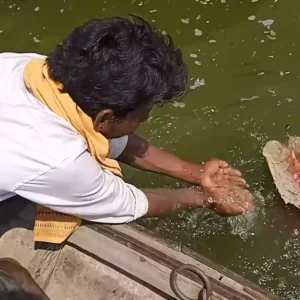
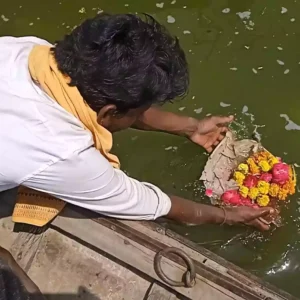
Water is the medium of transmission. As you cup your palms, face south — the direction of Yama and the ancestors — and allow the water to flow through your fingers, you are sending sustenance, blessings, and your own love across the veil between the living and the departed.
The Garuda Purana, Vishnu Purana, and Manu Smriti all describe Tarpan as a mandatory duty for those with departed relatives. Neglecting it is said to leave the ancestors in a state of want; performing it with sincerity ensures they ascend to higher lokas and, in turn, shower the performer with blessings of health, prosperity, and peace.
Why Prayagraj Is the Supreme Place for Tarpan
Among all the sacred teerths where Tarpan can be performed, Prayagraj stands apart. This is not sentiment — it is what the scriptures state plainly.
The Matsya Purana dedicates entire chapters to the glory of Prayag. It says that the punya (spiritual merit) accumulated by performing a single Tarpan at the Triveni Sangam exceeds the merit of performing the same ritual ten thousand times at any other location. The Padma Purana echoes this: the Sangam is where Brahma performed the first Yagna, where the earth was created, and where the divine energy of creation itself still resides.
What makes Prayagraj uniquely powerful is the Triveni Sangam — the three-river confluence. The Ganga descends from the Himalayas carrying the blessings of Shiva. The Yamuna flows from Yamnotri carrying the blessings of Surya. The Saraswati, invisible to the eye but very much present in spiritual reality, flows underground, carrying the energy of Brahma, the creator.
When these three rivers meet, their combined energy creates what the scriptures call an akshay teerth — an inexhaustible sacred field. Offerings made here multiply beyond calculation. The ancestors receive not just what you offer, but what the three divine rivers transmit on your behalf.
The Agni Purana specifically mentions that Tarpan performed at Prayagraj liberates seven generations of ancestors — both those who have ascended and those yet to take birth. That is the scale of this ritual's reach when performed at the right place.
To understand more about the spiritual significance of the Sangam itself, read our detailed guide: Triveni Sangam — The Land of Moksha.
Who Should Perform Tarpan
Tarpan is traditionally performed by the eldest son of the family. However, in the absence of a son, a daughter, son-in-law, grandson, or any close relative may perform the ritual. The key requirement is the sincere intention to offer gratitude and nourishment to departed souls.
You should perform Tarpan for:
- Departed parents, grandparents, and great-grandparents (on both paternal and maternal sides)
- Departed siblings, uncles, aunts, and their spouses
- Any close relative or guru whose soul you wish to remember and honour
- Ancestors whose names or faces you may not even know — the ritual extends to the whole lineage
There is a common misconception that Tarpan can only be done by men. While tradition assigns the role to male members, many families today perform Tarpan collectively, with the pandit guiding whoever is present. What matters most is the intention — the bhav — behind the act.
When to Perform Tarpan
Tarpan can be performed on several occasions through the year. Each carries its own weight of auspiciousness.
Pitrupaksha (Shraddh Paksha)
The most important period for ancestral rites falls during Pitrupaksha — the 15-day lunar fortnight in the Ashwin month (September-October). During this time, the veil between the world of the living and the world of ancestors is said to be thinnest. Performing Tarpan during Pitrupaksha is considered mandatory for those who have lost a parent or close ancestor within the past three years, and deeply beneficial for all others.
Death Anniversary (Tithi)
The specific lunar date (tithi) on which an ancestor departed is a powerful day for Tarpan and Shraddh. The soul is believed to be most accessible on this day, and offerings reach them with great directness.
Amavasya (New Moon Day)
Every Amavasya — the new moon — is considered a day of the pitrs. Regular monthly Tarpan on Amavasya keeps the ancestral connection alive through the year and ensures ongoing blessings. Mahalaya Amavasya, the final day of Pitrupaksha, is especially powerful.
Solar and Lunar Eclipses
Performing Tarpan during an eclipse is considered to multiply the merit significantly. However, this requires proper timing and guidance from a knowledgeable pandit.
Other Auspicious Occasions
Tarpan is also performed on Makar Sankranti, during the Kumbh Mela, and on certain specific lunar tithis mentioned in the Dharmashastra literature.
What Is Included in This Service
We have structured this package so that you can focus entirely on the ritual itself while we handle all logistics and materials.
- Experienced Vedic Pandit: A trained purohit with deep knowledge of Pitru Karma procedures. He will guide you through every step, explain the meaning of each mantra, and ensure the ritual is complete and correct according to your family's tradition (kul parampara).
- Complete Samagri: All ritual materials are provided — sesame seeds, barley, kush grass, flowers, incense, clay diya, gangajal, and everything else required for the full ritual.
- Boat to the Sangam: The actual confluence point is in the middle of the rivers. We arrange a boat to take your family to the exact meeting point of the three rivers, where the Tarpan is performed in the most spiritually potent spot.
- Step-by-step guidance: Your pandit will explain each mantra and action as you go, so even first-time performers understand what they are doing and why.
- Prasad after the ritual: The ritual concludes with a small prasad distribution as is customary.
Step-by-Step: What Happens During the Ritual
Understanding the process removes anxiety and helps you participate with full presence and devotion.
Preparation at the Ghat
You will be received by our pandit at the designated ghat. After a brief introduction and confirmation of the names of the ancestors you wish to honour, the pandit will set up the ritual space. You will be asked to bathe in the Sangam waters or at minimum perform achamana (ritual sipping of water) to purify yourself before the ritual begins.
Sankalpa
The ritual opens with the Sankalpa — a formal declaration of your name, your lineage (gotra), your location, and your intention. This is the spiritual contract that directs the ritual's energy toward your specific ancestors. The pandit recites the Sankalpa mantras while you repeat the key phrases after him.
Journey to the Sangam
The boat takes you to the exact confluence point. As you travel across the water, the pandit may recite specific hymns in praise of the Ganga, Yamuna, and Saraswati.
The Tarpan Offerings
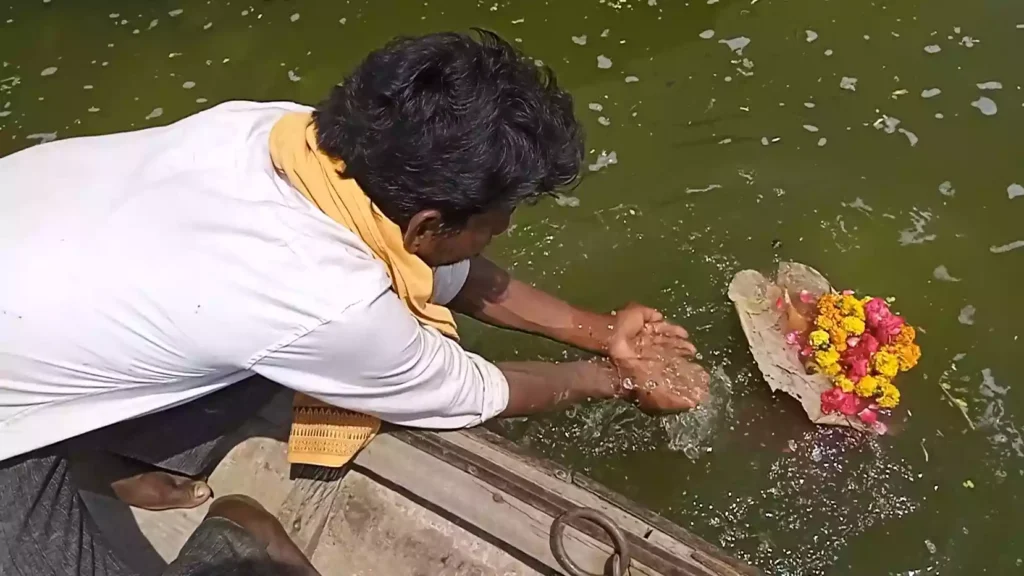
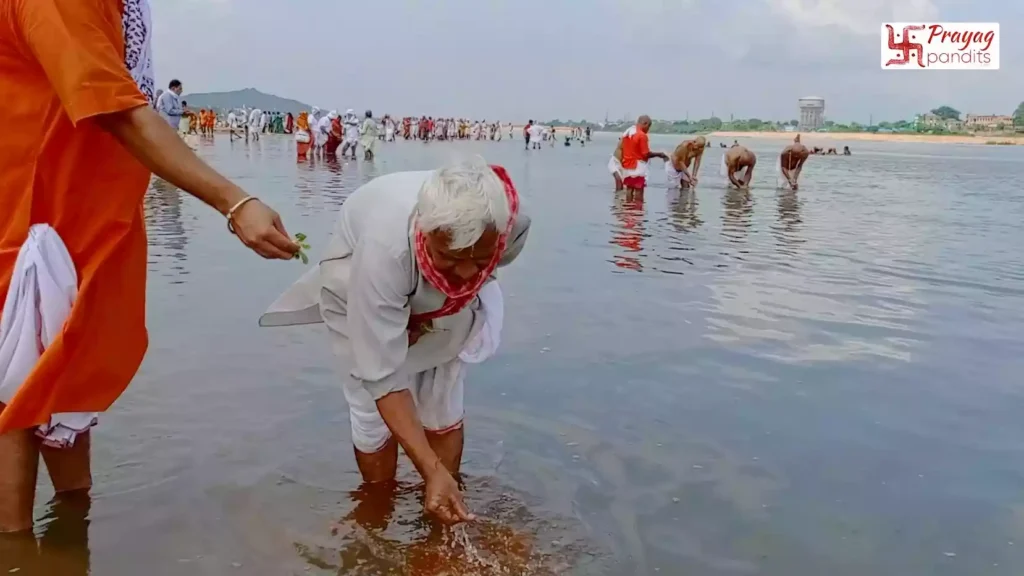
At the Sangam, you face south, cupping water with both hands. With each offering, the pandit recites the name and lineage of the ancestor being honoured. You release the water through your fingers three times for each ancestor — once for the paternal lineage, once for the maternal lineage, and once for sages and teachers (Rishi Tarpan). The sesame, barley, and kush grass are held in the cupped hands with each offering of water.
Closing Prayers
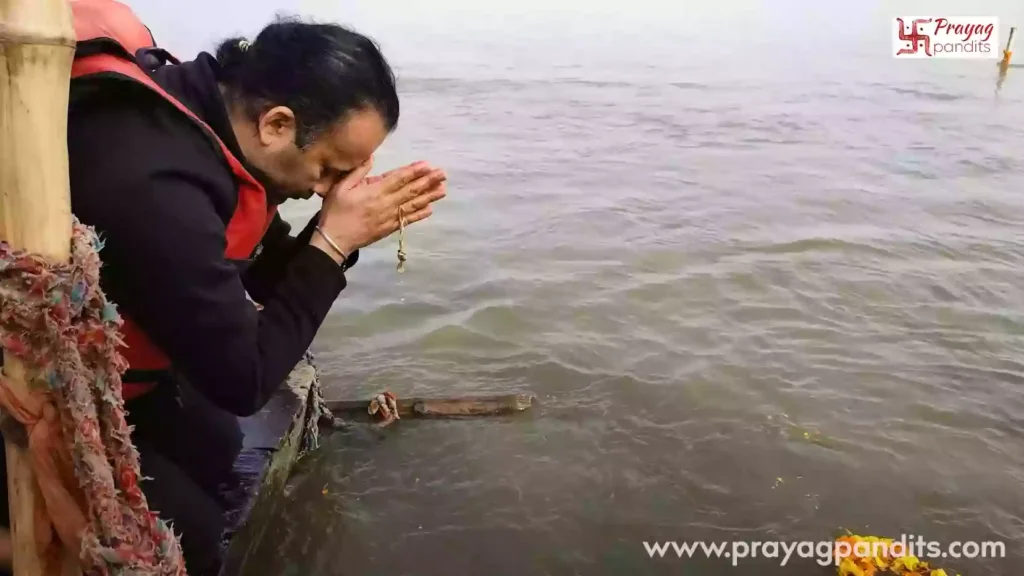
After all offerings are made, a prayer is offered to Yama (the god of death and justice) and to the Pitrs to receive and bless what has been offered. The ritual closes with a prayer for the living — for the health, happiness, and prosperity of the family performing the Tarpan.
How to Prepare Before You Arrive
- Observe a fast on the day of the ritual, or at minimum eat only sattvic food — no meat, no alcohol, no onion or garlic
- Wear clean, preferably white or undyed clothing
- Bring the names and, if known, the death dates (tithi) of the ancestors you wish to honour
- Know your gotra (family lineage) — if unknown, the pandit can help with a general Sankalpa
- Come with an open heart and sincere intention — this is more important than any external preparation
Spiritual Benefits of Tarpan at Prayagraj
The texts are explicit about what Tarpan accomplishes, particularly when done at a place of this magnitude.
For the ancestors: souls who may be in difficult realms due to unfinished karma receive relief. Their burden lightens. Those already in higher realms ascend further. Those yet to be reborn are directed toward auspicious births.
For the performer: the Pitr Rinn (ancestral debt) is discharged. Obstacles in one's life that stem from displeased ancestors — what the tradition calls Pitr Dosha — begin to dissolve. Families often report improved harmony at home, removal of long-standing difficulties, and a general sense of peace and lightness after performing sincere Tarpan.
The Skanda Purana states that Prayagraj Tarpan earns the same merit as performing Ashwamedha Yagna — one of the most elaborate and expensive Vedic sacrifices. For those of us who live in the modern world, the Tarpan at Triveni Sangam is the most accessible path to this extraordinary level of spiritual merit.
Frequently Asked Questions
Can women perform Tarpan?
Yes. While the tradition historically assigned this role to men, many sampradayas and modern practitioners allow and encourage women to perform Tarpan, particularly when there is no male heir or when the family chooses to perform together. Our pandits are experienced in guiding both men and women through the ritual.
Do I need to know Sanskrit or any mantras beforehand?
No. The pandit recites all mantras and you repeat the key phrases. No prior knowledge is needed. You only need to know the names and gotras of your ancestors, and even this can be approximated if not known.
How long does the ritual take?
The complete Tarpan ritual at the Sangam takes approximately 45 minutes to 1.5 hours depending on the number of ancestors being honoured and the completeness of the ritual you choose. The boat journey adds time to this.
Can I perform Tarpan outside of Pitrupaksha?
Absolutely. Tarpan on any Amavasya, on a death anniversary, or on other auspicious days is valid and beneficial. Pitrupaksha is the most powerful time, but the ritual carries full merit throughout the year.
Is this different from Shraddh or Pind Daan?
Yes. Tarpan is specifically the water offering to ancestors. Shraddh is a broader category of ancestral rites that includes food offerings (Pind Daan), Tarpan, and Brahmin feasting. Pind Daan involves offering cooked rice balls. These can be performed together or separately. Our full shop offers packages for each of these services individually and in combination.
What if I have multiple generations to remember?
The ritual systematically covers all three generations of the paternal lineage and maternal lineage, plus sages and teachers. Additional specific ancestors can also be named. The pandit will guide you through the complete list.
Tarpan in Prayagraj Cost — ₹5,100 All-Inclusive
Tarpan at Triveni Sangam, Prayagraj costs ₹5,100 (regular price ₹8,999). This covers the experienced Teerth Purohit, boat ride to the Sangam confluence, complete poojan samagri including sesame seeds and kusha grass, and the full Tarpan ceremony with Vedic mantras. No hidden charges.
What Families Say 4.5
First time booking online for a religious ceremony. Was skeptical but the service exceeded expectations.
My family performed Pind Daan through Prayag Pandits and it was a deeply spiritual experience. The location was serene and the pandit's chanting was beautiful. We felt connected to our…
पहली बार ऑनलाइन बुकिंग की थी, लेकिन अनुभव बहुत अच्छा रहा। पूजा पूरी विधि-विधान से हुई।
First time performing Pind Daan and was nervous about the process. But the team guided us well. They explained what to wear, what to bring, and what mantras to recite.…
पंडित जी ने बहुत अच्छे से समझाया और पूजा करवाई। परिवार को बहुत शांति मिली।
Worth every rupee. The puja was conducted exactly as per tradition. Family is very happy.
We booked this for our grandfather's annual shradh. The ceremony was performed with great reverence. Pandit ji even shared stories from the Garuda Purana which were very enlightening for the…
After losing my father suddenly we needed guidance on the proper rituals. Prayag Pandits team was very compassionate and helped us through every step. The Pind Daan brought us immense…
ખૂબ સારી સેવા. પંડિતજીએ બધું વ્યવસ્થિત કર્યું. સંતોષ થયો.
पंडित जी समय पर आए, सारी सामग्री लाए और पूरी श्रद्धा से पूजा करवाई। बहुत खुश हूँ।
Common Questions
What is the cost of Tarpan in Prayagraj?
Tarpan at Triveni Sangam in Prayagraj costs ₹5,100 with Prayag Pandits. This covers the experienced Teerth Purohit, complete samagri, boat to the Sangam, and the full Tarpan ceremony.
What is Tarpan and why is it important?
Tarpan is the Vedic ritual of offering water mixed with sesame seeds, kusha grass, and sacred ingredients to ancestors. It is one of the most fundamental duties prescribed for descendants to bring peace to departed souls.
Where is Tarpan performed in Prayagraj?
Tarpan in Prayagraj is performed at the sacred Triveni Sangam — the confluence of Ganga, Yamuna, and Saraswati. This is considered the most auspicious location for water offerings to ancestors.
When should Tarpan be performed?
Tarpan can be offered daily, on Amavasya, during Pitru Paksha, or on the death anniversary (tithi) of the ancestor. Performing it at Triveni Sangam multiplies the spiritual merit.
Can Tarpan be combined with Pind Daan at Prayagraj?
Yes. Many families perform Tarpan along with Pind Daan during their visit to Prayagraj. Both ceremonies can be arranged on the same day.