
No rituals selected yet.
Browse Pooja Packages →Key Takeaways
In This Article
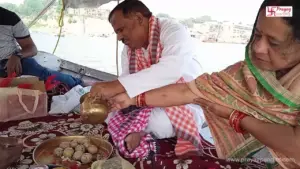
Sumangali Poojan — also known as Suhagan Poojan or Sumangali Prarthanai — is a deeply significant Hindu ritual performed to invoke the blessings of ancestral women who departed this world as sumangalis (women who died while their husbands were still alive, considered auspicious in tradition). Performed with great reverence and care, this ceremony honours the feminine lineage of a family and seeks the grace of departed foremothers for the wellbeing, longevity, and prosperity of the living married women of the household. At Triveni Sangam in Prayagraj — the confluence of the Ganga, Yamuna, and the invisible Saraswati — this poojan carries extraordinary spiritual potency, drawing families from across India, particularly from South India, for this sacred observance.
What Is Sumangali Poojan? Meaning and Significance
The word Sumangali (Sanskrit: सुमंगली) means “an auspicious married woman” — specifically, a woman who was never widowed, whose husband outlived her, and who is thus regarded as having departed the world in the most blessed marital state. In Hindu tradition, such women are held in the highest spiritual regard. It is believed that their souls, even after departing, retain the capacity to bestow blessings upon the living women of their lineage — blessings of long, happy, and prosperous married lives.
Sumangali Poojan is the ritual through which a family formally invites these departed ancestral women into their presence, honours them with traditional offerings, and prays for their blessings. It is performed not in mourning but in celebration — an expression of gratitude toward the women who upheld the sacred bonds of family through their lives and whose positive energy is believed to linger in the family’s spiritual landscape long after their physical passing.
This poojan is especially popular in South Indian traditions — Tamil, Telugu, Kannada, and Malayalam-speaking communities — where it is performed with great ceremony before important life events. Prayag Pandits provides multi-lingual purohits fluent in Tamil, Telugu, Kannada, and Malayalam who can conduct this poojan at Triveni Sangam in the complete regional tradition of your family.
Why Perform Sumangali Poojan at Triveni Sangam, Prayagraj?
While Sumangali Poojan can be performed at any sacred location, performing it at Triveni Sangam in Prayagraj amplifies its spiritual significance manifold. The confluence of three rivers — the Ganga, the Yamuna, and the mystical Saraswati — is described in the Prayaga Mahatmya section of the Matsya Purana and the Padma Purana as the most sacred tirtha in all of India. The waters of the Sangam are believed to dissolve accumulated karmic debts, purify the family lineage, and make offerings and prayers infinitely more potent than those made at ordinary locations.
Many South Indian families have maintained a centuries-old tradition of travelling to Prayagraj specifically to perform Sumangali Poojan at the Sangam. The belief is that the combined power of the three rivers carries the prayers of the living women directly to the souls of the departed sumangalis of the family. When a daughter of the family is about to be married, or when a daughter-in-law joins the household, performing this poojan at Triveni Sangam is considered one of the most auspicious and protective acts a family can undertake for her.
If your family is visiting Prayagraj for Pind Daan at Prayagraj — another important ritual performed at the Sangam for the liberation of departed souls — incorporating Sumangali Poojan on the same visit is a meaningful way to honour both the male and female lines of your ancestral family.
When Is Sumangali Poojan Performed? Occasions and Timing
Sumangali Poojan is performed on a variety of auspicious occasions throughout the family’s life cycle:
- Before a daughter’s wedding (Vivah): The most common occasion. The poojan is performed to seek the blessings of ancestral sumangali women for the bride’s long, prosperous, and happy married life.
- When a new daughter-in-law joins the family: Welcoming the new bride into the spiritual fold of the family’s ancestral lineage.
- On Aadi Amavasya and Karthigai: Particularly in Tamil tradition, these are specific calendar days dedicated to Sumangali Prarthanai.
- On Purnima (full moon days): Full moon days are considered highly auspicious for ancestral rites and prayers across all Hindu traditions.
- Before any major family ceremony: Wedding anniversaries, house-warming ceremonies (Griha Pravesh), and other significant life events.
- On the tithi (death anniversary) of a departed sumangali ancestor: Honouring a specific ancestral woman on the anniversary of her passing.
One important restriction: Sumangali Poojan is not performed on Tuesdays or Saturdays, which are considered inauspicious for this type of ceremony. When planning your visit to Prayagraj, ensure you schedule the poojan on a permitted day. Our pandits can help you select the most auspicious date based on the Hindu calendar and your family’s regional tradition.
Who Participates in Sumangali Poojan? The Role of Women
Sumangali Poojan is entirely a women’s ceremony. Men are excluded from the ritual proceedings — the poojan is presided over by the senior women of the family, typically the eldest married woman, who ensures that the preparations are made with the required purity and attention to tradition.
The number of sumangali women invited to participate in the poojan (representing the blessings of departed ancestors) must be an odd number: 3, 5, 7, or 9 is traditional. In many regional practices, these women represent the lineage of departed sumangali ancestors and are honoured with offerings on the ancestors’ behalf.
Each participating woman is asked to observe ritual purity before the ceremony: taking an oil bath, wearing a nine-yard madi-saree (or a fresh, unstitched cloth in some traditions), and refraining from non-vegetarian food on the day of the poojan. This attention to purity ensures that the energy of the ceremony remains focused and efficacious.
Sumangali Poojan: Procedure and Materials (Samagri)
While the precise procedure varies by regional tradition (Tamil, Telugu, Kannada, etc.) and by family kula sampradaya (clan tradition), the broad structure of Sumangali Poojan follows these steps:
Preparation (Purva Karma)
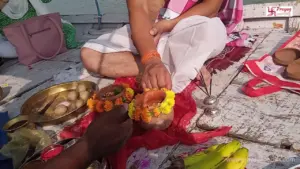
The puja space is cleaned and sanctified. A kuthu vilakku (a five-faced brass lamp) is lit — this lamp represents the presence of ancestral sumangali women. Turmeric, kumkum, and fresh flowers are arranged. The purohit begins with Sankalpa — a formal declaration of intent, including the name of the family, the gotra (lineage), and the specific purpose of the poojan.
Avahana (Invocation)
The souls of the departed sumangali women of the family lineage are formally invited into the puja space through specific mantras. In some traditions, symbolic representations (small figures made of turmeric) are placed on a fresh cloth and treated as the physical presence of the ancestral women.
Shodashopachara (Sixteen-Step Worship)
The ancestral sumangalis are honoured with the sixteen traditional offerings: bathing with sacred water, offering fresh garments (represented by new cloth), flowers, incense, lamps, naivedyam (food offering), and more. In particular, til oil (sesame oil), shikakai (used in traditional hair care), and thaila chhakkai (herbal hair oil compounds) are offered — items that sumangali women would have used in their earthly lives, and that thus carry deep personal resonance in the ritual.
Sumangali Prarthanai (Prayer for Blessings)
The living women of the family offer prayers, requesting the ancestral sumangalis to bless them with akhand saubhagya — unbroken auspiciousness in married life, the long life of their husbands, and the prosperity of their children. In many South Indian traditions, this prayer is sung as a collective song by all the women present.
Tambulam and Dakshina
At the close of the poojan, sumangali women present receive tambulam — a ritual gift package that traditionally includes betel leaves, betel nuts, turmeric, kumkum, a coconut, and often a blouse piece. This is given as an offering to the ancestral women through the living sumangalis present. The purohit receives his dakshina (ritual honorarium).
Key Materials Required for Sumangali Poojan (Puja Samagri)
- Kuthu vilakku (five-faced brass lamp) with oil and wicks
- Turmeric, kumkum, and chandan (sandalwood paste)
- Fresh flowers, particularly marigold and jasmine
- Betel leaves and betel nuts
- Coconuts (one for Sankalpa, others for offerings)
- Banana and other seasonal fruits
- Rice, sesame seeds (til), and other grains
- New cloth or sarees for the invited sumangali women
- Til oil, shikakai, and herbal hair preparations
- Agarbatti (incense sticks) and camphor
- A small dhoni or tray for the Sangam offering
When performing the poojan at Triveni Sangam, Prayag Pandits arranges all necessary puja samagri as part of the service. You need not worry about sourcing materials — everything is arranged by the purohit at the ghat.
Multi-Lingual Purohits for South Indian Families
Sumangali Poojan has deep roots in South Indian tradition. Prayag Pandits provides purohits who conduct this ceremony fluently in Tamil, Telugu, Kannada, and Malayalam — following the specific regional sampradaya of your family. Whether your tradition requires the Aadi Amavasya format, the Karthigai Deepam tradition, or a general Sumangali Prarthanai, our pandits are knowledgeable and respectful of your family’s specific customs.
Benefits and Spiritual Outcomes of Sumangali Poojan
The benefits attributed to Sumangali Poojan go beyond the ritual act itself. In the Hindu understanding of ancestral karma and family energy, the relationship between the living and the departed is an active, ongoing one. By performing this poojan, a family:
- Resolves unfulfilled desires of departed ancestral women: Souls that departed with wishes unfulfilled regarding the prosperity of their descendants are believed to find peace when these rituals are performed.
- Removes ancestral obstacles to married happiness: In some families, repeated marital difficulties or health problems are attributed to unresolved ancestral energy. Sumangali Poojan is believed to address such disturbances.
- Invokes active blessings for the bride or young married woman: The prayers specifically request long life for the husband (akhand saubhagya), prosperity for the family, and happiness in marital life.
- Maintains continuity of family tradition: By performing this poojan, a family honours its roots and ensures that the wisdom and values of ancestral women are remembered and respected.
- Strengthens the bonds between women of the household: The collective nature of the ceremony — with all the women of the family participating together — builds emotional and spiritual solidarity.
Sumangali Poojan and Pitrupaksha: The Ancestral Connection
Sumangali Poojan shares its philosophical roots with the broader tradition of ancestral worship in Hinduism. Just as Pind Daan at Prayagraj and Tarpan at the Sangam are performed to nourish and liberate the souls of all departed ancestors (pitrs), Sumangali Poojan specifically honours the female line of the ancestral family.
During the annual Pitrupaksha fortnight — the fifteen-day period in the Hindu calendar dedicated to ancestral rites — many families choose to perform both Pind Daan and Sumangali Poojan at Triveni Sangam in a single visit. This combined approach is considered especially meritorious: the Pind Daan addresses the souls of all departed ancestors across all lineages, while Sumangali Poojan specifically honours the sumangali women. Together, they represent a complete act of ancestral reverence.
Book at Triveni Sangam
🙏 Sumangali Poojan at Prayagraj — Arranged by Prayag Pandits
Starting from
₹7,100
per person
How to Book Sumangali Poojan at Triveni Sangam
Planning a Sumangali Poojan at Prayagraj requires a few advance steps to ensure the ceremony unfolds smoothly and according to your family’s tradition:
- Fix the date carefully: Choose a date that falls on an auspicious tithi and avoids Tuesdays and Saturdays. Our pandits can guide you toward the most suitable date based on your requirements and the Hindu calendar.
- Inform us of your regional tradition: Sumangali Poojan follows different regional protocols in Tamil, Telugu, Kannada, and other South Indian communities. Please share your family’s background so the correct purohit is assigned.
- Coordinate travel and accommodation: Prayagraj has comfortable accommodation options near the Sangam area. If you are combining the poojan with Pind Daan, plan to stay for at least one full day.
- Bring relevant family details: For the Sankalpa (formal declaration of intent), you will need your family’s gotra, the name of the bride or woman being blessed, and ideally the name and tithi of the departed sumangali ancestor being honoured.
Prayag Pandits has been facilitating ancestral and ritual ceremonies at Triveni Sangam for families from across India and from the South Indian diaspora worldwide. Our Tirth Purohits are familiar with the specific requirements of South Indian families and ensure that every detail of the ceremony reflects your community’s authentic tradition.
Conclusion: Honouring the Feminine Lineage at the Sacred Sangam
Sumangali Poojan is one of Hinduism’s most tender and intimate rituals — a conversation between the living women of a family and their departed foremothers, conducted with oil lamps, flowers, turmeric, and prayers at the bank of a sacred river. At Triveni Sangam in Prayagraj, where three rivers have merged for millennia and where the entire weight of Hindu pilgrimage tradition converges, this poojan achieves a depth and power that is difficult to describe in words but deeply felt by every woman who has participated in it.
If you are planning a visit to Prayagraj to perform Sumangali Poojan — whether for a forthcoming wedding, to honour an ancestor, or simply to seek renewal of blessings for the married women of your family — Prayag Pandits is here to ensure that every aspect of your visit is spiritually authentic, logistically smooth, and personally meaningful. Reach out to us today to begin planning your pilgrimage to the Sangam.
Related Services by Prayag Pandits
- 🙏 Veni Daan Poojan at Triveni Sangam — Starting from ₹7,100
- 🙏 Ganga Pooja / Prayaschit Pooja in Prayagraj — Starting from ₹2,500
- 🙏 Asthi Visarjan in Prayagraj — Starting from ₹5,100
Frequently Asked Questions
What is the meaning of Sumangali Pooja (Sumangali Prarthana)?
Sumangali Pooja (also called Sumangali Prarthana or Sumangali Puja) is a traditional South Indian Hindu ritual performed to invoke blessings from Sumangali — literally "auspicious women" — who are married ladies whose husbands are still living. "Sumangali" means "one who brings auspiciousness." In the ritual, 5, 7, 9, or an odd number of Sumangali women are invited, worshipped as embodiments of the Mahalakshmi, offered new clothes, jewellery, sweet foods (typically Pongal, payasam, and sundal), and given traditional thamboolam (betel leaves, betel nuts, turmeric, kumkum, flowers, and a token gift). Their blessings are believed to ensure long life, prosperity, and marital happiness for the Yajamani (host) and her family. The ritual has deep Vedic roots and is considered particularly auspicious for the unmarried daughters of the household.
Why is Sumangali Prarthanai performed and what are its benefits?
Sumangali Prarthanai is performed for multiple spiritual and familial purposes: (1) To seek blessings for unmarried daughters — the Sumangalis bless the daughters with "suhaag" (a happy married life), (2) To express gratitude and honour to married women in the family — mothers, mothers-in-law, sisters — during significant family events, (3) To mark important life milestones such as Grihapravesham (housewarming), weddings, Shraddha of a Sumangali ancestor, or annual family traditions, (4) To remember and honour deceased Sumangali ancestors (aunts, grandmothers, great-grandmothers who died before their husbands), (5) To invoke Mahalakshmi's grace through living embodiments of auspiciousness, (6) To strengthen family bonds and community ties through shared ritual and feast. The benefits include prosperity, familial harmony, marital happiness, and spiritual merit that extends to the entire family.
How many Sumangali ladies should be invited for Sumangali Prarthanai?
The traditional number of Sumangali ladies invited is always odd — typically 5, 7, 9, 11, or 21 — never even. The minimum is 3 Sumangalis for a small family observance, 5-7 for a typical household ceremony, 9-11 for Shraddha of a Sumangali ancestor, and 21 for major observances like a daughter's wedding preparations. Additionally, one kanya (young unmarried girl) and sometimes one Brahmin are also invited to represent the full feminine lineage. The Sumangalis should ideally be from diverse backgrounds — relatives, neighbours, Brahmin women, women from different ages — representing the broad feminine blessing. Each invited lady should have a living husband on the day of the pooja. Replacement is done if a circumstance prevents an invited Sumangali from attending.
How is Sumangali Pooja performed step-by-step?
The Sumangali Pooja follows this traditional sequence: (1) Invitation — the host formally invites the Sumangali ladies 2-3 days in advance, (2) Preparation — on the day, the home is cleaned, decorated with kolams (rangoli), flowers, and mango leaves, (3) Welcoming — when the Sumangalis arrive, they are welcomed at the door with aarti, kumkum, and flowers, (4) Feet washing — traditionally, the host washes the feet of each Sumangali (padapuja), (5) Arrangement — the Sumangalis are seated in a row, (6) Offering of thamboolam — each is offered new clothes (saris), jewellery, flowers, kumkum, turmeric, bangles, combs, and betel, (7) Feast — a traditional Tamil feast is served including Pongal, payasam, sambhar, rice, sundal, and sweets, (8) Blessing — after eating, each Sumangali places her hand on the head of the host's unmarried daughters and blesses them, (9) Namaskaram — the host performs namaskaram to each, (10) Farewell — the Sumangalis depart with the blessings.
When should Sumangali Pooja be performed and which days are auspicious?
Sumangali Pooja is traditionally performed on these auspicious occasions: (1) Before a daughter's wedding (typically 10-15 days in advance), (2) During Navaratri (the 9 days of Durga Puja in October), (3) During Adi month (Tamil calendar — July/August) for specific family traditions, (4) On the death anniversary of a Sumangali ancestor, (5) During Margazhi month (December-January) for Mahalakshmi invocation, (6) On Varalakshmi Vratam (the Friday before full moon in Shravana — August), (7) After housewarming, child birth, or other auspicious family events. Specific days within any month: Friday (Lakshmi's day), Tuesday (some traditions), and the Shukla Paksha (waxing moon) days are preferred. Amavasya and Tuesday-Saturday combinations are traditionally avoided. Our Tamil-speaking pandits can help plan your Sumangali Pooja on the most auspicious date for your family.
Can Sumangali Pooja be performed for a deceased Sumangali ancestor as Shraddha?
Yes. Performing Sumangali Pooja for a Sumangali ancestor (a married woman who predeceased her husband) is a special form of Shraddha particularly emphasised in Tamil Hindu tradition. Because a Sumangali dying before her husband is considered spiritually fortunate (she "goes" with all her married blessings intact), her annual Shraddha is celebrated rather than mourned. On her death tithi, the family invites living Sumangalis, performs the complete Sumangali Prarthanai in her memory, and offers the feast as if she were present receiving the honour. This form of Shraddha is believed to spiritually elevate the Sumangali ancestor and bring prosperity to the family. Our Tamil pandits specialise in this specific Sumangali Shraddha observance, including the complete vidhi and coordination of the Sumangali ladies.
Book Your Sacred Ritual
Authentic ceremonies performed by Veda-trained pandits with video proof at sacred sites across India.
2,263+ families served
Video proof included
Since 2019
