Key Takeaways
- Pitru paksha 2026 dates
- What pitru paksha is, and why it falls when it does
- Who the pitrus are
- The special days within the fortnight
In This Article
Pitru Paksha is the sixteen-day fortnight set aside for the ancestors, falling in the Krishna Paksha — the waning fortnight — before Navratri. In 2026 it runs from 26 September to 10 October. Each day of the fortnight corresponds to a lunar tithi, and a family performs shraddha on the tithi their ancestor died, whatever the calendar month of the death. Where that tithi is unknown, Sarva Pitru Amavasya on the closing day serves for all ancestors at once.
This guide covers the full 2026 calendar, what the fortnight is and why it falls when it does, the special days within it, how shraddha is performed step by step, the types of shradh, the rules that apply, and how families abroad arrange it.
Pitru paksha 2026 dates
| Date | Tithi | Whose day it is |
|---|---|---|
| Sat 26 September | Purnima Shraddha | Those who died on a full moon day |
| Sun 27 September | Pratipada | First lunar day of the fortnight |
| Mon 28 September | Dwitiya | Second lunar day |
| Tue 29 September | Tritiya — Maha Bharani | Bharani nakshatra; held equal to a shradh at Gaya |
| Wed 30 September | Chaturthi and Panchami | Two tithis on one day; Panchami also Kunwara Panchami, for those who died unmarried |
| Thu 1 October | Shashthi | Sixth lunar day |
| Fri 2 October | Saptami | Seventh lunar day |
| Sat 3 October | Ashtami | Eighth lunar day |
| Sun 4 October | Navami — Avidhava / Matru Navami | Mothers and all women ancestors |
| Mon 5 October | Dashami | Tenth lunar day |
| Tue 6 October | Ekadashi | Vaishnavas and those who died on Ekadashi |
| Wed 7 October | Dwadashi — Magha Shraddha | Sannyasis and those with Magha nakshatra |
| Thu 8 October | Trayodashi | Departed children and young adults |
| Fri 9 October | Chaturdashi — Ghata Chaturdashi | Those who died violently or by accident |
| Sat 10 October | Sarva Pitru Amavasya | All ancestors; and anyone whose tithi is unknown |
The Shradh dates calendar carries the muhurat timings and explains how the tithis are calculated each year.
What pitru paksha is, and why it falls when it does
The fortnight is the one period of the year in which the ancestors are held to be closest to the living world, and in which offerings reach them without the sankalpa needing to name a particular occasion. The Mahabharata gives the reason in the story of Karna: sent back to earth for a fortnight to perform the ancestral rites he had neglected in life, the days he was given became Pitru Paksha.
Its placing is not arbitrary. It falls in the waning fortnight — the Krishna Paksha — of Bhadrapada by the Purnimanta reckoning, or Ashwin by the Amanta one, which is why both month names appear in different regions for the same days. The waning moon is associated throughout Hindu tradition with the path of the ancestors rather than the path of the gods. The season matters too: the fortnight sits in the transition between the monsoon and autumn, after the rains and before the harvest, a time of completion rather than beginning.
Who the pitrus are
The pitrus are the departed of one’s own lineage — in the standard rite the father, grandfather and great-grandfather on the paternal side, with the corresponding three generations on the maternal side where the family observes them. A soul becomes a pitru only after the first-year rites are complete; before that it is a preta, in transit. Pitru Paksha offerings are made to the pitrus as a body, which is why ancestors whose names the family no longer knows are still reached on Sarva Pitru Amavasya.
The special days within the fortnight
- Maha Bharani — 29 September 2026. Held to carry the merit of a Gaya shraddha for families who cannot travel there.
- Avidhava Navami — 4 October 2026. For women who died before their husbands; also observed as Matru Navami for mothers generally.
- Magha Shraddha — 7 October 2026. For sannyasis, and for ancestors born under Magha nakshatra.
- Ghata Chaturdashi — 9 October 2026. For those who died by accident, violence or any unnatural cause.
- Sarva Pitru Amavasya — 10 October 2026. The closing day, and the single most important of the sixteen. It covers every ancestor, including those whose death tithi nobody remembers.
How shraddha is performed
1. Preparation and purity
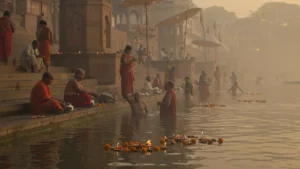
The rites begin the evening before. The karta — usually the eldest son or the senior man of the family — keeps a sattvic diet the previous day, with no meat, fish, alcohol, onion or garlic; sleeps early and rises before sunrise; takes a purifying bath, in the river itself where the rites are performed at a tirtha; and wears fresh unstitched cloth, traditionally a white dhoti. Arguments and trivial distraction are avoided until the day’s rites are finished.
2. Sankalpa
The sankalpa is the single most important act of the fortnight: without it the offerings have no address. The karta holds water, flowers, rice and kusha grass in cupped palms while the pandit leads the recitation. It states the karta’s name and gotra; the tithi, paksha, masa and samvat; the name and gotra of each ancestor being honoured; and the purpose of the rite. The water and rice are then released. Everything offered afterwards flows through that one declaration.
3. Tarpan
Water mixed with black sesame and kusha is offered to the ancestors, facing south, satisfying their thirst and calling them to the rite. Tarpan comes before the pindas and is performed on every day of the fortnight in many households, not only on the family’s own tithi.
4. Pind daan
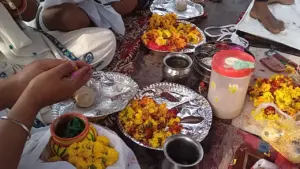
Pindas of cooked rice kneaded with sesame, milk, honey and ghee are offered with mantras. This is the central act — the direct nourishment of the ancestral body. The complete Pind Daan guide covers the offering in full.
5. Kak bali — the crow
Before the family eats, a portion of the day’s food is set aside for the crow, on a clean leaf in an open, raised place. In Vedic cosmology the crow carries between the world of the living and the realm of the ancestors, and its acceptance of the food is taken as the ancestor receiving the offering directly. Families consistently describe this as the most affecting moment of the day.
6. Pancha bali — the five offerings
| Offering | Made to | Why |
|---|---|---|
| Go bali | The cow | Held to embody all the devas |
| Shwan bali | The dog | Associated with Bhairava, and the companion of Yama |
| Kak bali | The crow | The messenger of the ancestors |
| Deva bali | The gods | Acknowledging the debt owed to them |
| Pipilika bali | Ants and small creatures | Compassion to the smallest of beings |
7. Brahman bhoj and daan
A Brahmin is fed so that the offering reaches the pitrus through a living channel, and daan is given — food, cloth, or whatever the family’s custom prescribes — to those in need. Only after this does the family eat.
The types of shradh
- Nitya — the daily observance, performed without a specific occasion.
- Naimittika — performed on a particular occasion, such as a death anniversary.
- Kamya — performed with a specific intention in mind.
- Vriddhi, also called Nandi — performed before an auspicious event such as a marriage or a birth, to seek the ancestors’ blessing.
- Sapindana — the rite at which the departed joins the body of the ancestors, ending the preta state. See sapindikarana.
- Parvana — the form performed during Pitru Paksha and on amavasya, addressing three generations together.
Rules during the fortnight
Eat sattvic food and avoid meat, fish, eggs, alcohol, onion and garlic. Keep to simple dress and a calm household. Feed a cow, a dog, a crow and an ant, and give to someone in need, on each day you observe. Offer water daily if you can, even without the full rite.
Avoid beginning anything auspicious in the fortnight — a marriage, a house move, a new business, a major purchase. Avoid cutting hair or nails on the day of your own shraddha. Do not turn anyone away hungry from the door during these sixteen days; the tradition is emphatic about it.
Where the rites are performed
They can be performed at home, and most families do. Where a family goes to a tirtha, the usual choices are Prayagraj at the Triveni Sangam, Gaya at the Vishnupad and the Falgu, Kashi, Haridwar, and Brahma Kapal at Badrinath in the pilgrimage season. The comparison of places covers each with prices.
Pitru dosha
Pitru dosha is the traditional name for the condition held to arise when ancestral rites have gone unperformed across a generation or more. A family that has not observed shraddha for years is not in any special danger and should not be told otherwise; the remedy the tradition prescribes is simply to begin — perform the rites properly on the next available tithi, or on Sarva Pitru Amavasya, and continue annually.
For families abroad
The pandit performs the complete rite physically at the tirtha while the family joins by live video, with the sankalpa taken in your name and your ancestors’. The Indian ceremony time is fixed first and the local joining time follows. A recording and photographs are sent afterwards. See the guide for families abroad for time zones and what to prepare.
🙏 Pind Daan and Tarpan at the Triveni Sangam
- Sankalpa in your ancestor's name and gotra
- Tirth purohit of the Sangam, not a general pandit
- Tarpan, pind daan, pancha bali and brahman bhoj
- Live video and a recording for families abroad
Common questions
Can a daughter perform shraddha? Yes. Where there is no son, or where the family chooses it, a daughter performs the rite and the purohits at Prayagraj and Gaya conduct it without qualification.
Both parents are living — should we observe it? The rites are for departed ancestors of the lineage, so a family with living parents still observes for grandparents and earlier generations.
We missed the tithi. What now? Observe on Sarva Pitru Amavasya, which closes the fortnight and covers every ancestor. Failing that, the next amavasya of any month.
What about the ashes, if they were never immersed? Asthi Visarjan is a separate rite and many families combine it with the fortnight. See the Asthi Visarjan guide.
Book Your Sacred Ritual
Authentic ceremonies performed by Veda-trained pandits at sacred sites across India.