
Key Takeaways
- The six temples of Gaya
- The Falgu, and the legend behind the ground
- Two days in Gaya
- Bodh Gaya alongside
In This Article
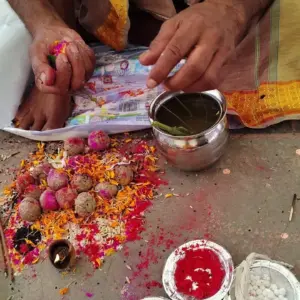
Six temples in Gaya matter to a family performing ancestral rites: Vishnupad, Mangla Gauri, Dakshinaarka, Pretshila, Ramshila and the Akshayavat. They sit across the town rather than in one compound, and two days is enough to cover them properly alongside Bodh Gaya. If the visit is for Pind Daan, our Pind Daan in Gaya page sets out what we arrange.
The six temples of Gaya
Vishnupad Temple
The centre of the Gaya rite. The temple enshrines a footprint held to be Vishnu’s, set in a silver basin, and the principal vedi sits within the complex. The present structure was rebuilt in the eighteenth century by Rani Ahilyabai Holkar of Indore. Most Pind Daan at Gaya begins here, before sunrise.
Mangla Gauri Temple
A Shakti Peetha on a hill above the town, where the goddess is worshipped in the form of a breast-shaped stone. Families often visit after the morning rites. The Mangala Gauri vrata observed by married women is associated with this shrine.
Dakshinaarka Temple
The temple of the southern Sun, near Vishnupad. Surya worship is part of the older layer of Gaya’s tradition, and the temple is quieter than the main complex. Worth the short walk if you have an hour.
Pretshila Hill
Pretshila is where the rite is performed for akal mrityu, a death by accident, by suicide, or before its time. It is a hill with a climb, about 8 kilometres from the town. Families who need this stop should say so when booking, because it is not part of the standard circuit and it changes the day’s timing.
Ramshila Hill
The hill where Rama is held to have performed the rite for Dasharatha. There is a Rameshwar temple at the top and a long view over the town. It carries the precedent families often cite: the rite was performed here by Rama himself.
Akshayavat
The immortal banyan, where the circuit closes and the pandas confirm the shradh has been performed. Many families treat the blessing taken here as the formal end of the observance. Our note on Akshayavat in the Gaya shradh covers its place in the rite.
The Falgu, and the legend behind the ground
The asura Gayasur performed such severe penance that whoever saw him was freed of their sins. The gods asked him to lie down so a yajna could be performed on his body, and he agreed on the condition that the place became a tirtha where ancestors could be released. Vishnu pressed his foot on him to hold him still, and that print is what Vishnupad enshrines. The story explains the geography: Gaya is a stretch of ground, not a single shrine, because the body it is named for lay across it.
The Falgu runs beside the temple and is dry on the surface for much of the year, with water beneath the sand. Tradition attributes this to a curse spoken by Sita. Families dig a small hollow in the bed to reach water for tarpan, and that act is part of the Gaya rite as it is practised.
Two days in Gaya
Two nights and three days covers the rite and the temples without rushing either.
Day one
- Arrive, check in, and meet your pandit to confirm the Sankalp details.
- Evening darshan at Vishnupad, so the morning is not your first sight of it.
- Dakshinaarka if there is light left.
Day two
- The rite, beginning before sunrise at Vishnupad.
- Tarpan at the Falgu.
- Pretshila, if your family’s circumstance calls for it.
- The circuit closes at Akshayavat. Brahmin Bhoj follows where it is part of the package.
- Mangla Gauri in the afternoon.
Day three
- Ramshila, or Bodh Gaya, then onward travel.
Bodh Gaya alongside
Bodh Gaya is thirteen kilometres away and belongs to a different tradition, but most families with a spare day go. The Mahabodhi Temple and the Bodhi tree are the reason; the complex is a UNESCO World Heritage Site.
- Mahabodhi Temple and the Bodhi tree. Where the Buddha is held to have attained enlightenment.
- Muchalinda Sarovar. The lake beside the temple, named for the serpent king said to have sheltered the Buddha during a storm.
- The Archaeological Museum. Small, and holds sculpture recovered from the site.
- The monasteries. Thailand, Bhutan, Japan and others each maintain one, and they are open to visitors. The Bhutanese monastery is the one most often singled out for its interior.
Practical notes
- Dress simply. Men are usually asked to wear a dhoti for the rite and one can be arranged.
- Most families observe sattvic food through the stay, avoiding meat, onion and garlic.
- Carry small notes. Change is hard to find near the ghats on a busy day.
- Photography is restricted inside parts of Vishnupad. Ask rather than assume.
- Do not arrange a pandit on arrival. Book before you travel.
🕉️ Book Pind Daan in Gaya
- Vishnupad, the Falgu and Akshayavat covered
- Pandit assigned before you travel
- All puja samagri included
- Pretshila added where the case calls for it
Common questions
Can the temples be seen without performing the rite?
Yes. Vishnupad, Mangla Gauri and the hills are open to visitors. The vedis are where the rite is performed, and you do not need to take part to see the town.
How long does the Pind Daan itself take?
Two to three hours for a standard observance at the principal vedis. The three-day circuit of all 45 vedis is a different undertaking.
Is Pretshila necessary?
Only where the death was untimely. Ask your pandit whether your family’s case calls for it.
What does a Gaya trip cost?
Packages run ₹7,100 to ₹31,000, and travel, stay and meals sit on top. Our Gaya Pind Daan cost guide budgets the whole trip.
Planning the visit
Fix the ritual date, then the travel, then the rooms. Tell us if Pretshila applies to your family and whether you want Bodh Gaya in the plan, and we will shape the days around it. Everything is on our Pind Daan in Gaya page.
Book Your Sacred Ritual
Authentic ceremonies performed by Veda-trained pandits at sacred sites across India.



