Key Takeaways
- Chautha — the fourth day
- Uthala — the tenth to twelfth day
- Terahvin — the thirteenth day
- What the Garuda Purana says is happening meanwhile
In This Article
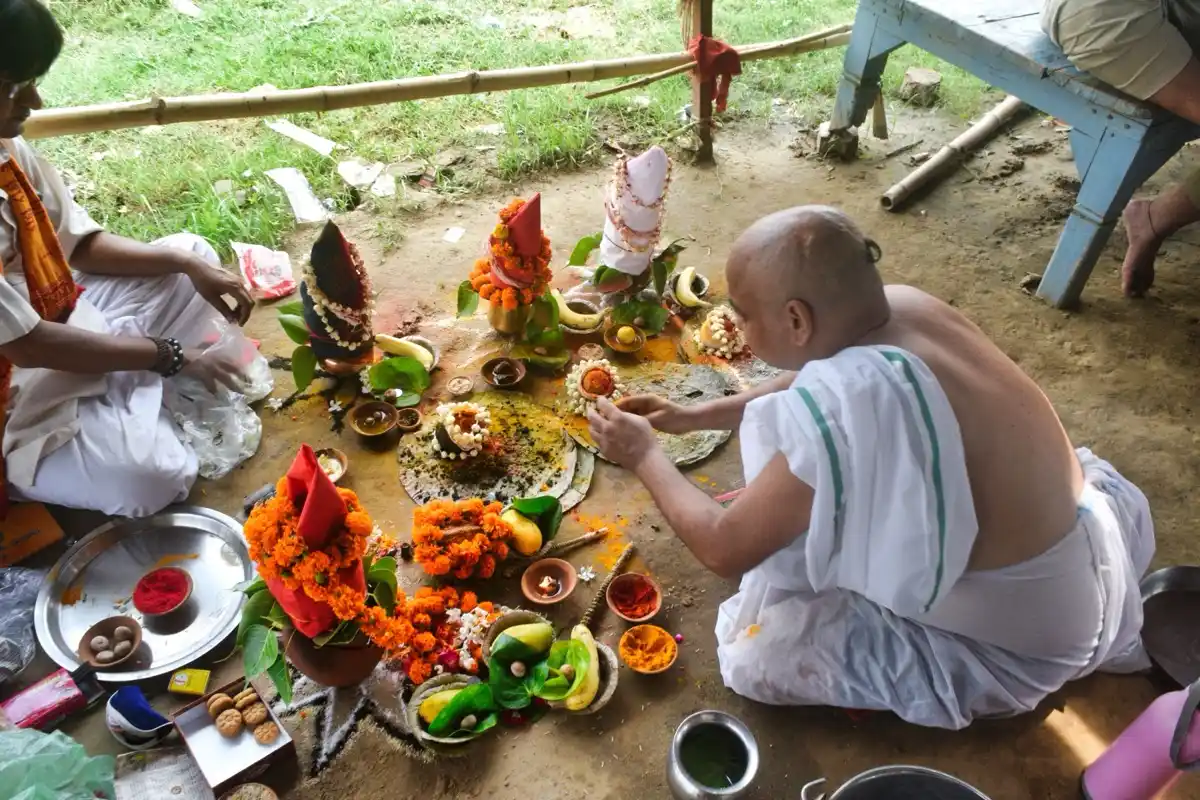
Three gatherings mark the first fortnight after a Hindu death. Chautha on the fourth day, when the community comes to the house. Uthala — also daswan, uthavani or uthamna — around the tenth to twelfth, the purification that lifts the household out of the heaviest mourning. And terahvin on the thirteenth, which closes it. In English they are simply the fourth-day, tenth-day and thirteenth-day ceremonies; there is no neater translation, and families filling in a form for an employer usually write “funeral rites, thirteen days”.
Chautha — the fourth day
Chauth is four. Relatives, neighbours and the wider community come to the house to offer condolences; the family sits together, the person is remembered aloud, and in many households a reading of the Garuda Purana begins on this day and runs through to the thirteenth.
It is worth being clear about what chautha is not. It is not a pinda offering and it is not prescribed in the Dharmashastras as a distinct rite. It is deshachar — regional custom — and its force is social rather than scriptural. Before chautha the news is still fresh and visits are informal. After it, the death has been collectively witnessed, and the family moves from receiving the shock to observing the mourning.
Uthala — the tenth to twelfth day
Uthala, daswan, uthavani, uthamna — the names differ by region and the day shifts between the tenth and the twelfth, but the function is the same. It marks the end of the heaviest phase of impurity. The house is cleaned, in many traditions the chief mourner’s head is shaved, bedding and clothing used through the mourning are given away or washed, and the family begins to return to ordinary activity.
Where sapindikarana is performed on the twelfth day, it sits here. That is the rite that moves the departed from the transitional state into the ancestors, and whether your family did it here or kept it for the first anniversary changes what the barsi contains — worth establishing now rather than a year later.
Terahvin — the thirteenth day
The thirteenth day closes the formal mourning. The rites are performed, brahmins are fed, daan is given, and the household re-enters ordinary life — the point at which the family can again attend weddings, visit temples and take part in auspicious occasions.
The scale of the terahvin feast is where families come under pressure, and it is worth knowing that the scriptures are on the side of restraint: the Manu Smriti caps the thirteenth-day rite at three brahmins, not three hundred. The village-scale meal is custom and social expectation, not prescription.
What the Garuda Purana says is happening meanwhile
Most accounts of these days describe what the family does. The Preta Kalpa describes what is simultaneously happening to the departed, and the two are meant to be read together — the daily pinda is not a gesture of remembrance but, in the text’s account, the material from which the soul’s travelling body is being built.
| Day | Part formed | The offering |
|---|---|---|
| Day 1 | Head | The first pinda, offered at the cremation ground |
| Day 2 | Neck and shoulders | Second daily pinda |
| Day 3 | Heart and chest | Third daily pinda |
| Day 4 | Back and spine | Fourth daily pinda — the day of chautha |
| Day 5 | Navel and abdomen | Fifth daily pinda |
| Days 6–7 | Hips and lower body | Sixth and seventh pindas |
| Days 8–9 | Knees, legs and feet | Eighth and ninth pindas |
| Day 10 | The body completed | Tenth pinda. The form is now able to travel — which is why uthala falls here |
The sequence is the reason the days are not interchangeable, and the reason uthala sits at the tenth rather than anywhere else. The fuller account of the whole arc, from cremation to the first anniversary, is in Hindu death rituals.
Pagdi Rasam — the turban
In Rajasthan, Haryana, Uttar Pradesh and Punjab the terahvin is often followed by the pagdi rasam, in which a turban is tied on the eldest son or senior heir. It is the community’s formal recognition that he has taken on the headship of the family — a statement about succession rather than about the departed.
This is deshachar, not scripture; you will not find it in the Garuda Purana or the Manu Smriti. Its social function is real, and so is its assumption — the custom is built around a male heir, and families without one adapt it or omit it according to their own community’s practice. A regional note specific to Rajasthan: there, younger brothers of the deceased whose own fathers have already died may also undergo mundan as a mark of shared mourning.
How the regions differ
The thirteen-day framework is universal; almost everything else about it is not. This is the table to show a relative who is insisting your family is doing it wrong.
| Region | Main day | What is distinctive |
|---|---|---|
| Uttar Pradesh, Bihar | Day 13 | The classic sequence — chautha on 4, uthala or daswan on 10 to 12, terahvin on 13, with the Garuda Purana path running throughout |
| Rajasthan | Day 13 | Pagdi rasam, the mundan of male descendants whose fathers have died, and a notably large community feast |
| Punjab | Day 13 | A Bhog ceremony combining the terahvin with the completion of an Akhand Path, reflecting the Sikh influence on the region’s mourning customs |
| Maharashtra, Gujarat | Day 12 | Baarvi rather than terahvin — corresponding directly to the scriptural twelfth day and its sapindikarana |
| Bengal | Day 11 | Shraddha on ekadasha, the eleventh, which carries the elevated weight here and corresponds to the Vrishotsarga day |
| Tamil, Telugu, Kannada, Malayalam | Day 13–16 | Varies by community. Tamil families observe karyam or karumathi |
| Odia | Day 11–12 | Dashaha for the ten days, then ekodishta and sapindikaran — see the Odia paddhati |
What the chief mourner observes
Through the thirteen days the karta keeps a simple vegetarian diet without onion or garlic, sleeps on the floor, wears plain undyed cloth, does not shave until the prescribed day, avoids temples and auspicious occasions, and performs the daily pinda and tarpan. The household observes sutak alongside him — the close blood kin fully, more distant relatives for a shorter period.
The restrictions are not a test. Where illness or age makes fasting a genuine health risk, the texts allow a light meal declared in the sankalpa, and a karta who cannot sleep on the floor should not. Tell the pandit what is actually possible and he will adjust it; nobody’s recovery is improved by a grieving son making himself ill.
What comes after
Monthly masik shradh through the first year, then the barsi at the anniversary, and annual shradh and Pitru Paksha from then on. Where the ashes have not been immersed, asthi visarjan comes first and everything else assumes it is done.
🙏 The rites after the thirteen days
- We will tell you which day is which, counted for your family’s tradition, at no charge
- Asthi visarjan, pind daan and shradh at Prayagraj, Gaya, Varanasi and Haridwar
- All samagri, ghat booking and dakshina included — nothing added on the day
- Live video link and a written record for relatives who cannot travel
If the death was sudden, violent, by suicide, or left the last rites undone, a different rite applies before the ordinary sequence resumes — see akal mrityu. And if nobody in the family can travel, the rites are performed in your name with a video link; NRI puja services explains how.
Book Your Sacred Ritual
Authentic ceremonies performed by Veda-trained pandits at sacred sites across India.



