No rituals selected yet.
Browse Pooja Packages →Key Takeaways
In This Article
As the monsoon rains begin to withdraw from the Indian subcontinent and the Bhadrapada month deepens into its waning fortnight, the Hindu calendar turns toward its most solemn and profound observance. Pitrupaksha — the 16-day ancestral fortnight — is approaching, and with it comes the annual opportunity to fulfill one of Vedic tradition’s most fundamental obligations: the remembrance, honoring, and spiritual nourishment of those who came before us.
In 2026, Pitrupaksha runs from September 26 (Purnima) to October 10 (Sarva Pitru Amavasya). This article explores the deep spiritual significance of this sacred period, the cosmological reasoning behind its timing, the specific benefits described in the scriptures for performing ancestral rites during these 16 days, and practical guidance for families planning to observe Pitrupaksha in 2026 — whether in person at the great Tirthas or through online services arranged from abroad.
For the comprehensive exploration of Pitrupaksha’s significance in Hindu traditions, see our detailed article on the significance of Pitrupaksha in Hindu traditions. This article complements that with specific 2026 dates, updated context, and additional practical guidance for the upcoming observance.
Pitrupaksha 2026: Complete Date Schedule
Each of the 16 days of Pitrupaksha carries its own significance based on the lunar tithi. The tradition recommends performing Shraddha for each ancestor on the tithi corresponding to their death date. Below is the complete schedule for Pitrupaksha 2026:
| Date (2026) | Tithi | Special Significance |
|---|---|---|
| September 26 (Friday) | Purnima (Full Moon) | Start of Pitrupaksha — for those who died on Purnima |
| September 27 (Saturday) | Pratipada (1st) | For those who died on Pratipada tithi |
| September 28 (Sunday) | Dwitiya (2nd) | For those who died on Dwitiya tithi |
| September 29 (Monday) | Tritiya (3rd) + Maha Bharani | Maha Bharani — especially potent for all ancestors |
| September 30 (Tuesday) | Chaturthi (4th) + Panchami | For Chaturthi and Panchami tithis |
| October 1 (Wednesday) | Shashthi (6th) | For those who died on Shashthi tithi |
| October 2 (Thursday) | Saptami (7th) | For those who died on Saptami tithi |
| October 3 (Friday) | Ashtami (8th) | For those who died on Ashtami tithi |
| October 4 (Saturday) | Navami (9th) — Matru Navami | Especially for deceased mothers and all female ancestors |
| October 5 (Sunday) | Dashami (10th) | For those who died on Dashami tithi |
| October 6 (Monday) | Ekadashi (11th) | For those who died on Ekadashi tithi |
| October 7 (Tuesday) | Dwadashi (12th) + Magha | For sanyasis and those who renounced worldly life |
| October 8 (Wednesday) | Trayodashi (13th) | For those who died in childhood |
| October 9 (Thursday) | Chaturdashi (14th) | For those who died in accidents or by violence |
| October 10 (Friday) | Amavasya — Sarva Pitru Amavasya | The most important day — for ALL ancestors regardless of death tithi |
The Spiritual Significance of Pitrupaksha: The Vedic Understanding
To observe Pitrupaksha with genuine understanding is to grasp the Vedic conception of what death is and what the soul’s journey looks like after it. This is not morbid — it is the most compassionate and realistic acknowledgment of impermanence that any spiritual tradition has articulated.
The Three Debts and the Meaning of Pitru Rin
Hindu philosophy teaches that every person is born carrying three fundamental debts (rins). The debt to the gods (Dev Rin) is repaid through worship and yajna. The debt to the sages (Rishi Rin) is repaid through study and the preservation of sacred knowledge. And the debt to the ancestors (Pitru Rin) — perhaps the most foundational of all — is repaid through Shraddha and Pind Daan.
Pitru Rin is described as so fundamental because it precedes all other debts. Without the succession of ancestors who lived, loved, and chose to bring the next generation into being, there would be no present individual to incur any debt at all. Every breath you breathe, every memory you carry, every language and tradition you were born into — all of this is the accumulated gift of countless generations who preceded you. Pitrupaksha is the annual formal acknowledgment of this gift and the annual formal effort to give something in return.
The Pitru Loka: Where Ancestors Reside
The Garuda Purana and the Bhagavata Purana both describe a specific realm — Pitru Loka — where departed souls reside between physical lifetimes, awaiting their next birth or final liberation (moksha). This is not a heaven or a hell in the theological sense but a transitional realm whose quality varies according to the soul’s karma and the quality of care it receives from its living descendants.
Souls in Pitru Loka are described as being capable of experiencing hunger and thirst. The offerings made during Tarpan — water mixed with sesame seeds — directly quench this subtle thirst. The pindas (rice balls) offered during Pind Daan provide this subtle nourishment. And the mantras chanted during the ceremony — specifically targeted to named individuals through the Sankalpa — create the subtle-plane address that ensures the offering reaches its intended recipient rather than dissipating into the general field.
Why These 16 Days Are Different: The Gates of Pitru Loka
The most fundamental significance of Pitrupaksha is this: during these 16 days, the gates between the world of the living and the realm of the ancestors are believed to be uniquely open. The Mahabharata’s account of Karna — who was permitted to return to earth for 16 days to perform the ancestral rites he had neglected in his lifetime — encodes this teaching. These 16 days are the window granted by cosmic law for the repayment of ancestral debt.
The Brahma Purana describes how the souls in Pitru Loka descend close to the earthly plane during Pitrupaksha, waiting near their living descendants and attending the ceremonies performed in their name with an immediacy and presence not available at other times. This is why Shraddha performed during Pitrupaksha is said to have manifold more efficacy than the same ceremony performed on an ordinary day. The ancestors are not merely notionally present — according to the tradition, they are actually present, attending their own Shraddha, and their presence multiplies the ceremony’s power.
What Makes Performing Rites During Pitrupaksha Uniquely Powerful
The Vishnu Purana provides a specific accounting of the merits of Pitrupaksha Shraddha compared to ordinary Shraddha, and the differences are described as extraordinary:
- A single Pind Daan during Pitrupaksha is described as equivalent to multiple years of monthly Amavasya rites.
- Rites performed at a Tirtha during Pitrupaksha multiply the effect several hundredfold compared to rites at the same Tirtha on an ordinary day.
- Rites performed at Prayagraj Triveni Sangam during Sarva Pitru Amavasya are described in the Matsya Purana as among the most meritorious acts possible in the human realm.
- The benefit extends seven generations upward — satisfying not only the three generations traditionally addressed (parents, grandparents, great-grandparents) but all seven, in both the paternal and maternal lines.
Pitru Dosha: Why Neglecting Pitrupaksha Has Consequences
Pitru Dosha — the ancestral affliction — is one of the most commonly encountered conditions in Hindu astrology and family counseling. It arises when the chain of Shraddha observance is broken, leaving ancestors in Pitru Loka without the nourishment and attention they need. The consequences are felt not by the ancestors alone but by their descendants, as the flow of ancestral blessing becomes obstructed.
Signs of Pitru Dosha in the Family
The classical texts list several indicators that may point to Pitru Dosha:
- Persistent financial difficulties that do not improve despite hard work and ability
- Recurrent health problems, particularly related to chronic illness, particularly in male members
- Difficulty conceiving children, or concerns about the welfare of children in the family
- Unusual patterns of early death or untimely misfortune in the family across generations
- Recurring family conflicts, relationship breakdowns, and an atmosphere of unresolved grief
- Dreams of deceased ancestors that are troubled, hungry, or searching
- A general sense that something important has been neglected or left unfinished
None of these signs is definitive on its own, and a qualified pandit or astrologer should be consulted to determine whether Pitru Dosha is the relevant factor. However, when multiple signs appear together, performing Pind Daan during Pitrupaksha at a major Tirtha is consistently the first recommended remedy. Prayag Pandits has guided thousands of families in this process and has observed the genuine transformations that follow sincere ancestral rites.
The Remedies: What Pitrupaksha Rites Accomplish
When performed with correct procedure and sincere intention during Pitrupaksha, the following specific outcomes are described in the Puranic texts:
- The ancestors in Pitru Loka are satisfied and nourished, enabling their progress toward liberation
- The channel of ancestral blessing — previously obstructed — is reopened, allowing prosperity, health, and harmony to flow toward the family
- The karmic account of Pitru Rin (ancestral debt) is reduced, removing its weight from the living descendants
- Patterns of misfortune that arose from Pitru Dosha begin to dissolve — often gradually, over subsequent months and years, as the effect of the rites ripples through the family system
- The performer of the rites receives the direct blessings of the ancestors, who are now satisfied and grateful
Pitru Dosha Nivaran Puja: When Pitrupaksha Alone May Not Be Enough
For families with severe or long-standing Pitru Dosha — particularly when indicated by the horoscope with Saturn or Rahu in the 9th house, or with the Sun in the 1st or 8th — a dedicated Pitru Dosha Nivaran Puja may be recommended in addition to standard Pitrupaksha rites. This puja involves specific mantras and offerings targeting the karmic root of the dosha. Contact Prayag Pandits for an assessment and recommendations based on your family’s specific situation.
Why Prayagraj Is the Supreme Site for Pitrupaksha 2026
While Pitrupaksha rites can be performed at any water body, the tradition identifies three supreme Tirthas for ancestral ceremonies: Varanasi, Gaya, and Prayagraj. Of these, Prayagraj — and specifically the Triveni Sangam, the confluence of the Ganga, Yamuna, and the subterranean Saraswati — holds the most comprehensive spiritual potency for Pitrupaksha observance.
The Matsya Purana, Padma Purana, and Brahma Purana all describe Prayagraj (then known as Prayaga) as the Tirtha Raj — the king of all pilgrimage sites. The texts specify that performing Pind Daan and Tarpan at Triveni Sangam during Pitrupaksha grants the ancestors liberation from the cycle of birth and death — the ultimate gift of moksha — rather than merely improving their condition in Pitru Loka.
The Triveni Sangam’s unique power comes from the convergence of three rivers with distinct metaphysical properties: the Ganga brings liberation (mukti), the Yamuna brings devotion (bhakti), and the Saraswati — invisible to the physical eye — brings wisdom (gyana). When ancestral rites are performed at this confluence, all three dimensions of spiritual benefit flow together, creating a ceremony of extraordinary completeness.
Prayag Pandits, as traditional pandits of the Triveni Sangam, has served families from across India and from the global Indian diaspora at this sacred site for generations. During Pitrupaksha 2026, our pandits will be performing complete ancestral rites at the Sangam for families who make the pilgrimage in person and for NRI families who arrange remote ceremonies.
The Psychological Dimension: Why Pitrupaksha Matters Beyond Religion
The significance of Pitrupaksha is not confined to those who hold the Vedic metaphysical worldview. Even for practitioners who approach these observances with uncertainty about the literal existence of Pitru Loka, the psychological and relational dimensions of Pitrupaksha offer profound value.
Structured Grief and the Integration of Loss
Modern psychology has extensively documented the difficulty that contemporary culture creates around grief. Without cultural containers for mourning — structured rituals, designated periods, communal acknowledgment — grief tends either to be suppressed prematurely or to become chronic and debilitating. Pitrupaksha provides exactly the cultural container that contemporary grief practice identifies as beneficial: a designated period, a structured set of actions, a communal dimension (families observe together), and a clear sense of purpose and completion.
The act of naming the deceased — out loud, formally, at the banks of a sacred river — is particularly powerful psychologically. It is the opposite of forgetting. It claims the relationship, acknowledges the loss, and creates a moment of genuine presence with the one who is no longer physically here. Many participants describe this naming as the most emotionally significant moment of the ceremony.
Intergenerational Continuity and Identity
Pitrupaksha also serves a crucial function in maintaining intergenerational identity — the sense of belonging to a lineage, of being a link in a chain, of having come from somewhere and carrying something forward. In an era of increasing rootlessness and social atomization, this sense of lineage connection is a psychological resource of enormous value. Families who observe Pitrupaksha together — across generations, with younger members present and learning — pass on not only the ritual but the underlying worldview that sees individuals as embedded in a web of relationships that includes the dead.
How Pitrupaksha 2026 Differs From Previous Years
The dates of Pitrupaksha shift each year according to the lunar calendar, and certain years carry specific astronomical configurations that add additional significance to the observance. For Pitrupaksha 2026:
- The Maha Bharani (Bharani Nakshatra coinciding within Pitrupaksha) falls on September 29 — exceptionally auspicious for all ancestral rites, especially for deceased parents.
- Matru Navami — the day specifically dedicated to deceased mothers and female ancestors — falls on October 4.
- Sarva Pitru Amavasya falls on Friday, October 10 — a Friday being associated with Venus and the compassionate, nurturing aspects of devotional practice, making it particularly appropriate for this universal observance.
- The 2026 dates create a continuous 15-day arc from September 26 through October 10 with no calendar interruptions, making this an unusually clean and complete Pitrupaksha period.
Planning Your Pitrupaksha 2026 Observance
Whether you plan to travel to Prayagraj, Varanasi, or Gaya for in-person rites, or to arrange remote services from abroad, advance planning makes a significant difference to the quality and completeness of your Pitrupaksha observance.
For Families Traveling to Prayagraj
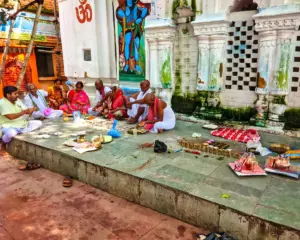
Prayagraj during Pitrupaksha receives hundreds of thousands of pilgrims, with the peak on Sarva Pitru Amavasya. Accommodation books up months in advance. Plan to arrive at least the day before your intended ceremony date, and contact Prayag Pandits well in advance to secure your pandit and confirm the timing. Bring: a list of ancestors’ names and, if possible, their death dates and gotra. Wear clean cotton clothing — white or off-white. Arrive at the Sangam before sunrise for the most auspicious timing.
For NRI Families Arranging Remote Rites
Prayag Pandits offers fully documented online Pind Daan and Tarpan services during Pitrupaksha 2026. The ceremony is performed at Triveni Sangam by our experienced pandits, with your name, your gotra, and your ancestors’ names included in the Sankalpa. The complete ceremony is video-recorded and shared with you in real time or as. Many NRI families across the United States, United Kingdom, Canada, Australia, and Malaysia have used this service and found it a meaningful way to observe Pitrupaksha while managing the constraints of distance and time.
See our dedicated guide on NRI Pind Daan services for complete information on how this works, what to expect, and how to prepare.
Choosing the Right Tirtha
All three principal Tirthas — Prayagraj, Varanasi, and Gaya — are supreme for ancestral rites. The choice depends on:
- Prayagraj — Recommended as the comprehensive solution for all ancestral concerns, especially during Pitrupaksha. Particularly recommended for addressing Pitru Dosha and for Sarva Pitru Amavasya rites.
- Varanasi — Particularly recommended when combined with Asthi Visarjan, and for ancestors who died in Varanasi or who died in inauspicious circumstances.
- Gaya — Particularly recommended for the final liberation (moksha) of the departed soul, especially through the Vishnupada rites.
Many families perform rites at all three Tirthas during a single pilgrimage. If only one is possible, Prayagraj during Pitrupaksha is the most comprehensive choice.
Pitrupaksha 2026
🙏 Book Your Pitrupaksha Ceremony
Starting from
₹5,100
per person
Frequently Asked Questions About Pitrupaksha 2026
Conclusion: The Significance of Pitrupaksha Endures
The spiritual significance of Pitrupaksha 2026 is the same as it has been in every year since the tradition was established in Vedic antiquity — and the same as it will be in every year to come. The ancestors require our remembrance. The debt of Pitru Rin asks for acknowledgment. The gates between this realm and the realm of the ancestors stand open for 16 days each year, and the tradition invites us to use that opening with full sincerity and proper procedure.
What changes from year to year is the specific opportunity: this year’s dates, this year’s Maha Bharani, this year’s Sarva Pitru Amavasya. These are the windows given to us in 2026 — September 26 through October 10 — and the tradition asks that we honor them with the same commitment that our own parents and grandparents honored them before us.
To book your Pitrupaksha 2026 ceremony at Prayagraj Triveni Sangam — in person or through our online documentation service for families abroad — contact Prayag Pandits. Our pandits will guide your family through every step of this sacred observance with the knowledge, reverence, and care that these ancient rites deserve.
Also read: Significance of Pitrupaksha in Hindu Traditions — Full Scriptural Guide | Pind Daan 101: Complete Guide | Pind Daan in Varanasi
Book Your Sacred Ritual
Authentic ceremonies performed by Veda-trained pandits at sacred sites across India.
2,263+ families served
Clear package details
Since 2019
