


Personally Coordinated
Our team guides you through the arrangements described in your selected package.
Pilgrimage journey
₹60,000.00
Per person
Applicable taxes are shown in your booking. Optional additions are separate.
Exclusions
Thoughtfully arranged, personally guided
Our team guides you through the arrangements described in your selected package.
Stay in touch with our team for your booking details and arrangements.
See what your selected package includes. Optional additions are shown separately.
Share your preferences with our team. Final arrangements are confirmed with you.
Experiences shared by our families
8 family reviews0 for this pooja · 8 from across our services
Watching the pandit perform the rituals in real-time by the Falgu River, mentioning my father's name... it felt like we were truly there. Immense gratitude to the entire team.
Being in the USA, travelling to India just for Tarpan during Pitru Paksha was becoming very difficult. Prayag Pandits offered a well-coordinated solution.
I was skeptical about performing such a sacred ritual online from Canada. But honouring my parents in Kashi was important. They were very patient and answered all my questions.
Living in Singapore, we felt disconnected from these essential rituals. The live stream option for Tarpan at Prayagraj gave us a profound sense of connection and peace.
It was deeply important for us in Australia that the rituals were performed correctly. The ceremony reflected the authenticity we sought and was performed by a knowledgeable priest.
The Pind Daan at Kashi was handled carefully, with the pandit following every step diligently. Very reassuring.
Arranging Asthi Visarjan from Bhubaneswar seemed complex, but Prayag Pandits made it seamless. The pandit called us before the ceremony to explain every step. Very professional.
During Pitru Paksha, we booked Shradh at Prayagraj. The coordination was flawless - from date selection to the pandit assignment. Our family felt at peace after the ceremony.
YOUR EXPERIENCE MATTERS
Tell us about your ceremony and the support you received. Your email address will stay private.
From your first choice to your booking
Review your package and any available additions, then add it to your booking.
Share your contact details and booking preferences. Our team coordinates the arrangements with you.
Our team contacts you to confirm the arrangements described in your selected package.
Review your itinerary, travel inclusions and exclusions. Our team confirms your departure and travel arrangements.
The Kashi-Rameshwaram Yatra is not a modern travel package invented by tour companies. It is one of the oldest pilgrimage circuits in the Hindu tradition, documented in the Skanda Purana, the Padma Purana, and the oral traditions of Tamil Nadu’s Saivite and Vaishnavite communities for centuries. Known in Tamil as Sethu Yathirai or Kasi Yatra, this sacred journey connects the four most powerful ancestral and spiritual sites in India — Rameshwaram, Prayagraj (Triveni Sangam), Gaya, and Kashi (Varanasi) — into a single transformative circuit that begins and ends at the Ramanathaswamy Temple in Rameshwaram.
The tradition is precise about one thing: you must carry sacred materials from each site to the next, and you must return to Rameshwaram to complete the circle. Sand collected from the Sethu shore is dissolved at Triveni Sangam. Ganga water collected at Prayagraj is carried to Kashi. And finally, Ganga Jal from Varanasi is brought back to Rameshwaram for the concluding Abhishekam to Lord Ramanathaswamy. When this circuit is completed properly, the scriptures describe it as granting moksha — both for the pilgrim and for the ancestors honoured along the way.
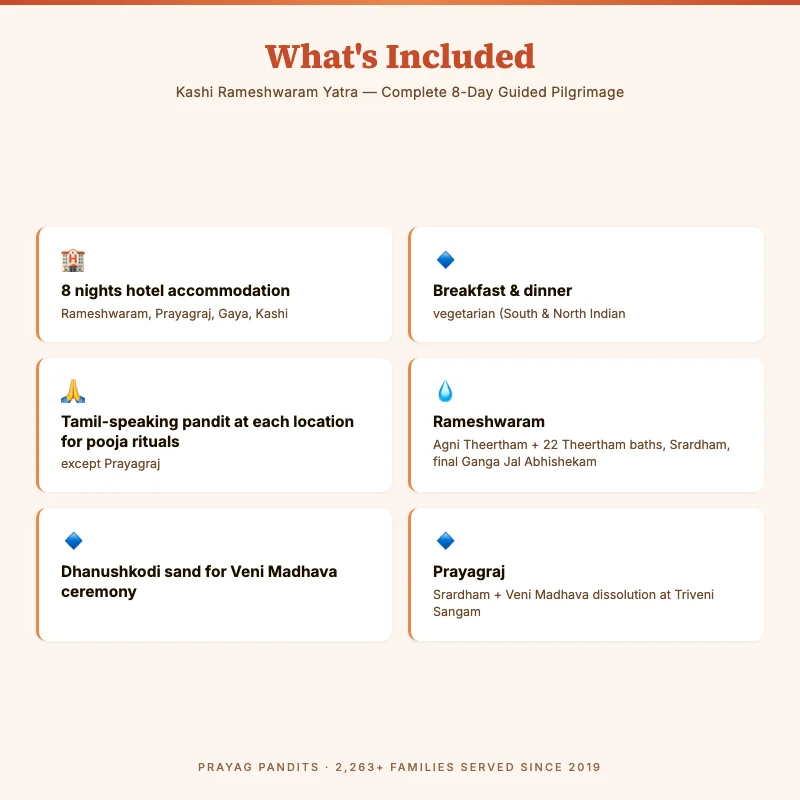
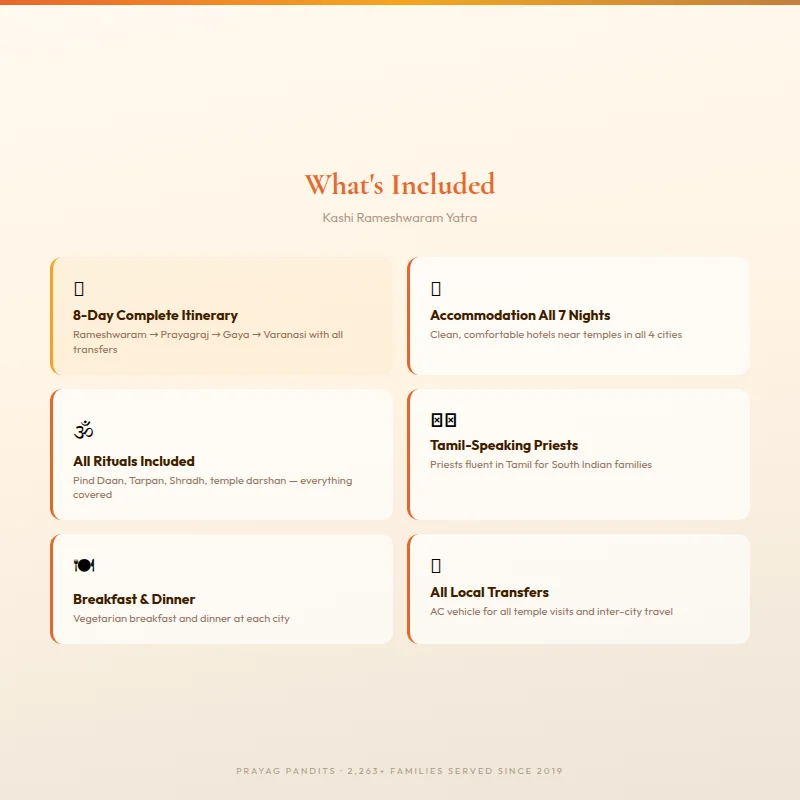
Our 8-day guided package handles every detail of this complex multi-city pilgrimage so that families can focus entirely on the spiritual significance of each stage, without worrying about logistics, priest arrangements, or ritual materials.
Why Families Trust Prayag Pandits for This Yatra
The Kashi-Rameshwaram Yatra — called Sethu Yathirai in Tamil tradition — traces a pilgrimage route that connects the southern tip of India to its northern spiritual heartland. The Skanda Purana describes this circuit as one of the most complete pilgrimages a Hindu can undertake, combining ancestral rites (Pind Daan, Srardham), purification rituals (Theertham baths, Sangam snan), and temple darshans into a single journey that addresses both the pilgrim’s spiritual growth and the liberation of departed ancestors.
The circuit is not arbitrary. Each destination in the yatra serves a specific spiritual function that builds upon the previous one:
The yatra is considered incomplete unless the pilgrim returns to Rameshwaram and performs the closing Ganga Jal Abhishekam to Lord Ramanathaswamy. This act — pouring the waters of the Ganga over the Shivalinga at Rameshwaram — symbolises the unification of Shaiva and Vaishnava traditions and the completion of the pilgrim’s spiritual circuit. This marks the formal conclusion of the Sethu Yathirai.
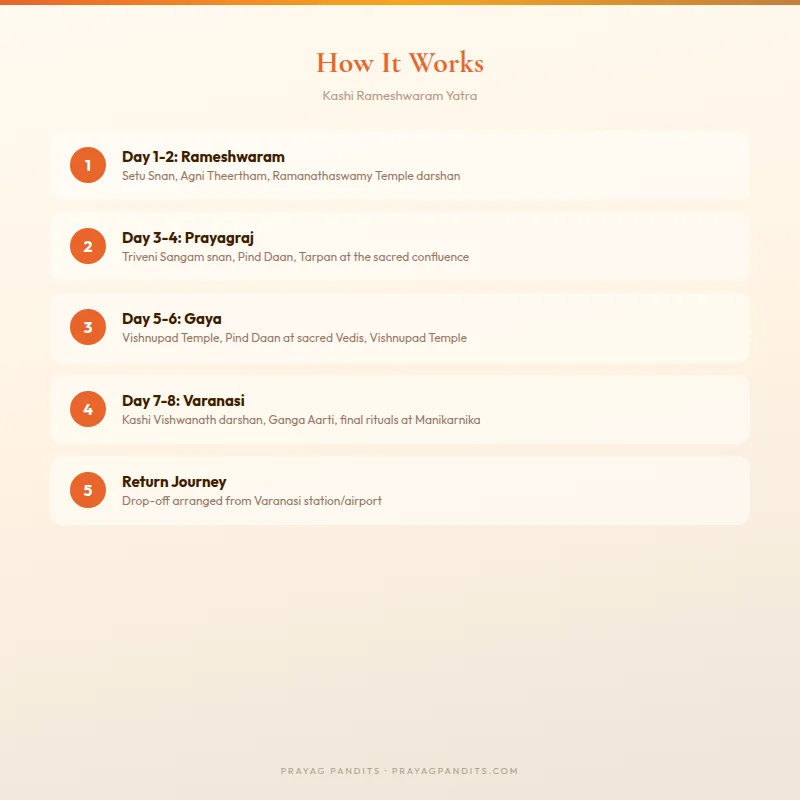
Every day of this yatra has been structured around the traditional sequence prescribed in the Skanda Purana and Tamil Saivite practice. Our experienced pandits guide families through each ritual, explaining the significance in Tamil and Hindi so that every participant — including those performing these rituals for the first time — understands what they are doing and why.
The yatra begins at Rameshwaram, the southernmost point of the pilgrimage circuit. Rameshwaram is one of the twelve Jyotirlinga sites and one of the four Char Dham, making it among the most sacred destinations in the entire Hindu tradition.
Day 1 — Agni Theertham Bath and Temple Darshan
The first act of the yatra is a ritual bath at Agni Theertham — the sea-facing ghat directly in front of the Ramanathaswamy Temple. This is not a casual dip. The pandit guides the family through the sankalpa (formal declaration of the yatra’s purpose), followed by the purification bath. After the bath, the family enters the Ramanathaswamy Temple for darshan of the main Shivalinga and the temple’s famous corridor — one of the longest temple corridors in India at over 1,200 metres.
Following darshan, the family begins the 22 Theertham circuit. Rameshwaram is unique among Hindu pilgrimage sites for having 22 sacred wells within the temple complex, each associated with a specific purification. Bathing in all 22 — following the prescribed order — is believed to cleanse the pilgrim of all accumulated sins, preparing them spiritually for the ceremonies at subsequent sites. Our pandit manages the logistics of accessing each Theertham and recites the appropriate mantras at each one.
Day 2 — Srardham, Sand Collection, and Dhanushkodi
Day 2 focuses on the preparatory rituals for the onward journey. The Srardham (ancestral ceremony) performed at Rameshwaram sets the spiritual intention for the entire yatra. This is different from the Pind Daan performed later at Gaya — the Rameshwaram Srardham is a declaration to the ancestors that their descendants are undertaking the full Sethu Yathirai circuit on their behalf.
After the Srardham, the family collects the three types of sacred sand that must be carried forward:
The day includes a visit to Dhanushkodi, the land’s-end point where the Indian subcontinent meets the sea. This is where Lord Rama is said to have broken the Sethu bridge after returning from Lanka. The ghostly remains of the town destroyed by the 1964 cyclone make this one of the most atmospherically powerful places on the yatra. Our vehicle takes the family along the sand road to the tip, where the Bay of Bengal and the Indian Ocean merge.
The family travels to Prayagraj (formerly Allahabad), where the Ganga, Yamuna, and the mythical Saraswati river converge at the Triveni Sangam. This is one of the holiest sites in Hinduism and the location of the Maha Kumbh Mela.
At the Sangam, two critical rituals are performed:
Veni Madhava Sand Dissolution: The sand collected at Rameshwaram is ceremonially dissolved into the Sangam waters. This act carries profound significance — it symbolically connects the waters of the southern ocean (where Lord Rama performed penance) with the waters of the three northern rivers. The pandit recites the specific mantras for this dissolution while explaining the significance to the family.
Srardham at Triveni Sangam: A full Srardham ceremony is performed at the confluence. The Padma Purana states that Srardham performed at Triveni Sangam yields results equivalent to performing it at ten thousand other tirthas. The ceremony here addresses the ancestors directly, invoking them at the meeting point of three sacred rivers.
After the ceremonies, the family collects Sangam Jal (holy water from the confluence) in sealed containers. This water is carried forward and will eventually be used in the final Abhishekam at Rameshwaram. The pandit also guides the family through darshan at the Akshayavat (the indestructible banyan tree within the Allahabad Fort) and the Hanuman Mandir at Sangam.
Gaya is the spiritual heart of this yatra. It is the single most powerful site on earth for performing ancestral rites, and the Garuda Purana is explicit: Pind Daan performed at Gaya grants complete moksha to the departed soul. No other location carries this specific scriptural guarantee.
Day 4 — Vishnupad Temple and First Ghats
The Pinda Pradanam at Gaya is performed at the sacred ghats, with each location associated with a different aspect of ancestral liberation:
On Day 4, the pandit guides the family through offerings at the first three ghats, taking time to explain the significance of each Pindam and each mantra. For Tamil-speaking families, the entire ceremony is conducted with Tamil explanation alongside the Sanskrit mantras.
Day 5 — Remaining Ghats and Completion
Day 5 covers the remaining two ghats and the concluding ceremonies at Gaya:
After completing the ceremony, the Pinda Pradanam concludes with Tarpan (water oblations) and Brahmin Bhoj (feeding of Brahmins in the ancestors’ names).
Kashi is the city where Lord Shiva whispers the Taraka Mantra (the mantra of liberation) into the ear of every soul that departs within its boundaries. For the Kashi-Rameshwaram Yatra pilgrim, Kashi represents the penultimate stage — the accumulation of maximum spiritual merit before the return to Rameshwaram.
Day 6 — Kashi Vishwanath and Manikarnika
The day begins early with darshan at the Kashi Vishwanath Temple, one of the twelve Jyotirlingas and the most sacred Shiva temple in India. Our pandit arranges priority darshan where possible and conducts a Rudrabhishekam — the ceremonial bathing of the Shivalinga with milk, curd, honey, and Ganga water — on behalf of the family.
Following Vishwanath darshan, the family proceeds to Manikarnika Ghat — the principal cremation ghat of Varanasi, burning continuously for over 3,000 years. Here, a specific Pind Daan ceremony is performed. The significance of Pind Daan at Manikarnika is distinct from Gaya: while Gaya addresses the ancestors’ liberation, Manikarnika addresses the pilgrim’s own relationship with mortality. Standing at the place where bodies are cremated around the clock, performing ancestral rites, brings a grounding reality to the spiritual journey.
The evening is devoted to the famous Ganga Aarti at Dashashwamedh Ghat. This spectacular ceremony — with its choreographed fire offerings, bells, and chanting — is one of the most powerful visual and auditory experiences in Indian spiritual culture. Our pandit secures good viewing positions and explains the significance of each element of the Aarti.
Day 7 — Dampathi Pooja and Ganga Jal Collection
Day 7 includes the Dampathi Pooja — a ceremony specifically for married couples, invoking blessings for the continuation of the family lineage. This pooja addresses the future rather than the past: having honoured the ancestors through Pind Daan at Gaya and Pind Daan at Manikarnika, the family now seeks blessings for the generations to come.
The pandit also guides the family in collecting Ganga Jal from Varanasi in properly sealed containers. This Ganga water — drawn from the holiest stretch of the river, in the holiest city — is the most sacred element carried on the return journey. It will be used for the concluding Abhishekam at Rameshwaram, completing the spiritual circuit.
Additional darshans available on Day 7 include Sankat Mochan Hanuman Temple, Tulsi Manas Temple, and a morning boat ride on the Ganga to witness the sunrise over the ghats — one of the most photographed and deeply moving experiences in India.
The final day is the culmination of the entire Sethu Yathirai. The family returns to Rameshwaram carrying the Ganga Jal collected at Varanasi.
Ganga Jal Abhishekam to Lord Ramanathaswamy: This is the defining ritual of the entire yatra. The Ganga water — carried across the length of India, from the northern plains to the southern coast — is poured over the Ramanathaswamy Shivalinga. This act symbolises the union of the Ganga (the river of Lord Shiva’s matted locks) with the Shivalinga of Rameshwaram (established by Lord Rama). It closes the spiritual circuit opened on Day 1 when the family bathed at Agni Theertham.
This serves as a family record of the Sethu Yathirai having been properly completed.
From booking to completion — a clear, simple process
Contact us on WhatsApp (+91 7754097777) or book online. Tell us your preferred dates, number of family members, and any specific requirements. We will confirm pandit availability and accommodation within 24 hours.
Pay a 30% advance to confirm your booking. You will receive a detailed day-by-day itinerary with accommodation details, pandit name and contact, what to carry, and a checklist of ancestral details needed for the ceremonies.
Arrive at Rameshwaram where our pandit meets you. The 8-day yatra begins with the Agni Theertham bath and 22 Theertham circuit. Our team manages everything from this point forward.
Over 8 days, perform rituals at Rameshwaram, Prayagraj, Gaya, and Kashi. Each ceremony is conducted by the same dedicated pandit, with real-time WhatsApp photo updates for family members not present.
After the concluding Ganga Jal Abhishekam at Rameshwaram, receive a yatra summary with the confirmed ritual schedule and completion dates.
Organising a multi-city pilgrimage across four states is genuinely difficult. The Kashi-Rameshwaram Yatra involves coordination between priests in Tamil Nadu, Uttar Pradesh, and Bihar — each with their own traditions, schedules, and expectations. Many families who attempt to organise this independently find themselves dealing with unreliable local pandits, inflated on-the-spot pricing, incomplete rituals, and the stress of managing logistics in unfamiliar cities.
Here is what sets our service apart:
Pandit Ramesh Iyer has been guiding Tamil families through the complete Kashi-Rameshwaram Yatra circuit for over 12 years. Born in Kumbakonam and trained in the Shaiva Agama tradition, he brings deep knowledge of both South Indian and North Indian ritual practices. He has conducted over 3,000 ceremonies across Rameshwaram, Prayagraj, Gaya, and Kashi, serving families from Tamil Nadu, Kerala, Malaysia, Singapore, and the Gulf countries. His calm, patient guidance and fluency in Tamil make the multi-city pilgrimage accessible and deeply meaningful for every family member.
Book Yatra with Pandit Ramesh
We did the full Kashi-Rameshwaram Yatra for our late father through Prayag Pandits. The pandit was Tamil-speaking and explained every ritual beautifully. From the 22 Theertham at Rameshwaram to the Ganga Jal Abhishekam on the last day, everything was handled perfectly. My mother, who is 72 years old, was treated with so much care and respect. The Pind Daan at Gaya was the most moving experience of our lives. We felt our father’s presence throughout. I would recommend this service to any Tamil family wanting to do the Sethu Yathirai properly.This yatra is not for every family. It is specifically intended for those who fall into one or more of the following situations:
The primary purpose of the Kashi-Rameshwaram Yatra is ancestral liberation. Tamil families traditionally undertake the Sethu Yathirai within the first year after the death of a parent or grandparent — particularly the father. The combination of Srardham at Rameshwaram, Pind Daan at Gaya, and the concluding Abhishekam creates what the scriptures describe as a complete “release package” for the departed soul, addressing every stage of their afterlife journey.
Not all families perform the yatra immediately after a death. Some undertake it years or even decades later, when the family feels a spiritual obligation to provide moksha for ancestors who may not have received proper rites at the time of their passing. This is particularly common among families where the death occurred abroad, where proper Vedic ceremonies could not be performed, or where the death was sudden and the family was unable to complete all prescribed rituals.
In Tamil Nadu, the Sethu Yathirai is a deeply embedded cultural practice. Many families have a tradition of undertaking this pilgrimage at least once in a lifetime, often combining it with ancestral rites. The tradition holds that completing the Sethu Yathirai circuit — starting at Rameshwaram, visiting the northern tirthas, and returning to Rameshwaram with Ganga Jal — is one of the highest spiritual accomplishments a householder can achieve.
For Tamil families settled in Malaysia, Singapore, the Gulf, the US, or other countries, the Kashi-Rameshwaram Yatra represents an opportunity to honour their parents and grandparents in the most complete way possible. Many NRI families tell us that they feel a deep obligation to perform these rites but have been unable to do so because of the complexity of organising a multi-city pilgrimage in India. Our service removes that barrier entirely — the family simply needs to arrive at Rameshwaram on Day 1, and everything else is arranged.
In Vedic astrology, Pitra Dosha — the affliction caused by unsettled ancestors — manifests as repeated obstacles in family life: financial instability, relationship difficulties, health issues in children, or inability to conceive. The Kashi-Rameshwaram Yatra, with its comprehensive Pind Daan at Gaya and Srardham at multiple tirthas, is considered one of the most powerful remedies for Pitra Dosha. It addresses the root cause by providing complete moksha to the ancestors whose unsettled state is causing the dosha.
Every Kashi-Rameshwaram Yatra we conduct is backed by Prayag Pandits’ guarantee of authenticity and care.
📞 Call to Discuss: +91 7754097777 | 💬 WhatsApp Us
For any questions about the Kashi-Rameshwaram Yatra or to discuss your family’s specific requirements, contact us directly on WhatsApp at +91 7754097777. Our team responds within 2 hours during business hours and will provide a complete itinerary and cost breakdown based on your preferred dates and group size.
Related reading that may help you prepare for the yatra: