
Ritual guidance
Mahamrityunjay Jaap Pooja
Mahamrityunjay Jaap by Vedic Brahmins at Prayagraj in 3, 5 or 7 days: 25,000 to 1,25,000 chants, daily Rudrabhishek, closing havan. Get clear help choosing the right vidhi, package and arrangement before you book.
- Verified pandits
- Clear package details
- Vedic vidhi
- All samagri included
- Rated 4.8/5 · 500+ reviews
- 2,263+ families served
- Serving since 2019
Before you choose a package
Confirm the right vidhi, date and arrangement for your family. Share the family situation, preferred date, city, and whether the family will attend in person or remotely. We will help you choose the right next step.
Share context
Tell us the family situation and preferred date.
Confirm fit
We help identify the suitable vidhi and package.
Proceed calmly
Book only after the arrangement is clear.
About Mahamrityunjay Jaap Pooja
A Mahamrityunjay Jaap is the formal recitation of the Mahamrityunjay mantra to a fixed count, addressed to Lord Shiva as Tryambaka, the three-eyed one. Trained Vedic Brahmins complete the count over several days and close it with a havan.
Prayag Pandits arranges the jaap in three durations: 3, 5 and 7 days. They differ in the number of Brahmins, the mantra count and the size of the closing havan. The jaap is performed at Prayagraj, and the person it is for does not need to be there, because the sankalpa names them.
This page gives the mantra, how each duration works, what is included and how to book.
The mantra and its meaning
Om tryambakam yajamahe sugandhim pushti-vardhanam | urvarukam iva bandhanan mrityor mukshiya ma’mritat ||
“We worship the three-eyed one, fragrant, who nourishes all beings. As a ripened cucumber is freed from its stem, may we be freed from death, not from immortality.” The fruit does not tear away; it separates when it is ready.
The verse is Vedic text, not a later composition. It is Rigveda Mandala 7, Sukta 59, verse 12, attributed to Rishi Vasishtha, and it appears again in the Yajurveda and in the Rudrashtadhyayi. It is also called the Rudra mantra and the Tryambakam mantra. The story attached to it is Markandeya’s: granted a life of sixteen years, the boy held on to the Shiva lingam when Yama came, and Shiva turned Yama back.
For the rules of recitation and the meaning of the counts in more detail, read our guide to the Mahamrityunjay mantra, the 1.25 lakh count and the vidhi.
When it is performed
The jaap can be performed at any time of year. Shravan, the period around Mahashivaratri and Pradosha days are held to be especially auspicious. The start date is chosen by lunar phase and weekday: Shukla Paksha is generally preferred, and Pradosha, Chaturdashi and Monday are good starting days.
The occasion usually decides the duration:
- 3 days: a birthday, a wedding anniversary, a yearly observance for the family, recovery from a moderate illness, or a new beginning such as Graha Pravesh or a new business.
- 5 days: a serious illness under treatment, Sade Sati, a difficult Mahadasha or Antardasha, or recovery after surgery or an accident.
- 7 days: a critical illness, a major surgery, Mrityu Yoga identified in the kundali, or a pattern of untimely deaths in the family.
The jaap is a prayer offered alongside medical care, not a substitute for it.
The three durations compared
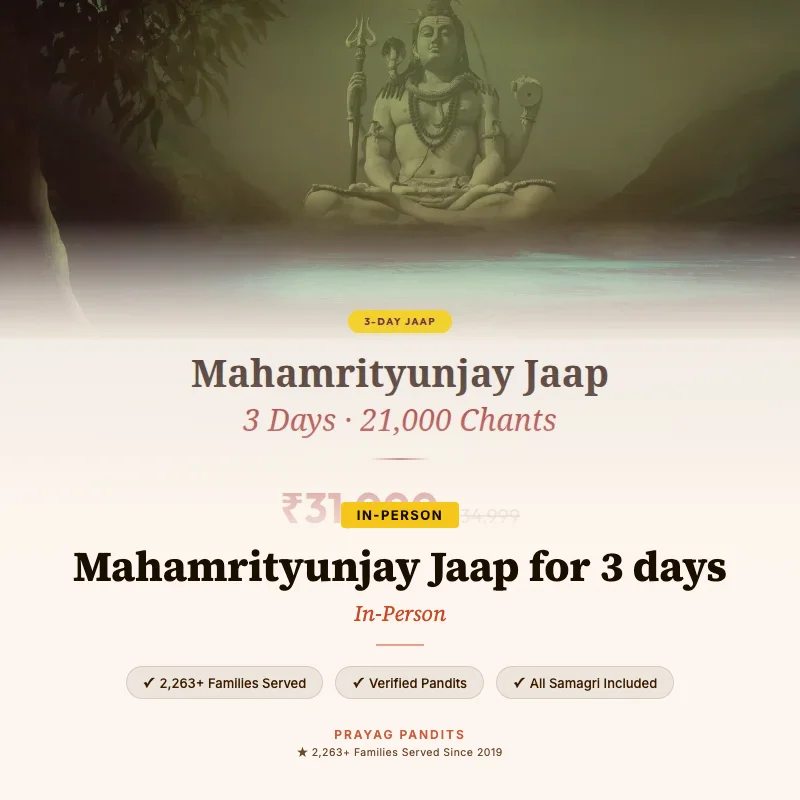
- 3-day jaap: 5 Brahmins, 25,000 repetitions, and a havan of 2,500 ahutis on the third day.
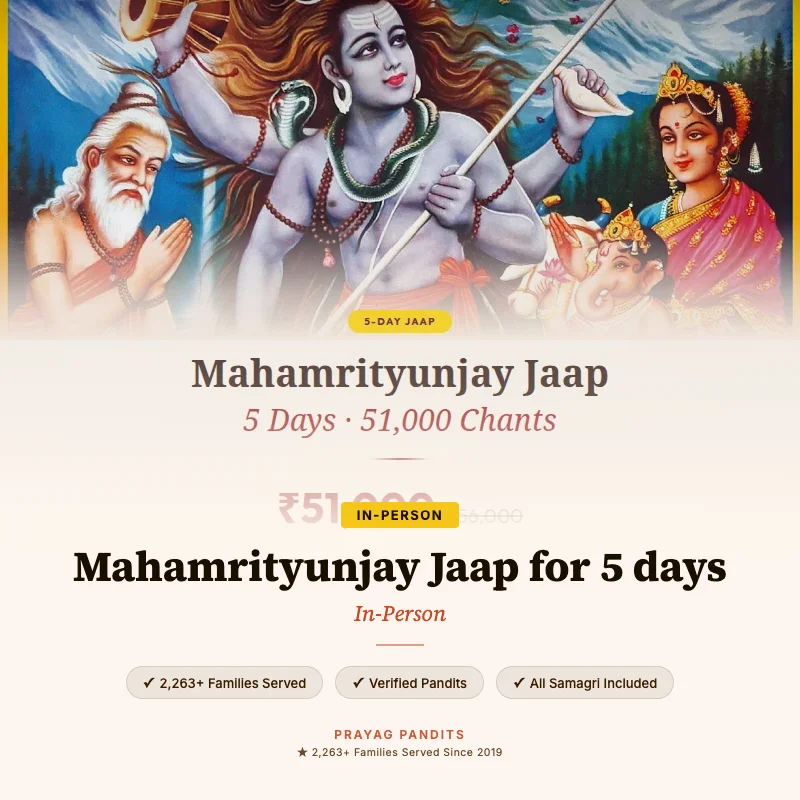
- 5-day jaap: 7 Brahmins, 51,000 repetitions, and a havan of 5,100 ahutis on the fifth day.
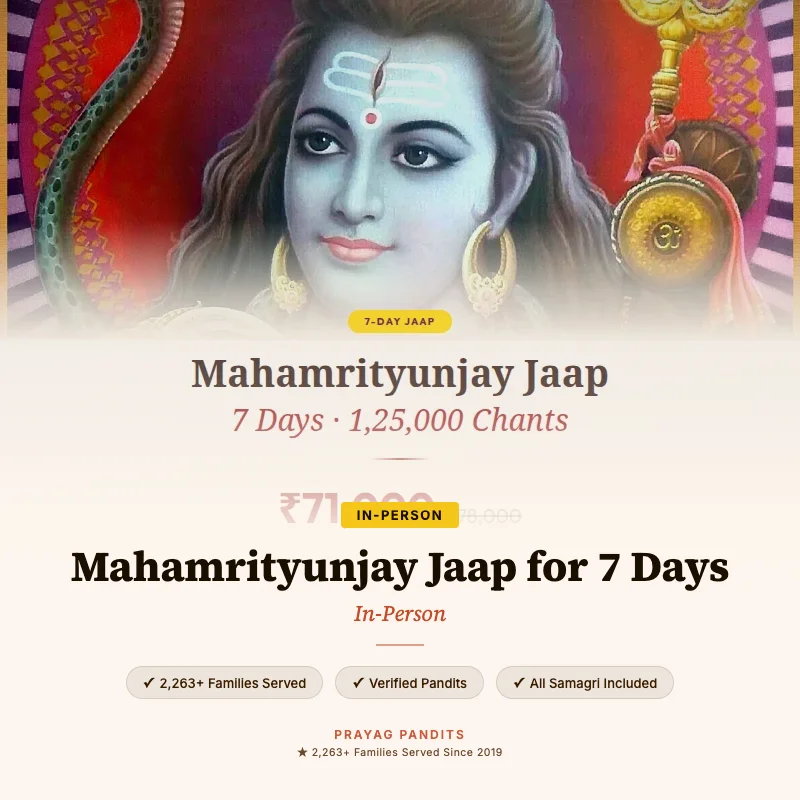
- 7-day jaap: 11 Brahmins, 1,25,000 repetitions (the full sava lakh count), and a Maha Havan of 12,500 ahutis on the seventh day.
In each case the havan offers a tenth of the recited count. The sava lakh count is the complete purascharana; the shorter counts suit less acute intentions, which is why three durations exist.
How it is performed
- At Brahma Muhurta on the first day, the lead pandit takes the sankalpa: the name, gotra and nakshatra of the person the jaap is for, and its purpose.
- Lord Ganesh is invoked first, and the Shivalinga is installed and consecrated.
- The Brahmins chant in morning and evening sessions each day, with the evening session at Pradosha. The count is kept on a Rudraksha mala and tallied at the end of each day.
- Rudrabhishek is performed daily with Panchamrit, Gangajal and Bilva leaves.
- On the last morning the remaining count is completed, followed by the havan and the Poornahuti, the final offering.
- Brahmin bhoj is served to the performing Brahmins after the pooja is complete.
Two rules hold throughout. The reciters keep a sattvic diet, and the count is agreed before the start and not changed during it, because a jaap begun and abandoned is held to be worse than one not begun.
What is included
Included
- Vedic Brahmins trained in Shukla Yajurveda and Rudra-patha, reciting with the correct Vedic accents
- Morning and evening jaap sessions on each day
- The mantra count kept on a Rudraksha mala
- Daily Rudrabhishek with Panchamrit, Gangajal and Bilva leaves
- Complete samagri, including Rudraksha mala, Bilva, Dhatura, ghee, sesame, barley and Gangajal
- The final-day havan with the Mahamrityunjay mantra
- Brahmin bhoj for the performing Brahmins on the last day
- An online option, on request
- Coordination support before the ritual
- Ceremony update on WhatsApp
Not included
- Travel
- Accommodation if you attend in person
- Personal meals
- Any extra dakshina
- Gifts or donations to the pandits
Book Mahamrityunjay Jaap
Choose the duration that matches the situation:
When you book, share the full name of the person, their father’s name, gotra, rashi or nakshatra if known, the intention of the jaap and your preferred dates. Allow about 3 to 5 days’ notice for the 3-day jaap and 5 to 7 days for the 7-day jaap.
Not every situation calls for a full jaap. Sometimes a Rudrabhishek at Haridwar, from ₹5,100 is the lighter and more fitting Shiva rite. If you are unsure, send the circumstances on WhatsApp at +91 77540 97777 or through our contact page, and a pandit will say which applies.

Mahamrityunjay Jaap for 3 days, View & book
- 5 experienced Vedic Brahmins (Shukla Yajurveda & Rudra-patha trained)
- 3 consecutive days of jaap (morning & evening sessions)
- 25,000 mantra repetitions (counted with Rudraksha mala)
Price ₹31,000
Mahamrityunjay Jaap for 5 days, View & book
- 7 experienced Vedic Brahmins (Shukla Yajurveda & Rudra-patha trained)
- 5 consecutive days of jaap (morning & evening sessions)
- 51,000 mantra chants (counted with Rudraksha mala)
Price ₹51,000
Mahamrityunjay Jaap for 7 Days, View & book
- 11 experienced Vedic Brahmins (Shukla Yajurveda & Rudra-patha trained)
- 7 consecutive days of jaap (morning & evening sessions)
- 1,25,000 mantra chants (counted with Rudraksha mala)
Price ₹71,000
Personal guidance
Have a question? Ask a pandit.
Tell us about your family. A pandit will suggest the right way.
- 2,263+families served
- 10+ yearspandit experience
How It Works
Book & Confirm
Select your package and complete booking. We confirm details on WhatsApp within 1–2 hours.
Share Family Details
Provide your gotra, departed soul’s name, and any special requirements.
Ceremony Performed
Experienced pandit performs the complete ceremony at the sacred site.
Updates Shared
The family receives ceremony updates on WhatsApp after completion.
Frequently Asked Questions
Yes. The sankalpa at the start names the person, with their gotra and the purpose, and the jaap is directed to them wherever they are. Send their full name, father’s name, gotra, and rashi or nakshatra if known. If you do not know the gotra, your family priest usually will.
The 3-day jaap suits occasions such as birthdays, anniversaries and new beginnings. The 5-day jaap is for serious illness under treatment, Sade Sati or a difficult dasha. The 7-day jaap, with the full 1,25,000 count, is for critical illness, major surgery or Mrityu Yoga. If you are unsure, tell us the situation first.
Yes. A daily mala of 108 is personal practice and needs nobody. Bathe, sit facing east or north before a lamp and an image of Shiva, and recite on a Rudraksha mala. A full jaap is different: it needs several trained reciters, a tally kept against the sankalpa, and a havan to close.
The family is encouraged to keep a sattvic diet during the jaap, without onion, garlic, meat or alcohol where possible. This is guidance, not an absolute rule, especially for a patient who is ill. The pandits observe the ritual restrictions on your behalf.
Yes. If the jaap is for the welfare of the whole family rather than one person, the sankalpa can include several names. Mention this when booking so the lead pandit can frame the sankalpa accordingly.
The mantra carries Vedic accents, udatta, anudatta and svarita, that are not visible in writing but must be pronounced correctly. The Brahmins who perform this jaap are trained in Shukla Yajurveda and Rudra-patha through a teacher-student lineage, so the recitation keeps those accents across the whole count.
Yes. Families are welcome at Prayagraj, particularly for the final day’s havan. Tell us in advance so you can take part in the sankalpa and the closing rites. Travel and accommodation are not included in the package.
Still deciding?
Not sure which package fits your family?
Share the basic details first. We will help identify whether a simple ceremony, remote coordination, or a fuller support package is suitable.
- Quick guidance on WhatsApp
- No booking pressure
- Package suggestion after context
Ask for guidance
Name, WhatsApp number and service are enough to start.
Two short steps. Only your name and WhatsApp number are needed; the rest helps us prepare.
- 1 · Your details
- 2 · About the rite (optional)
What happens next
- Send your detailsOnly your name and WhatsApp number are needed.
- We reply on WhatsAppWithin 1–2 hours, from +91 77540 97777.
- You choose with usThe package and the date. Nothing is booked or paid until you decide.
What happens next
- Your request is with usWe read every request ourselves.
- We reply on WhatsAppWithin 1–2 hours, from +91 77540 97777.
- You choose with usThe package and the date. Nothing is booked or paid until you decide.