
Key Takeaways
- Why daan at Magh Mela carries extra weight
- Tila Daan: the gift of sesame
- Gau Daan: the gift of a cow
- Anna Daan: the gift of food
In This Article
Six daans are traditionally offered at the Magh Mela: tila (sesame), gau (a cow), anna (food), vastra (cloth), vidya (knowledge) and shayana (a bed). Each has its own scriptural basis and its own effect, and the Puranas single out the month of Magh at Prayag as the time and place where all of them carry their greatest weight. You can offer any of them in person, or have us perform the daan on your behalf with the Sankalp in your name.
Why daan at Magh Mela carries extra weight
Three things stack up at once. The place is Prayag, which the Puranas call Tirthraj and where the Matsya Purana says a gift yields a thousand times what the same gift yields elsewhere. The month is Magh, which the Prayag Mahatmya treats as the one month of the year when the Triveni Sangam is at full potency. And the occasion is the Mela, when the recipients the scriptures name, learned brahmins and ascetics keeping Kalpavas, are actually present in one place.
That last point is the practical one. A daan needs a patra, a worthy recipient. For most of the year finding one is the hard part. During Magh at the Sangam it is the easy part, which is why the tradition concentrates these offerings here.
Tila Daan: the gift of sesame
Sesame is the offering most closely tied to the ancestors. Til is used in tarpan, in shradh and in pind daan, and giving it away at the Sangam is understood as a direct act of service to the departed. It is also the smallest of the six, which makes it the one families usually start with.
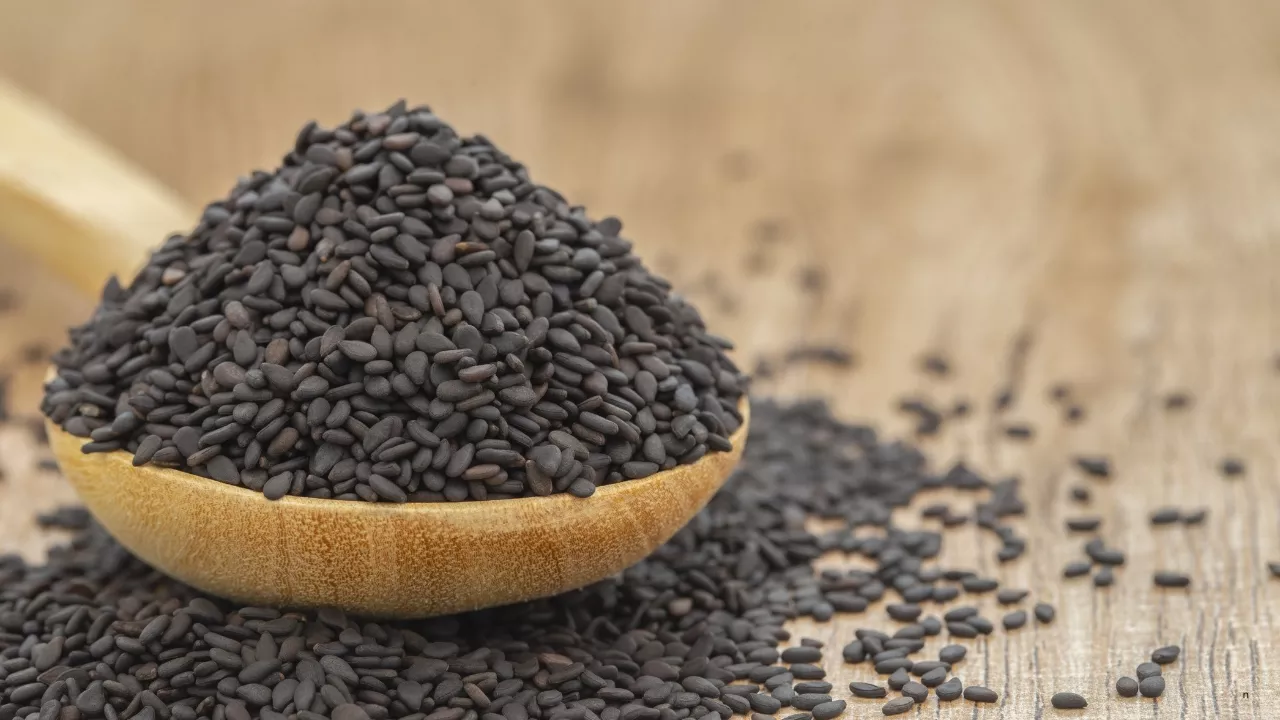
The Puranas associate til with the purification of accumulated fault, and it is the first named in the traditional list of eight gifts that cleanse the soul. It is offered alongside water in tarpan and given separately as daan.
Gau Daan: the gift of a cow
Gau daan is the offering the texts place at the top of the ordinary list. The cow is understood to carry the donor across the Vaitarani, the river the soul meets after death, and the gift is prescribed particularly for the dying and for rites performed on behalf of the departed.
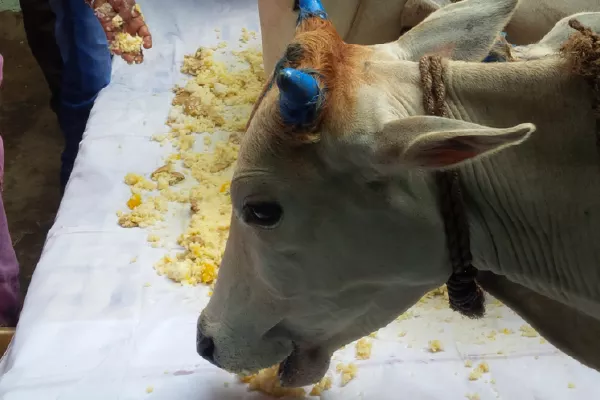
In practice this is the daan most often misrepresented, so it is worth being plain about how ours works. The cow goes to a family or a goshala that will keep and feed it. It is not a symbolic transfer that is reversed after the ceremony.
Anna Daan: the gift of food
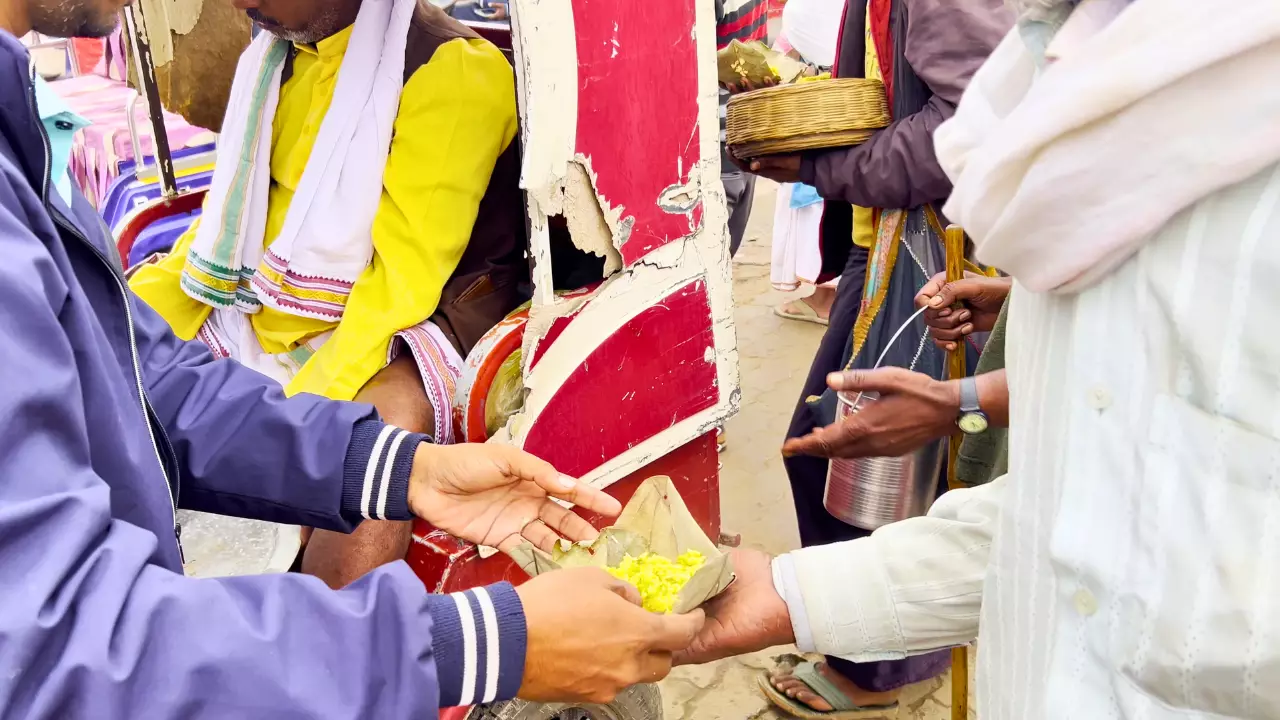
Anna daan is the one the texts call supreme, on the reasoning that every other gift serves a want while food serves a need, and that the merit of feeding someone returns every time they eat. At the Magh Mela it usually means feeding Kalpavasis, the pilgrims living on the sand for the full month, for whom the meal is not symbolic.
Vastra Daan: the gift of cloth
Vastra daan takes two forms at the Sangam and they are not the same rite. The first is the offering of a piyari, a length of cloth, to the river herself, tied at the confluence as an offering to Mother Ganga. The second is the giving of clothing to brahmins and ascetics, which is the daan proper.
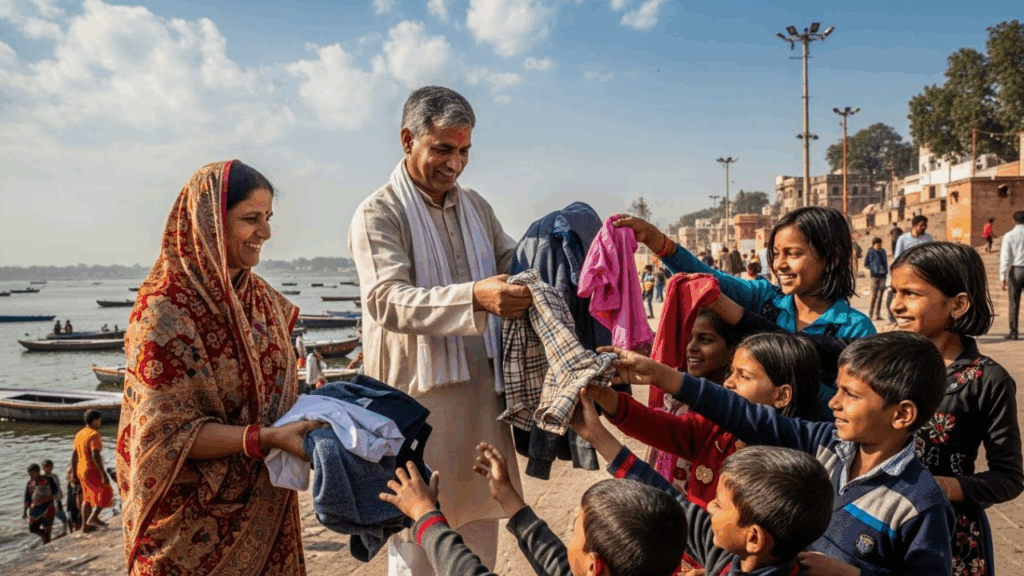
Winter is the reason this daan matters at Magh specifically. The Mela runs through the coldest weeks of the year in north India and the people living on the sand for the month are the ones who need the cloth.
Vidya Daan: the gift of knowledge
Vidya daan is the gift the texts rank above material giving, on the argument that what is given is not diminished in the giving. In practice at the Mela it means supporting a student’s education or a pathshala teaching Sanskrit and Vedic recitation, rather than handing over an object.
Shayana Daan: the gift of a bed
Shayana daan, also called sajja daan, is classed as a mahadaan, a great gift. The Padma Purana equates giving a fully furnished bed with giving gold equal to one’s own body weight. The Garuda Purana goes further and says the merit exceeds that of rites performed during Vyatipata yoga, or in the month of Kartika, or at an eclipse at Naimisha, Dwarka or Prayag itself.

What goes into a complete sajja
This is the part families most often get wrong, because an unfurnished bed does not satisfy the rite as the Garuda Purana describes it. The list the text gives:
- The bed itself. Of sound quality, not broken or makeshift.
- Cotton bedding. A mattress or quilt, the filling being specified rather than assumed.
- Pillows. Counted as part of the furnishing, not as an extra.
- Bedsheets and covers. Clean and new where possible.
- Household provision, in the fuller form. When the daan is made for a departed person, the tradition extends it to household furniture, clothing and a year’s grain, representing complete domestic provision for the recipient.
Which daan should you choose?
There is no ranking that applies to everyone. The texts praise each one highest in its own section, which is a convention of the genre rather than a contradiction. What actually decides it is the purpose.
| If you are doing it for | The usual choice |
|---|---|
| A recently departed parent | Gau daan, or shayana daan in the fuller form |
| Ancestors generally, alongside tarpan | Tila daan |
| General merit, with no particular occasion | Anna daan |
| A vow, or a first offering | Tila daan, the smallest of the six |
| Marital longevity or family stability | Shayana daan |
| Giving that outlasts the giving | Vidya daan |
Having the daan performed for you
If you cannot be at the Sangam in the month of Magh, the daan can be made on your behalf. What makes that valid is the Sankalp: the formal declaration naming you, your gotra and the purpose, said by the pandit at the moment of the offering. The merit is directed by the Sankalp, not by your physical presence, which is the same principle that allows a shradh to be performed for someone who cannot attend.
| Daan | From | What the lowest tier covers |
|---|---|---|
| Tila Daan | ₹2,100 | One offering with tarpan at the Sangam. A single tier |
| Anna Daan | ₹5,100 | Feeding 11 people. Also offered for 51 and 101 |
| Gau Daan | ₹5,100 | The cow alone. With tarpan ₹11,000, with pind daan and tarpan ₹21,000 |
| Vastra Daan | ₹5,100 | Clothing 11 people. Also offered for 51 and 101 |
| Shayana Daan | ₹15,000 | 11 beds with the full sajja. Also 51, 101 and 501 |
| Vidya Daan | ₹25,000 | Support for a student or a pathshala. A single tier |
Three of the six are priced by how many people the offering reaches, which is the honest way to cost a daan: eleven is the traditional minimum, and the rate per head falls as the number rises.
| Recipients | Anna Daan | Vastra Daan | Shayana Daan |
|---|---|---|---|
| 11 | ₹5,100 | ₹5,100 | ₹15,000 |
| 51 | ₹21,000 | ₹21,000 | ₹75,000 |
| 101 | ₹51,000 | ₹51,000 | ₹1,50,000 |
| 501 | Not offered | Not offered | ₹7,50,000 |
Every booking includes the procurement of what is being given, the Sankalp said with your name and gotra, the offering made at the Sangam during Magh, and photographs sent to you afterwards. It does not include travel, your attendance, or a separate puja ceremony, which is booked on its own. A pandit calls you within two hours of the booking.
🙏 Offer Anna Daan at the Magh Mela
- Sankalp said in your name and gotra at the Sangam
- Food served to Kalpavasis during the month of Magh
- Photographs of the offering sent to you
What we do not do: we do not promise a result from a daan, we do not resell a gau daan cow, and we do not ask for anything beyond the booking amount on the day. If a daan cannot be made properly within the Magh window we will say so rather than take the booking.
Common questions
When is daan performed during the Magh Mela?
Any day of the Magh month carries the benefit, but the six bathing days are when most families choose to offer. Mauni Amavasya, 6 February 2027, is the most sought after. The full 2027 bathing calendar sets out all six.
Can a daan be made for someone who has died?
Yes, and that is the commonest reason for gau daan and shayana daan in particular. The Sankalp names the departed person and their gotra, and the merit is directed to them rather than to the person paying.
Do I have to give all six?
No. One daan offered properly is the tradition’s own standard. The six are a list of what may be given, not a sequence to complete.
What proof do I get that the daan was made?
Photographs of the offering, sent by WhatsApp or email, along with confirmation of the date and the recipient. For gau daan we send the details of the family or goshala receiving the cow.
Magh comes once a year and the window closes on 6 March 2027. If you know which daan you want, tell us the name and gotra and we will do the rest: offer Anna Daan at the Magh Mela.
Book Your Sacred Ritual
Authentic ceremonies performed by Veda-trained pandits at sacred sites across India.



