Key Takeaways
- Haridwar Climate Overview — Four Distinct Seasons
- Month-by-Month Climate Guide for Haridwar
- Best Time to Visit Haridwar — Our Recommendation
- What to Pack for Each Season in Haridwar
In This Article
Haridwar sits at an elevation of approximately 314 metres above sea level at the base of the Siwalik Hills — the outer Himalayan foothills in Uttarakhand. This geography shapes the climate in Haridwar profoundly: the city is hot and humid in summer, receives heavy monsoon rainfall from June through September, and enjoys a crisp, cool winter that is one of the most pleasant seasons for pilgrimage. Understanding the climate in Haridwar is essential for planning your visit — whether you are coming for the Ganga Aarti and temple darshan, for Asthi Visarjan or Pind Daan at Haridwar, or simply for a spiritual retreat.
Haridwar Climate Overview — Four Distinct Seasons
The climate in Haridwar follows a classic north Indian subtropical pattern, modified slightly by its proximity to the Himalayas. Annual rainfall averages around 1,800–2,100 mm, the vast majority of which falls during the monsoon months (June–September). Temperatures range from near-freezing in January (lows of 2–4°C) to 40°C or above in the peak of May–June. The city does not receive snowfall itself, though the surrounding hills occasionally have frost in the coldest nights. Four seasons shape the pilgrimage calendar: winter (November–February), spring/pre-summer (March–mid-May), summer/monsoon (mid-May–September), and post-monsoon/autumn (October–November).
Month-by-Month Climate Guide for Haridwar
January — Peak Winter
Temperature: 2–18°C | Rainfall: Very low (10–20 mm) | Crowd level: High (Magh Mela season)
January is the coldest month in Haridwar and simultaneously one of the most spiritually charged. The Magh Mela — the sacred bathing fair held during the Hindu month of Magh — draws hundreds of thousands of pilgrims to the ghats for the holy dip. The Ganga is cold (water temperature drops to 8–12°C), and early morning bathing requires genuine courage, but the spiritual merit is held to be exceptional. Morning fog settles over the river, and the Ganga Aarti in the chill of a January evening — with the sacred fire blazing bright against the cold air — is a uniquely powerful experience. Pack heavy woolens: a fleece layer, a down jacket, and thermal underlayers are necessary for the evenings and early mornings.
February — Late Winter
Temperature: 5–22°C | Rainfall: Low (15–25 mm) | Crowd level: High (Magh Mela continues)
February remains cold, especially in the first two weeks, with the Magh Mela season continuing through Shivaratri (which typically falls in February or early March). Basant Panchami (usually late January or early February) marks the beginning of spring and is one of the important bathing dates. By late February, temperatures begin to moderate pleasantly. The Ganga remains clear and cool, and accommodation is at a premium during the Magh Mela period — book well in advance. If the Ardha Kumbh or Kumbh Mela falls in this year (as it does every six or twelve years), February draws record crowds.
March — Transition to Spring
Temperature: 12–28°C | Rainfall: Very low (15 mm) | Crowd level: Moderate
March is arguably the single best month for a first-time visit to Haridwar. The days are pleasantly warm (25–28°C), the nights are cool but no longer cold, and the Siwalik Hills behind the city bloom with wildflowers. Magh Mela crowds have dispersed, accommodation is readily available, and the Ganga runs clear and inviting. Holi (the festival of colours, usually in March) brings festive energy to the city. If you are performing Pind Daan at Haridwar and have flexibility on timing, March is an ideal month — the ghats are accessible, the pandits are available without the rush of peak season, and the overall experience is serene.
April — Spring
Temperature: 18–35°C | Rainfall: Low (20 mm) | Crowd level: Moderate to low
April sees temperatures rising steadily, with afternoons approaching 33–35°C. However, mornings and evenings remain pleasant, and the general atmosphere is one of spring transitioning to early summer. The ropeway rides to Mansa Devi and Chandi Devi are particularly enjoyable in April — the air is clear and the views of the Ganga valley are excellent. Ram Navami (April) is an important festival occasion that draws pilgrims. Light cotton clothing is sufficient during the day; carry a light layer for evenings.
May — Pre-Monsoon Heat
Temperature: 24–40°C | Rainfall: Low (30–40 mm) | Crowd level: Moderate (summer tourists from plains)
May is hot — afternoon temperatures regularly touch 38–40°C. The Ganga provides relief, and bathing in the cool river during the heat of a May afternoon is genuinely refreshing. Many families from the Delhi and UP plains visit Haridwar in May as part of a hill station circuit, combining Haridwar with Rishikesh and onward to Mussoorie or Dehradun. If you are visiting primarily for ghats and temple darshan, plan activities in the early morning (5–9 am) and evening (after 5 pm), resting during the afternoon heat. Stay well hydrated — the dry heat of May can dehydrate quickly.
June — Monsoon Onset
Temperature: 24–38°C | Rainfall: High (150–200 mm) | Crowd level: Lower
The monsoon arrives in Haridwar typically in the second or third week of June, transforming the city almost overnight. The Siwalik Hills turn brilliant green, the air fills with humidity and the smell of wet earth, and the Ganga begins to rise with the added volume of Himalayan rains. June remains hot but the intermittent rains bring relief. Note that Char Dham Yatra — the pilgrimage to Badrinath, Kedarnath, Gangotri, and Yamunotri — is at its peak in May–June, and Haridwar is the gateway city for all four shrines. This brings a specific category of spiritual traveller to Haridwar even as general tourist traffic slows.
July — Peak Monsoon
Temperature: 23–33°C | Rainfall: Very high (300–400 mm) | Crowd level: Low for tourists; high during Kanwar Yatra
July is the wettest month in Haridwar. Heavy, sustained rainfall occurs daily — often for several hours at a stretch. The Ganga turns a turbid brown as glacial silt and mountain runoff are carried downstream, and the water level can rise 3–5 metres above its winter level, submerging the lower ghat steps. Outdoor activity is severely curtailed. However, the Kanwar Yatra — one of the world’s largest religious processions, in which devotees (Kanwariyas) travel on foot to Haridwar to collect Ganga Jal and carry it to their home temples — transforms July into one of Haridwar’s busiest religious events. Tens of millions of Kanwariyas pour through the city during the month of Shravan, particularly on Mondays (Somvar). Accommodation during the peak Kanwar period (late July) is extremely difficult to find — plan well ahead.
August — Monsoon Continues
Temperature: 23–32°C | Rainfall: High (250–300 mm) | Crowd level: Low to moderate
August remains heavily monsoon-affected but begins to ease toward the end of the month. Janmashtami (Lord Krishna’s birthday, usually in August) is celebrated with great fervour at several temples. The lush green hills are at their most beautiful in August — the scenery is genuinely spectacular even as outdoor activities remain limited. Pilgrimages to ancestral rites sites are fewer in August, but those performing Pind Daan who cannot travel at other times can still do so in August, as the ghats and pandit services remain operational throughout the monsoon.
September — Late Monsoon and Pitrupaksha
Temperature: 22–32°C | Rainfall: Moderate (120–150 mm) | Crowd level: Moderate to high (Pitrupaksha)
September is a transitional month — the monsoon weakens progressively through the month, and by late September the skies begin to clear. Pitrupaksha — the fortnight of ancestral rites — falls in September (exact dates vary by year). This is one of the busiest times at Haridwar’s ancestral rite ghats, with families arriving from across India to perform Pind Daan, Tarpan, and Shradh ceremonies at the Ganga for their departed ancestors. Prayag Pandits offers full Shradh Puja and Pind Daan services during Pitrupaksha at Haridwar with advance booking.
October — Post-Monsoon Autumn
Temperature: 14–30°C | Rainfall: Very low (30 mm) | Crowd level: High (Navratri and Diwali season)
October is one of the finest months to visit Haridwar. The monsoon has fully retreated, the Ganga has returned to its clear, green winter character, and the temperature is ideal — warm enough for comfortable outdoor activity but cool enough for long walks and ghat sitting. Navratri (the nine nights of the Goddess) transforms both Mansa Devi and Chandi Devi temples into major festival sites, with special aartis, extended darshan hours, and thousands of devotees scaling the hills. The atmosphere of Haridwar during Navratri — the sound of Devi bhajans echoing across the ghats, the smell of incense from every temple, the rows of diyas flickering in the evening breeze — is deeply moving.
November — Early Winter
Temperature: 8–26°C | Rainfall: Very low (10 mm) | Crowd level: Moderate
November brings a noticeable drop in temperature, particularly in the evenings. Diwali (usually October–November) is celebrated with spectacular lighting of the ghats — the Ganga Aarti on Diwali night, with the river surface covered in floating diyas and the entire ghat illuminated with earthen lamps, is one of the most breathtaking sights in Haridwar. Dev Diwali (on Kartik Purnima, 15 days after Diwali) is also marked at the ghats with elaborate celebrations. Pack a medium-weight jacket for evenings in November.
December — Winter Sets In
Temperature: 4–20°C | Rainfall: Very low (10 mm) | Crowd level: Low to moderate
December is cold and quiet — the city has a meditative, uncrowded quality that appeals to serious spiritual seekers and long-stay retreat visitors. The mornings at the Ganga are misty and bitterly cold before sunrise, but the afternoon sunshine is pleasant. Christmas and New Year’s Eve draw some domestic tourists (particularly Rishikesh is popular for New Year), but Haridwar itself remains relatively calm. A full set of winter woolens (thermal base layer, fleece, down jacket, warm hat and gloves for evenings) is essential for December visits.
Best Time to Visit Haridwar — Our Recommendation
Based on climate, crowd patterns, and pilgrimage significance, here is our clear recommendation for the best time to visit Haridwar:
- Best overall months: October–November and February–March. The weather is ideal, the Ganga is clear and accessible, the main temples and ghats are all fully operational, and the festive energy of Navratri (October) or the Magh Mela (January–February) adds spiritual significance to your visit.
- Best for Pind Daan and ancestral rites: September–October (Pitrupaksha season). This is the most meritorious time for performing Pind Daan and Shradh at Haridwar. The monsoon has retreated, the ghats are fully accessible, and the pandits are fully available for ancestral rite ceremonies.
- Best for Kumbh Mela: Once every 12 years (Purna Kumbh) and every 6 years (Ardha Kumbh) — the dates are determined astronomically and are announced well in advance. The next Purna Kumbh at Haridwar is in 2033.
- Best for solitude and retreat: December–early January (outside the Magh Mela rush), or the post-Navratri weeks of late October to mid-November.
- Avoid: Mid-July to late August for outdoor pilgrimage activities. The Ganga is in flood, the ghats can be dangerous, and outdoor ropeway operations may be suspended in heavy rain. Visitors performing indoor rituals or attending ashram programs are not affected.
What to Pack for Each Season in Haridwar
The right clothing and gear makes a significant difference to the pilgrimage experience at Haridwar. Here is a practical packing list by season:
Winter (November–February)
- Thermal underlayers (top and bottom)
- Medium-weight fleece or wool sweater
- Down jacket or heavy woolen shawl for evenings and early mornings
- Warm hat and gloves (essential for January–February morning baths)
- Waterproof footwear (morning dew and ghat water can make surfaces slippery)
- Extra towels and quick-dry inner garments for ghat bathing
Spring and Autumn (March–April, October)
- Light cottons for the day
- A medium-weight layer or shawl for evenings and early mornings
- Comfortable walking shoes with grip (temple steps and ghat stairs can be steep)
- Sun protection: hat, sunscreen, sunglasses
- A foldable bag for prasad, herbal purchases, and shopping in the Bara Bazaar
Monsoon (June–September)
- Lightweight waterproof rain jacket or poncho
- Quick-dry synthetic clothing (cotton takes too long to dry in humid conditions)
- Waterproof sandals or rubber-soled footwear (ghat steps are extremely slippery)
- Dry bags or waterproof pouches for phone, passport, and cash
- Insect repellent (mosquito activity increases in monsoon)
- Check flood and bathing advisories from the district administration before entering the Ganga
Performing Pind Daan at Haridwar — Best Season Guidance
For families travelling to Haridwar to perform Pind Daan, Asthi Visarjan, or Shradh ceremonies, the seasonal guidance is specific. The most meritorious period is Pitrupaksha (the fortnight of ancestral rites, September–October), followed by Amavasya days (new moon, once a month) throughout the year. Outside of Pitrupaksha, October through March is the recommended window — the ghats are fully accessible, the pandit community is well-organized, and the weather allows for comfortable performance of the outdoor rituals that ancestral rites entail.
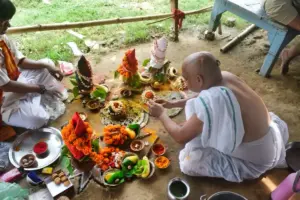
The Pind Daan ceremony at Har Ki Pauri typically involves bathing at the Brahmakund, changing into fresh white or off-white cotton dhoti (for men) or saree (for women), and then performing the puja under the guidance of a local pandit. The ritual includes Tarpan (water offerings with sesame and Kusha grass), the preparation and offering of rice pindas, and concludes with Dakshina and the immersion of ritual materials in the Ganga. The entire ceremony takes 1.5–3 hours depending on the depth of the ritual being performed. Prayag Pandits provides pre-arranged ceremonies at Haridwar with experienced pandits and handles all logistics including accommodation recommendations for outstation families.
🙏 Book Pind Daan at Haridwar — Any Month
Related Services by Prayag Pandits
- 🙏 Pind Daan in Haridwar — Starting from ₹7,100
- 🙏 Asthi Visarjan in Haridwar — Starting from ₹7,100
- 🙏 Shradh Poojan in Haridwar — Starting from ₹5,100
Book Your Sacred Ritual
Authentic ceremonies performed by Veda-trained pandits at sacred sites across India.