
Magh Mela 2027 is on until 6 March 2027. Magh Mela 2027 is on See packages & dates See dates
Pitru Paksha 2027 is on until 29 September 2027. Pitru Paksha 2027 is on See packages & dates See dates
Sarva Pitru Amavasya is today. Sarva Pitru Amavasya is on See packages & dates See dates
Haridwar ritual guidance
Tarpan in Haridwar
Three handfuls at Gangadvara, where four Puranas say the Ganga enters the plains.
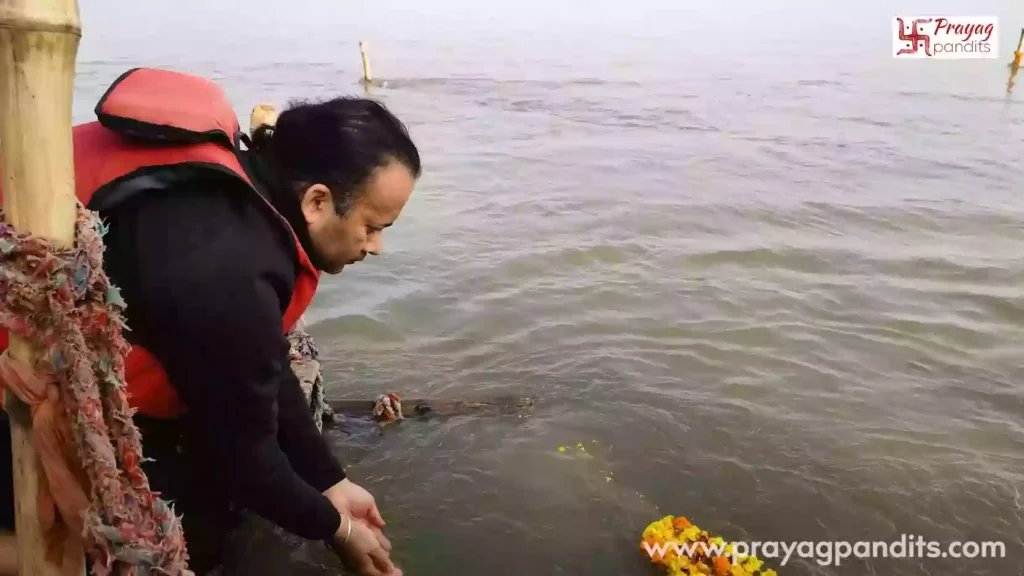
Tarpan at Haridwar — the Skanda, Agni, Garuda, and Padma Puranas name this ghat Gangadvara, the doorway of the Ganga from the Himalayas. Three handfuls of water with darbha twigs per the Baudhayana procedure. Daily, through Pitrupaksha (Sep 26 — Oct 10, 2026), and on the annual Tithi.
- Verified pandits
- Clear package details
- Vedic vidhi
- All samagri included
- Rated 4.8/5 · 500+ reviews
- 2,263+ families served
- Serving since 2019
Choose your package
Choose the arrangement that fits your family
Every package includes an experienced Vedic pandit and the required puja samagri. The difference is in boat, location, stay, and tradition.

Tarpan in Haridwar, View & book
- Tarpan at Har Ki Pauri, Haridwar
- Experienced Haridwar-based pandit
- All samagri (sesame, kusha, Gangajal, flowers)
- Tarpan with three-generation ancestral invocation
Price ₹5,100
Haridwar
More rites at Haridwar
Asthi Visarjan, Kaal Sarp Dosh Puja, Narayan Bali, Pind Daan, Rudrabhishek and Shradh, with pandits at Haridwar.
- 2,263+families served
- 10+ yearspandit experience

Planning Tarpan during Pitru Paksha?
Compare the Pitru Paksha packages in Haridwar, online or in person.
Why families choose Prayag Pandits
- Families served
- 2,263+
- Serving since
- 2019
- Average rating
- 4.8/5
- GST registered
- Registered
Har-ki-Pauri Tirth Purohit lineage
qualified for Vedic tarpan, shradh, and pind-daan at Gangadvara
Darbha & anjali per Baudhayana
directional facing + handful count observed
Tarpan at Gangadvara
Per the Skanda, Agni, Garuda, & Padma Puranas
Same-day confirmation
WhatsApp message from the pandit the same evening
Voices from families
What families say after the rite
Rated 4.8 out of 5
500+ reviews
Our pandits









- 2,263+ families served
- Serving since 2019
- GST registered
Very professional service. The pandit ji explained every step of the ritual which helped us understand the significance. Everything was arranged well including the samagri. We are grateful to Prayag Pandits for making this spiritual journey meaningful. Om Shanti.
We had been wanting to perform Pind Daan for years but couldn't travel to India. This online service was a blessing. The entire ritual was done as per shastras. Thank you Prayag Pandits team for your dedication.
The pandit ji recited the mantras perfectly and explained the significance of each ritual. Deeply moving experience.
Third time booking with Prayag Pandits. Always reliable service. The pandits are well versed in the scriptures and perform rituals with full devotion. The pricing is fair and transparent. No hidden charges.
We booked Pind Daan for our late father's shradh ceremony. The pandits were very knowledgeable and performed all rituals with proper Vedic mantras. The whole family felt at peace after the poojan. Highly recommended for anyone looking for authentic rituals.
पितृपक्ष में पिंडदान करवाया। पूरी व्यवस्था उत्तम थी। पंडित जी समय पर आए और सभी विधि-विधान पूर्ण भक्तिभाव से सम्पन्न करवाए। प्रसाद वितरण भी अच्छा था। Om Shanti.
After losing my father suddenly we needed guidance on the proper rituals. Prayag Pandits team was very compassionate and helped us through every step. The Pind Daan brought us immense peace.
Not sure which package fits?
Talk to a family advisor — free, no obligation. We reply on WhatsApp within 1–2 hours.
What's included
Every package lists exactly what is included no pressure for "extra dakshina" on the day
We've seen too many families face hidden boat fees, samagri costs, and "dakshina" pressure on the day. Here's exactly what's covered, and what isn't.
Included in your package
- Experienced Haridwar Pandit Verified Har-ki-Pauri Tirth Purohit from a registered Haridwar ghat — the priestly lineage qualified for tarpan, shradh, and pind-daan rites across the Pitrupaksha calendar and the annual death-anniversary Tithi.
- All Tarpan Samagri Darbha (kusha) twigs, til, jau (barley), gangajal, kalash, white cloth — prepared in advance, ready before the family arrives at the ghat. Tarpan requires the dried grass twig and the prescribed water vessel per Baudhayana.
- Package add-ons available Optional upgrades: online tarpan with live video proof for NRI families, Pitrupaksha 2026 timing-specific variants (Sep 26 — Oct 10), and combinations with full Shradh or Pind Daan rites on request.
- Family Coordinator One person on WhatsApp through your entire booking — fluent in Hindi, English, and major regional languages — before and after the ceremony.
- Same-day Confirmation WhatsApp message from the Haridwar pandit the same evening, with details of all tarpan offerings made on your behalf.
- Gangadvara tarpan coordination Tarpan at the Ganga ghat the Skanda, Agni, Garuda, and Padma Puranas all name Gangadvara — the doorway where the Ganga emerges from the Himalayas onto the plains. Har-ki-Pauri, the traditional place-name for the ghat, is the sthala-parampara anchor for ancestral rites at this tirtha.
Not included in your package
- Travel to Haridwar Train or road travel. Haridwar Junction is well-connected from Delhi (4-5 hours by train); Jolly Grant Airport (Dehradun) is 35 km away. We can recommend trusted operators.
- Hotel / Accommodation Not bundled with the base packages; stay-inclusive options available on request.
- Pind Daan offering (Not included) Tarpan packages cover the water-libation rite only. For the full Pind Daan offering at Haridwar, see Pind Daan in Haridwar. Combined tarpan + pind-daan packages available on request.
How it works
Four steps. We carry the rest.
From your first call to same-day confirmation — we handle every coordination, so the family can focus on what matters.
Book & confirm
Choose a package and complete payment online. We confirm details on WhatsApp within 1–2 hours.
Share ancestral details
Provide gotra, names of departed ancestors (up to three generations), preferred date — the annual Tithi or a Pitrupaksha day — and any special vidhi requirements.
Tarpan at Gangadvara
Haridwar pandit performs the complete tarpan vidhi at the Gangadvara ghat — Sankalp, then water libation with darbha twigs for deva-tarpan (East), rishi-tarpan, and pitri-tarpan (South), with the prescribed anjali count per Baudhayana.
Confirmation & report
Haridwar pandit sends a same-evening WhatsApp confirmation with offerings detail. Online poojas include video delivery (online) within 48 to 72 hours.
- We respond within 1–2 hours · No commitment required
When to perform
When to perform tarpan at Gangadvara — daily, monthly, annually, and through Pitrupaksha
Tarpan is a nitya-karma — the Manusmriti, in its Pitri-yajna section, names tarpan one of the five mahayajnas every householder performs daily after the morning bath. At Haridwar, the rite intensifies through the Gangadvara Mahatmya: the Skanda Purana, Agni Purana, Garuda Purana, and Padma Purana all name this ghat Gangadvara — the doorway where the Ganga emerges from the Himalayas onto the plains. Har-ki-Pauri, the traditional place-name for the ghat, is the sthala-parampara anchor for ancestral rites at this tirtha. Pitrupaksha (Sep 26 — Oct 10, 2026) is the peak fortnight, with Sarva Pitru Amavasya (Mahalaya) as the universal-ancestors day. The annual death-anniversary Tithi is the lifelong family obligation; monthly Amavasya keeps the rite alive between Pitrupakshas; tarpan is valid year-round at Gangadvara.
Daily
Nitya-karma
Pitrupaksha
Most ideal
Amavasya
Monthly
Tithi
Anniversary
Year-round
Always valid
Two ways to perform
In-person at Har-ki-Pauri, or online from anywhere
Travel to Haridwar
Performed by your own hands at the Gangadvara ghat under a Har-ki-Pauri Tirth Purohit. Karta recites Sankalp; tarpan is offered in three directions — deva-tarpan facing East, pitri-tarpan facing South — with the prescribed darbha twigs and anjali count per Baudhayana.
- Karta performs Sankalp & tarpan personally
- Gangadvara ghat — where the Ganga enters the plains
- Pitrupaksha 2026 variant available (Sep 26 — Oct 10)
- Add hotel, transport, Ganga Aarti darshan
from ₹5,100
Online for NRI families
For families abroad or unable to travel. Sankalp recited remotely; Haridwar pandit performs tarpan at the Gangadvara ghat with live video proof.
- Live Zoom / WhatsApp ceremony
- Names & gotra confirmed remotely before sankalp
- Pitrupaksha 2026 online variant available
- Performed with your family's Sankalp, in your names
Complete guide
Tarpan in Haridwar
everything families ask before booking
An editorial reference covering the ritual, the place, eligibility, timing, and what to keep ready — written for families weighing the decision.
About Tarpan
Book Online and In person Tarpan in Haridwar Packages
- 2,263+ Families Served Since 2019
- Pooja Samagri Included
- Experienced Pandits
- 4.8/5 Average Rating
- Online Pooja Available
Common questions about the procedure
How is tarpan performed at Haridwar?
The traditional tarpan vidhi follows the procedure attributed to the Baudhayana Dharmasutra: stand in the river or sit on the ghat steps at the Gangadvara. Face East for the deva-tarpan (offerings to the deities); face South for the pitri-tarpan (offerings to the departed ancestors). The darbha (dried kusha grass) is the prescribed medium for the water-libation — held differently for each class of offering. Water mixed with til (sesame) and jau (barley) is offered through the hands in the prescribed number of handfuls for each class of recipient. At Haridwar, the rite is performed at the Gangadvara ghat — the point four Puranas name as the doorway where the Ganga emerges from the Himalayas onto the plains.
Why perform Tarpan at Haridwar specifically?
Tarpan is valid at any river ghat — every householder offers daily tarpan after the morning bath as one of the five mahayajnas per the Manusmriti. But at Haridwar, the rite intensifies through the Gangadvara Mahatmya: the Skanda, Agni, Garuda, and Padma Puranas all name this ghat Gangadvara — the doorway of the Ganga. Haridwar is also one of the Sapta Puris (as Mayapuri), making it a doubly-anchored tirtha. The Padma Purana affirms that the bank of the Ganga is everywhere divine; the Agni Purana teaches that the Ganga succours the two lines of ancestors. Pitrupaksha tarpan at Gangadvara carries Mahatmya merit beyond ordinary river-side tarpan.
Who can perform Tarpan in Haridwar?
The eldest son holds the first authority to conduct tarpan to the ancestors as part of his shradh-karma obligation. After marriage, the son performs tarpan with his wife. If the eldest son is deceased, the younger son carries out tarpan, pind-daan, and shradh karma. In the absence of a son, the grandson (son’s son); in the absence of male issue from the deceased, the brother; if the departed had only daughters, the daughter’s son holds the right. We coordinate the family-relation verification before the ceremony.
When should Tarpan in Haridwar be performed?
Tarpan is fundamentally a daily nitya-karma — Manusmriti chapter 3 lists it among the five mahayajnas every householder performs after the morning bath. Beyond the daily obligation: (1) Pitrupaksha — the 16-day fortnight in Ashwina Krishna Paksha, with Sarva Pitru Amavasya as the universal-ancestors closing day; (2) the annual death-anniversary Tithi — the karta’s lifelong family obligation; (3) monthly Amavasya — the recurring touchpoint between Pitrupakshas. Pitrupaksha 2026 runs September 26 — October 10. The Gangadvara ghat holds year-round — families performing tarpan outside Pitrupaksha still receive Mahatmya merit at Haridwar.
What is the difference between Tarpan, Pind Daan, and Shradh at Haridwar?
Three related but doctrinally distinct rites. Tarpan is the water-libation offered with darbha twigs and the prescribed anjali count — performed daily by every householder, with peak intensity during Pitrupaksha. Pind Daan is the specific pinda-offering rite — rice-flour balls offered with mantras, performed at tirthas including Haridwar. Shradh is the broader institution combining tarpan + dakshina + Brahmin bhojan. Tarpan can be performed standalone as the daily rite; shradh requires Brahmin bhojan as its sustaining component; pind-daan is the moksha-direction offering. Many families combine all three during Pitrupaksha at Haridwar; we offer combined packages on request.
Can tarpan at Haridwar be performed online for NRI families?
Yes. Online tarpan is performed by a Har-ki-Pauri Tirth Purohit at the Gangadvara ghat with live video proof — the karta recites Sankalp remotely (over Zoom or WhatsApp), and the pandit performs the three-direction tarpan with the prescribed darbha and anjali per Baudhayana. Names and gotra are confirmed remotely before the sankalp. The Gangadvara Mahatmya does not condition the merit of tarpan on physical presence — the Sankalp and the offering define the rite, both of which can be authentically performed with the karta participating remotely.
What is the role of darbha grass in Tarpan?
The darbha (dried kusha grass twig) is the prescribed medium for water-libation per the Baudhayana Dharmasutra. The three forms — tip alone for the deities (deva-tarpan), folded in half for the sages (rishi-tarpan), and tip-and-root for the ancestors (pitri-tarpan) — physically distinguish the three offerings even when performed in sequence. The grass acts as a conductor between the karta’s hand and the recipient lokas; per shastra tradition, water poured without the darbha is incomplete tarpan. Our packages include all the required darbha twigs prepared in advance.
What is Har-ki-Pauri, and why is it important for ancestral rites?
Har-ki-Pauri is the traditional sthala-parampara name (place-tradition name) for the primary ghat at Haridwar where ancestral rites are performed. The Puranic name for this tirtha is Gangadvara — literally ‘the doorway of the Ganga’ — as named by the Skanda Purana, Agni Purana, Garuda Purana, and Padma Purana. Har-ki-Pauri and the adjacent Brahmakund are place-tradition names that evolved through centuries of practice, anchoring the ghat in living memory. The ghat is the traditional site for tarpan, shradh, and pind-daan rites; families performing tarpan here receive the fourfold-Purana Gangadvara merit.
Spiritual depth & scriptural detail
Drawn from puranic references and pandit consultations — for families who want to understand the ritual’s meaning before booking.
What does the Manusmriti say about daily tarpan?
The Manusmriti, in its Pitri-yajna section (chapter 3), names the five great daily oblations every householder performs after the morning bath. Pitri-yajna is the second of the five, and the Manusmriti elaborates its substance as jala-tarpana — water libation, not Brahmin bhojan and not pinda offering. The smriti is explicit on the daily obligation: even if the karta is unable to perform the full shraddha rite, he must at minimum perform tarpan. This is the doctrinal foundation that distinguishes tarpan as a standalone daily rite from the periodic shraddha cycle. For families who cannot make the annual Tithi at Haridwar, the daily tarpan at any river ghat preserves the dharmic continuity; the Gangadvara ghat intensifies it through the fourfold-Purana merit.
What is the Baudhayana procedure for tarpan, and why does precision matter?
The traditional tarpan procedure, attributed to the Baudhayana Dharmasutra, is the most detailed surviving liturgical instruction for the water-libation rite. The core elements observed by Haridwar pandits: East-facing for the deva-tarpan, South-facing for the pitri-tarpan (ethnographically confirmed at major Gangetic tirthas); the darbha (kusha grass) twig held differently for each class of recipient; water mixed with til and jau offered in the prescribed number of handfuls per class. The precision matters because tarpan is a karma — a ritual act whose efficacy depends on procedural correctness, not just intention. Our pandits observe the traditional procedure faithfully; the prescribed materials (darbha, til, water-vessel) are prepared in advance.
Why do four Puranas name Haridwar as Gangadvara?
The Skanda, Agni, Garuda, and Padma Puranas independently name Haridwar as Gangadvara — the doorway of the Ganga. The name carries geographic literalism: this is the precise point where the Ganga emerges from the Himalayan gorges onto the Indo-Gangetic plain. The fourfold-Purana convergence on this name is rare — most tirthas are named by one or two texts. The Padma Purana further affirms that the bank of the Ganga is everywhere divine; the Agni Purana teaches that the Ganga succours the two lines of ancestors. At Gangadvara, the Ganga water is the freshest from the mountains, compounding the merit of the tarpan offering.
How is Pitrupaksha tarpan different from daily tarpan?
Daily tarpan is jala-tarpana to the three classes (deva / rishi / pitri) — the karta’s mahayajna obligation, performed after the morning bath at any river or with prepared water. Pitrupaksha tarpan intensifies this in three ways: (1) Calendar specificity — the 16 tithis of Ashwina Krishna Paksha are each dedicated to a specific ancestor-category (Purnima for full-moon-day deaths, Bharani for Bharani-nakshatra deaths, Avidhava Navami for women, Ghata Chaturdashi for violent deaths). (2) Place specificity — tarpan at tirthas like Gangadvara during Pitrupaksha carries Mahatmya merit far beyond daily tarpan at a local ghat. (3) Universality — Sarva Pitru Amavasya (Mahalaya), the closing day, catches every ancestor including those whose tithi is unknown.
What is the Sapta Puri significance of Haridwar?
Haridwar is one of the seven Sapta Puris — the sacred cities named across the Purana corpus as moksha-granting tirthas. Haridwar is identified as Mayapuri in the Sapta Puri list. This Sapta Puri identity is distinct from and additional to the Gangadvara Mahatmya: the city carries two layers of Puranic merit — the tirtha-specific Gangadvara merit (fourfold-Purana) and the city-level Sapta Puri moksha-potential. For tarpan, the Gangadvara merit is the more directly relevant anchor; the Sapta Puri status adds a broader frame of the city as a lifelong pilgrimage destination for ancestral rites.
What are the Pitrupaksha 2026 tarpan dates and how should families plan?
Pitrupaksha 2026 runs from September 26 (Saturday, Purnima Shraddha) through October 10 (Saturday, Sarva Pitru Amavasya / Mahalaya). The fortnight is daily-tithi-specific: families typically perform tarpan on the tithi corresponding to the ancestor’s death day (Pratipada through Chaturdashi), with Maha Bharani Nakshatra (Sep 30) and Matru Navami (Oct 4, dedicated to women ancestors) as additional high-merit days. Mahalaya Amavasya (Oct 10) is the catch-all closing day. Families who cannot determine the exact death tithi should plan for Mahalaya. We recommend booking 2-3 weeks in advance during Pitrupaksha as Gangadvara ghat coordination is dense.
Frequently asked
FAQs
Questions families ask us on WhatsApp and over the phone.
Tarpan is a sacred Hindu ritual of offering water, often mixed with black sesame seeds (kala til), to satisfy the souls of departed ancestors (Pitrus), as well as deities (Devas) and ancient sages (Rishis). Performing Tarpan in Haridwar is highly significant because Haridwar is one of the seven holiest cities (Sapta Puri), and the ritual is performed using the holy water of the Ganges River at a point (Gangadwara) where it’s considered exceptionally pure and spiritually potent, believed to directly benefit the ancestors.
Tarpan can be performed in Haridwar on various occasions:
- Daily (Nitya Tarpan): Traditionally, devout Hindus may perform Tarpan daily after their morning bath. Doing this at a holy place like Haridwar adds merit.
- Pitru Paksha: This 16-day period is the most important time for ancestral rites. Performing Tarpan daily throughout Pitru Paksha in Haridwar is highly recommended and considered very beneficial.
- Amavasya (New Moon): Every Amavasya is considered auspicious for Pitru Tarpan. Sarva Pitru Amavasya (the Amavasya during Pitru Paksha) is especially significant.
- During Shradh: Tarpan is an integral part of the Shradh ceremony, performed before Pind Daan.
- Solar/Lunar Eclipses: Special Tarpan may be performed during eclipses.
- Upon visiting Haridwar: Anytime one visits the holy city is an opportunity to perform Tarpan for ancestors.
The essentials are simple:
- Water: Holy Ganges water is readily available at the Ghats.
- Black Sesame Seeds (Kala Til): Crucial for Pitru Tarpan.
- Kusha Grass (Darbha): Often used to make a ring (Pavitri) worn during the ritual and sometimes placed in the water.
- Copper Vessel (Optional): Often used to hold water, though offering directly from cupped hands is common.
- (Optional) Rice Grains (Akshat), Barley (Jau): Sometimes used for Deva/Rishi Tarpan or mixed with water.
Yes, black sesame seeds, Kusha grass, and basic vessels are easily available for purchase from vendors near the Ghats in Haridwar.
No, they are distinct but related rituals often performed together during Shradh.
- Tarpan: Offering water (with sesame seeds) to quench the thirst and provide satisfaction (Trupti) to ancestors.
- Pind Daan: Offering Pindas (food balls made of rice/barley flour) to provide nourishment and substance to ancestors in the Pitru Loka.
Tarpan usually precedes Pind Daan in a Shradh ceremony performed in Haridwar.
Kushavarta Ghat holds a special place in Haridwar for ancestral rites. It is believed to be the spot where the sage Dattatreya performed austerities. Tradition strongly associates this Ghat with Pitru Karma (ancestral duties), making it the most sought-after and considered the most scripturally appropriate location in Haridwar for performing Tarpan and Pind Daan, ensuring maximum benefit for the ancestors.
Still have a question?
Ask our team on WhatsApp and we will help you plan the ceremony.
We reply on WhatsApp within 1–2 hours.
Ask a pandit (opens WhatsApp)Free consultation
Talk to a family advisor today
We’ll listen, understand your family’s situation, and recommend the right package — never push. We reply on WhatsApp within 1–2 hours.
- Clear package details before you book
- The ceremony in the language you choose
- 2,263+ families served
- Serving since 2019
- GST registered