



What’s included
Included in your package
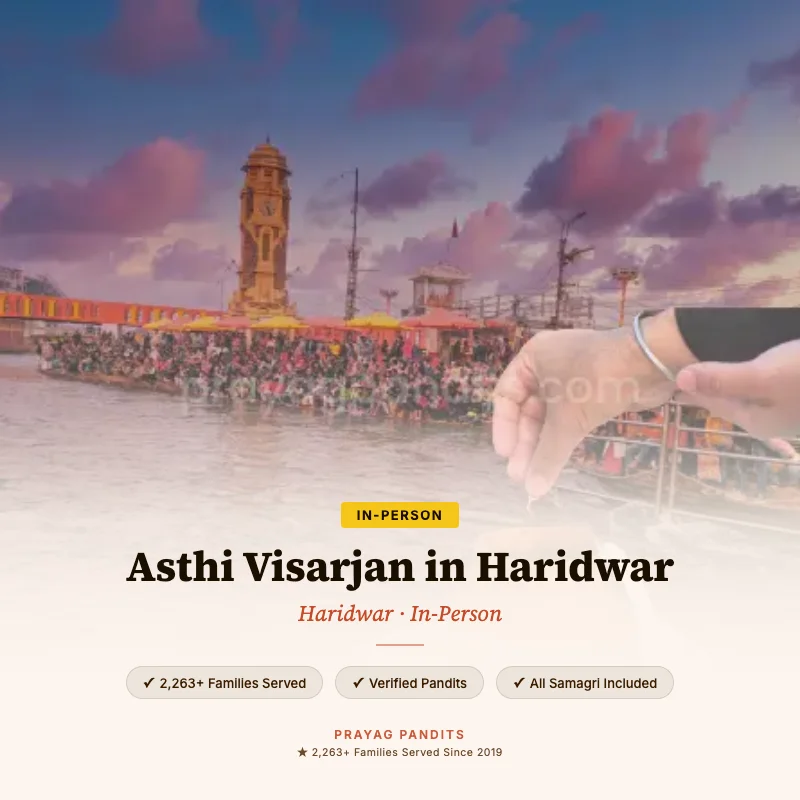
- Asthi Visarjan at Har Ki Pauri, Haridwar
- Experienced Haridwar-trained pandit
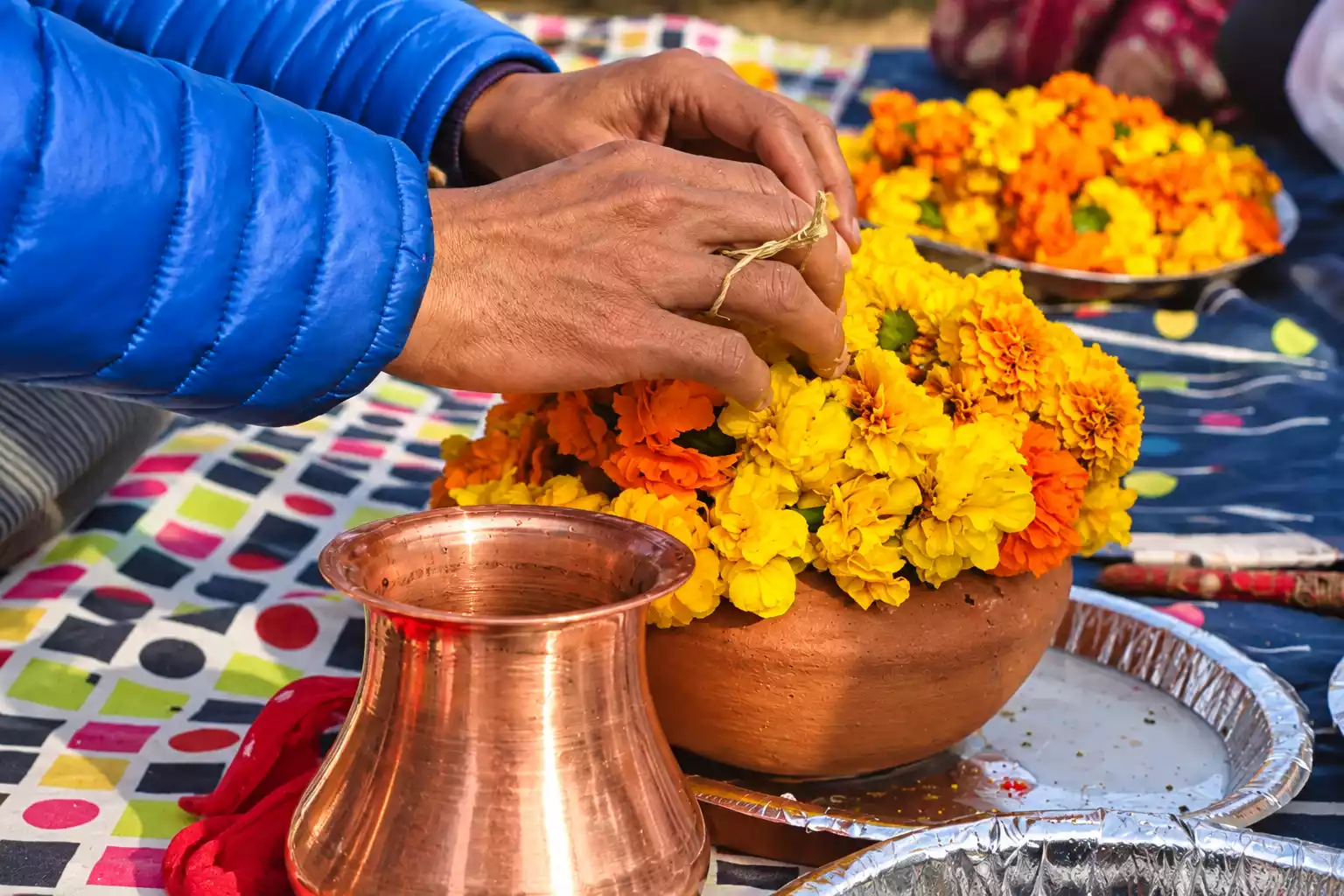
- All samagri sesame, Gangajal, kush, flowers, incense, ghee lamps, barley
- Sankalpa with gotra, nakshatra & lineage
- Tarpan with water & sesame offerings
- Asthi Pravah ash immersion with full Vedic mantras
- Ganga Aarti darshan guidance
Not included in your package
- Travel to Haridwar
- Accommodation
- Meals for family
- Pind Daan / Shradh (separate services)
- Boat hire for mid-river immersion (available at extra cost)
- Photography / videography
- Extra Dakshina/Gifts/Donations made to the Priest/Pandit
How it works
Choose your pooja
Review your package and any available additions, then add it to your booking.
Share your preferences
Enter your contact details, preferred date and time. Add ancestral details if you wish.
We coordinate with you
Our team confirms the arrangements and shares your coordinator’s details 24 hours before the pooja.
Participate in your pooja
Follow the participation and joining arrangements described in your package and shared by your coordinator.
What families say after the rite
From families who booked Asthi Visarjan in Haridwar.
Rated 4.8 out of 5
500+ reviews · Prayag Pandits
This poojarated 4.6 out of 516 reviews
Our pandits








- 2,263+ families served
- Serving since 2019
- GST registered
Families on video
The player loads only when you press play.


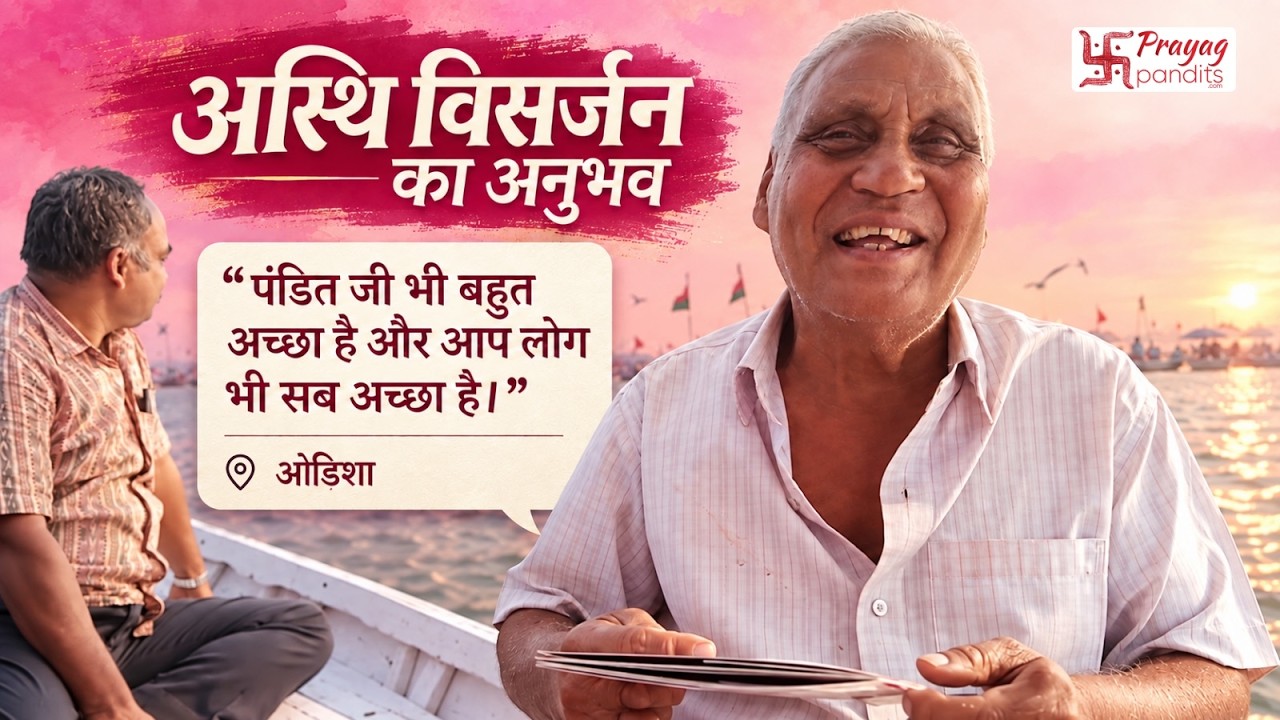


In their words
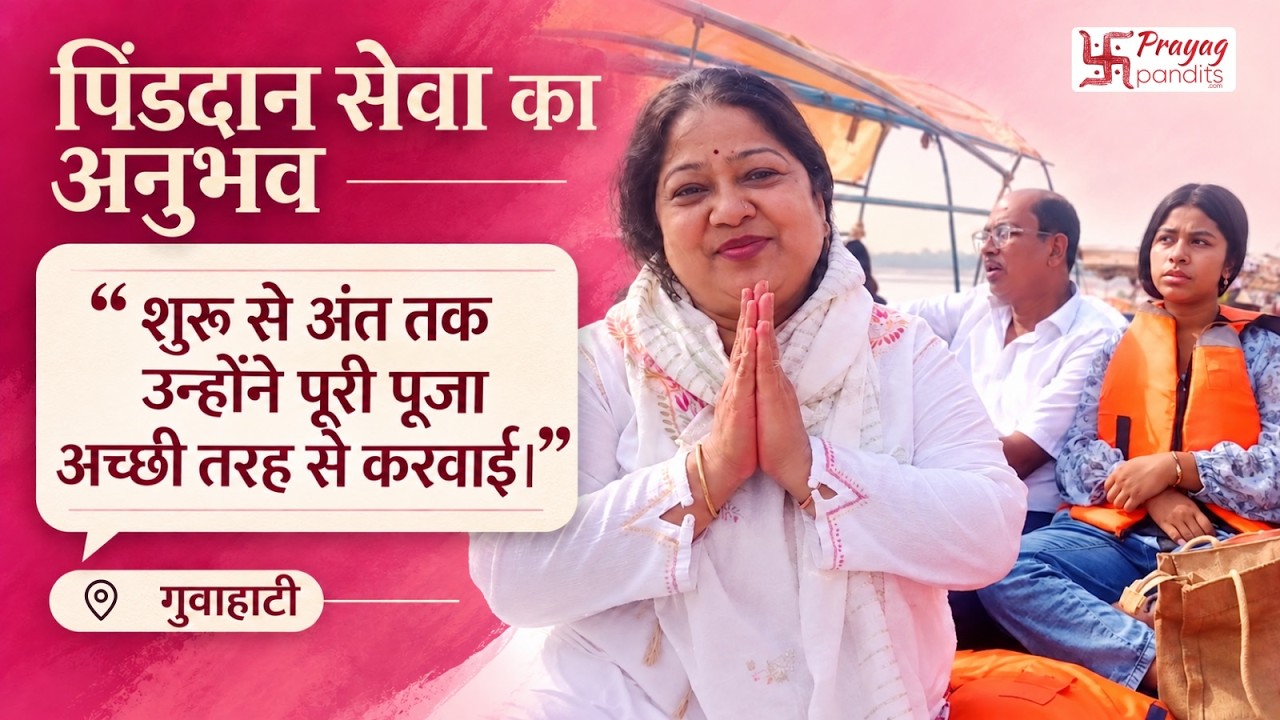
अस्थि विसर्जन कराने के बाद पूरे परिवार को शांति मिली। प्रयाग पंडित्स ने सब कुछ बहुत अच्छे से संभाला। स्टेशन से पिकअप, घाट तक व्यवस्था, और पूजा - सब उत्तम था।
The Asthi Visarjan service was conducted with dignity and proper Vedic rituals. The pandit explained the spiritual significance of each step. The team also helped with accommodation recommendations. Om Shanti.
The ceremony at Haridwar was beautiful. Early morning visarjan with proper mantras. The pandit was very experienced and conducted the poojan with great devotion. Highly satisfied. 🙏
Being abroad makes it difficult to perform these rituals in person. The online asthi visarjan option was perfect for our family. We could participate from three different countries via the video call.
The team was very sensitive to our emotions during this difficult time. The pandit performed every ritual with care and explained the significance in simple language. Truly grateful for this service.
We performed Asthi Visarjan at Haridwar through Prayag Pandits. The ceremony was very peaceful and the pandit was extremely respectful during the entire process. The boat ride to the sangam was well arranged.
Review your ceremony
Asthi Visarjan in Haridwar
Please check 1 thing
Questions families ask
Asthi Visarjan is the Hindu ritual of immersing the 'Asthi' (ashes and leftover bone fragments) of a deceased person after cremation into a holy body of water. Visarjan' means immersion. This ritual is crucial because Hindus believe it helps the departed soul break free from earthly attachments, purify their sins, and attain 'Moksha' (liberation or salvation), facilitating their peaceful journey to the afterlife.
Haridwar, meaning "Gateway to God," is one of the seven most sacred cities (Sapta Puri) for Hindus. Its significance for Asthi Visarjan is profound:
- Holy Ganges River: The Ganges, considered the holiest river, flows through Haridwar as it enters the plains, making its waters exceptionally pure here. Immersing ashes in the Ganga at Haridwar is believed to grant salvation.
- Mythological Sanctity: Drops of Amrit (elixir of immortality) are believed to have fallen at Har Ki Pauri during Samudra Manthan, sanctifying the location.
- Gateway to the Divine: As a major pilgrimage site and gateway to the Char Dhams, Haridwar possesses a potent spiritual energy considered highly beneficial for ancestral rites. Scriptures like the Garuda Purana emphasize Haridwar's importance for afterlife rituals.
Usually, the closest family members, particularly the son(s) or other male relatives (like grandsons), perform the ritual. However, other family members can participate, and in the absence of male relatives, daughters or wives can also perform the immersion. A Pandit (priest) is essential to guide the process and chant the appropriate mantras.
The cost varies depending on the services included, the Pandit's experience, and whether it's an online or in-person service. Based on available data:
- Basic ritual with Pandit and samagri (materials) might range from ₹3,000 to ₹4,000.
- Packages including the puja, materials, and priest charges often cost around ₹3,500 - ₹7,100.
- Online Asthi Visarjan services (where a Pandit performs it on your behalf) are advertised from around ₹3,500 to ₹7,100 or even ₹11,000 by different providers.
Packages might differ in inclusions (e.g., Brahmin Bhoj, additional pujas). Always clarify what is covered.
The primary item is the urn (Kalash), usually earthen, containing the ashes. Other items often used in the accompanying puja include flowers, incense, ghee, rice grains, black sesame seeds, Gangajal (Ganges water), and sometimes cloth. Yes, all necessary puja materials (samagri) are easily available in shops around the Ghats and temple areas in Haridwar. Many service packages include the cost of these materials.
Yes, absolutely. There is no requirement that the cremation and the Asthi Visarjan take place in the same location. Families routinely have the cremation performed at their hometown crematorium and then travel to Haridwar — or Prayagraj, Varanasi, or Gaya — for the immersion. The tradition specifically encourages performing Asthi Visarjan at a sacred teertha rather than at the local river or cremation site, wherever that is. The ashes can be brought to Haridwar regardless of where the cremation took place or how long ago it happened.
The traditional guidance places the ideal window within the first ten to thirty days after cremation, coordinated with the eleventh or twelfth-day rites. However, the ritual is fully valid whenever it is performed — months or even years later. Many families delay due to illness, travel constraints, financial circumstances, or the disruptions of the Covid-19 period. The important thing is that the ceremony is performed eventually, with proper Vedic rites at a sacred teertha. If you have preserved a loved one’s ashes and the time has now come, the ceremony at Haridwar is complete and meritorious regardless of the interval since the death. For more context on this, see our guide on all aspects of the Asthi Visarjan ceremony.
No. Traditionally, the eldest son performs the Asthi Visarjan, but in practice, any family member — son, daughter, spouse, brother, sister — can perform the rite. A single family member traveling to Haridwar is entirely sufficient for the ceremony to be valid and complete. The pandit will include all family members by name in the Sankalp even if they are not physically present. If your family is spread across different cities or countries, one representative can come to Haridwar and the ceremony will fulfil the obligation for the entire family lineage.
Har Ki Pauri is our recommended and default choice. The Brahma Kund at Har Ki Pauri is specifically identified in the Vishnu Purana as a point of extraordinary sacred potency, and the tradition of ancestral rites here is the oldest and most deeply established in Haridwar. For families who prefer more privacy, Birla Ghat or Kushavarta Ghat are quieter alternatives. For families with elderly members who find the steps at Har Ki Pauri difficult, Gau Ghat offers easier access. When you book, you can specify a preference or leave the selection to our pandit, who will advise based on the conditions of the day.
Yes, and many families do. Rishikesh is 25 km from Haridwar and a natural extension for families spending a day or two in the region after the ceremony. Triveni Ghat at Rishikesh, Ram Jhula, and Lakshman Jhula are all meaningful places to visit after performing ancestral rites. Some families also choose to attend morning yoga sessions or visit the ashrams of Rishikesh as part of a broader pilgrimage trip. We can advise on planning your Haridwar-Rishikesh visit if you let us know your dates and how long you plan to stay.
Still have a question?
Ask our team on WhatsApp and we will help you plan the ceremony.
We reply on WhatsApp within 1–2 hours.
Ask a pandit (opens WhatsApp)Know your ceremony
There is a particular quality of stillness at Har Ki Pauri in the early morning that is difficult to describe and impossible to forget. The river arrives here still carrying the cold of the Himalayas — clear, fast, green in the shallows where the light reaches. The sound of bells from the Ganga Mata temple above the ghat drifts across the water. The mountains are visible to the north. And here, at what the Vishnu Purana calls one of the seven most sacred tirthas in India, thousands of families every year entrust their loved one’s remains to the sacred waters and say a final farewell.
Asthi Visarjan in Haridwar holds a place of particular importance in the Hindu understanding of the last rites. Haridwar is the precise point where the Ganga crosses from the mountains into the plains — it is a city of thresholds, a city of crossings. The Skanda Purana describes the Ganga at Haridwar as carrying an exceptional capacity for purification: the water here is still young from its descent from Gangotri, still pure from the heights, and charged with the sacred energy of the Himalayas through which it has traveled. The ashes immersed at Har Ki Pauri enter these waters at their most powerful.
This service — Asthi Visarjan in Haridwar at ₹7,100 — includes a complete Vedic ceremony at Har Ki Pauri or the ghat of your choosing, conducted by an experienced pandit, with all ritual materials, Sankalp, Tarpan, and the evening Ganga Aarti darshan. You travel to Haridwar with your loved one’s ashes; we take care of everything else from the moment you arrive at the ghat.
Why Families Trust Prayag Pandits
Haridwar is one of the four cities that hosts the Kumbh Mela — alongside Prayagraj, Nashik, and Ujjain. Among these four, it occupies the specific position of being where the Ganga first touches the plains. This is not merely a geographical distinction. In Hindu sacred geography, the point of transition — the place where the river crosses from one domain to another — carries a heightened spiritual charge. Haridwar is a city of thresholds, and it is precisely this quality that makes it so potent for Asthi Visarjan, which is itself the ultimate rite of crossing.
The name Haridwar carries two classical interpretations, both of which illuminate why it was chosen for this role. “Haridwar” reads as “Gateway of Hari (Vishnu),” establishing it as the primary entry point for pilgrims beginning the Char Dham Yatra — Kedarnath, Badrinath, Gangotri, and Yamunotri. “Hardwar” reads as “Gateway of Hara (Shiva),” placing the city within the Shaiva pilgrimage geography of the Himalayan region. Both Vaishnava and Shaiva traditions recognize Haridwar as a place of exceptional sacred power, and the convergence of these two major streams of devotion at a single location is itself extraordinary.
Har Ki Pauri — “the steps of Hara” — is where this sacred energy concentrates most powerfully. The Brahma Kund at Har Ki Pauri is identified in scripture as the exact spot where Vishnu’s footprint is imprinted in the stone, marking it as a point of direct divine presence. The Ganga here is described in the Vishnu Purana as capable of dissolving the accumulated karma of many lifetimes. Families who bring a loved one’s ashes to Har Ki Pauri are bringing them to the most sacred point in Haridwar — the place where the sacred geography, the scripture, and the living river tradition all converge.
For North Indian families, Haridwar also has the practical advantage of accessibility. From Delhi, the journey is approximately 220 km — manageable in a half-day by road or train. Families from Uttarakhand, Haryana, Punjab, Himachal Pradesh, and western Uttar Pradesh can reach Haridwar without the multi-day travel that Varanasi or Gaya requires. The ceremony can be completed, and the family can return home, or choose to spend a day in the broader Haridwar-Rishikesh region if they wish. To understand how Haridwar compares with other sacred sites for Asthi Visarjan, read our guide: Best Places to Do Asthi Visarjan in India.
Families who have not performed Asthi Visarjan before often want to know what the ceremony actually looks and feels like — not just a list of ritual steps, but the texture of the experience. This matters. Asthi Visarjan is not a routine procedure. It is a sacred farewell, and knowing what you are walking into helps you be present for it in the way that counts.
The ceremony at Har Ki Pauri unfolds over approximately forty-five minutes to one hour at the water’s edge. The ghat steps descend directly into the moving Ganga. The pandit establishes a ritual space with the necessary materials — flowers, sesame, Ganga jal, ghee lamps — arranged in the traditional sequence. As the Sankalp begins and the pandit names your loved one formally in the presence of the river and the presiding deity, families consistently report a feeling of the ceremony becoming real in a way that changes something in them.
The Tarpan — the offering of cupped water and sesame seeds poured into the river in the name of the departed — is the moment that most families find most affecting. The pandit recites the tarpan mantras, and family members who wish to participate do so by repeating after the pandit and releasing the water-sesame offering into the Ganga. Then comes the Asthi pravah itself: the ashes are lowered into the current, flowers follow, and the river receives them. The pandit closes with Ganga Vandana and Shanti path — prayers for the soul’s liberation and peace.
For a complete, detailed account of what the Asthi Visarjan ceremony involves — its scriptural basis, the meaning of each ritual element, and what to expect — read: Asthi Visarjan Poojan — All You Need to Know.
Your Ceremony at Har Ki Pauri — Step by Step
From your arrival at the ghat to the evening Ganga Aarti — a complete walkthrough
Arrival & Ghat Preparation
Our pandit receives your family at the agreed meeting point near Har Ki Pauri. The ashes, typically in a clay or copper vessel wrapped in white cloth, are kept respectfully covered until the ceremony begins. The pandit introduces the full ritual sequence, confirms the gotra and name of the departed, and prepares all ritual materials at the water’s edge. This preparation takes approximately 15-20 minutes and is itself part of the ceremony.
Sankalp at the Ganga
The Sankalp — the formal declaration of purpose — is the most important opening act of the ceremony. Facing the Ganga, the pandit formally states the time, the tithi, the sacred location (Haridwar, Har Ki Pauri, Brahma Kund), the name and gotra of the departed, and the lineage of the family performing the rite. This declaration directs the ceremony’s entire spiritual intention toward the specific soul being honoured. Family members who wish to participate repeat after the pandit.
Asthi Pravah — The Immersion
Ganga jal is sprinkled over the urn, purifying the ashes for the ceremony. The pandit recites the Asthi Visarjan mantras — the specific verses prescribed for the immersion of mortal remains in sacred waters — and the ashes are lowered into the Ganga at Har Ki Pauri. The pandit will guide you in whether to release the ashes yourself or have him do so; both are entirely appropriate. Flower petals follow the ashes downstream as an offering of farewell.
Tarpan & Closing Prayers
Immediately after the immersion, Tarpan begins — Ganga water mixed with sesame seeds and barley, cupped in the palms and poured into the river in the name of the departed. The tarpan mantras invite the soul to receive nourishment and find peace in its onward journey. The ceremony closes with Ganga Vandana (prayer to the Ganga as divine receiver) and Shanti path (peace mantras for the departed soul and blessings for the living family).
Ganga Aarti Darshan
As evening approaches, the family joins the Ganga Aarti at Har Ki Pauri — one of the most celebrated ritual fires in India, performed at sunset with massive brass lamps, conch shells, bells, and collective chanting by hundreds of devotees. Attending the aarti after the Asthi Visarjan gives the day a natural, powerful close — a collective prayer offered to the Ganga in whose care the ashes now rest. The aarti arrangement is included in this package.
Most families have very practical questions when planning Asthi Visarjan in Haridwar: when to go, what to wear, how to carry the ashes, what to expect at the ghat. These are all good questions, and having clear answers to them makes a real difference to how the day unfolds.
Best Time for the Ceremony
Early morning — specifically between sunrise and 10:00 AM — is the traditional and preferred time for Asthi Visarjan at Har Ki Pauri. The ghat is quietest at this hour, the Ganga is at its most still and contemplative, and the atmosphere carries the quality of concentration that the ceremony deserves. Afternoon ceremonies are also valid and performed regularly, particularly for families arriving from long distances whose journey brings them to Haridwar later in the day. We work around your schedule while recommending the most auspicious slot available.
Particularly auspicious times for Asthi Visarjan at Haridwar include:
- Pitrupaksha (September-October): The fifteen-day period specifically dedicated to ancestral rites, when the tradition holds that the ancestral realm is most accessible. Demand is highest during this period — book well in advance.
- Amavasya (new moon days): All new moon days are traditionally sacred to the pitru and especially auspicious for ancestral rites throughout the year.
- Makar Sankranti (January): One of the most sacred solar transitions; offerings made to the Ganga on this day carry amplified merit.
- Shradh Paksha days: Any day during the waning fortnight (Krishna Paksha) of any month is considered appropriate for ancestral rites.
Clothing and Preparation
Traditional attire is recommended. For men, a white or light-coloured dhoti or kurta-pajama is appropriate. For women, a white or muted-coloured saree or salwar suit is the traditional choice. The spirit of the occasion calls for simplicity and modesty. If you are not accustomed to traditional attire, clean, modest clothing in neutral or light colours is entirely acceptable. Avoid dark, patterned, or festive clothing — the ceremony is a farewell, not a celebration, and the dress should reflect that.
Carrying the Ashes
The ashes should be in a sealed, secure container — a traditional clay or copper urn is ideal, but any clean, sealed container works. Many families wrap the container in white cloth and carry it separately, held in the lap during travel rather than placed in baggage. For travel by train (Haridwar Junction is well connected to Delhi and major cities), there are no legal restrictions on carrying cremated remains domestically. For air travel to Dehradun’s Jolly Grant Airport, keep the ashes in cabin baggage and inform the airline at check-in. A letter from the crematorium is helpful but not always required for domestic flights.
Our qualified pandit
Senior Vedic Priest — Asthi Visarjan & Ganga Poojan SpecialistOur qualified pandit has been conducting Asthi Visarjan and Ganga Poojan ceremonies at Haridwar and across the sacred tirthas of North India for over seven years. He is fluent in Hindi, Sanskrit, and English — making him especially effective with families from across India and NRI families who want to understand exactly what each mantra and ritual element means. In more than 5,000 ceremonies, he has guided families through the complete Asthi Visarjan vidhi with care, precision, and the quiet sensitivity that this occasion demands. Our qualified pandit explains each step in language the family can follow, ensuring that the ceremony is genuinely participated in — not merely witnessed.
Book With Our Pandit
We had kept my mother-in-law’s ashes for nearly eight months — we had been unable to travel during that period, and the delay was weighing on us. When we finally came to Haridwar for the Asthi Visarjan, we were not sure how the ceremony would feel. What we found was something we had not expected: a pandit who explained everything in clear Hindi, who was unhurried, and who conducted the ritual with such genuine respect that the whole family felt it. When the ashes entered the Ganga at Har Ki Pauri, the feeling was of something completing. The evening aarti that night was the right way to close the day. We are grateful to Prayag Pandits for making this possible.Prayag Pandits Booking Guarantee
Every ceremony is conducted with full transparency, experienced pandits, and personal accountability to your family.
- Booking confirmed within 2 hours via WhatsApp
- Pandit's name and contact number shared at confirmation
- Full refund within 24 hours if your chosen date cannot be served
- All ritual materials provided — nothing extra to arrange at the ghat
- Post-ceremony booking confirmation provided
The complete Asthi Visarjan ceremony at Haridwar costs ₹7,100 (regular price ₹11,000). This fixed price covers the experienced purohit, all poojan samagri, Ganga ceremony at the sacred ghats, boat ride for immersion, and complete documentation. No hidden charges. Trusted by 2,263+ families since 2019.