
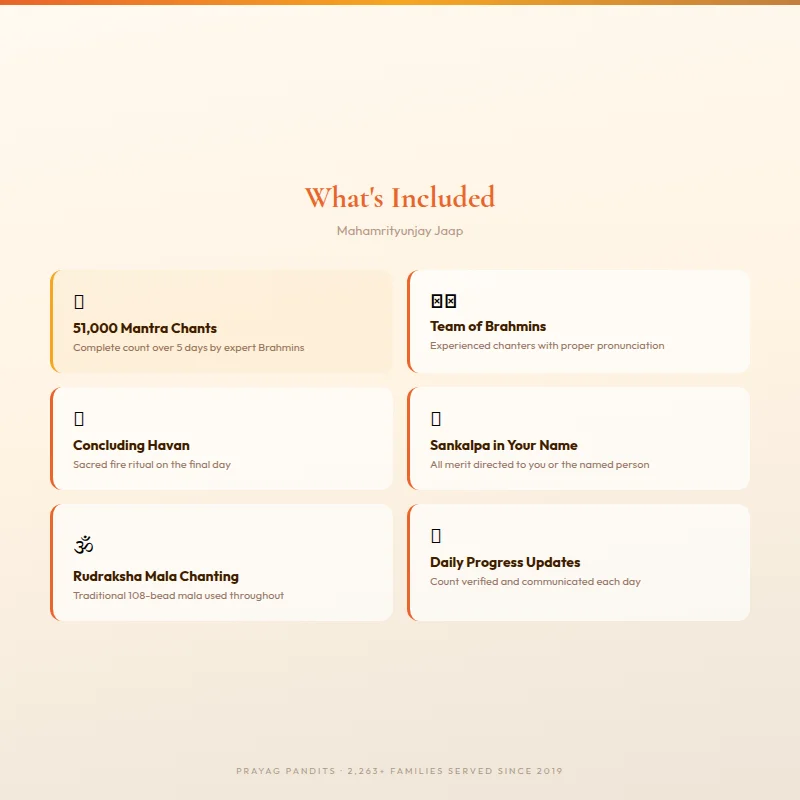



What’s included
Included in your package
- 7 experienced Vedic Brahmins Shukla Yajurveda & Rudra-patha trained
- 5 consecutive days of jaap morning & evening sessions
- 51,000 mantra chants counted with Rudraksha mala
- Daily Rudrabhishek with Panchamrit, Gangajal & Bilva leaves
- Complete samagri Rudraksha mala, Bilva, Dhatura, Shami, ghee, sesame, barley, Gangajal
- Final Day Havan with Mahamrityunjay Mantra
- Brahmin Bhoj on the last day after pooja completion
- Online option available on request
Not included in your package
- Travel to puja location (if attending in-person)
- Accommodation
- Personal meals (Brahmin Bhoj is for the performing Brahmins)
- Extra Dakshina/Gifts/Donations made to the Priests/Pandits
How it works
Choose your pooja
Review your package and any available additions, then add it to your booking.
Share your preferences
Enter your contact details, preferred date and time. Add ancestral details if you wish.
We coordinate with you
Our team confirms the arrangements and shares your coordinator’s details 24 hours before the pooja.
Your ceremony, across several days
Choose a preferred start date. Our team coordinates the daily sessions. Online participation is available on request.
What families say after the rite
From families who booked Mahamrityunjay Jaap for 5 days.
Rated 4.8 out of 5
500+ reviews · Prayag Pandits
This poojarated 4.3 out of 520 reviews
Our pandits









- 2,263+ families served
- Serving since 2019
- GST registered
Families on video
The player loads only when you press play.





In their words
Smooth experience from start to finish. The live video call gave us peace of mind that everything was done correctly.
We were looking for reliable pandit services online and found Prayag Pandits. The experience exceeded our expectations. Professional team, knowledgeable pandits, and transparent pricing.
The coordination was excellent. We received all details well in advance. The puja was performed exactly as described.
Booked this for my late father. Everything was arranged perfectly. The team was professional and respectful throughout.
Very satisfied with the service. The pandit arrived on time and had all the materials ready. The ceremony was conducted as per proper Vedic traditions. The team followed up after the poojan as well. Dhanyavaad.
We have used Prayag Pandits twice now for different ceremonies. Both times the service was excellent. The team remembers returning customers and gives personal attention. Highly recommended. Dhanyavaad.
Review your ceremony
Mahamrityunjay Jaap for 5 days
Please check 1 thing
Questions families ask
The key differences are scale and intensity. The 7-Day package involves 11 Brahmins, 1,25,000 chants, and a daily Rudrabhishek — it is prescribed for acute, life-threatening situations and severe Mrityu Yoga in the Kundali. The 5-Day package involves 7 Brahmins and 51,000 chants — it is prescribed for serious but non-acute health conditions, difficult astrological periods like Sade Sati, and recovery support. Both are complete, properly conducted anushthanas. The choice depends on the urgency and severity of the situation.
Absolutely. A significant portion of the 5-Day Jaap commissions we receive are motivated by astrological reasons — entering a difficult Dasha period, Sade Sati beginning, or a Jyotishi’s specific recommendation — rather than existing illness. The Mahamrityunjay Jaap is protective and preventive as much as it is curative. Performing it before a difficult period arrives is considered more effective than waiting until the problems have already manifested.
Each Brahmin uses a traditional Rudraksha mala of 108 beads. Rounds completed are tracked through a counter system maintained by the lead Pandit. At the end of each day, the total count is tallied and verified at the end of each day. The complete 51,000-count is confirmed to you at the end of the five-day period.
Yes. The puja’s efficacy comes from the Brahmins’ devotion, their training, and the sanctity of the mantra and location — not from the yajamana’s own ritual knowledge or level of religious practice. Many people who commission this puja are not daily practitioners and simply feel, at a difficult moment, that they want to offer the most sincere and powerful spiritual support they can to a family member. That intention is itself an act of devotion that is recognized and honored in the Vedic tradition.
Yes. The Sankalpa can include multiple names if the puja is being performed for the welfare of an entire family rather than a single individual. Inform us of this requirement when booking and the lead Pandit will structure the Sankalpa accordingly.
The puja can be performed at any time of year. Particularly auspicious periods include Shravan (the month of Shiva), the period around Mahashivaratri, and Pradosha days generally. However, given that many people commission this puja in response to a health crisis or astrological urgency, we are able to begin at any time. We simply select the most auspicious start day within the available window.
Still have a question?
Ask our team on WhatsApp and we will help you plan the ceremony.
We reply on WhatsApp within 1–2 hours.
Ask a pandit (opens WhatsApp)Know your ceremony
In the long middle stretch of a serious health journey — after the immediate crisis has passed but before recovery is secure — a family often finds itself in a particular kind of uncertainty. Treatment is ongoing. The doctors are cautiously hopeful. But something deeper is needed. A sustained appeal to the divine, not a single prayer but a continuous invocation across multiple days, building in strength and purpose.
The 5-Day Mahamrityunjay Jaap is designed for exactly this space. It is a serious, sustained anushthana — seven experienced Vedic Brahmins performing 51,000 repetitions of the Mahamrityunjay Mantra over five continuous days at Prayagraj, accompanied by Rudrabhishek and culminating in a Havan. It is the standard package for families dealing with significant health challenges, planetary adversity, and the need for strong spiritual protection — situations that call for more than a one-day puja but do not yet require the full Maha-level 7-day anushthana.
The source of this puja’s power is the Mahamrityunjay Mantra — one of the most ancient and revered mantras in the Vedic tradition. It comes from Rig Veda 7.59.12, attributed to Rishi Vasishtha, and is addressed to Lord Shiva in his form as Tryambaka, the Three-Eyed One:
Om Tryambakam Yajamahe Sugandhim Pushti-Vardhanam
Urvarukamiva Bandhanan Mrityor Mukshiya Maamritat
We worship Tryambaka (the three-eyed Shiva), the fragrant one who nourishes and sustains all living beings. May he liberate us from the bondage of death — as a ripe fruit is freed from its vine — and lead us toward immortality.
This mantra appears not only in the Rig Veda but throughout the Yajur Veda and is central to the Rudrashtadhyayi, the eight-chapter collection of Vedic hymns to Rudra-Shiva. It is the mantra the ancient physicians (Dhanvantari’s tradition) recommended alongside medical treatment, the one Vedic astrologers prescribe for malefic planetary periods, and the one that has been chanted at bedsides and in temple halls across India for thousands of years when the need for divine protection becomes acute.
The number 51,000 is not arbitrary. In the Vedic system of Purascharana — the science of mantra repetition required for specific outcomes — different counts are prescribed for different purposes and intensities. A 51,000-count Purascharana of the Mahamrityunjay Mantra is prescribed in classical texts as sufficient for health protection, the resolution of medium-severity Mrityu Dosha, and the strengthening of a person’s vital force (Prana) during periods of illness or planetary adversity.
This makes it distinct from the 1,25,000-count complete Purascharana (required for the most severe Mrityu Yoga situations) and from a shorter 25,000-count jaap (suitable for preventive and general well-being purposes). For families navigating a serious but not immediately life-threatening situation, the 51,000-count 5-day jaap occupies exactly the right position in the spectrum of ritual intensity.
Seven Brahmins chanting together for five days generates a sustained vibrational field around the Sankalpa (the sacred intention and the person named within it). Each day builds on the previous. The cumulative effect of 51,000 repetitions in a group setting is qualitatively different from the same number chanted individually — collective Vedic chanting has always been understood in our tradition to produce a resonance that individual practice cannot match.
Over many years of performing this anushthana, we have found that the 5-Day Mahamrityunjay Jaap serves a distinct set of situations — different from the acute emergencies that call for the 7-day package and different from the preventive purposes for which a 3-day jaap is sufficient. Here is who typically commissions this puja and why:
Serious Illness Requiring Sustained Divine Protection
When a family member is dealing with a condition that is serious but not immediately critical — a cancer diagnosis in the early stages of treatment, a cardiac condition under management, a chronic disease with significant implications — the 5-Day Jaap provides sustained, multi-day divine protection that a single-day puja cannot. The five-day duration means the mantra energy builds day upon day, surrounding the patient with an increasingly strong kavach (protective shield). Many families choose to perform this puja at the beginning of a major treatment phase — at the start of chemotherapy, before radiation, or at the beginning of a prolonged medical protocol.
Sade Sati — The Seven-and-a-Half Year Saturn Transit
Sade Sati is one of the most significant and difficult astrological periods in a person’s life — the seven-and-a-half-year transit of Saturn across the three signs surrounding one’s natal Moon sign. It brings challenges in health, finances, relationships, and mental peace. When the health dimension of Sade Sati is pronounced — when a person is falling ill repeatedly or struggling with chronic fatigue and weakness during this period — the Mahamrityunjay Jaap is among the most effective Shani-related remedies. The 51,000-count 5-day jaap is the standard prescription for Sade Sati-related health concerns.
Difficult Mahadasha or Antardasha Periods
In the Vimshottari Dasha system used in Vedic astrology, the Mahadasha of Rahu, Shani, Ketu, or the Antardasha of a malefic planet within a generally difficult Mahadasha can create periods of pronounced vulnerability — to accidents, illness, or significant setbacks. A Jyotishi who identifies such a period in a client’s Kundali will often specifically recommend a Mahamrityunjay Jaap of this scale as a protective measure. We have performed this puja many times for clients who were entering a known difficult planetary period and wanted to create spiritual protection before the period’s most challenging phase arrived.
Recovery Support After Illness, Surgery, or Accident
After a person has survived a serious health crisis — major surgery, a significant accident, a severe bout of illness — there is a period of recovery during which the body and spirit are both depleted. This is a time of vulnerability in Vedic understanding, when the person’s Prana (vital force) needs to be rebuilt and their protective spiritual shield needs to be restored. The 5-Day Jaap performed during this recovery period, once the immediate crisis has passed, serves exactly this purpose. It is restorative in its orientation — rebuilding strength, renewing vitality, and closing the window of vulnerability that opens after a major health event.
Removing Obstacles That Are Blocking Progress
The Mahamrityunjay Mantra is not only about physical health. In its deeper understanding, it is about liberation from all forms of bondage — including the kind of invisible obstacles that seem to block a person’s progress at every turn. If a person or family finds themselves in a prolonged period of setbacks despite sincere effort, where opportunities collapse at the last moment and every endeavor seems to encounter an invisible resistance, the cause may be a deeper doshic or karmic imbalance. The 5-Day Jaap addresses this by invoking Shiva’s grace as the remover of Mrityu — which in its broader application means the death of opportunity, health, and wellbeing in all forms.
Understanding the daily rhythm of this puja helps you appreciate what is being done on your behalf throughout the five days:
Morning Session — Brahma Muhurta
Each day begins before sunrise at Brahma Muhurta, the pre-dawn period of heightened spiritual receptivity. The Brahmins assemble, perform their personal ritual purification, and begin the day’s chanting session. The environment at this hour — quiet, before the world has woken — is the most conducive to concentrated Vedic recitation. A significant portion of each day’s mantra count is completed in this morning session.
Rudrabhishek — Mid-Morning
After the morning chanting session, the daily Rudrabhishek is performed. The Shivalinga is bathed with the Panchamrit, then with Gangajal, adorned with fresh Bilva leaves and Dhatura flowers, and worshipped with the full Shri Rudram recitation. This daily abhishek functions as a ritual renewal — it keeps the puja’s connection to Lord Shiva’s energy active and alive between chanting sessions.
Afternoon and Evening Sessions
The afternoon session continues the jaap count. The evening session is timed to coincide with Pradosha — the period between approximately 6 PM and 8 PM (varying by season) that is specifically auspicious for all Shiva-related rituals. According to the Shiva Purana, Shiva is particularly accessible and responsive during Pradosha, and Mahamrityunjay Jaap performed at this time carries special weight.
Day 5 — Havan and Completion
The fifth and final day completes the remaining chanting quota in the morning, then moves into the Havan. The fire ritual uses a Vedic Havan Kund built according to scriptural specifications. Each of the 5,100 ahutis is offered with Swaha, the accumulated mantra energy of five days flowing into the sacred fire as a formal offering. After the Havan, Brahmin Bhoj is served, the Poornahuti (final offering) is made, and the puja is formally concluded.
Prayagraj — the Triveni Sangam, the meeting of the Ganga, Yamuna, and the invisible Saraswati — is among the holiest tirthas in the Hindu tradition. The Matsya Purana contains the explicit statement that a puja performed at Prayag carries the merit of the same puja performed a thousandfold elsewhere. The Skanda Purana dedicates an entire section to the glories of Prayag tirtha, calling it the king among all tirthas.
For a Mahamrityunjay Jaap — which is specifically about invoking divine protection against death and disease — the location amplifies the ritual’s purpose. Prayag is where Brahma performed the first yajna (fire sacrifice) at the beginning of creation, according to the Puranas. It is where the sage Bharadwaja maintained his ashram. It is a place of layered sanctity accumulated over millennia of continuous ritual activity. Our Pandits perform this puja at this sacred location because the location itself is a component of the ritual’s efficacy.
You do not need to be present in Prayagraj for this puja to be performed on your behalf or on behalf of a family member. The Sankalpa — the formal sacred resolve made at the beginning of the puja — establishes the yajamana’s identity and the puja’s purpose. This formal declaration directs all the ritual’s benefits to the named individual, regardless of their physical location.
To commission this puja for someone who cannot travel, you need to provide: their full name, their father’s name, their gotra (family lineage — your family priest will know this if you don’t), and their Rashi (moon sign) or nakshatra if known. We handle the rest.