

What’s included
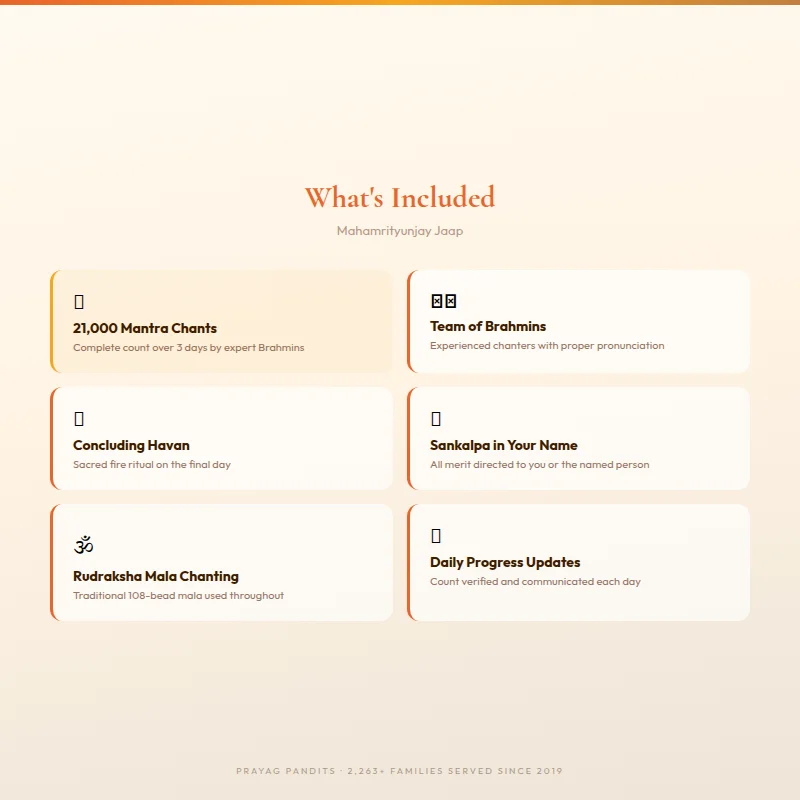
Included in your package
- 5 experienced Vedic Brahmins Shukla Yajurveda & Rudra-patha trained
- 3 consecutive days of jaap morning & evening sessions
- 25,000 mantra repetitions counted with Rudraksha mala
- Daily Rudrabhishek with Panchamrit, Gangajal & Bilva leaves
- Complete samagri Rudraksha mala, Bilva, Dhatura, Shami, ghee, sesame, barley, Gangajal
- Final Day Havan with Mahamrityunjay Mantra
- Brahmin Bhoj for the 5 performing Brahmins on the last day after pooja completion
- Online option available on request
Not included in your package
- Travel to puja location (if attending in-person)
- Accommodation
- Personal meals (Brahmin Bhoj is for the performing Brahmins)
- Extra Dakshina/Gifts/Donations made to the Priests/Pandits
How it works
Choose your pooja
Review your package and any available additions, then add it to your booking.
Share your preferences
Enter your contact details, preferred date and time. Add ancestral details if you wish.
We coordinate with you
Our team confirms the arrangements and shares your coordinator’s details 24 hours before the pooja.
Your ceremony, across several days
Choose a preferred start date. Our team coordinates the daily sessions. Online participation is available on request.
What families say after the rite
From families who booked Mahamrityunjay Jaap for 3 days.
Rated 4.8 out of 5
500+ reviews · Prayag Pandits
This poojarated 4.3 out of 518 reviews
Our pandits









- 2,263+ families served
- Serving since 2019
- GST registered
Families on video
The player loads only when you press play.





In their words
We have used Prayag Pandits twice now for different ceremonies. Both times the service was excellent. The team remembers returning customers and gives personal attention. Highly recommended. Jai Shri Ram.
Had a wonderful experience with Prayag Pandits. The team is very organized and the pandits are genuine. They don't rush through the ceremonies like some other services do. Quality work. 🙏
प्रयाग पंडित्स से दूसरी बार पूजा करवाई। दोनों बार अनुभव शानदार रहा। उनकी टीम पुराने ग्राहकों को याद रखती है और व्यक्तिगत ध्यान देती है।
Very authentic Vedic ceremony. All materials were included as promised. Will definitely use their services again.
Performed Mahamrityunjay Jaap for 3 days through Prayag Pandits. The pandit ji was very knowledgeable and explained every step of the ritual. Very satisfied with the experience.
We were looking for reliable pandit services online and found Prayag Pandits. The experience exceeded our expectations. Professional team, knowledgeable pandits, and transparent pricing. Dhanyavaad.
Review your ceremony
Mahamrityunjay Jaap for 3 days
Please check 1 thing
Questions families ask
There is no set frequency for performing the Jaap. Some people choose to recite the mantra daily, while others may do it on special occasions or during times of crisis. Ultimately, the decision of how often to perform the Jaap is a personal one and should be based on your own spiritual goals and needs.
The duration depends on the scale of the Jaap. A single round of 108 mantras takes about 15 to 20 minutes. An 11,000-chant session, often done in one sitting by a group of priests, lasts roughly 3 to 4 hours. The full 1.25 lakh (125,000) recitation Jaap requires 5 pandits chanting together and spans multiple days — typically 5 to 7 days when 1,000 mantras are chanted per priest per session. Your pandit will set the exact schedule based on the Sankalp and muhurat.
Yes, the Mahamrityunjay Jaap can be performed at home, in a temple, or at any clean and sacred space. For personal daily practice, chanting 108 repetitions with a Rudraksha mala is common. However, a full 1.25 lakh Jaap typically requires 5 trained Vedic priests chanting together over several days, which is best organized with a pandit. If performing at home, maintain a sattvic (pure vegetarian) diet during the Jaap period, sit facing east or north, and keep a photo or idol of Lord Shiva at the puja spot.
While it is not strictly necessary to have a spiritual leader present, it can be helpful to have someone who is knowledgeable about the Mahamrityunjay Jaap to guide you through the process.
The Mahamrityunjay Mantra, rooted in Rigveda (Mandala 7, Sukta 59), is called the "death-conquering" chant. A full Jaap of 1.25 lakh (125,000) recitations is believed to grant divine protection against life-threatening illness, speed recovery after surgery or accidents, remove the negative effects of Kaal Sarp Dosh, and shield the devotee from untimely death. It also brings mental clarity, emotional stability, and spiritual growth. Families often arrange this Jaap during serious health crises or major life transitions to seek Lord Shiva's healing grace.
It is one of the most meaningful birthday pujas a person can receive. Performing the Mahamrityunjay Jaap for someone’s birthday is a request for divine protection and longevity for the year ahead — there is very little in the tradition that is more appropriate or generous as a birthday gift. Many families choose to make this an annual observance rather than a one-time event.
Not only can you — the Vedic tradition actively encourages this approach. The highest use of a protective ritual is before protection is urgently needed. Devotional motivation for a puja is considered more pure than crisis-driven motivation, and a puja performed from a place of gratitude and devotion carries its own special quality. Lord Shiva is described throughout the Puranas as Ashutosh — the easily pleased one — and he responds to sincere devotion with corresponding grace.
No. We arrange everything for the Havan, including the Havan Kund construction, all the Samagri (ghee, sesame, barley, and other prescribed offering materials), and the ritual itself. If you are attending in person, you may participate in offering a few symbolic ahutis under the guidance of the lead Pandit, which adds a personal dimension to the ritual. If you are attending remotely, you will receive a live video of the Havan.
Home recitation of the Mahamrityunjay Mantra is genuinely beneficial and we encourage it as a daily practice. But a formal jaap conducted by trained Pandits at a sacred tirtha is a different category of practice. The trained pronunciation (with correct Vedic accents), the ritual context (Sankalpa, Shivalinga, prescribed Samagri, sacred location), the sustained collective chanting by multiple trained voices, and the formal Havan completion together create an intensity and completeness that individual home practice cannot replicate. Both are good — but they serve different purposes and different levels of need.
Yes. Many families commission the Mahamrityunjay Jaap alongside or shortly after the Namkaran (naming ceremony), Annaprashna (first rice feeding), or Mundan (first haircut) of an infant — creating a protective spiritual foundation at key moments of a child’s early life. Similarly, it can be performed before a child begins school, before an important examination period, or before any major milestone. The mantra’s aspect as Pushti-Vardhanam — the nourisher of growth — makes it particularly fitting for young lives beginning their journey.
Still have a question?
Ask our team on WhatsApp and we will help you plan the ceremony.
We reply on WhatsApp within 1–2 hours.
Ask a pandit (opens WhatsApp)Know your ceremony
Not every spiritual undertaking needs to begin with a crisis. Some of the wisest choices a person makes in life are the preventive ones — choosing to strengthen the roof before the rains arrive, rather than scrambling to repair it afterward. The 3-Day Mahamrityunjay Jaap is built on exactly this principle: a complete, properly conducted Vedic ritual performed by five experienced Brahmins over three continuous days, creating a foundation of health, protection, and divine grace that serves you or your loved one before difficulties arise.
At ₹34,999, this is the most accessible form of this ancient puja, and it is intentionally designed to be so. We believe that the blessings of the Mahamrityunjay Mantra should not be available only in moments of crisis. This package makes a meaningful, fully traditional anushthana accessible to devotees who want to perform this puja for a birthday, for general well-being, for a family member beginning something new, or simply as an annual act of spiritual maintenance — inviting Lord Shiva’s protection as a matter of devotion rather than desperation.
The Mahamrityunjay Jaap is the ritual systematic recitation of the Mahamrityunjay Mantra — one of the oldest and most powerful mantras in the entire Vedic tradition. It comes from the Rig Veda, composed in Mandala 7, Sukta 59, verse 12, by Rishi Vasishtha:
Om Tryambakam Yajamahe Sugandhim Pushti-Vardhanam
Urvarukamiva Bandhanan Mrityor Mukshiya Maamritat
The meaning unfolds phrase by phrase. Tryambakam — we offer our worship to the Three-Eyed One, Lord Shiva. Sugandhim — the fragrant one, whose very presence purifies all that surrounds him. Pushti-Vardhanam — the one who nourishes, sustains, and increases the vitality of all beings. Urvarukamiva Bandhanan — just as a ripe cucumber falls effortlessly from its vine, naturally and without force. Mrityor Mukshiya Maamritat — may he liberate us from death, and grant us a path toward the immortal.
This mantra is also known as the Maha Mrityunjaya Mantra, the Rudra Mantra, and the Tryambakam Mantra. In the Shiva Purana, Lord Shiva himself is described as Mrityunjaya — the conqueror of death — and this mantra is the primary means of invoking him in that aspect. It is found across the Vedic canon, central to the Rudrashtadhyayi (the eight-chapter Vedic collection dedicated to Rudra), and has been in continuous use in ritual and devotional practice for thousands of years.
In the Vedic approach to mantra, intention alone is not sufficient — the mantra must reach a threshold of repetition before its vibrational energy becomes truly effective. This principle, called Purascharana, assigns specific counts to specific mantras for specific purposes.
For the Mahamrityunjay Mantra, a 25,000-count jaap is the prescribed count for general well-being, health protection, and preventive spiritual maintenance. It is substantial enough to create a genuine protective field around the yajamana (the person for whom the puja is performed), meaningful enough to accumulate real mantric energy, and appropriate in scale for the purposes this package is designed to serve. It is not a token gesture or a symbolic few hundred repetitions — it is a proper, complete jaap that takes five trained Brahmins three full days of disciplined chanting to complete.
Five Brahmins chanting together generate a collective resonance that is categorically different from individual recitation. The Vedic tradition has always recognized this — the great Somayagas and other Vedic yajnas required multiple trained priests precisely because collective chanting produces a different quality of sacred sound, one that fills and charges the ritual space in a way no single voice can achieve.
This is a complete traditional anushthana — not a simplified or abbreviated version of the ritual. Every component is present and properly conducted:
- Five experienced Vedic Brahmins — trained in Shukla Yajurveda and Rudra-patha, able to recite the Mahamrityunjay Mantra with correct Vedic tonal accents (Udatta, Anudatta, Svarita), which are essential for the mantra’s proper vibrational effect
- Three consecutive days of Mahamrityunjay Jaap — morning and evening sessions daily, beginning at Brahma Muhurta (the pre-dawn period of heightened spiritual receptivity) and including an evening session at Pradosha time
- 25,000 mantra repetitions — counted precisely using traditional Rudraksha mala, with the count documented and shared with you
- All Puja Samagri included — every required ritual item is sourced and arranged by us. Rudraksha mala, fresh Bilva patra, Dhatura and Shami flowers, pure cow’s ghee, sesame seeds, barley, Gangajal, Vibhuti (sacred ash), Panchamrit ingredients, and all other prescribed items. You need not arrange or bring anything.
- Havan on the final day — the third day culminates in a complete Havan (fire ritual) with 2,500 ahutis offered into the sacred fire. The Havan is the formal completion of the jaap — the ritual act that transforms the accumulated mantra energy into a direct offering to Lord Shiva and seals the puja’s benefits to the yajamana. We never skip the Havan because the jaap without the Havan is considered unfinished in the traditional system.
You will be able to see the puja, the Shivalinga, the Brahmins, and the Havan fire, regardless of where you are.
The 3-Day Mahamrityunjay Jaap serves a wide range of devotees and situations. Here are the most common reasons people choose this package:
Birthday Puja — The Best Gift to Begin a New Year of Life
In Hindu tradition, the birthday — Janma Tithi (the actual lunar date of birth) or the Gregorian birthday — is an auspicious moment for spiritual renewal. Performing the Mahamrityunjay Jaap on or around a person’s birthday is a way of inviting divine protection and blessings at the beginning of a new year of life. It is a particularly meaningful gift to arrange for an elderly parent, a spouse, or a child beginning a new chapter. Rather than giving something material that will depreciate, a puja at Prayagraj creates merit and protection that endures through the year. Many families now commission this as the central spiritual observance of a family member’s birthday.
First-Time Devotees — Beginning a Relationship with Mahamrityunjay Jaap
For families who have heard of the Mahamrityunjay Jaap and want to perform it for the first time, the 3-day package is the right entry point. It is complete and traditional in every respect, but it is accessible in scale and cost. Many families who begin with the 3-day package return for the 5-day or 7-day package when a more significant situation arises, because they have already established trust in the puja and seen its effects. Starting here is not a compromise — it is a natural beginning.
Annual Spiritual Maintenance — Proactive Protection
Some families have adopted the practice of commissioning this puja once a year as a matter of course — a preventive spiritual practice rather than a reactive one. They choose a significant date (a family member’s birthday, a wedding anniversary, the beginning of a new financial year, or an astrologically important date identified by their Jyotishi) and perform the jaap annually. Over years, this builds accumulated protective merit (Punya) around the family and creates a living tradition of Shiva devotion that strengthens with time. We have families who have been performing this annual puja with us for several years.
Wedding Anniversary or Marriage Milestone Puja
A wedding anniversary is not merely a sentimental occasion — it is, in the Vedic view, a renewal of the sacred bond created at the time of marriage. Performing the Mahamrityunjay Jaap for a couple on their wedding anniversary — particularly a significant one such as a 25th, 30th, or 50th — is a beautiful and spiritually meaningful observance. It invokes Lord Shiva’s blessings on the couple’s continued health, longevity together, and the wellbeing of the family they have built.
Moderate Health Concerns and Recovery
Not every health situation requires the intensity of a 5-Day or 7-Day Jaap. If a family member has recovered from a moderate illness and is returning to normal life, if someone is dealing with a manageable chronic condition and wants ongoing spiritual support, or if a person is experiencing a period of low immunity or recurring minor health issues, the 3-Day Jaap provides meaningful spiritual support without the scale of the larger packages. Think of it as a course of Vedic medicine for the subtle body — not an emergency treatment, but a strengthening protocol.
Graha Pravesh, New Business, or Major Life Transition
Any major new beginning carries with it the hope that it will go well and the unspoken awareness that it might not. Moving into a new home (Graha Pravesh), beginning a new business, a child beginning formal education, a family member relocating abroad — these are transitions where invoking Lord Shiva’s protection through the Mahamrityunjay Jaap is a natural and beautiful act. The mantra’s aspect as Pushti-Vardhanam — the nourisher of growth and vitality — makes it particularly appropriate for new beginnings, not just endings of difficult situations.
Day 1: Sankalpa and Establishment of the Puja
Everything begins with the Sankalpa — the formal sacred resolve in which the lead Pandit, at Brahma Muhurta, takes the yajamana’s name, gotra, nakshatra, and the intention of the puja. This is the moment when the ritual becomes specific to you — when your name, your lineage, and your prayer are formally entered into the sacred space and the divine is formally asked to receive them. The Shivalinga is installed and consecrated. Ganesh is invoked first, as the remover of obstacles in all undertakings. The five Brahmins settle into their formation, and the chanting begins. The first day covers approximately 8,000 to 9,000 of the 25,000 total repetitions.
Day 2: Deepening the Jaap
The second day continues with morning and evening chanting sessions. By this point, the ritual space has settled into a concentrated rhythm — the combined voice of five trained Brahmins creates a palpable atmosphere. This is the day that families who attend in person often find most striking: the steady, continuous sound of the Vedic mantra filling the space, the Shivalinga adorned with fresh Bilva leaves, the scent of incense and pure ghee. Even those watching via video call report feeling a different quality of attention and peace during the puja periods. The day’s count brings the total close to completion, setting up the final day’s Havan.
Day 3: Completion, Havan, and Dedication
The morning of the third day completes the remaining chanting count. Then the Havan begins. A Vedic Havan Kund — the sacred fire altar built according to scriptural specifications — is prepared and lit with the invocation of Agni, the fire deity. Each of the 2,500 ahutis is offered with Swaha, the accumulated energy of three days of chanting flowing into the sacred fire as a direct offering to Lord Shiva in his Mrityunjaya form. After the Havan, the Poornahuti (the grand final offering) is made, and the puja is formally concluded.
The Mahamrityunjay Mantra, like all Vedic mantras, carries specific Vedic tonal accents — Udatta (raised pitch), Anudatta (lowered pitch), and Svarita (falling from raised to neutral) — which are not visible in the written form but are essential to the mantra’s correct pronunciation. The ancient Vedic grammarians understood that a mantra recited with wrong accents produces a different — and potentially contrary — effect to one recited correctly. The famous example cited in Vedic grammar texts is the improper recitation of Indra-related mantras that inadvertently empowered the enemy.
Our Brahmins are not general Sanskrit scholars who have simply memorized the words. They are trained specifically in Shukla Yajurveda and Rudra-patha, which means they have internalized the correct tonal pattern of the Rudra-related mantras through sustained Guru-shishya (teacher-student) training. This distinction matters practically: correct Vedic recitation of the Mahamrityunjay Mantra is fundamentally different from merely saying the words in a flat tone, and it is the difference that makes a properly trained Brahmin essential for this puja.
If you are commissioning this puja for a family member who lives elsewhere — a parent in another city, a sibling abroad, a child studying far from home — no presence in Prayagraj is required. The Sankalpa formally establishes the yajamana’s identity at the beginning of the puja, and the benefits are directed to that named person through the Sankalpa regardless of physical distance. You need to provide: their full name, their father’s name, their gotra (family lineage name — your family priest will know this), and their Rashi (moon sign) or nakshatra if known. We handle everything from there.
Booking is simple. Contact us through the form on this page or reach us directly by phone or WhatsApp. Provide the following:
- Full name of the person for whom the puja is to be performed
- Father’s name and gotra (family lineage)
- Rashi (moon sign) or nakshatra, if known
- The intention of the puja — birthday, health, well-being, astrological reason, etc.
- Your preferred date range for the puja
We will confirm the most auspicious available start date, typically within 3 to 5 days of advance notice for this package. Once confirmed, we send you a booking confirmation and the lead Pandit’s contact information for the daily video updates.