







No rituals selected yet.
Browse Pooja Packages →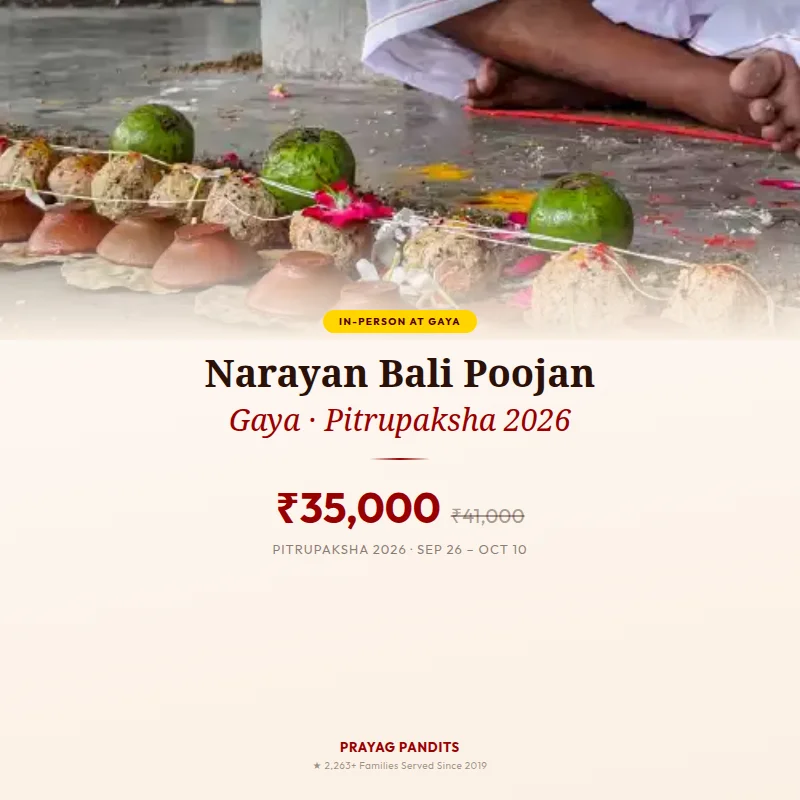





Narayan Bali Poojan in Gaya Pitrupaksha 2026
₹35,000
₹41,000
15% off
per family · all-inclusive
Verified Pandits
Since 2019
All Samagri Included
Free Cancellation
Why Families Choose Us
How It Works
1
Book & Confirm Your Date
Select your preferred date and complete the booking. Our team calls you within 2 hours to confirm details.
2
Share Family Details
Provide gotra, departed soul's name, and any requirements. Don't know your gotra? Our pandits will help.
3
Ritual Performed at Sacred Site
A Veda-trained pandit performs the complete ceremony as per shastra at the designated holy teerth.
4
Confirmation & Documentation
Booking confirmation on WhatsApp. Digital documentation available on select poojas within 48 hours.
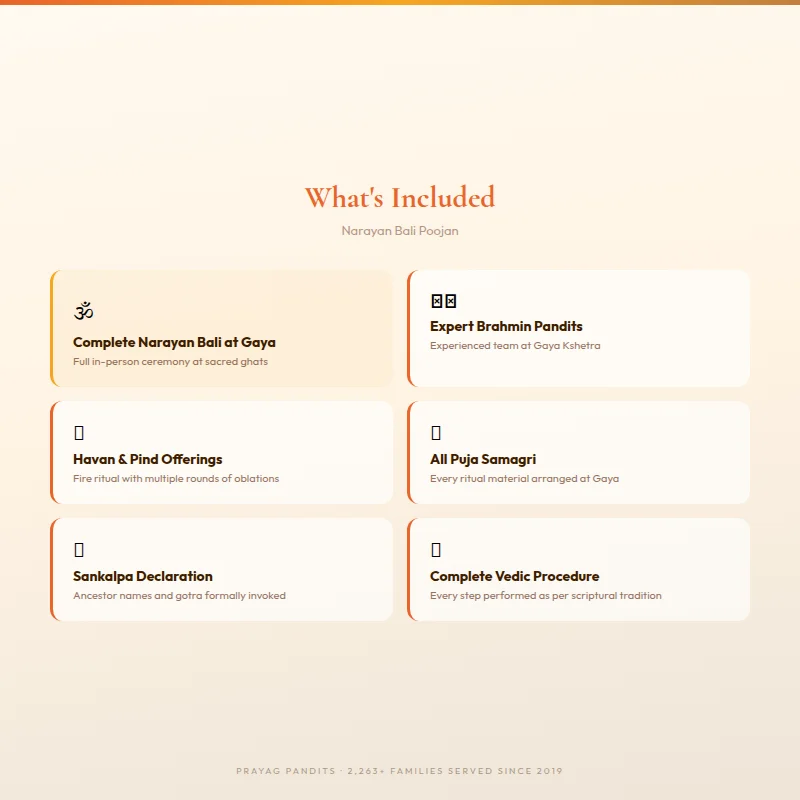
What's Included
- Starvation
- Animals
- Accident
- Arson
- Curse
- Epidemics such as Corona virus or other diseases causing untimely death
- Suicide,
- Fall from a mountain, tree or any height,
- Drowning,
- Murder
- Snake bite,
- Lightning
- Narayan Bali Poojan in Gaya.
- Priest Charges
- Poojan Material
- Guide support
- Any extra offerings to the priest.
- Any pick and drop charges from the station/airport.
About This Ritual
To Go to Gaya During Pitrupaksha Is an Act of Devotion in Itself
There is a kind of pilgrimage you make not for yourself but for someone else — for an ancestor who suffered, who left the world badly, whose departure was never completed properly. When you travel to Gaya during Pitrupaksha 2026 to perform Narayan Bali Poojan in person, this is exactly the journey you are making.Gaya is not an ordinary city. The Garuda Purana calls it a Mukti Kshetra — a field of liberation — and describes its ground as charged with the energy of Lord Vishnu himself. The Vishnupad Temple stands at its heart, built over the stone footprint of Vishnu. During Pitrupaksha, thousands of families from across India and the Hindu diaspora gather here to perform ancestral rites. The Phalgu River — where Lord Rama himself performed Pind Daan for Dasharatha — flows through it. Narayan Bali performed in person at Gaya during Pitrupaksha aligns the sacred site, the sacred season, and the sacred ritual — three forces of liberation acting simultaneously for your ancestor.What Narayan Bali Poojan Is
When a person dies in the ordinary course — in old age, after illness, with the proper Antim Sanskar performed — the soul follows a known path. The last rites sever the soul's ties to its previous life and set it on its journey forward. But when death is sudden and violent — an accident, a drowning, a murder, a suicide — this departure is disrupted. The soul is wrenched from its body without preparation. The last rites, if performed at all, are often hurried or incomplete. The result is a soul that remains caught, unable to go forward — what the Vedic tradition calls Pret Yoni, a limbo existence between death and rebirth.This trapped soul affects the living family through persistent Pitru Dosha: financial decline, health problems, broken relationships, miscarriages, disturbed sleep, and a household atmosphere that never settles into peace.Narayan Bali addresses this at its root. The ceremony constructs an effigy — the "bali" — as a symbolic body for the trapped soul. Over it, the complete Antim Sanskar is performed in full, with all the appropriate Vedic mantras. The soul receives the proper departure it was denied. The effigy is immersed in sacred waters, completing the journey. The soul moves on. The family can breathe.The Experience of Being in Gaya During Pitrupaksha
Pilgrims who visit Gaya during Pitrupaksha for the first time often describe the experience as unlike anything else in their lives. The city wakes before dawn. By the time the first light appears, the ghats along the Phalgu are already busy with families who have traveled from Maharashtra, Bengal, Tamil Nadu, Punjab, Nepal, and across the diaspora — all for the same purpose. Priests recite mantras in a dozen regional traditions simultaneously. The smell of incense and marigolds is constant.What strikes most visitors is not the spectacle of numbers but the quality of collective intention. Every person there has come for an ancestor. The grief is private and particular to each family, but the ritual action is shared, and there is a solidarity in that sharing which gives the experience a warmth alongside its solemnity. The Vishnupad Temple area, where our team works, is the heart of this activity — rituals conducted here without interruption for centuries, and that continuity is something you feel when you stand there.The Ritual: What Happens During the Ceremony
Our team meets you at the agreed location near the Vishnupad Temple area on the morning of the ceremony. The ritual follows a structured sequence that runs approximately 4 to 5 hours.Opening Rituals
The ceremony begins with Ganesh Puja — invoking the remover of obstacles so that the main ritual proceeds without interruption. This is followed by Navgraha Stuti, honoring the nine planetary forces that govern the cycle of birth and death. These opening rites take approximately 30 minutes and set the ritual space.The Sankalpa
The most crucial moment of the entire ceremony. The pandit formally declares the purpose of the ritual, naming you, your family, your gotra, and the specific ancestor or ancestors for whom the Narayan Bali is being performed. The Sankalpa is what gives the ceremony its spiritual direction — it channels everything that follows toward the liberation of that specific soul. You repeat certain phrases after the pandit and place your hand on sacred materials as part of this declaration. It is a moment of genuine weight and meaning.Construction and Consecration of the Bali
The Narayan Bali effigy is constructed before your eyes from specific materials prescribed in the ritual texts: cotton, sacred thread, rice, sesame, and other prescribed items. The pandit consecrates this effigy with mantras, establishing it as the symbolic representation of the trapped soul. This is not a cursory step — it takes time, care, and the correct recitation of the appropriate Vedic passages.Performance of the Antim Sanskar
Over the consecrated effigy, the complete sequence of last rites is performed — the very rites that were incomplete or absent at the time of the actual death. Each stage has its corresponding mantra. The pandit works through this sequence methodically, and you witness each stage as a formal farewell that is being given for the first time, properly.The Immersion
The ceremony concludes with the effigy being carried to the Phalgu River and immersed in the sacred waters. This is the moment of liberation — the symbolic completion of the soul's departure. Standing at the river in Gaya, watching this happen, with the city of ancestral liberation all around you, is an experience that many families describe as the most moving of their lives.Preparation and Travel Tips for Gaya
Pitrupaksha is one of the busiest periods in Gaya's annual calendar. A little preparation makes the experience significantly smoother.- Book accommodation early: Hotels and dharamshalas near the Vishnupad Temple fill up weeks before Pitrupaksha begins. Book at least 6 to 8 weeks in advance, particularly for dates near Sarva Pitru Amavasya (October 10, 2026).
- Travel by train: Gaya Junction is well-connected to major cities. Train tickets fill quickly in September-October — book as early as possible.
- Arrive the evening before: Come the evening before the ceremony to rest, meet the pandit for the pre-ceremony briefing, and approach the ritual day without rushing.
- Dress appropriately: White or light cotton clothing is traditional. Men should wear a dhoti or white kurta-pajama; women a plain white or light-colored saree or salwar-kameez. Avoid dark colors and synthetic fabrics.
- Fast or eat light on the ceremony morning: Sattvic food only — no meat, no alcohol. The pandit will advise on any specific observances.
What is Included
- Pre-ceremony consultation and briefing with the performing pandit
- Complete Narayan Bali Poojan at the Vishnupad Temple area, Gaya
- Sankalpa performed in your family's name and the ancestor's name
- All ritual materials: flowers, til (sesame), kusha grass, darbha, sacred threads, diya, honey, rice, cotton cloth for effigy, aromatic substances
- Narayan Bali effigy, constructed and consecrated during the ceremony
- Full recitation of all prescribed Vedic mantras by a qualified, experienced pandit
What is Not Included
- Your travel to and from Gaya
- Accommodation in Gaya during Pitrupaksha
- Brahmin Bhoj or dakshina beyond the standard ritual (can be arranged as an add-on)
- Additional ancestral rites such as Pind Daan at the 45 Vedis of Gaya, if you wish to combine rituals
- Photography or videography equipment (you may bring your own)
Pitrupaksha 2026 at Gaya: The Timeline
Pitrupaksha 2026 begins on September 26 with Purnima Shradh and concludes on October 10 with Sarva Pitru Amavasya — the most powerful day of the entire fortnight, when rites performed are said to benefit ancestors across all tithis (death dates). Narayan Bali can be performed on any day during Pitrupaksha, but certain tithis carry specific additional significance depending on the tithi (lunar day) on which your ancestor died. Our pandit will advise on the most auspicious date for your specific situation during the pre-booking consultation.Frequently Asked Questions
Does Narayan Bali at Gaya during Pitrupaksha need to be combined with Pind Daan?
They are two different ceremonies for different situations, but many families do perform both during the same visit to Gaya during Pitrupaksha. Pind Daan is the general ancestral offering for all departed ancestors. Narayan Bali is specifically for souls who died unnatural deaths or whose rites were incomplete. If you want to perform both, please mention this when booking and we can schedule them appropriately across the available days of your stay in Gaya.Can the ceremony be performed for more than one ancestor in the same sitting?
Yes, a single Narayan Bali ceremony can include Sankalpa for multiple ancestors who died unnatural deaths. The effigy represents the collective need rather than a single individual. There is no additional charge for including multiple names in the Sankalpa, provided they are all from the same family lineage.We do not know the gotra of our family. Can we still proceed?
Yes. When the gotra is unknown, the Vedic tradition uses Kashyap Gotra as the universal default for the Sankalpa. This is a fully accepted and standard practice — it does not diminish the efficacy of the ceremony in any way. Many families who have lost track of their gotra over generations perform ancestral rites successfully using this default.My father passed away in an accident last year and we performed the regular last rites. Is Narayan Bali still necessary?
This is a question worth discussing in a consultation with our pandit before booking. If the regular last rites were performed promptly and completely after the accidental death, Narayan Bali may not be strictly necessary. However, if there were any irregularities, delays, or shortcomings in the original rites — or if the family has observed Pitru Dosha symptoms in the year since the death — Narayan Bali is a compassionate additional step that resolves any remaining karmic irregularities. Our pandit can help you assess this honestly.What is the difference between attending in person versus the online version of this ceremony?
Both perform the complete Narayan Bali ceremony with full ritual integrity. Attending in person adds kshetra phal — the merit of being physically present at a sacred site — and allows you to participate directly in the Sankalpa and key offering moments. For families able to travel, being physically present in Gaya during Pitrupaksha transforms the ritual into a complete pilgrimage experience.What Families Say 4.3
आमच्या कुटुंबासाठी हे पूजन करून घेतले. पंडितजी खूप अनुभवी आहेत. धन्यवाद.
We performed Narayan Bali Poojan on the advice of our family pandit. The ceremony took the full day but Prayag Pandits managed everything perfectly. The senior pandit was very knowledgeable…
প্রয়াগ পণ্ডিতস-এর সেবা খুবই ভালো। সব ব্যবস্থা সময়মতো হয়েছিল।
Very authentic Vedic ceremony. All materials were included as promised. Will definitely use their services again.
हमारे परिवार ने पहली बार ऑनलाइन पूजा करवाई। शुरू में थोड़ा संशय था लेकिन अनुभव बहुत अच्छा रहा। वीडियो कॉल की गुणवत्ता अच्छी थी और पंडित जी ने हमें पूजा…
Had a wonderful experience. The booking process was easy and the ceremony was conducted with full devotion.
We performed Narayan Bali Poojan on the advice of our family pandit. The ceremony took the full day but Prayag Pandits managed everything perfectly. The senior pandit was very knowledgeable…
प्रयाग पंडित्स ने बहुत अच्छी सेवा दी। Booking से लेकर पूजा तक सब smooth रहा।
We performed Narayan Bali Poojan on the advice of our family pandit. The ceremony took the full day but Prayag Pandits managed everything perfectly. The senior pandit was very knowledgeable…
Narayan Bali is a very specific ritual and finding the right pandit was our main concern. Prayag Pandits connected us with an experienced purohit who had performed this poojan many…