Veda-Trained Pandits
Experienced pandits guide the ceremony with care for your family’s tradition.
Pooja booking
Original price was: ₹17,000.00.₹12,382.00Current price is: ₹12,382.00.
Per pooja
Applicable taxes are shown in your booking. Optional additions are separate.
Exclusions
Thoughtfully arranged, personally guided
Experienced pandits guide the ceremony with care for your family’s tradition.
Stay in touch with our team for your booking details and ceremony arrangements.
See what your selected package includes. Optional additions are shown separately.
Share the date and timing that suit you. Our team confirms the final arrangements.
Experiences shared by our families
8 family reviews0 for this pooja · 8 from across our services
Watching the pandit perform the rituals in real-time by the Falgu River, mentioning my father's name... it felt like we were truly there. Immense gratitude to the entire team.
Being in the USA, travelling to India just for Tarpan during Pitru Paksha was becoming very difficult. Prayag Pandits offered a well-coordinated solution.
I was skeptical about performing such a sacred ritual online from Canada. But honouring my parents in Kashi was important. They were very patient and answered all my questions.
Living in Singapore, we felt disconnected from these essential rituals. The live stream option for Tarpan at Prayagraj gave us a profound sense of connection and peace.
It was deeply important for us in Australia that the rituals were performed correctly. The ceremony reflected the authenticity we sought and was performed by a knowledgeable priest.
The Pind Daan at Kashi was handled carefully, with the pandit following every step diligently. Very reassuring.
Arranging Asthi Visarjan from Bhubaneswar seemed complex, but Prayag Pandits made it seamless. The pandit called us before the ceremony to explain every step. Very professional.
During Pitru Paksha, we booked Shradh at Prayagraj. The coordination was flawless - from date selection to the pandit assignment. Our family felt at peace after the ceremony.
YOUR EXPERIENCE MATTERS
Tell us about your ceremony and the support you received. Your email address will stay private.
From your first choice to your booking
Review your package and any available additions, then add it to your booking.
Enter your contact details, preferred date and time. Add ancestral details if you wish.
Our team confirms the arrangements and shares your coordinator’s details 24 hours before the pooja.
Follow the participation and joining arrangements described in your package and shared by your coordinator.
Of all the rites the Hindu tradition prescribes for the welfare of departed ancestors, the Shradh ceremony — performed annually on the death-anniversary Tithi and during the Pitrupaksha fortnight — is the one the Manusmriti names as among the five mahayajnas every Brahmin householder is obligated to perform. The Shradh is not a one-time rite. It is the lifelong calendar institution through which a karta sustains his ancestors in the Pitru Loka. The Vayu Purana, in its Gaya Mahatmya, names the Phalgu river an incarnation of Vishnu and describes Gaya as the one tirtha where the Pitri-yajna does not lapse with the calendar — the merit of Shradh performed here carries Mahatmya weight beyond ordinary ghat-side rites.
This package brings two elements together: the complete Shradh ceremony at the Phalgu vedi at Gaya — performed during Pitrupaksha 2026 — followed by Brahmin Bhoj in which one learned Brahmin is served a full traditional meal in your ancestors’ names, with the specific Brahmin Bhoj mantras that direct the merit toward your lineage. Everything is performed live at Gaya and witnessed by you on a video call from wherever you are.
Pitrupaksha 2026 runs from September 26 to October 10. Slots for Shradh ceremonies at Gaya during this fortnight are limited. This page explains everything about the ceremony, what is included, how the online format works, and how to prepare.
For a broader understanding of Shradh procedure and significance, read our guide: What is Shradh — Complete Guide.
The three ceremonies are often mentioned together but serve doctrinally distinct purposes. Understanding the difference helps families choose the right rite for their specific situation.
Shradh is the broader ancestral institution combining tarpan + dakshina + Brahmin Bhoj + (in Pitrupaksha) pinda offering. The Manusmriti, in its Pitri-yajna section (chapter 3), names Shradh as one of the five pancha mahayajna — alongside Brahma-yajna (Vedic study), Deva-yajna (offering to deities), Bhuta-yajna (offering to elemental spirits), and Manushya-yajna (hospitality to guests) — every grihastha is obligated to perform. The annual Tithi-Shradh on the death-anniversary day is the karta’s lifelong obligation; the Pitrupaksha-Shradh is the most powerful annual window; the monthly Amavasya-Shradh keeps the rite alive between these high-merit days.
The substance of Shradh is the feeding of the Brahmin. The Garuda Purana, the Manu Smriti, and the Apastamba Dharmasutra all describe Brahmin Bhoj as the central act of Shradh — the means by which the meal’s nourishment is transmitted to the Pitru Loka. Shradh without Brahmin Bhoj is, in the language of the Garuda Purana, “the lamp without oil.”
Pind Daan is the specific pinda offering — rice-flour balls offered at the sacred Vedis of Gaya with mantras directing the merit toward ancestral liberation. Pind Daan operates at a different doctrinal level: it offers the ancestor a subtle vehicle through which they can receive concentrated merit at Gaya specifically, where the Vayu Purana Gaya Mahatmya describes the Pitra Devatas as receiving the offering and granting moksha. Pind Daan is the high-occasion rite — performed once for the soul’s release, or during Pitrupaksha as part of the larger Shradh. For families wanting the dedicated Pind Daan ceremony at Gaya with three-Brahmin Bhoj, see our Online Pind Daan in Gaya with Brahmin Bhoj.
Tarpan is jala-tarpana — the offering of water with darbha twigs and the prescribed anjali count. The Manusmriti lists tarpan as one of the five daily mahayajnas every Brahmin householder performs after the morning bath. Tarpan is the daily nitya-karma; Shradh is the annual / Pitrupaksha intensification; Pind Daan is the Gaya-specific moksha rite. For families wanting the dedicated tarpan ceremony at the Phalgu, see Tarpan in Gaya.

The Manusmriti, in chapter 3 on Shradh ritual, contains the verse at 3.189: “Brahmanobhojanat punyam pitarah susthiran smrita” — the ancestors are established in peace and contentment through the feeding of Brahmins. The chapter elaborates: the merit of Brahmin Bhoj is proportional to the learning and tapas of the Brahmin fed. One deeply learned Brahmin at Gaya, fed with the appropriate mantras, generates more merit than many less-learned Brahmins fed elsewhere.
The Garuda Purana’s Pretakalpa section — the portion of the text dealing with the soul’s journey after death and the ceremonies that affect it — describes the Brahmin Bhoj as the act through which the Pitrs depart fully satisfied from the Shradh ceremony, calling down blessings on the descendants who performed the feeding. The imagery is specific: the Pitrs arrive drawn by the Sankalpa, they receive the tarpan offering, and they depart fully nourished by the Brahmin Bhoj.
The Matsya Purana describes Brahmin Bhoj at Gaya specifically, noting that Brahmins of the Gaya Kshetra tradition — who have studied the Gaya Mahatmya texts and the specific Shradh procedures of the local tradition — carry an additional potency because of their immersion in the sacred field itself. The Brahmins in our network at Gaya come from exactly this background.
This package serves one learned Brahmin a complete traditional meal during the Brahmin Bhoj. The single-Brahmin Shradh has its own well-attested doctrinal basis: the Apastamba Dharmasutra and the Manu Smriti both note that for the annual Tithi-Shradh — as distinct from the high-occasion Pitrupaksha-Shradh combined with Pind Daan — one dedicated learned Brahmin fed with full attention and the appropriate mantras carries the same merit as larger feedings performed with diluted attention. The principle is one of focused intent: a single Brahmin receives the karta’s complete devotion and mantra-attention; the meal is offered with the karta’s full Sankalpa.
For families performing the annual Tithi-Shradh during Pitrupaksha or wanting a focused dedicated Shradh ceremony, the one-Brahmin format is the right scale. The merit is fully complete; the format is simply suited for the rite’s annual rather than high-occasion dimension. For the larger three-Brahmin Pitrupaksha ceremony combined with Pind Daan, see our Online Pind Daan in Gaya with Brahmin Bhoj.
Gaya in Bihar is the site that appears in every major treatment of ancestral rites in Hindu scripture. The Vayu Purana’s Gaya Mahatmya — the canonical textual authority for Gaya rites — names the Phalgu river an incarnation of Vishnu himself, and describes Gaya as the one tirtha where the Pitri-yajna does not lapse with the calendar.
The Brahma Purana’s Gaya Mahatmya extends this with the explicit blessing on shaak-tarpan (the darbha-grass + til + water offering) performed at Gaya: “the karta who performs Shradh and tarpan for his ancestors by means of shaak shall increase his entire family, and no person of his lineage shall remain unhappy.” The Akshayavata — the imperishable banyan within the Vishnupad complex — is the second Gaya-tirtha where the Mahatmya promises the Shradh offering does not pass away with the season.
The Mahabharata, in its Vana Parva (Tirthayatra section), names Gaya-Shradh among the most meritorious of pitru-rites — a passage cited across the tradition for over a millennium. The sacred Vedis of the Gaya Kshetra — the Phalgu River Vedi, the Akshayavata Vedi, and others — each carry specific scriptural promises for different categories of ancestors. A Shradh ceremony performed at the Phalgu Vedi ensures the widest possible ancestral benefit.
For families planning to visit Gaya in person, our in-person package is available at: Pind Daan in Gaya.
Pitrupaksha 2026 begins on September 26 with the Purnima Shradh and concludes on October 10 with Sarva Pitru Amavasya. These fifteen days are set aside entirely for ancestral rites in the Hindu calendar, and the tradition regards them as the single most auspicious period of the year for any Shradh ceremony.
The key dates within the fortnight carry specific significance:
Each of the fifteen days between these points corresponds to a specific lunar tithi. When an ancestor departed on a particular tithi — say, Panchami (the fifth lunar day) — the Panchami of Pitrupaksha is considered the most auspicious day to perform that ancestor’s Shradh. Our pandits can help you identify which day within Pitrupaksha is most appropriate based on your specific ancestors’ tithis.
Slots for Shradh ceremonies at Gaya during Pitrupaksha fill up significantly faster than at any other period of the year. Families from across India and from abroad all converge on Gaya during this fortnight. Booking 2-3 weeks in advance of September 26 is strongly recommended.
The online format makes the merit of Gaya Shradh with Brahmin Bhoj accessible to families everywhere. The scriptural validity of this format rests on a principle the Dharmashastra texts have always upheld: the Sankalpa — the ritual declaration of intent made with the karta’s full name, gotra, and conscious resolve — is the anchor of any Hindu ceremony. When the Sankalpa is made sincerely and correctly, the physical performance of the ceremony on behalf of the declared person is as meritorious as their own physical participation. This principle of representation by an authorised pandit, called Pratinidhi Karma, is documented in the Parashar Smriti and the Yajnavalkya Smriti.
Here is the complete process from booking to ceremony completion:
Our team contacts you within 24 hours of booking to collect all the details needed for the Sankalpa: your full name, your father’s name, your family gotra (lineage), and the names of the ancestors to be included in the ceremony. We also confirm your preferred date within Pitrupaksha and the video call platform (WhatsApp, Zoom, or Google Meet). Sometimes due to network surge and other logistical issues, we work with available video call options. If your gotra is unknown, this is not an obstacle — our pandits are experienced in constructing the Sankalpa with the information available.
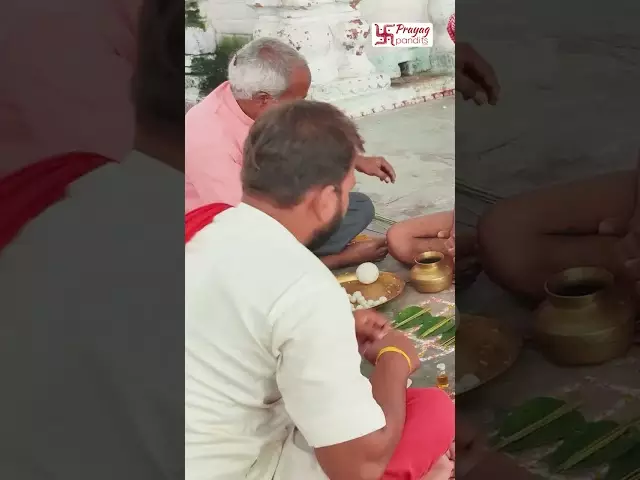
On the day of the ceremony, the pandit begins the preparatory rituals. All Shradh samagri — the cooked rice, til (sesame), honey, ghee, milk, kusha grass, flowers, incense — has been prepared specifically for your ceremony. The video call is initiated at the confirmed time. You join the call and are greeted by the pandit at the Phalgu Vedi.
The ceremony begins with the Sankalpa — the formal declaration of intent. The pandit recites the time, place, your name, your gotra, your father’s name, and the names of each ancestor being offered the ceremony. You are present on the video call to witness this declaration. At this moment, according to the Dharmashastra tradition, the ceremony is formally linked to your lineage and your specific ancestors. Everything that follows from this point carries merit for the named individuals.
The pandit performs the complete Shradh vidhi at the Phalgu Vedi — Sankalp, tarpan (water libation with darbha twigs in three directions: East for deva-tarpan, South for pitri-tarpan, with the prescribed anjali count per Baudhayana), samagri offering with the mantras specific to the Gaya tradition. The Phalgu Vedi is the canonical Shradh ghat at Gaya per the Vayu Purana Mahatmya. The pandit explains each step as it occurs so you understand what is being done and why. The camera is positioned to show both the Vedi and the pandit performing the ceremony.
After the Shradh tarpan is complete, the ceremony moves to the Brahmin Bhoj. One learned Brahmin who has been invited and prepared for this ceremony is seated. The meal — prepared fresh that morning, sattvic throughout (vegetarian, without onion or garlic) — is served with the recitation of the Brahmin Bhoj mantras drawn from the Shradh Kalpa texts. These mantras specifically direct the merit of the feeding to your ancestral lineage as established in the Sankalpa.
You watch the Brahmin Bhoj in real time on the video call. When the Brahmin is served and the mantras are complete, the Brahmin offers their blessings — for the peace of your ancestors and for the welfare of your family. This blessing, offered by a Brahmin of the Gaya Kshetra tradition after a properly conducted Brahmin Bhoj, is considered one of the most auspicious events in the tradition of ancestral rites.
The ceremony closes with the pandit’s final blessings and a summary of what was performed. The complete video recording (where possible — for WhatsApp video calls, only portions of the screen recording without voice can be shared) of the ceremony — from the first Sankalpa through the conclusion of Brahmin Bhoj — is shared with you via WhatsApp or Google Drive within 48 hours.
The total ceremony duration, from Sankalpa through Brahmin Bhoj and closing, is typically between 60 and 90 minutes — shorter than the larger three-Brahmin Pind Daan ceremonies because of the focused single-Brahmin scale.
Families performing the annual Tithi-Shradh. The annual death-anniversary Shradh is the karta’s lifelong obligation per the Manusmriti’s Pitri-yajna section. This package is sized for that yearly observance — focused, one dedicated Brahmin, full ceremony rigor with the Phalgu-Vedi merit unique to Gaya.
NRI families and those living far from Gaya. Distance is the most common reason families miss the annual Shradh. The online format removes that barrier entirely. Families in the United States, United Kingdom, Canada, Australia, the Gulf, Malaysia, and Singapore regularly book the annual Shradh through this online format during Pitrupaksha. For families in Western time zones where the morning IST ceremony corresponds to late night locally, we record the entire ceremony and share it in full — you do not miss a moment.
Families wanting the Pitrupaksha Shradh at focused scale. For families who want the Pitrupaksha-Shradh at Gaya but prefer a focused single-Brahmin ceremony over the larger Pind-Daan + three-Brahmin format, this is the right package. Both formats are doctrinally complete; this is simply scaled for the focused annual rite rather than the high-occasion Pind-Daan combination.
Families performing Shradh for the first time. The Manusmriti makes no distinction between a Shradh performed in the year following death and one performed years or decades later. The rite is equally valid and the merit equally complete whenever it is performed with sincere intention.
For the larger three-Brahmin Pitrupaksha ceremony combined with Pind Daan, see Online Pind Daan in Gaya with Brahmin Bhoj.
For NRI families seeking a complete guide to online ancestral rites, read: Online Pind Daan for Non-Resident Indians.
Depending on your family’s specific situation, one of these related packages may be more appropriate or may serve alongside this one:
To ensure the Sankalpa is precise and every ancestor is honoured correctly, please gather the following information before our team contacts you after booking:
On the day of the ceremony, bathe before joining the call, wear clean clothing, and if possible keep a glass of water and a few sesame seeds (til) with you. These simple preparations are not mandatory but are traditionally recommended as they help anchor your presence and intention in the ceremony as it is performed at Gaya on your behalf.
The two are doctrinally distinct rites combined with the same completing act. Shradh is the broader ancestral institution combining tarpan + dakshina + Brahmin Bhoj; the Manusmriti names it one of the five pancha mahayajnas every householder must perform. Pind Daan is the specific pinda-offering rite — rice-flour balls offered at Gaya’s Vedis for ancestral moksha. This package is the Shradh ceremony with the completing single-Brahmin Bhoj — suited for the annual Tithi observance or a focused Pitrupaksha rite. For Pind Daan with the larger three-Brahmin Bhoj — the high-occasion ceremony — see our Online Pind Daan in Gaya with Brahmin Bhoj package.
The annual Tithi-Shradh has historically been performed with one dedicated learned Brahmin per the Apastamba Dharmasutra and Manu Smriti tradition. One Brahmin fed with full attention and the appropriate mantras at Gaya generates the focused merit suited to the annual observance. The three-Brahmin format is for the larger Pitrupaksha-Shradh combined with Pind Daan — a different scale for the high-occasion ceremony, where three Brahmins represent the three tiers of ancestral lineage (recently deceased, intermediate, and remote ancestors). Both formats are doctrinally complete; the choice depends on whether you are performing the annual Tithi-Shradh, the focused Pitrupaksha-Shradh, or the larger Pitrupaksha-Shradh-with-Pind-Daan.
The Brahmin is served a complete traditional meal prepared fresh on the morning of the ceremony. The food is fully sattvic — vegetarian, without onion, garlic, or other tamasic ingredients. The standard meal in the Gaya tradition includes rice, dal, two vegetable preparations, fresh roti, a sweet item (typically kheer or halwa), and fresh fruit. The meal is served with the Brahmin Bhoj mantras recited throughout. After eating, the Brahmin offers their formal blessings for your ancestral lineage and your family’s welfare.
Yes. Both lineages are included in a single Sankalpa. The ceremony structure in the Gaya tradition covers ancestors from both the paternal and maternal sides. You provide the names and gotra for both sides when you fill in the ceremony details after booking, and the pandit constructs the Sankalpa to address all named ancestors.
Many NRI families and families that have migrated multiple times have lost gotra records. This is not an obstacle. Our pandits are experienced in constructing the Sankalpa with the information available, and there are well-established procedures in the Dharmashastra tradition for families where the gotra has been forgotten. The Sankalpa is constructed to honour the named ancestors regardless of whether the gotra record is complete.
Yes — the full Pitrupaksha ancestral circuit. Many families perform Shradh on their parents’ death-anniversary tithi within Pitrupaksha, Pind Daan on Sarva Pitru Amavasya for the moksha-direction merit, and Tarpan daily through the fortnight. We coordinate combined packages on request; pricing depends on the rite-mix selected.
The recording is shared within 48 hours of ceremony completion via WhatsApp or Google Drive. For WhatsApp video calls, only the screen recording without voice can be shared due to platform limitations. For Zoom or Google Meet calls, the full audio-video recording is shared in its entirety. The pandit’s narration of each step, the Sankalpa, the tarpan offering, and the Brahmin Bhoj are all captured.