
Key Takeaways
- What shradh means
- Who performs shradh
- The twelve types of shradh
- When shradh is performed
In This Article
Shradh is the Hindu rite in which the living offer food, water and prayer to their departed ancestors. The word comes from shraddha — faith, sincerity — and that is what separates it from ordinary remembrance: it is a formal act of ancestral nourishment, performed to rules set out in some of the oldest surviving texts of the tradition. It is performed on the annual death tithi, during Pitru Paksha, and on amavasya.
This guide covers what the word means, who performs the rite, the twelve types of shradh, when it is done, the complete vidhi, the eight kutapa that make a shradh complete, the flower and food rules, and how families abroad arrange it. For the Pitru Paksha calendar see the Pitru Paksha guide; for dates, Shradh dates.
What shradh means
The word is formed from shrat, faith or truth, and dha, to hold or to offer — an offering made with complete sincerity. In the Manusmriti, Manu lists shradh among the daily duties of a householder, beside the worship of the gods, the household fire, hospitality to guests and reverence toward living beings.
The Vishnu Purana sets out the mechanism: ancestors in Pitru Loka receive what descendants offer, transmitted through the Pitras, the ancestor-deities who stand between the two realms. The pindas and the water offered at the riverbank are not understood to dissolve meaninglessly — they reach the ancestor named in the sankalp. The Garuda Purana, the most detailed scripture on death and the rites that follow it, describes Pitru Loka as where souls dwell between death and rebirth, sustained by what their families offer.
Shradh is not a ceremony of grief. It is the maintenance of a relationship — a way of saying to the people who gave you your life that they have not been forgotten.
Who performs shradh
The traditional answer in both the Manusmriti and the Garuda Purana is the eldest son, because in the patrilineal reckoning it is his thread that continues the lineage. In practice the tradition has always been flexible: where there is no eldest son the rite passes to a younger son, a grandson, a brother, a nephew or a son-in-law, and daughters perform it in a growing number of families without any qualification from the purohits at Prayagraj or Gaya.
A daughter’s son — the dauhitra — holds a specific and honoured place, named among the eight kutapa below. Where no relative can perform it, a qualified pandit performs it on the family’s behalf with the sankalp taken in their name.
The twelve types of shradh
- Nitya — the daily rite, performed without a particular occasion.
- Naimittika — tied to an occasion, most often the annual death tithi.
- Kamya — performed with a specific intention.
- Vriddhi, or Nandi — before an auspicious event such as a marriage or a birth.
- Parvana — the periodic form used during Pitru Paksha and on amavasya, addressing three generations together.
- Sapindan — the rite that joins the departed to the body of ancestors, ending the preta state. See sapindikarana.
- Goshthi — performed by a group of families together.
- Shuddhyartha — for purification.
- Karmanga — performed as part of a larger rite.
- Daivika — offered to the deities rather than to the ancestors directly.
- Yatrartha — before setting out on a journey.
- Pushtyartha — for growth and wellbeing.
When shradh is performed
The annual death tithi is the principal occasion — the lunar date of the death, not its Gregorian anniversary, which is why the date moves each year. Pitru Paksha, 26 September to 10 October in 2026, is the fortnight in which the rite carries the most weight, and the day within it is chosen to match the ancestor’s tithi. Sarva Pitru Amavasya on the closing day serves every ancestor, including those whose tithi nobody remembers. Monthly amavasya serves where none of the above is possible.
Shradh vidhi — the ceremony
- Sankalp. The formal vow. The karta names himself and his gotra, the tithi and month, and each ancestor being honoured with their gotra. Nothing offered afterwards has an address without it.
- Tarpan. Water with black sesame and kusha grass is offered facing south, satisfying the ancestors’ thirst and calling them to the rite.
- Pind daan. Pindas of cooked rice with sesame, milk, honey and ghee are offered — the central act. See the Pind Daan guide.
- Brahmin bhoj. A Brahmin is fed, so the offering reaches the ancestors through a living channel.
- Daan. Food, cloth or whatever the family’s custom prescribes is given to those in need. Only then does the family eat.
The eight kutapa
The Vishwamitra Smriti names eight elements, collectively the kutapa, whose presence marks a complete shradh. It is one of the most specific passages in the whole ancestral-rite tradition and is rarely discussed outside pandit circles.
| Kutapa | What it is, and what it means today |
|---|---|
| Kutapa kala | The eighth muhurta, about 11:36 am to 12:24 pm — the window in which the rite is most potent |
| Khadgapatra | A rhinoceros-horn vessel. Rare now; the principle is a ritually pure vessel, so silver or clay is used |
| Pavitri | A Himalayan wool blanket as the seat. The principle is purity of the seat; kusha mats or clean wool serve |
| Rajat | Silver, held to have come from the eyes of Shiva and to give akshaya tripti — imperishable satisfaction |
| Darbha | Kusha grass, which holds and transmits the offering |
| Krishna tila | Black sesame — the single most important ingredient in any ancestral rite |
| Go | The cow, present through its milk, curd and ghee, and through go daan |
| Dauhitra | The daughter’s son, whose presence at the rite is specifically honoured |
Flowers — what is permitted
The Vishwamitra Smriti is unusually precise here. Permitted: white, fragrant flowers — malati and juhi jasmine, champa, white lotus, tulsi leaves and flowers, and bhringraj. Avoided: red flowers of any kind, black flowers, and flowers without scent. The principle is that white fragrant flowers carry sattvic purity.
Food rules
The rules below come from the Vishwamitra Smriti and the Manusmriti and govern both the pindas and the meal served at brahmin bhoj.
- Cow products — milk, curd and ghee are the three most sacred substances for the rite.
- Grains — barley, rice, wheat and sanwa millet. The Manusmriti singles out barley.
- Black sesame — the most important single ingredient.
- Pulses — moong dal specifically.
- Kheer — rice pudding, considered particularly auspicious.
Meat, fish, eggs, alcohol, onion and garlic are excluded, as are masoor dal and most pungent or sour preparations. A family that cannot prepare an elaborate meal is not failing the rite: the tradition explicitly provides that where means are short, what is offered with sincerity suffices.
Where shradh is performed
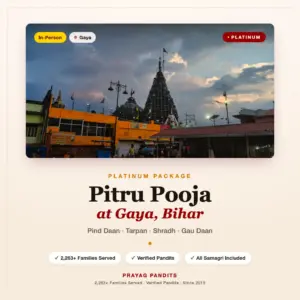
Most families perform it at home, and that is entirely proper. Where a family goes to a tirtha, Gaya stands first for ancestral rites, then Prayagraj at the Triveni Sangam, then Kashi and Haridwar.
| Where | Price | Note |
|---|---|---|
| Gaya — Pitru Paksha group rite | ₹1,100 | Shared sankalp on a fixed day of the fortnight |
| Prayagraj (Triveni Sangam) | ₹7,100 | Individual sankalp, own pandit |
| Haridwar | ₹7,100 | Individual sankalp, own pandit |
| Garh Mukteshwar | ₹7,100 | Individual sankalp, own pandit |
| Varanasi (Kashi) | ₹10,999 | Individual sankalp, own pandit |
| Gaya — online, individual | ₹10,999 | Live video, sankalp in your name |
Shradh from abroad
The pandit performs the complete rite physically at the tirtha while the family joins by live video, with the sankalp taken in your name and your ancestors’. The Indian ceremony time is fixed first — ideally inside kutapa kala — and your local joining time follows from it. A recording and photographs are sent afterwards, and payment is in rupees by PayPal or an international card.
Have ready the karta’s name and gotra, the ancestors’ names and relationships, the death tithi if the family observes one, and the tirtha if an elder has named one. Nominate one relative as the coordinator — when family is spread across time zones, a single point of contact is the difference between a confirmed time and a missed call. The guide for families abroad sets out the time differences country by country.
🙏 Shradh at the Triveni Sangam
- Sankalp in your ancestor's name and gotra
- Scheduled inside kutapa kala where possible
- Tarpan, pind daan, brahmin bhoj and daan
- Live video and a recording for families abroad
Common questions
Shradh, tarpan and pind daan — what is the difference? Shradh is the whole ceremony. Tarpan is the water offering within it, and pind daan the offering of the pindas. A family that performs only one has done part of the rite, not all of it.
We do not know the death tithi. Observe on Sarva Pitru Amavasya, the closing day of Pitru Paksha. It exists for exactly this and nothing about the rite is diminished.
Can shradh be done at home? Yes, and most families do. A tirtha adds scriptural merit; it is not a requirement.
What if the ashes were never immersed? Asthi Visarjan is a separate rite and can be arranged alongside. See the Asthi Visarjan guide.
Book Your Sacred Ritual
Authentic ceremonies performed by Veda-trained pandits at sacred sites across India.



