
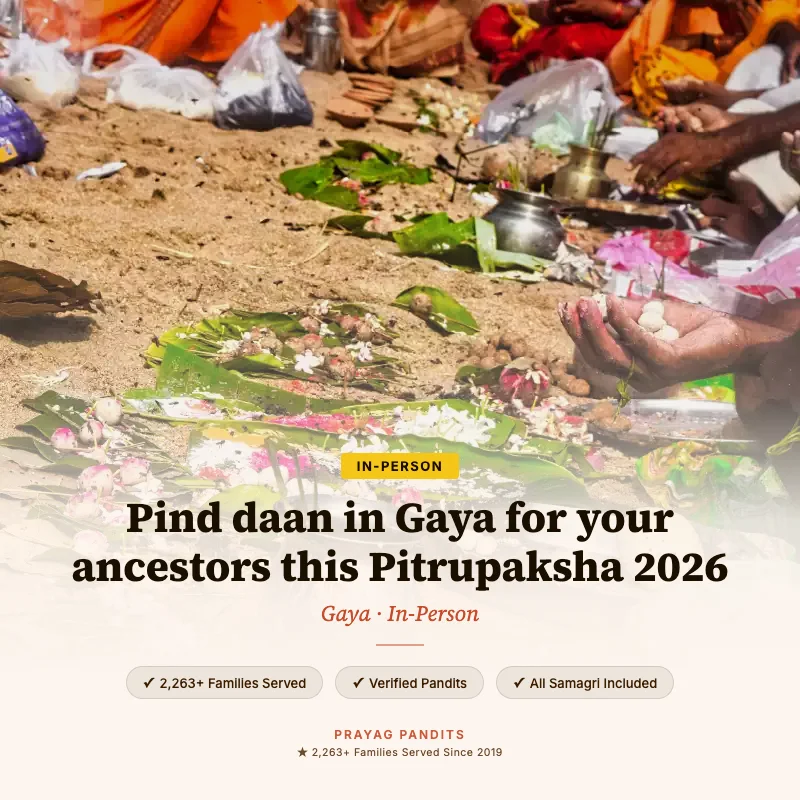



What’s included
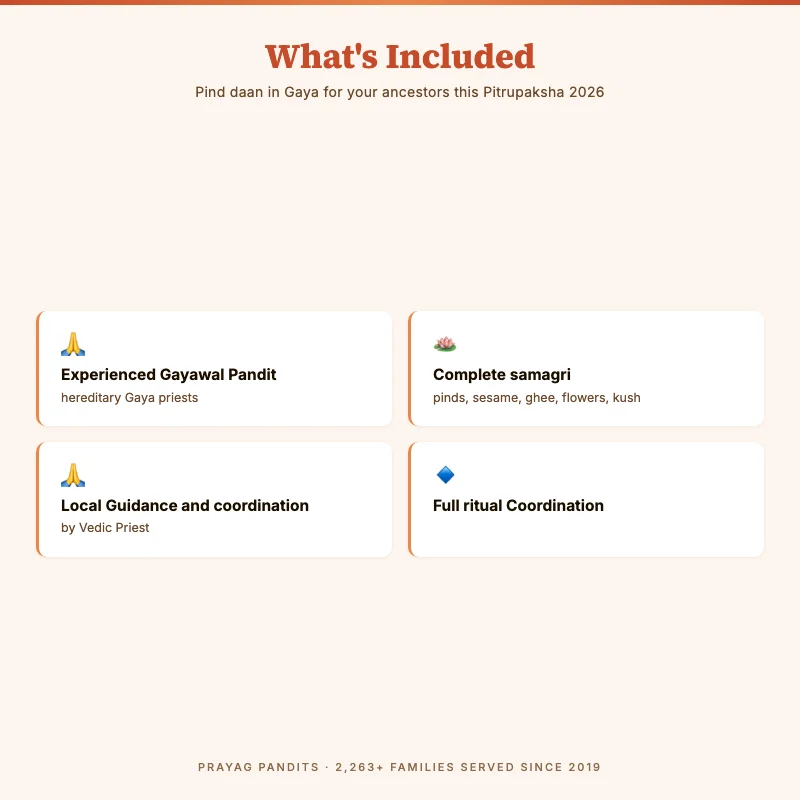
Included in your package
- Experienced Gayawal Pandit hereditary Gaya priests
- Complete samagri pinds, sesame, ghee, flowers, kush
- Local Guidance and coordination by Vedic Priest
- Full ritual Coordination
Not included in your package
- Travel to and from Gaya
- Accommodation in Gaya
- Meals during your stay
- Extra Dakshina/Gifts/Donations made to the Priest/Pandit
This is not a Daswa Pind Daan package.
How it works
Choose your pooja
Review your package and any available additions, then add it to your booking.
Share your preferences
Enter your contact details, preferred date and time. Add ancestral details if you wish.
We coordinate with you
Our team confirms the arrangements and shares your coordinator’s details 24 hours before the pooja.
Participate in your pooja
Follow the participation and joining arrangements described in your package and shared by your coordinator.
What families say after the rite
From families who booked Pind daan in Gaya for your ancestors this Pitrupaksha 2026.
Rated 4.8 out of 5
500+ reviews · Prayag Pandits
This poojarated 4.6 out of 518 reviews
Our pandits



- 2,263+ families served
- Serving since 2019
- GST registered
Families on video
The player loads only when you press play.


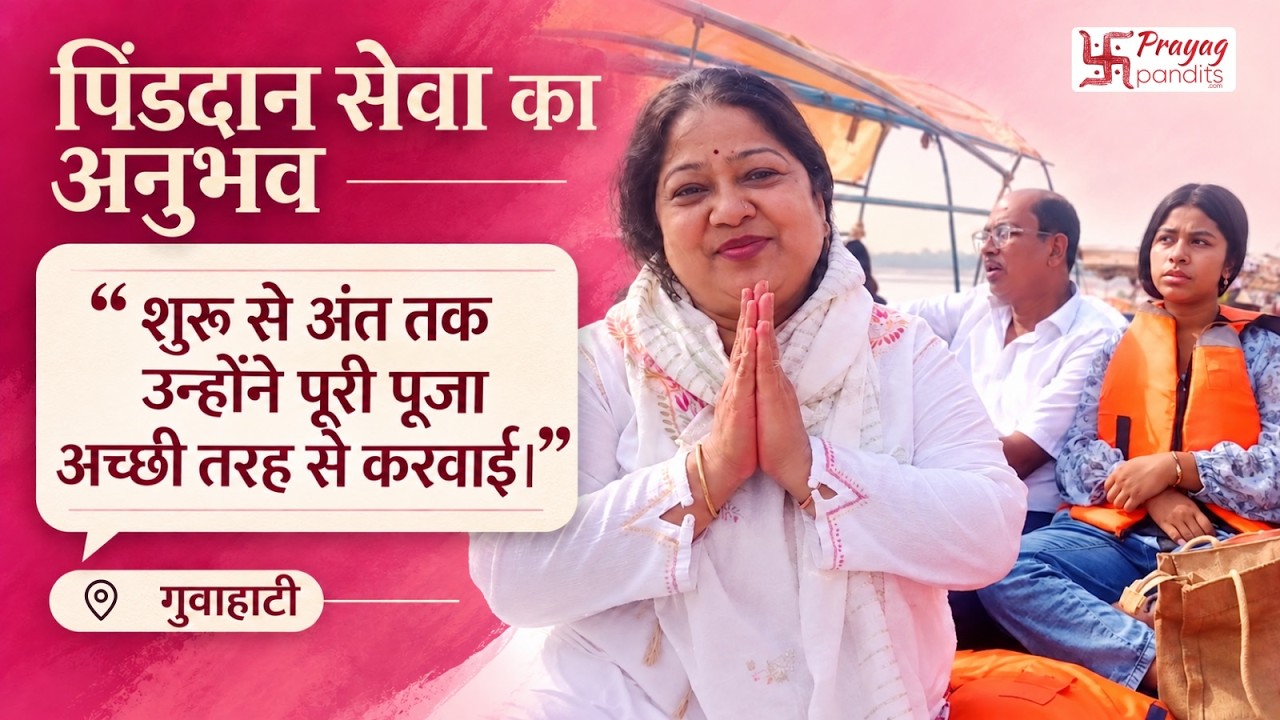
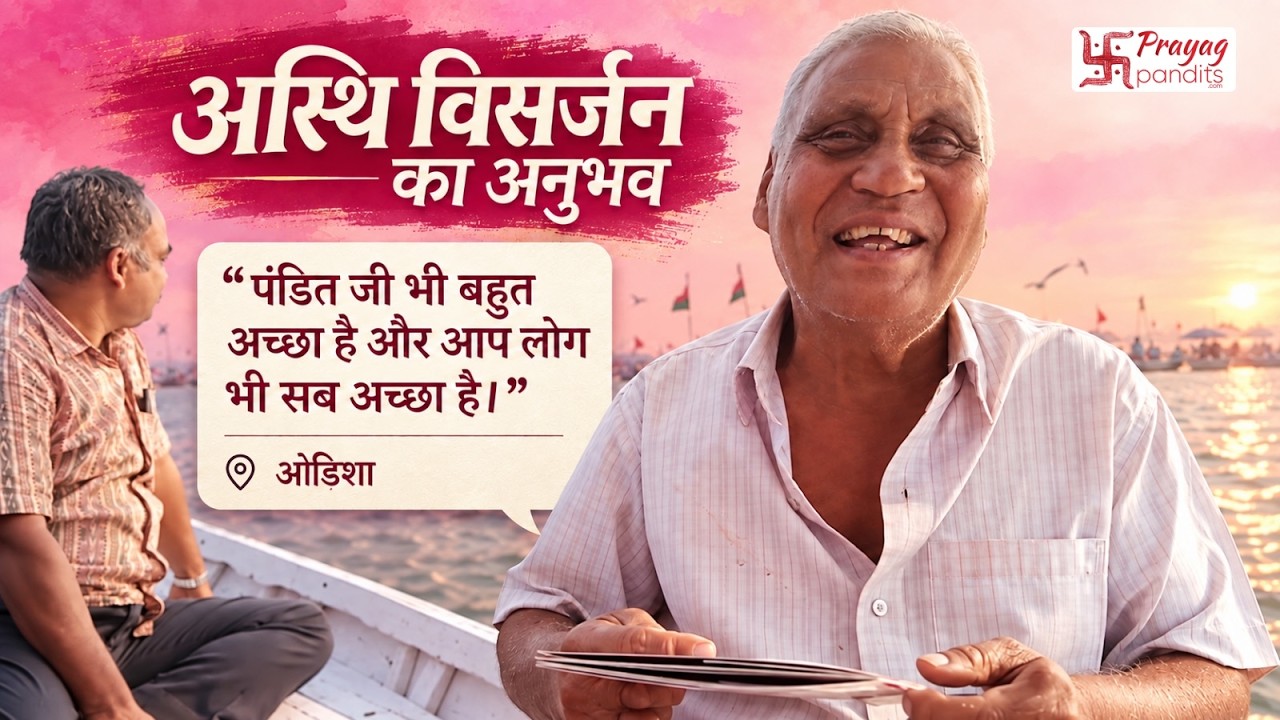
In their words
पिंडदान की पूरी व्यवस्था बहुत अच्छी थी। पंडित जी ने सभी मंत्रों का सही उच्चारण किया और हर विधि को विस्तार से समझाया। परिवार के सभी सदस्य संतुष्ट हैं। प्रयाग पंडित्स की सेवा सराहनीय है।
We booked this for our grandfather's annual shradh. The ceremony was performed with great reverence. Pandit ji even shared stories from the Garuda Purana which were very enlightening for the younger generation.
Performed Pind Daan here during Pitrapaksha. The entire process was smooth. Pandit ji was very cooperative and explained the mantra meanings. The prasad distribution was also well organized. A truly fulfilling experience.
ऑनलाइन पिंडदान का विकल्प हमारे जैसे NRI परिवारों के लिए वरदान है। वीडियो कॉल पर सब कुछ स्पष्ट दिख रहा था और हम पूजा में भाग ले सके। पंडित जी ने धैर्य से सब कुछ समझाया। Dhanyavaad.
We are NRI family based in USA. We booked online poojan and it was conducted very sincerely. The video quality was good and we could see everything clearly. The team sent us photos and videos after the ceremony too.
My family performed Pind Daan through Prayag Pandits and it was a deeply spiritual experience. The location was serene and the pandit's chanting was beautiful. We felt connected to our ancestors throughout the ceremony. Dhanyavaad.
Review your ceremony
Pind daan in Gaya for your ancestors this Pitrupaksha 2026
Please check 1 thing
Questions families ask
Yes, families observing Pitru Paksha typically follow a Saatvik (pure) vegetarian diet. This means avoiding non-vegetarian food (meat, fish, eggs), onion, garlic, masoor dal (red lentils), mustard oil, alcohol, and tobacco. Only simple, home-cooked vegetarian food is consumed and offered
Sarva Pitru Amavasya (also called Mahalaya Amavasya) is the most significant day in the entire Pitrupaksha period because it is the single day when Shraddha offerings are accepted by ALL ancestors — known and unknown, distant generations, those who died on forgotten tithis, and those whose names are lost to family memory. The scriptures state that on this day, the gates of Pitru Loka open fully and ancestors descend to receive offerings from their living descendants. Any family member who could not perform Shraddha on their specific ancestor's death tithi can offer it on Sarva Pitru Amavasya as a comprehensive "all-ancestors" Shraddha. This makes it the most practically useful day for busy families.
Pitrupaksha 2026 begins on Saturday, September 26, 2026 (Purnima Shraddha) and ends on Saturday, October 10, 2026 (Sarva Pitru Amavasya / Mahalaya Amavasya). The period spans 16 lunar days and is the most sacred fortnight of the year for ancestral worship.
Sarva Pitru Amavasya — the new moon that concludes Pitrupaksha — is the single most important ancestral rites day in the entire Hindu calendar. It is the day when rites can be performed for ALL ancestors simultaneously, regardless of their individual death tithis. Even ancestors whose names or death dates are unknown can be addressed on this day. The Triveni Sangam at Prayagraj is considered the supreme location for performing rites on this day.
According to the Manual of Hindu Funeral and Ancestral Rites, Pitru Tarpan for direct ancestors is performed using Pitru Tirtha (water offered through the space between thumb and index finger), facing South, with the sacred thread on the right shoulder (Apasavya). Three anjalis (handfuls) of water mixed with black sesame seeds are offered for each ancestor:
For the Father (Vasu form): Om Adya Asmatpita [Gotra] [Name] Sharma/Varma/Gupta Vasuswarupah Idam Satilam Gopuchchodakam Tasmai Svadha Namah
For the Grandfather (Rudra form): Om Adya Asmatpitamaha [Gotra] [Name] Sharma/Varma/Gupta Rudraswarupah Idam Satilam Gopuchchodakam Tasmai Svadha Namah
For the Great-grandfather (Aditya form): Om Adya Asmatprapitamaha [Gotra] [Name] Sharma/Varma/Gupta Adityaswarupah Idam Satilam Gopuchchodakam Tasmai Svadha Namah
For the Mother (Vasu form): Om Adya Asmanmata [Gotra] [Name] Devi Vasuswarupa Idam Satilam Gopuchchodakam Tasyai Svadha Namah
Replace [Gotra] with your family gotra and [Name] with the ancestor"s name. For Sharma/Varma/Gupta, use the appropriate varna suffix. Each ancestor form (Vasu for parents, Rudra for grandparents, Aditya for great-grandparents) reflects the scriptural understanding of their progression toward liberation.
No. Gaya Pind Daan can be performed throughout the year. However, Pitrupaksha is the most potent time because the ancestors are believed to be most accessible during this fortnight. Many families perform Gaya Shraddh once in a generation, choosing Pitrupaksha for maximum effect. Others return annually during Pitrupaksha. The ritual is fully valid and powerful at any time of year.
Yes. The Sankalpa includes a general declaration that covers all ancestors across seven generations in both the paternal and maternal lines, including those whose names are unknown. The ritual’s reach is not limited by the information you bring — it extends to your entire lineage.
This is one of the most important reasons families come to Gaya. The Garuda Purana specifically addresses this: Gaya Pind Daan liberates even souls who died in accidents, far from home, without proper rites, or in circumstances that prevented normal Shraddh. The completeness of Vishnu’s grace at Gaya covers what ordinary rites cannot reach.
The complete 17-site Gaya Shraddh ideally takes two to three days. An abbreviated version covering the principal sites can be completed in one day. Our team will work with you on the schedule that fits your available time while ensuring ritual completeness.
Yes. The base package is designed for a small family. For groups, additional arrangements for materials and additional pandits can be made. Please contact us with your family size when booking so we can plan accordingly.
Still have a question?
Ask our team on WhatsApp and we will help you plan the ceremony.
We reply on WhatsApp within 1–2 hours.
Ask a pandit (opens WhatsApp)Know your ceremony
The Garuda Purana says it plainly: Gayam gatva narah shraddhah kritvaa pitrun samuddharet — one who goes to Gaya and performs Shraddh delivers his ancestors. Not helps. Not benefits. Delivers. In all of Hindu scripture, there is no stronger statement about the power of a single pilgrimage to liberate departed souls.
Pind Daan in Gaya during Pitrupaksha 2026 is the highest act of ancestral devotion that a Hindu can perform in a single ritual. At the Vishnupad Temple, on the banks of the Phalgu River, beneath the immortal Akshaywat tree, your offering to your ancestors is received and transmitted directly by Lord Vishnu himself — for Gaya is not merely a place of ancestral rites, it is a place where Vishnu stands as guarantor of those rites.
Pitrupaksha 2026 falls in the Ashwin month (September-October 2026), across 15 days of the Krishna Paksha. This is the single most powerful period of the year for Pind Daan, and Gaya is the single most powerful place. This combination cannot be replicated anywhere else.
Our package is priced at ₹15,000 and includes the complete ceremony, an experienced Gaya Pandit (Gayawal), all ritual samagri, and a local guide. Travel, accommodation, food, and dakshina are not included.
Among all the sacred locations in Hinduism where ancestral rites are performed — Prayagraj, Varanasi, Haridwar, Nashik, Pushkar — Gaya holds a unique and supreme position specifically for Pind Daan. The distinction is not a matter of opinion or regional tradition. It is what the major Puranas state unequivocally.
The Garuda Purana devotes extensive passages to Gaya’s special status. It describes how Lord Brahma, seeking a place on earth powerful enough to confer liberation to all ancestors whose descendants performed Shraddh there, was directed by Lord Vishnu to choose Gaya. Vishnu himself is present in Gaya as Gadhaadhara — Vishnu holding his divine mace — and his footprint (Vishnupaad) in stone at the Vishnupad Temple marks this divine presence permanently. Every Pind offered at Vishnupad is said to be received directly by Vishnu and transmitted to the departed soul.
The Vayu Purana reinforces this: it lists Gaya as the pitru teertha — the teerth specifically designated for ancestral liberation — and states that Pind Daan at Gaya cancels the accumulated negative karma of departed souls, regardless of what those souls did in their lifetimes. This unconditional quality is what makes Gaya unique. Other teerths multiply merit. Gaya cancels the debt entirely.
The mythology of Gaya adds further depth. The demon king Gayasur, having performed such extreme austerities that he attained the power to grant liberation to all who touched him, was pressed into the earth by Lord Vishnu with his own feet. Vishnu stood on the demon’s chest at the spot now marked by the Vishnupad Temple, and granted him the boon that this place would forever be the most sacred for ancestral liberation. The earth of Gaya is literally the body of an ascetic demon whose austerities bent the will of Vishnu — and that energy persists in every grain of this soil.
For further reading on the complete practice and significance of Pind Daan, see our detailed guide: All You Need to Know About Pind Daan. For step-by-step ritual guidance, read: How to Perform Pind Daan Poojan.
Pitrupaksha is the 15-day lunar fortnight designated entirely for ancestral worship. During this period, the texts say that the ancestors descend from their respective realms and come close to the earthly plane, waiting for their descendants to remember and nourish them.
Pitrupaksha 2026 begins on the day of Bhadrapada Purnima (the full moon that marks the start of the fortnight) and ends on Mahalaya Amavasya — Sarva Pitru Amavasya — the new moon day on which Pind Daan for all ancestors simultaneously is most powerfully performed.
The dates for Pitrupaksha 2026 fall in September-October 2026. We recommend booking well in advance as demand for Gaya services during Pitrupaksha is extremely high, particularly from families whose elders passed during the preceding year.
Specific tithis within Pitrupaksha carry additional significance. If your ancestor departed on a particular lunar date, performing Pind Daan on that same tithi during Pitrupaksha is considered especially powerful. Our pandits will advise on the most auspicious date within Pitrupaksha for your specific family’s circumstances.
Vishnupad Temple
The heart of Gaya’s spiritual geography, the Vishnupad Temple marks the footprint of Lord Vishnu — the charanamrit (sacred foot impression) pressed into a stone slab within the temple’s inner sanctum. Pind Daan performed here is understood to be received directly by Vishnu, who then delivers it to the designated ancestor. The temple dates its origins to Lord Brahma himself, though the current structure was built in 1787 by Ahilya Bai Holkar, the great queen of Indore who dedicated her reign to temple restoration across India.
Phalgu River
The Phalgu River flows through Gaya, and its dry sandy bed is itself a place of immense sanctity. The Ramayana records that Lord Ram himself came to Gaya to perform Pind Daan for his father Dasharath, and that Sita Mata offered the Pind in the Phalgu when Ram went to fetch materials. The Phalgu is said to flow with water beneath its sandy surface — the visible dryness is itself an ancient divine consequence of Sita’s curse upon the river. Bathing in the Phalgu (even in its invisible waters) and performing Tarpan here is an integral part of the complete Gaya ritual.
Akshaywat — The Immortal Banyan Tree
Within the temple complex stands the Akshaywat — the Immortal Banyan Tree. Its name means “the Banyan that never perishes.” Pind offered beneath this tree is said to bear akshay phal — imperishable fruit — meaning the benefit to the ancestor never diminishes or decays. Generations of pilgrims have performed Pind Daan at the Akshaywat’s roots, and the tree itself is considered a living deity and a witness to millions of ancestral rites.
Pind Daan is the offering of pinds — balls of cooked rice mixed with sesame seeds, honey, ghee, barley flour, and sometimes milk — to the departed souls. The word pind in Sanskrit refers to both the body and the ball of rice, and this double meaning is intentional: the pind is a symbolic body offered to nourish the ancestor’s subtle being in whatever realm they inhabit.
The Garuda Purana explains that after death, the subtle body of the departed has specific material needs. These needs are met by the Shraddh offerings of descendants. When Pind Daan is neglected, the ancestor exists in a state of want, which manifests as discomfort for the ancestor and as Pitr Dosha in the lives of descendants. When Pind Daan is performed correctly — especially at Gaya — the ancestor’s needs are fully met, their karma is lightened, and they ascend toward liberation.
The Gaya Shraddh, specifically, is understood to complete what no other Pind Daan can: it grants uttara kriya — the final rite — with absolute completeness, regardless of how or where the ancestor died.
Arrival and Registration
Upon arriving in Gaya, you will be received by our pandit. The first step is a visit to the Vishnupad Temple area where the pandit conducts the initial registration of your family details — name, gotra, city, and the names of the ancestors you have come to honour.
Ritual Bathing at Phalgu
The ceremony begins at the Phalgu River. You bathe in the sacred waters and perform initial Tarpan here. The Phalgu bathing is considered the purifying first step before the main Pind Daan offerings.
Sankalpa
The pandit conducts the formal Sankalpa — a declaration in Sanskrit of your identity, lineage, the current auspicious time, and the exact intention of the ritual. This focuses the entire ceremony’s spiritual energy toward your specific ancestors.
Pind Daan at the 17 Sacred Sites
The complete Gaya Shraddh ideally covers 17 sites (vedis) within Gaya, each associated with a specific aspect of ancestral liberation. The main sites include the Phalgu River vedi, the Vishnupad Temple, and the Akshaywat. At each site, pinds are offered with specific mantras. Even an abbreviated Gaya Pind Daan covering the three principal sites is considered complete and fully efficacious.
Final Offering and Prayers
The ceremony closes with the final offering at Vishnupad, where the pandit formally presents your offerings to Lord Vishnu and requests his direct blessing for the departed. Prayers are offered for the liberation of all ancestors and for the peace and prosperity of the living family.
- Observe a fast on the day of the Pind Daan, or eat only sattvic food — no meat, no alcohol, no onion or garlic
- Wear clean, white or undyed clothing
- Bring the names and gotras of the ancestors you wish to honour. If gotra is unknown, the pandit will use Kashyap gotra as the standard
- Bring the approximate death dates (year, if not exact tithi) of departed relatives — this helps the pandit tailor the Sankalpa
- Come with a sincere and focused heart. The quality of your intention amplifies the ritual’s power significantly