



Veda-Trained Pandits
Experienced pandits guide the ceremony with care for your family’s tradition.
Pooja booking
Original price was: ₹10,999.00.₹5,100.00Current price is: ₹5,100.00.
Per pooja
Applicable taxes are shown in your booking. Optional additions are separate.
Exclusions
Thoughtfully arranged, personally guided
Experienced pandits guide the ceremony with care for your family’s tradition.
Stay in touch with our team for your booking details and ceremony arrangements.
See what your selected package includes. Optional additions are shown separately.
Share the date and timing that suit you. Our team confirms the final arrangements.
Experiences shared by our families
23 family reviews15 for this pooja · 8 from across our services
We had been carrying the asthi for months not knowing what to do. Prayag Pandits guided us through the entire process from courier to the actual visarjan. Very professional and caring team.
Booked for my mother-in-law’s shradh. The entire ceremony was conducted with great reverence. Thank you.
Very authentic Vedic ceremony. All materials were included as promised. Will definitely use their services again.
We performed Asthi Visarjan at Prayagraj through Prayag Pandits. The ceremony was very peaceful and the pandit was extremely respectful during the entire process. The boat ride to the sangam was well arranged.
Booked for my mother-in-law’s shradh. The entire ceremony was conducted with great reverence. Thank you.
ऑनलाइन video call पर पूजा हुई, सब कुछ सही तरीके से हुआ। बहुत अच्छा अनुभव।
We performed Asthi Visarjan at Prayagraj through Prayag Pandits. The ceremony was very peaceful and the pandit was extremely respectful during the entire process. The boat ride to the sangam was well arranged. 🙏
Had a wonderful experience. The booking process was easy and the ceremony was conducted with full devotion.
हमारे पूर्वजों की आत्मा की शांति के लिए यह पूजा करवाई। पूरा परिवार संतुष्ट है।
చాలా మంచి సేవ. పండిట్ జీ చాలా అనుభవజ్ఞుడు. సంతృప్తిగా ఉన్నాం.
We had been carrying the asthi for months not knowing what to do. Prayag Pandits guided us through the entire process from courier to the actual visarjan. Very professional and caring team.
We are settled abroad and wanted to perform the puja in Prayagraj. Prayag Pandits made it possible. Grateful.
Booked online Asthi Visarjan from Canada. The team arranged everything perfectly. We watched the entire ceremony via video call. It was emotional but the pandit’s prayers brought comfort to the whole family. Om Shanti.
We performed Asthi Visarjan at Prayagraj through Prayag Pandits. The ceremony was very peaceful and the pandit was extremely respectful during the entire process. The boat ride to the sangam was well arranged.
The Asthi Visarjan service was conducted with dignity and proper Vedic rituals. The pandit explained the spiritual significance of each step. The team also helped with accommodation recommendations.
Watching the pandit perform the rituals in real-time by the Falgu River, mentioning my father's name... it felt like we were truly there. Immense gratitude to the entire team.
Being in the USA, travelling to India just for Tarpan during Pitru Paksha was becoming very difficult. Prayag Pandits offered a well-coordinated solution.
I was skeptical about performing such a sacred ritual online from Canada. But honouring my parents in Kashi was important. They were very patient and answered all my questions.
Living in Singapore, we felt disconnected from these essential rituals. The live stream option for Tarpan at Prayagraj gave us a profound sense of connection and peace.
It was deeply important for us in Australia that the rituals were performed correctly. The ceremony reflected the authenticity we sought and was performed by a knowledgeable priest.
The Pind Daan at Kashi was handled carefully, with the pandit following every step diligently. Very reassuring.
Arranging Asthi Visarjan from Bhubaneswar seemed complex, but Prayag Pandits made it seamless. The pandit called us before the ceremony to explain every step. Very professional.
During Pitru Paksha, we booked Shradh at Prayagraj. The coordination was flawless - from date selection to the pandit assignment. Our family felt at peace after the ceremony.
YOUR EXPERIENCE MATTERS
Tell us about your ceremony and the support you received. Your email address will stay private.
From your first choice to your booking
Review your package and any available additions, then add it to your booking.
Enter your contact details, preferred date and time. Add ancestral details if you wish.
Our team confirms the arrangements and shares your coordinator’s details 24 hours before the pooja.
Follow the participation and joining arrangements described in your package and shared by your coordinator.
When a family from Odisha loses someone dear, the journey that follows is as much an emotional one as it is a physical one. Carrying the mortal remains of your beloved to a sacred tirtha — to perform Asthi Visarjan at the holiest confluence in the Hindu world — is one of the most profound acts of love and duty a family can undertake. At Prayag Pandits, we have had the honour of standing beside Odia families at this moment for over a decade, and we understand what you need: a ceremony conducted with complete correctness, a pandit who speaks your language, and a team that guides you with patience and warmth through every step.
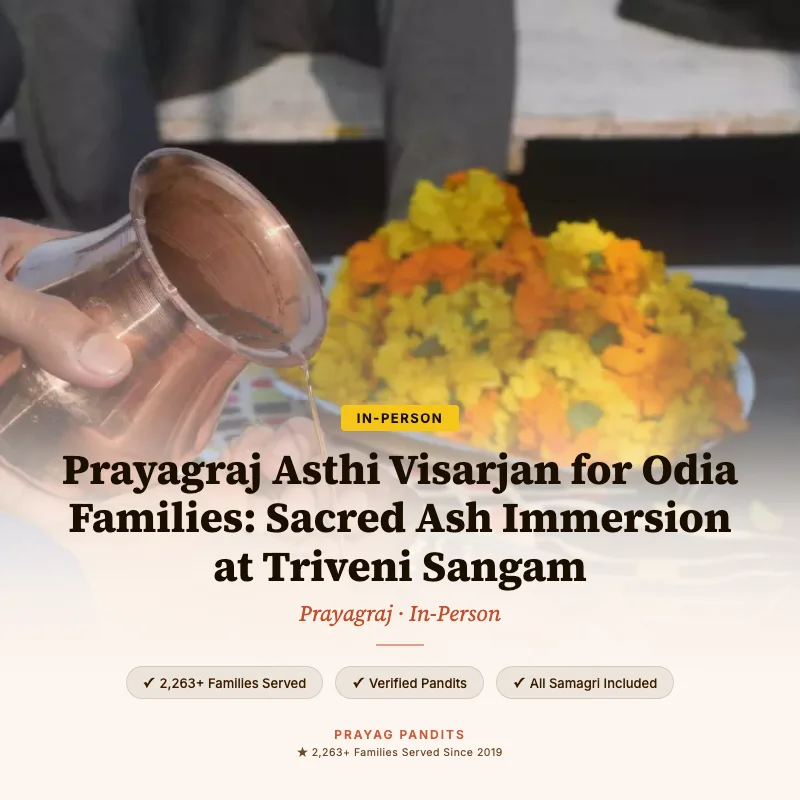
This package for Odia families includes the complete Asthi Visarjan ceremony, all listed ritual materials and the dedicated private boat shown in the booking inclusions. The family travels from the ghat to the Triveni Sangam point with the Pandit Ji and returns after the ceremony.
The Triveni Sangam — where the Ganga, Yamuna, and the unseen Saraswati converge — is described across the Puranas as a tirtha of extraordinary spiritual potency, particularly for post-death rites. Asthi Visarjan performed here, with the proper Vedic mantras and in the presence of a qualified pandit, is believed to give the departing soul the clearest possible path toward peace and liberation. This is why Odia families have been making this journey for generations, and why we consider this service among the most sacred responsibilities we fulfil.
Why Odia Families Trust Prayag Pandits
Travelling from Odisha to Prayagraj for a sacred ceremony requires planning, trust, and a service partner who understands you — not just your booking. What makes this package meaningful for Odia families is not any single feature but the combination of practical support and spiritual correctness that we have refined through many years of serving this community specifically.
The most immediate concern for most families is language. Grief is already heavy enough — the last thing a bereaved family needs is to struggle through ritual instructions in a language they are not fully comfortable with. Our pandit performing Odia Vidhi Ceremony ensures that every element of the Sankalp, Tarpan, and Asthi Visarjan is explained in Odia, that the departed’s name and gotra are recorded correctly, and that family members understand what they are participating in at every stage. When your elders ask a question or express a concern, they are answered in the language they think in.
Beyond language, this package addresses the practical burden of organising a ceremony in an unfamiliar city. All ritual materials — flower garlands, sesame (til), Kusha grass, Gangajal, dhoop, diya, tulsi leaves — are sourced and prepared by us before the ceremony. You do not need to arrive early at a market, negotiate with vendors, or worry whether you have the right items. You arrive at the ghat ready to grieve and pray, and we handle the rest.
The Triveni Sangam itself is the third reason families from Odisha specifically make this journey. Asthi Visarjan can technically be performed at the ocean, at any major river, or at the family’s local riverbank — but the spiritual significance of performing it at the triple confluence, where the waters of three sacred rivers receive the ashes, is considered far greater. The Matsya Purana and Skanda Purana both speak of Prayagraj as a tirtha that multiplies the merit of any sacred act performed there. To learn more about why Triveni Sangam holds this special place in the Hindu geography of liberation, read our guide to Triveni Sangam — the Tirtharaj of India.
The banks of Triveni Sangam are a living place of devotion. Depending on the time of day and the season, you may be surrounded by pilgrims bathing, priests reciting mantras at the water’s edge, or the quiet of an early morning before crowds arrive. We typically recommend scheduling the ceremony at dawn or in the mid-morning — these are the most auspicious timings for Pitru karma (rites for the departed), and the ghat is often more serene at these hours.
When you arrive at the designated ghat with our pandit, the atmosphere is one that many families describe as deeply calming despite their grief. The sound of the Ganga, the sight of the confluence, and the knowledge that countless generations of families have performed this same rite at this same spot — all of it comes together in a way that holds the family gently through a difficult moment.
The pandit begins by establishing the Sankalp — the formal intention statement — naming the departed, their gotra, their relationship to the performing family members, and the occasion. This Sankalp is recited in Sanskrit but explained in Odia so that every family member understands what is being declared. After the Sankalp and the Sangam Poojan, the Tarpan is performed — water and sesame offered to the ancestors with the prescribed mantras. Finally, the mortal remains are immersed in the sacred waters with the liberation mantras that form the culmination of the rite.
From arrival at the ghat through the private boat journey, ceremony and return, the complete service typically takes around two hours. We recommend not rushing. Allow the family time to sit by the river after the immersion — to grieve, to offer silent prayers, to feel the completion of this sacred duty. Our pandit remains with you for as long as the family needs before the day concludes.
To understand the full spiritual context of what Asthi Visarjan means, why it is performed, and what it accomplishes for the soul of the departed, please read our detailed guide to Asthi Visarjan. And to see how Prayagraj compares with other sacred tirthas for this rite, our article on the best places to perform Asthi Visarjan in India provides a comprehensive comparison.
From arrival at the ghat to the closing blessings
Our pandit greets you at the designated ghat and explains the entire ceremony in Odia so every family member understands what will happen and why.
The formal sankalp is taken with the family’s name, gotra, and the ancestor’s name. The elder family member takes a ritual dip at the Sangam ghat to purify before the ceremony begins.
Sangam Poojan is performed with flowers, incense, and ghee lamps. Tarpan water offerings are made with full mantra recitation invoking the ancestors by name.
The sacred ashes are immersed into the Sangam waters with Vedic mantras. The pandit guides the family through the offering, explaining each step in Odia as the ashes join the confluence.
Final prayers are offered. Our pandit provides guidance on any follow-up ceremonies such as Shradh or Tarpan that may be appropriate for the family’s situation.
For families making this journey from Odisha, Prayagraj is well connected by both rail and air. Most families prefer to travel by train, which is comfortable for groups and allows the family to stay together during what is often an emotionally demanding journey. Here is a practical overview of the main routes:
Bhubaneswar to Prayagraj Junction (also known as Allahabad Junction) is one of the most commonly used routes by Odia pilgrims. The journey takes approximately 14 to 17 hours depending on the train. Key trains that serve this route include the Prayagraj Express and various Howrah-Allahabad services. We recommend booking berths in the Sleeper or 3AC class well in advance, particularly around Pitrupaksha (the ancestral fortnight in September-October) and Makar Sankranti, when this route is heavily booked. Prayagraj Junction station is approximately 6 to 8 km from the main Sangam ghats, easily covered by prepaid auto, taxi, or cycle rickshaw.
Cuttack is well connected to Prayagraj via trains through Bhubaneswar, and the journey time is broadly similar. Families from northern Odisha — Rourkela, Sambalpur, Jharsuguda — often travel via Bilaspur or Varanasi depending on the train availability. The Prayagraj Sangam Junction and Naini Junction are the two other railway stations in the city — if your train terminates at one of these, you are still within reasonable reach of the Sangam ghats.
Prayagraj has its own airport (Bamrauli Airport / Prayagraj Airport), and Bhubaneswar’s Biju Patnaik International Airport operates direct or one-stop flights to Prayagraj. Air travel is the fastest option for families with elderly members who cannot manage a long train journey, though it requires advance booking as seats fill up quickly during Pitrupaksha and Kumbh periods. From the airport, the Sangam ghats are approximately 15 km and accessible by taxi.
Prayagraj has accommodation options for all budgets in the Civil Lines area and closer to the Sangam. For families performing Asthi Visarjan, we recommend staying in the Sangam area itself — it is more convenient for the ceremony and also allows the family to spend time by the river before and after. Simple but clean dharamshalas (pilgrim rest houses) are available near the ghats for families who prefer modest accommodation. Our team can suggest specific options when you contact us for booking.
Our qualified pandit has been performing Asthi Visarjan, Pind Daan, and Shradh ceremonies at Prayagraj's Triveni Sangam for eight years. He has served hundreds of Odia families specifically, and his fluency in Odia means that every element of the ceremony — the Sankalp, the Tarpan, the immersion — is explained and performed in the language the family is most comfortable with. Families consistently describe him as patient, thorough, and deeply respectful of the emotional weight of the occasion.
Book Our Pandit for Your Ceremony
We came from Bhubaneswar after losing my father. None of us had been to Prayagraj before and we were worried about how to manage everything in a strange city while already in grief. Our pandit was waiting for us at the ghat. He spoke to my mother in Odia from the first moment — explained every step of the puja, was patient with her questions, and performed the ceremony with so much care. The Sankalp he recited correctly mentioned my father’s full name and gotra without any error. By the time the ashes were immersed in the Sangam, our family felt a true sense of peace. We are so grateful.Our qualified pandit performs the Odia Vidhi Ceremony — enough to explain every step of the ceremony in the language, answer questions from family members, and ensure that elders who are not comfortable with Hindi feel fully at ease. The Sanskrit mantras are recited in Sanskrit (as they must be for ritual correctness), but the explanations, the Sankalp details, and all communication with the family are in Odia. This is not a situation where one team member translates for another — your pandit himself speaks your language.
The traditional guideline is that Asthi Visarjan should be performed within ten days of death, ideally after the Dashagatra Kriya sequence. In practice, however, many families — particularly those who need to travel a significant distance — perform the ceremony weeks or even months after the death. The rite remains spiritually valid regardless of the gap in time, provided it is performed with correct intention, the proper mantras, and the correct ritual sequence. Please inform our pandit of the exact date of death when you book, so the Sankalp can be correctly formulated to acknowledge the period elapsed.
This package includes a dedicated private boat to the Triveni Sangam point, as stated in the booking inclusions. The Pandit Ji accompanies the family for the boat journey and ceremony. Review the visible inclusions and exclusions on this booking page as the controlling service scope.
Asthi Visarjan and Pind Daan are complementary but distinct rites. Asthi Visarjan releases the physical remains of the departed to the sacred waters; Pind Daan (offering of pinda — rice balls — with prescribed mantras) provides spiritual nourishment to the soul in its onward journey. Both are considered important post-death rites in the Vedic tradition, and Prayagraj is an auspicious location for both. Many families perform Asthi Visarjan in Prayagraj and then travel to Gaya — one of the most specifically prescribed locations for Pind Daan — to complete the full rite sequence. Others perform Pind Daan at Prayagraj as well. Our pandit can guide you on the most appropriate sequence based on your family’s tradition and your available time.
Yes. When you contact us after booking, please share your preferred date and we will confirm availability. For auspicious timing, we will also check the Panchang for the selected date and advise whether it is suitable for Pitru karma, or whether an adjacent date would be more auspicious. Certain dates — Amavasya, Purnima, and the Pitrupaksha fortnight — are considered particularly powerful for Asthi Visarjan and tend to book up quickly. We recommend reaching out to us at least a week in advance, and two to three weeks in advance during the Pitrupaksha period (September-October).
These articles will help you understand the rites in more depth and plan your visit to Prayagraj with confidence:
ଆମ ପଣ୍ଡିତ ଶ୍ରୀ ସ୍ୱୟଂ କେଶ ର୍ୱାଣୀ ଧାରାପ୍ରବାହ ଭାବରେ ଓଡ଼ିଆ ଭାଷାରେ କଥା ହୁଅନ୍ତି। ଅସ୍ଥି ବିସ ର୍ଜନ ଙ୍କ ସଂକଳ୍ପ ଠାରୁ ଆରମ୍ଭ କ ରି ଅନ୍ତିମ ମ ନ୍ ତ୍ ର ପ ର୍ ଯ୍ ୟ ନ୍ ତ ପ୍ ର ତ୍ ୟ େ କ ପ ଦ କ୍ ଷ େ ପ ଓ ଡ଼ ି ଆ ଭ ାଷ ାର େ ବ୍ ୟ ାଖ୍ ୟ ା କ ର ାଯ ାଏ। ଉ ତ୍ ଦ ଶ ର ଙ ୍ ଗ ୋ ତ୍ ର ଓ ଡ଼ ି ଆ ଉ ଚ୍ ଚ ାର ଣ ପ ର ମ୍ ପ ର ାର େ ସ ଂ କ ଳ୍ ପ ର େ ଅ ନ୍ ତ ର୍ ଭ ୁ କ୍ ତ ହ ୁ ଏ।
Our qualified pandit performs the Odia Vidhi Ceremony — every step of this ceremony is explained in the language your family is most comfortable with. The Sankalp records the departed’s name and your family’s gotra following the Utkala Brahmin Shraddha Paddhati. For the full context on Odia ancestral customs and how they shape the rites performed at Triveni Sangam, read our Odia Shraddha Paddhati guide.
For the complete range of Pitr Karma services for Odia families at Prayagraj — including Pind Daan and Tarpan — see our Oriya-speaking pandits in Prayagraj page. Families travelling from Odisha may also find our guide to Asthi Visarjan in Odisha helpful when planning which tirthas to include in their pilgrimage circuit.