






अभी तक कोई अनुष्ठान नहीं चुना गया।
पूजा पैकेज देखें →
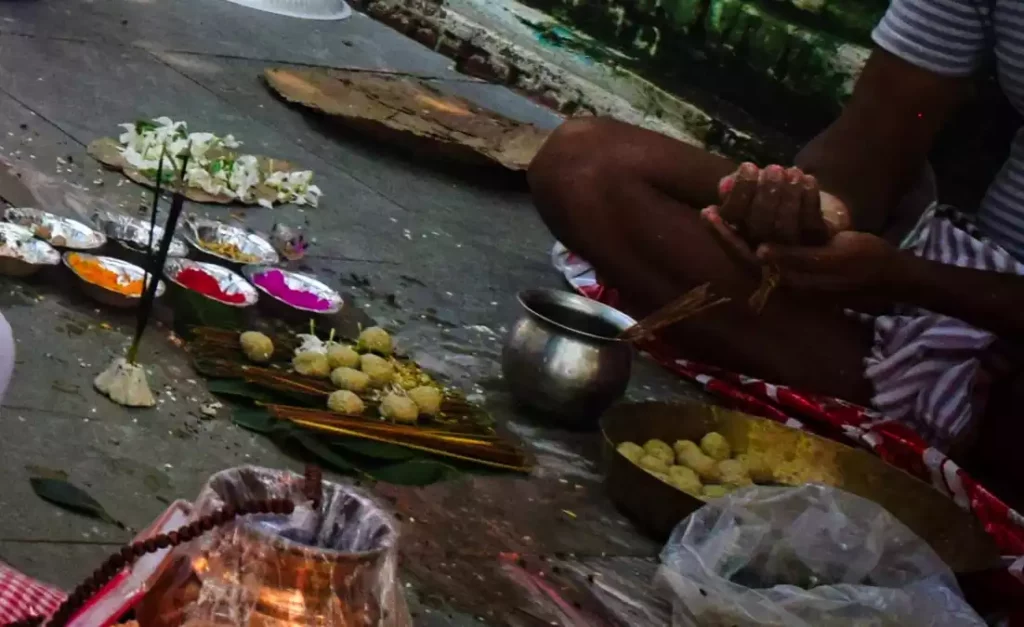





Shradh Poojan in Haridwar Pitrupaksha 2026
₹7,100
₹9,100
22% off
प्रति परिवार · सब शामिल
सत्यापित पंडित
2019 से
सभी सामग्री शामिल
निःशुल्क रद्दीकरण
यह पूजा बुक करें
पहले हमें व्हाट्सएप करें
No hidden charges · Cancel up to 48hrs · GST invoice provided
परिवार हमें क्यों चुनते हैं
यह कैसे काम करता है
1
Book & Confirm Your Date
Select your preferred date and complete the booking. Our team calls you within 2 hours to confirm details.
2
Share Family Details
Provide gotra, departed soul's name, and any requirements. Don't know your gotra? Our pandits will help.
3
Ritual Performed at Sacred Site
A Veda-trained pandit performs the complete ceremony as per shastra at the designated holy teerth.
4
Confirmation & Documentation
Booking confirmation on WhatsApp. Digital documentation available on select poojas within 48 hours.
क्या शामिल है
- Shradh poojan at the bank of River Ganga.
- Priest Charges
- Poojan Material
- Guide support
- Any extra offerings to the priest.
- Any pick and drop charges from the station/airport.
इस अनुष्ठान के बारे में
Shradh Poojan in Haridwar — Pitrupaksha 2026
Some journeys are made for the living. This one is made for those who are gone.
When you travel to Haridwar during Pitrupaksha and stand at the edge of the Ganga to offer sesame and water to your ancestors, something shifts in the way that only physical presence can shift it. You are there. The river is there. The pandit is beside you, guiding you through mantras that have been spoken at this same water for thousands of years. The ceremony is not something happening on your behalf elsewhere — it is happening through your hands, your voice, your body at the ghat. That is a different experience entirely, and it carries a weight that no digital representation can fully replicate.
Prayag Pandits offers this in-person Shradh Poojan at Haridwar's sacred ghats during Pitrupaksha 2026, running from September 26 to October 10, 2026. You travel to Haridwar. Our experienced pandit meets you at the ghat, arranges all materials, and guides you through the complete ceremony — Tarpan, Pind offering, and all accompanying Vedic rituals — so that your ancestors receive the fullest possible offering.
The Tradition of Shradh and Its Purpose
Shradh is among the oldest continuous ritual traditions in Hinduism. It is the practice by which descendants acknowledge and honor departed ancestors — parents, grandparents, and forebears beyond — and provide them with the ritual nourishment that the scriptures describe as sustaining their onward journey.
The Garuda Purana, the Vishnu Purana, and the Manusmriti all dedicate considerable attention to the importance of Shradh. According to these texts, ancestors exist in a subtle realm after death, and during Pitrupaksha — the fifteen days of the waning moon in Bhadrapada — they are granted special access to receive offerings from their descendants. The offerings made during this fortnight reach ancestors directly and provide them with tripti: satisfaction and peace that enables their continued progression toward liberation.
Conversely, the failure to perform Shradh for departed ancestors is said to cause Pitru Dosha — an ancestral imbalance that can manifest in a family as recurring illness, difficulty in marriage or childbearing, financial obstacles, or a general sense that prosperity does not hold. Regular Shradh, performed sincerely, removes this imbalance and restores the natural flow of blessings between generations.
For a comprehensive understanding of Shradh — its types, philosophy, and ritual logic — see our guide: Shradh Karm 101: A Deep Dive into Types, Rituals, Philosophy, and Importance in Hinduism.
Why Haridwar, and Why in Person
Haridwar holds a permanent place in the geography of Hindu sacred space. It is one of the seven Maha Teertha mentioned in the Puranas, and the Ganga that flows past Har Ki Pauri is considered among the most powerful in the world — still carrying the full sanctity of its Himalayan origin as it meets the plains for the first time. The scriptures state that a Shradh performed here earns merit equivalent to a hundred ordinary Shradh ceremonies performed elsewhere.
But beyond what the scriptures say, there is what you feel when you are there.
Haridwar during Pitrupaksha is unlike Haridwar at any other time. The city slows. Families from across the country arrive bearing the weight of their grief and their love in equal measure. At Har Ki Pauri and the surrounding ghats, the air is thick with dhoop smoke, marigold, and the sound of Sanskrit prayers rising over the water. The Ganga is lit in the evenings by the same aarti that has been performed here for centuries — the famous Ganga Aarti at Haridwar, which many families attend after completing their Shradh as a final act of devotion.
Performing Shradh in person means that you are the karta — the one who gives. Your hands hold the sesame and kusha. Your voice joins the mantras. You watch the Pind enter the Ganga with your own eyes. The ancestors are invoked by their names in your presence, and the offering reaches them through your conscious participation. This is what the tradition has always intended, and this is what physical presence makes possible.
The Ceremony — What Happens at the Ghat
Our pandit meets you at the appointed ghat at the scheduled time. All materials are already arranged. The ceremony proceeds in the following order:
- Sankalpa: The ceremony opens with the Sankalpa — a formal declaration of your intention. The pandit helps you state your name, your gotra (family lineage), the names of your ancestors, and the purpose of the ceremony. This connects you formally to the ritual and establishes its sacred frame
- Tarpan: The offering of water mixed with sesame seeds (til), kusha grass, and sacred materials, made while chanting the names of ancestors across three generations — father, grandfather, great-grandfather, and their wives on both the paternal and maternal sides. Tarpan is the primary act of satisfaction for the departed soul
- Pind Preparation and Offering: The Pind — balls of cooked rice or barley, sesame, honey, and ghee — are prepared according to scriptural specification and offered to the ancestors with accompanying mantras. The Pind is the symbolic body of the ancestor during the ceremony, and its offering is the central act of Shradh
- Pitra Stuti and Shradh Mantras: Complete recitation of the ancestral hymns from the Pitru Sukta and Yajurveda, inviting the ancestors, offering them the ceremony, and seeking their blessings in return
The full ceremony takes approximately 60 to 90 minutes.
What to Bring and How to Prepare
Our pandit provides all ritual materials (samagri). However, your own preparation matters and will affect how fully you experience the ceremony.
- Attire: Wear clean, preferably white or light-colored clothing. Avoid synthetic fabrics if possible. For men, a dhoti is traditional but not required. For women, a sari or salwar kameez in white, cream, or light yellow is appropriate
- Observe a partial fast: Many families observe a light fast on the morning of Shradh — eating only once the previous evening and arriving for the ceremony before eating. A sattvic meal (no meat, onion, or garlic) on the day of Shradh is recommended
- Arrive on time: Shradh is ideally performed in the morning hours — this is when the Pitru energy is considered most accessible. Our appointments are typically between 7 a.m. and 11 a.m.
- Know your ancestors' names: The ceremony is much more powerful when ancestors can be named. Bring the names, relationships, and if known, the Tithi of passing for those you are honoring
- Come with an open mind: You need not understand every mantra. The pandit will guide you through each step and explain the significance as you go. Your sincere presence and intention are the essential ingredients
Pitrupaksha 2026 — Dates and Significance
Pitrupaksha 2026 begins on September 26 (Purnima) and concludes on October 10 (Sarva Pitru Amavasya). Each day of the fortnight corresponds to a specific lunar Tithi, and the Shradh for an ancestor is ideally performed on the Tithi that matches the day of their passing in the lunar calendar. If you do not know your ancestor's Tithi, or if multiple ancestors with different Tithis are to be honored, October 10 — Sarva Pitru Amavasya — is the most auspicious choice, as it honors all ancestors simultaneously.
If you are visiting Haridwar specifically for Pitrupaksha, we recommend planning to stay for at least two days. This allows for the ceremony itself, time to experience the Ganga Aarti, and the opportunity to visit the Daksheswara Mahadeva Temple and Mansa Devi Temple, which many pilgrims include in their Haridwar visit.
Who Should Perform In-Person Shradh
- Those who have the ability to travel and wish to honor their ancestors with full physical presence at the sacred ghat
- Families performing Shradh for the first time after a recent loss — the first annual Shradh is considered especially significant
- Those who have received astrological guidance about Pitru Dosha and have been advised to perform Shradh at a Maha Teertha
- Individuals who have made a vow (mannat) to perform Shradh at Haridwar
- Families who wish to make the Pitrupaksha journey an annual tradition at one of Hinduism's holiest cities
- Those who have performed Shradh at home or online in previous years and wish this year to experience the full ceremony at the ghat
Includes and Excludes
What Is Included
- Experienced pandit at the ghat for the duration of the ceremony (60-90 minutes)
- All samagri — sesame seeds, kusha grass, flowers, rice, barley, Pind ingredients, dhoop, deepak
- Complete Tarpan with three-generation ancestral invocation
- Pind offering prepared and offered at the ghat according to scriptural tradition
- Vedic mantras — Pitru Sukta, Yajurveda passages — recited in full
- Pre-ceremony guidance call to confirm ancestor names, Tithi, and schedule
What Is Not Included
- Travel to Haridwar, accommodation, or any transportation costs
- Narayan Bali, Tripindi Shradh, or Nagbali — these are extended rituals for specific ancestral conditions and are booked separately
- Puja for deities beyond the Pitru Karma component of Shradh
Frequently Asked Questions
Can women perform Shradh?
Yes. While the eldest son is traditionally the primary karta for Shradh, daughters, wives, grandsons, and even daughters-in-law can perform Shradh in the absence of a son or when the son is unable to do so. The scriptures are clear that the sincerity of the offering matters more than the gender or precise relationship of the one who offers. Our pandits are experienced in guiding female kartas through the complete ceremony with all appropriate modifications.
What if I do not know my ancestor's gotra or Tithi?
This is common, especially for those performing Shradh for the first time or for ancestors several generations back. If the gotra is unknown, the pandit uses a standard invocation that covers this circumstance. If the Tithi is unknown, the ceremony is performed on Sarva Pitru Amavasya, which the scriptures designate specifically for such cases. The ceremony loses none of its validity in either situation.
How early should I book, and what is the cancellation policy?
Pitrupaksha slots fill quickly, particularly for Sarva Pitru Amavasya. We recommend booking at least three to four weeks in advance. If circumstances require cancellation, please contact us at least seven days before your scheduled ceremony date and we will reschedule your booking or provide a refund according to our policy.
Is it appropriate to attend the Ganga Aarti after the Shradh ceremony?
Absolutely. Many families complete their Shradh in the morning and attend the evening Ganga Aarti at Har Ki Pauri as a joyful conclusion to their day at the ghat. The Aarti is an expression of gratitude and devotion to the Ganga, and attending it after Shradh is considered auspicious — you have given to your ancestors, and now you receive the blessing of the river in return.
Can I perform Shradh for more than one ancestor in a single ceremony?
Yes. A standard Shradh ceremony at Haridwar invokes and honors ancestors across three generations on both the paternal and maternal sides — typically covering six to twelve individuals in a single ceremony. If you have specific individuals beyond this scope for whom you wish Shradh performed, please mention this when booking and the pandit will make the necessary arrangements. Additional Pind offerings for named ancestors can be accommodated within the same session.
परिवार क्या कहते हैं 4.5
आमच्या कुटुंबासाठी हे पूजन करून घेतले. पंडितजी खूप अनुभवी आहेत. धन्यवाद.
Booked this for my mother-in-law's teerth yatra. The arrangements were perfect from pickup to drop. The pandit performed all mantras correctly and with devotion. The poojan materials were all arranged…
We booked this for our grandfather's annual shradh. The ceremony was performed with great reverence. Pandit ji even shared stories from the Garuda Purana which were very enlightening for the…
Thoroughly impressed with the professionalism. The pandit ji was punctual and well prepared with all the samagri.
We had been wanting to perform Pind Daan for years but couldn't travel to India. This online service was a blessing. The entire ritual was done as per shastras. Thank…
Had a wonderful experience. The booking process was easy and the ceremony was conducted with full devotion.
हमने गया जी में पिंडदान करवाया। पंडित जी ने विष्णुपद मंदिर से लेकर फल्गु नदी तक सभी स्थानों पर विधि-विधान से पूजा करवाई। बहुत शांति मिली। Jai Shri Ram.
प्रयाग पंडित्स की सेवा बहुत बढ़िया है। समय पर सब arrangements हो गए। धन्यवाद।
पंडित जी ने बहुत अच्छे से समझाया और पूजा करवाई। परिवार को बहुत शांति मिली।
ప్రయాగ్ పండిట్స్ సేవ అద్భుతంగా ఉంది. మా పూర్వుల కోసం ఈ పూజ చేయించాం. చాలా సంతోషంగా ఉన్నాం.