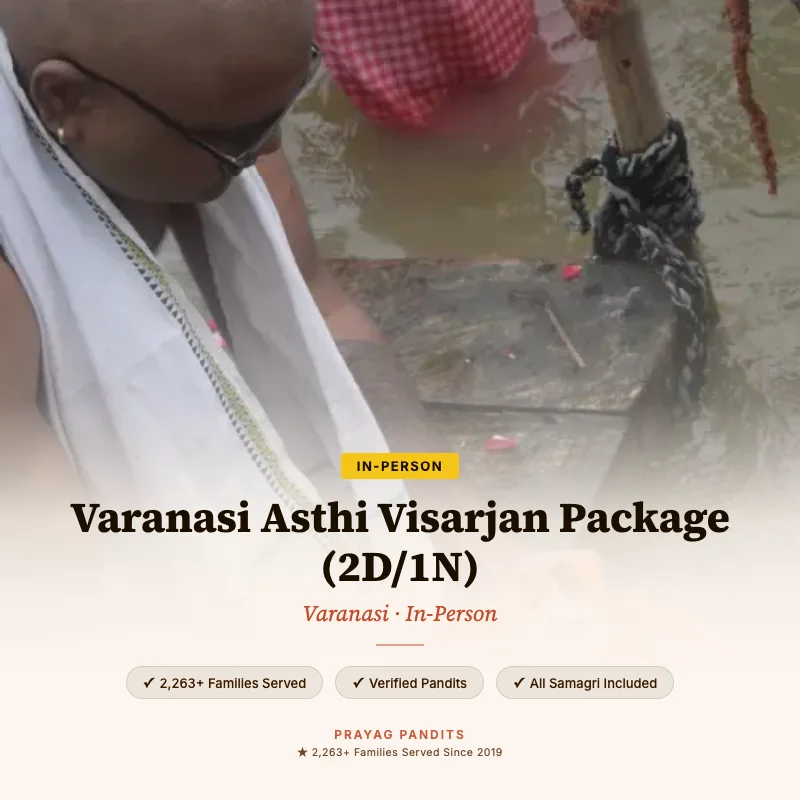


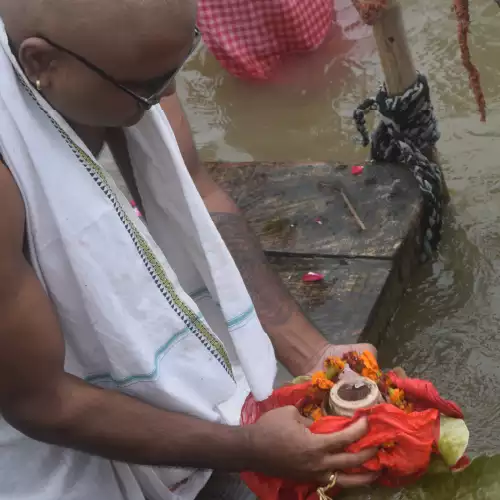


Veda-Trained Pandits
Experienced pandits guide the ceremony with care for your family’s tradition.
Attend in person
Original price was: ₹15,000.00.₹12,500.00Current price is: ₹12,500.00.
Per pooja
Applicable taxes are shown in your booking. Optional additions are separate.
Exclusions
Thoughtfully arranged, personally guided
Experienced pandits guide the ceremony with care for your family’s tradition.
Stay in touch with our team for your booking details and ceremony arrangements.
See what your selected package includes. Optional additions are shown separately.
Share the date and timing that suit you. Our team confirms the final arrangements.
Experiences shared by our families
31 family reviews23 for this pooja · 8 from across our services
Booked online Asthi Visarjan from Canada. The team arranged everything perfectly. We watched the entire ceremony via video call. It was emotional but the pandit’s prayers brought comfort to the whole family.
Booked this service for my uncle’s asthi visarjan. Everything was arranged from our pickup at the station to the ceremony at the ghat. Smooth and hassle-free experience. Jai Shri Ram.
ऑनलाइन अस्थि विसर्जन सेवा बहुत अच्छी है। हम विदेश में रहते हैं और आ नहीं सकते थे। वीडियो कॉल पर सब कुछ देख सके। पंडित जी ने सम्मानपूर्वक सारी विधि पूरी की।
अस्थि विसर्जन कराने के बाद पूरे परिवार को शांति मिली। प्रयाग पंडित्स ने सब कुछ बहुत अच्छे से संभाला। स्टेशन से पिकअप, घाट तक व्यवस्था, और पूजा – सब उत्तम था।
अस्थि विसर्जन कराने के बाद पूरे परिवार को शांति मिली। प्रयाग पंडित्स ने सब कुछ बहुत अच्छे से संभाला। स्टेशन से पिकअप, घाट तक व्यवस्था, और पूजा – सब उत्तम था।
Booked this service for my uncle’s asthi visarjan. Everything was arranged from our pickup at the station to the ceremony at the ghat. Smooth and hassle-free experience.
The Asthi Visarjan service was conducted with dignity and proper Vedic rituals. The pandit explained the spiritual significance of each step. The team also helped with accommodation recommendations.
Booked this service for my uncle’s asthi visarjan. Everything was arranged from our pickup at the station to the ceremony at the ghat. Smooth and hassle-free experience. 🙏
कूरियर से अस्थि भेजने का विकल्प बहुत सुविधाजनक है। टीम ने सब कुछ गोपनीय और सम्मानजनक तरीके से किया। विसर्जन के बाद फोटो और वीडियो भी भेजे। धन्यवाद प्रयाग पंडित्स। Dhanyavaad.
We performed Asthi Visarjan at Varanasi through Prayag Pandits. The ceremony was very peaceful and the pandit was extremely respectful during the entire process. The boat ride to the sangam was well arranged. Dhanyavaad.
अस्थि विसर्जन कराने के बाद पूरे परिवार को शांति मिली। प्रयाग पंडित्स ने सब कुछ बहुत अच्छे से संभाला। स्टेशन से पिकअप, घाट तक व्यवस्था, और पूजा – सब उत्तम था।
Booked this service for my uncle’s asthi visarjan. Everything was arranged from our pickup at the station to the ceremony at the ghat. Smooth and hassle-free experience. Om Shanti.
Booked this service for my uncle’s asthi visarjan. Everything was arranged from our pickup at the station to the ceremony at the ghat. Smooth and hassle-free experience.
Booked this service for my uncle’s asthi visarjan. Everything was arranged from our pickup at the station to the ceremony at the ghat. Smooth and hassle-free experience.
Being abroad makes it difficult to perform these rituals in person. The online asthi visarjan option was perfect for our family. We could participate from three different countries via the video call.
i recommend this
The Varanasi Asthi Visarjan Package from Prayag Pandits was a great help during a difficult time. The arrangements were well-organized, and the priest guided us through the rituals with patience and understanding. The accommodation and transportation were also comfortable. Thank you for making this process easier for our family.
We opted for the Package, and it was a smooth and well-organized experience. The package inclusions were as described, and the team was responsive to our queries. The priest’s presence and guidance throughout the ritual were reassuring. We are thankful for the support provided by Prayag Pandits.
this asthi package from prayagpandits simplified the process for our family. The arrangements, including the hotel stay, transportation, and poojan samagri, were taken care of, allowing us to focus on the rituals and our emotional well-being. The priest’s guidance and the serene boat ride for the asthi immersion brought us a sense of peace.
Excellent tamil pandit. Had issue at hotel, they responded quickly. Trustworthy service provider.
YOUR EXPERIENCE MATTERS
Tell us about your ceremony and the support you received. Your email address will stay private.
From your first choice to your booking
Review your package and any available additions, then add it to your booking.
Enter your contact details, preferred date and time. Add ancestral details if you wish.
Our team confirms the arrangements and shares your coordinator’s details 24 hours before the pooja.
Our team guides you to the designated pooja area and helps you participate in the ceremony.
In the entire geography of Hindu sacred tradition, no city holds the place that Varanasi holds for the rites of the departed. Kashi is not simply a pilgrimage destination. It is, according to the Kashi Khand of the Skanda Purana, the personal domain of Lord Shiva — the city he never abandons, the ground he keeps beneath his trident, the place where death itself becomes liberation. The Skanda Purana states with extraordinary directness: “Kashyam maranam muktih” — death in Kashi is moksha. For the Asthi Visarjan of a beloved family member, this means that the Ganga at Varanasi is not merely one option among many. It is, for millions of Hindu families across India and across the world, the supreme destination.
The ritual of Asthi Visarjan — the immersion of the cremated ashes and bones of the departed in sacred water — forms the final link in the chain of last rites. The Garuda Purana, the principal scriptural text on death and ancestral duties, describes this ceremony as the act that releases the subtle body from its attachment to the physical world and allows the soul to begin its onward journey without burden. When this immersion is performed at the Ganga in Varanasi, at the ghats where Shiva himself is said to whisper the Taraka Mantra into the ears of the dying, the spiritual potency of the act is magnified beyond measure.
Prayag Pandits arranges the complete Varanasi Asthi Visarjan ceremony for families who wish to fulfill this sacred obligation at the holiest city in the world. Our 2-day, 1-night package covers your stay, your ceremony, your pandit, all ritual materials, the Ganga Aarti darshan, and every logistical detail — so your family can be present, present-minded, and entirely focused on the one thing that matters: honouring the soul of your loved one.
50,000+ Families Have Trusted Prayag Pandits for Ancestral Rites
Families sometimes ask us: is Varanasi really different from Haridwar or Prayagraj for Asthi Visarjan? The scriptural answer is nuanced, but it comes down to one extraordinary claim that no other city makes. The Kashi Khand of the Skanda Purana — one of the eighteen Mahapuranas, composed of more than fifteen thousand verses dedicated specifically to Varanasi — declares that Lord Shiva himself resides in Kashi without pause, and that at the moment of death within the city, he personally recites the Taraka Mantra into the ear of the dying soul. This mantra — the bridge mantra, the mantra of crossing — is said to grant instant liberation regardless of the soul’s accumulated karma. No other place carries this specific promise.
For families performing Asthi Visarjan — where the death happened elsewhere but the ashes are brought to Varanasi — the Skanda Purana again provides specific guidance. It states that the Ganga at Varanasi carries a sanctity that cleanses the karma of the departed on contact. The river that flows through Kashi is not the same as the Ganga flowing through Haridwar or Rishikesh in terms of spiritual weight, according to these texts. Varanasi is where the Ganga turns northward — against its own natural direction — as if bowing to the city. This place where the river reverses is called the Uttaravahini Ganga, and the ghats along this northward-flowing stretch are considered the most powerful sites for last rites on earth.
The two ghats where our ceremony is performed — Manikarnika Ghat and Dashashwamedh Ghat — each carry their own profound significance. Manikarnika is the oldest continuously active cremation ghat in the world. The Puranas say that Sati’s earring fell here, making it a Shakti Peetha as well as a cremation site. The fires at Manikarnika are said to have burned without interruption for centuries. Performing Asthi Visarjan in the Ganga adjacent to Manikarnika, where so many souls have already made the crossing, is understood to carry those ashes into the most liberated current in the world. Dashashwamedh Ghat — the ghat of the ten horse sacrifices performed by Brahma himself — is the most vibrant spiritual centre of Varanasi, alive with the evening Ganga Aarti whose flame-lamps are offered to the river every night without fail.
For any family that has carried the ashes of a loved one and felt the weight of that responsibility — the duty to do what is right, to complete what was begun — Varanasi offers something rare: the certainty that here, the offering reaches where it needs to go. To understand more about why Varanasi holds this singular position, read our guide: Why Varanasi Is Called Kashi — The City of Light, Liberation, and Lord Shiva.
How soon after the cremation should Asthi Visarjan be performed?
The Garuda Purana prescribes specific timelines that vary by caste tradition and regional custom. Generally, the ashes should be collected on the 3rd, 7th, or 9th day after cremation and the Asthi Visarjan should ideally happen before the 10th day. However, this timeline is followed primarily for those who can act quickly. If circumstances prevented you from reaching Varanasi within this window — due to travel distance, health, financial constraints, or simply not knowing about the rites — there is no scriptural barrier to performing Asthi Visarjan months or even years later. The soul continues to benefit from rites performed sincerely. Please do not feel that the delay has made the ceremony less valid. It has not. Read our complete guide: Asthi Visarjan Poojan — All You Need to Know.
Can daughters or other female family members perform the Asthi Visarjan?
Traditionally, the eldest son or the chief male mourner performs the rite. However, shastric interpretation has evolved significantly across regional traditions, and daughters, daughters-in-law, grandsons, and other close relatives regularly perform this ceremony. Our pandits have guided ceremonies led by daughters in families where no son is present, and the ritual is conducted with complete Vedic validity. What matters is the sincerity of the offering and the correct Sankalp, not the gender of the performer. Please inform us at the time of booking so the pandit can prepare the appropriate Sankalp wording for your family’s situation.
Which ghat is better — Manikarnika or Dashashwamedh?
Both are considered supremely sacred for Asthi Visarjan at Varanasi. Manikarnika Ghat is the ancient cremation ghat — the place where Sati’s earring is said to have fallen, a Shakti Peetha that has seen an unbroken fire for centuries. Performing Asthi Visarjan in the Ganga directly adjacent to Manikarnika carries an especially deep resonance for families who wish the ceremony to be near the most powerful death-and-liberation site in Varanasi. Dashashwamedh Ghat is the most spiritually vibrant ghat, the site of the nightly Ganga Aarti, and offers easier access for older family members. Our pandit will recommend the appropriate ghat based on your family’s mobility needs, the time of year, and current ghat conditions. Both are entirely valid.
What happens if we do not know our gotra?
Not knowing your gotra is more common than you might think, especially for families who have lived away from their ancestral region for generations, or for NRI families. The pandit handles this with a standard shastric fallback: if the gotra is unknown, the Sankalp is taken in the Kashyap gotra, which is the oldest recorded gotra and is universally accepted as a stand-in when lineage records are unavailable. The ceremony is fully valid. There is no spiritual compromise.
Can we perform Pind Daan at Varanasi in addition to Asthi Visarjan?
Yes, and many families choose to combine both during the same visit. Varanasi is one of the most important Pind Daan tirthas in India, second only to Gaya in the northern tradition. If you wish to add Pind Daan, Tripindi Shradh, or Narayan Bali to your ceremony during the 2-day stay, please mention this at the time of booking so the pandit can prepare accordingly and additional time can be factored into the Day 2 schedule. For the comparative value of different Asthi Visarjan locations across India, read: Best Places to Do Asthi Visarjan in India — A Complete Guide to All 15 Sacred Tirthas.
We understand that this is not a service you are shopping for casually. You are entrusting us with one of the most sacred acts your family will ever perform. We take that trust completely seriously.
Many families find it useful to read more about the spiritual significance of Varanasi and the Asthi Visarjan ceremony before arriving. The following guides have helped thousands of families prepare for this journey.