
No rituals selected yet.
Browse Pooja Packages →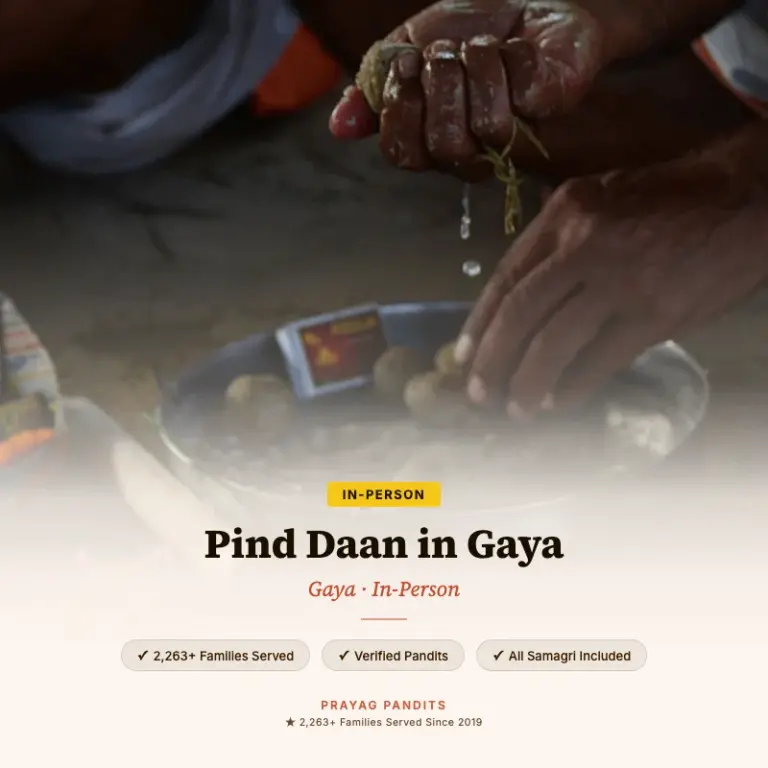 Save 35%
Gaya
Pind Daan in Gaya
Pind Daan at Vishnupad Temple / Phalgu River, Gaya Experienced Gayawal Pandit...
from
₹7,100
₹11,000
Get clear help choosing the right vidhi, package and arrangement before you book.
Share the family situation, preferred date, city, and whether the family will attend in person or remotely. We will help you choose the right next step.
Tell us the family situation and preferred date.
We help identify the suitable vidhi and package.
Book only after the arrangement is clear.
Vishnupad Mandir stands on the bank of the Falgu river in Gaya, Bihar, built over a 40 cm footprint of Lord Vishnu enshrined in solid basalt. The temple as it stands today was rebuilt in 1787 by Queen Ahilya Bai Holkar of Indore in the Nagara style, with an octagonal shrine and a tower rising about 30 metres. The deity is the Vishnu Paduka — the footprint itself, not an image — and it is the reason Gaya is called the final gate of salvation.
The asura Gayasur won a boon that anyone who saw him would attain moksha. So many souls reached liberation that the moral order collapsed, and the gods asked him to lie down so a yajna could be performed on his body. He agreed on one condition: that the place bear his name and that offerings made there reach the ancestors. When he would not stay still, Lord Vishnu pressed his right foot onto Gayasur's head to hold him down. That footprint is what the temple is built over.
From that boon comes the belief that pind daan performed at Gaya releases ancestors from the cycle of rebirth in a way no other tirtha can match. The Vayu Purana devotes its Gaya Mahatmya to it, and the Mahabharata records Lord Rama performing the rites here for Dasharatha.
A Gayawal Panda — the hereditary priestly lineage scripturally authorised at this temple — takes the Sankalp in your name and gotra, and the first pind is offered at the footprint. Tarpan and the remaining offerings follow on the bed of the Falgu, and the rites close at the Akshayavat, the immortal banyan, where the Panda gives the family its blessing. A single day covers these three principal sites; longer arrangements work through the wider circuit of forty-five vedis.
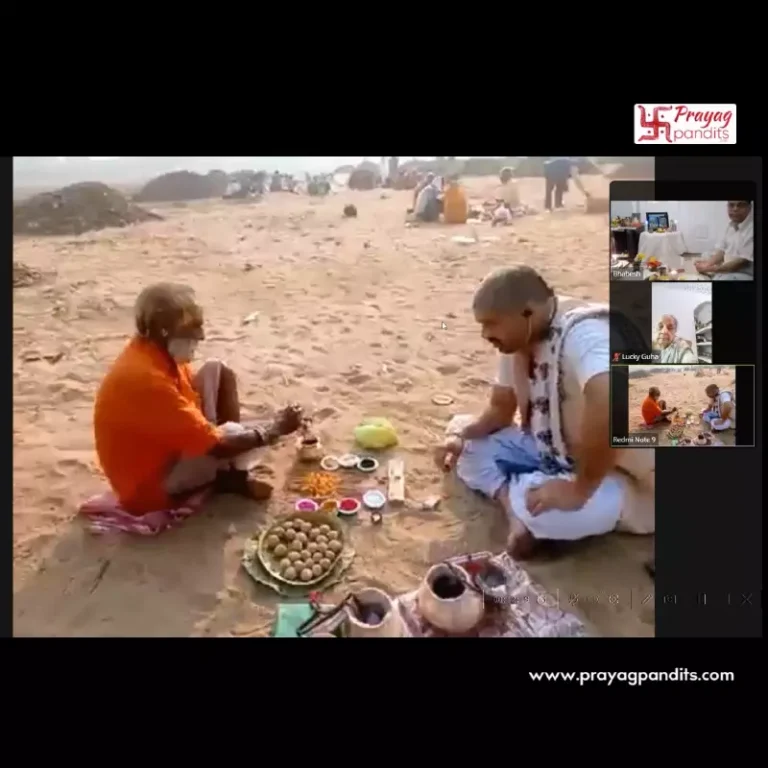
Families who cannot travel can have the same rite performed in full by our purohits at the temple while they join by video call, with the Sankalp taken in their name. The complete Gaya pind daan guide sets out each step and every vedi.
The temple is open from 5 am to 12 noon and again from 3 pm to 9 pm. Ancestral rites are performed in the morning, and the queue is shortest before 7 am. Leather items are left outside, and phones are not permitted in the inner sanctum.
Pitrupaksha, the sixteen-day fortnight of Ashwin Krishna Paksha, is the most auspicious window and by far the most crowded — its dates move each year with the tithi, so ask us and we will confirm them against the panchang. Every Amavasya carries full merit at a fraction of the crush, and the rites are valid through the year because the temple's sanctity is permanent. The death anniversary tithi is always a sound choice. See the shradh and Amavasya dates.
Pind daan at Gaya starts at ₹7,100 performed in person and ₹11,000 performed online on your behalf, with Gau Daan, Brahmin Bhoj and the three-city Prayagraj–Kashi–Gaya circuit available as additions. Nothing further is asked for on the ghat. The cost guide compares what each package covers, and the booking page carries current prices.
Gaya International Airport is 7 km away with direct flights from Delhi, Kolkata, Bangkok and Colombo. Gaya Junction is a major railhead on the Delhi, Mumbai, Kolkata, Chennai and Varanasi routes. By road it is about two and a half hours from Patna and five from Varanasi on NH 83. The temple sits in the old city, a short auto ride from the station.
Select your package and complete booking. Our team calls within 2 hours to confirm details.
Provide your gotra, departed soul's name, and any special requirements.
Experienced pandit performs the complete ceremony at the sacred site.
The family receives ceremony updates on WhatsApp after completion.
Save 35%
Pind Daan at Vishnupad Temple / Phalgu River, Gaya Experienced Gayawal Pandit...
 Save 35%
Complete Pind Daan at Triveni Sangam Shastri-qualified pandit Private boat ride to...
 Save 31%
Pind Daan at Vishnupad Area AND Phalgu Area Dedicated experienced pandit for...
 Save 35%
Pind Daan at Har Ki Pauri, Haridwar Experienced Haridwar-based pandit (Pitrupaksha rites)...
 Save 35%
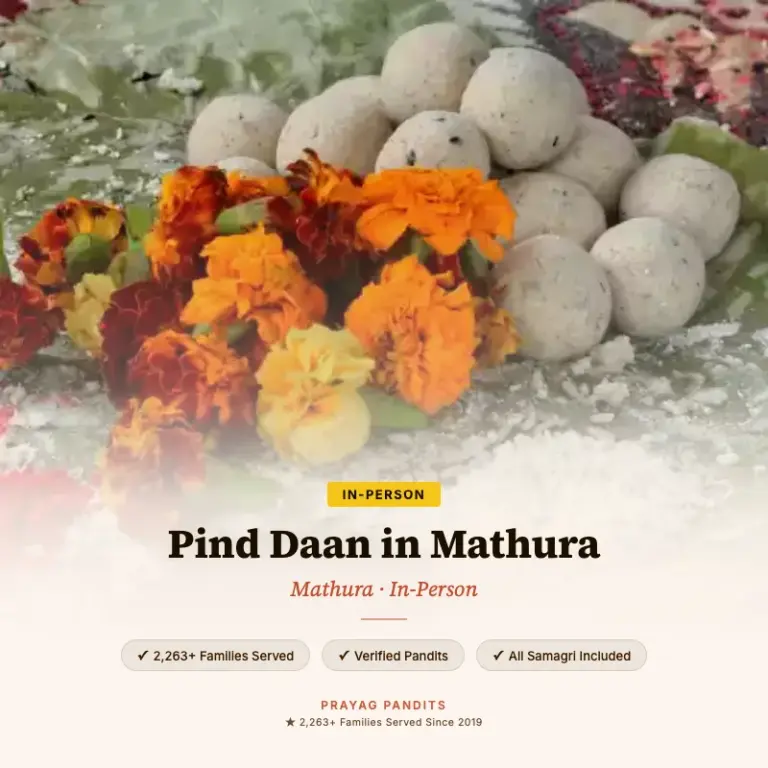
Pind Daan at Vishram Ghat, Mathura Experienced pandit (Mathura tradition) Complete samagri...
 Save 35%
Pind Daan at Brij Ghat, Garh Mukteshwar Experienced Vedic pandit All samagri...
 Save 56%
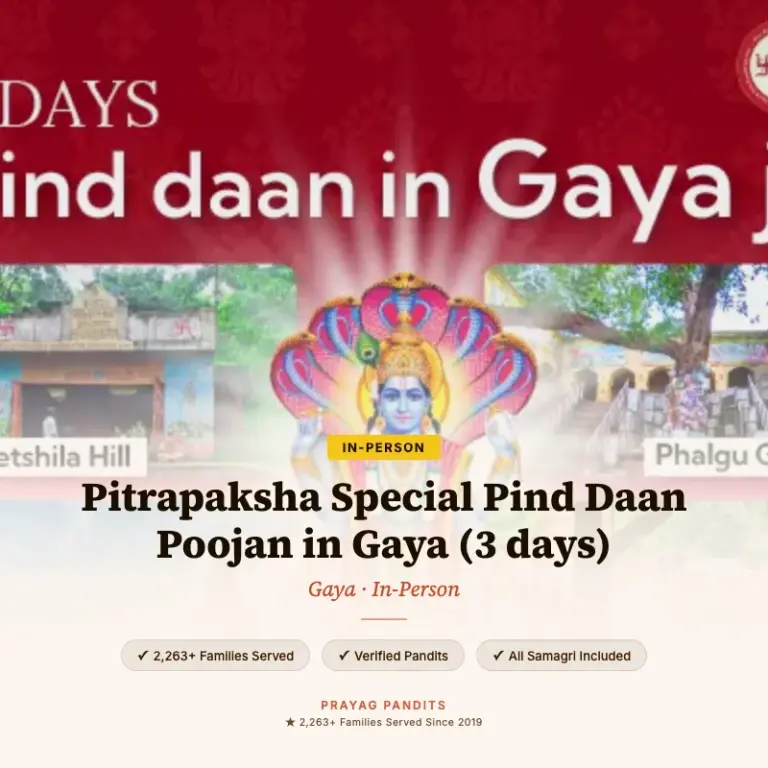
Dedicated Vedic priest for 3 days Complete premium samagri Pind Daan at...
 Save 48%
Online Pind Daan at Vishnupad Area OR Phalgu Area Experienced pandit (Gaya...
 Save 40%
Gau Daan Complete Shradh Pooja with Tarpan at Triveni Sangam (up to...
 Save 35%
Online Pind Daan + Deep Daan at Brij Ghat, Garh Mukteshwar (live...
 Save 40%
Online Pind Daan at Triveni Sangam, Prayagraj (live video) Online Pind Daan...
 Save 40%
Online Pind Daan at Triveni Sangam, Prayagraj Complete Shradh Pooja with Tarpan...
The Akshayavat is the immortal Banyan tree at Gaya that told the truth when all others lied about Mata Sita's Pind Daan. As a reward for its truthfulness, Sita blessed it with immortality and decreed that ancestral offerings performed under its shade would earn immense merit. Today, a Pinda offered at the Akshayavat is believed to provide liberation to the ancestors, and it is one of the most important stops in the Gaya pilgrimage circuit.
The Falgu River is the essential sacred medium for Gaya's ancestral rites. While the Pind Daan sequence includes multiple locations (Vishnupad Temple, Akshayavat, Pretshila Hill, etc.), the ritual bath and Tarpan at the Falgu's banks are the foundational first steps. Omitting the Falgu component diminishes the completeness of the rite. A qualified Gayawal Panda will always guide pilgrims to the river as part of the correct sequence.
According to the Ramayana legend, the Falgu River was cursed by Mata Sita to flow underground because it falsely denied witnessing her performance of Pind Daan for King Dasharatha. Since then, the river flows primarily beneath its sandy bed — an Antahsalila (underground river) — and pilgrims must dig into the sand to access its sacred water for Tarpan and Pinda preparations. Despite this curse, the river remains supremely sacred and indispensable for ancestral rites at Gaya.
Yes. Pind Daan at Gaya can be performed by a qualified proxy pandit on behalf of individuals or families who cannot travel. The ritual efficacy depends on the sincerity and correctness of the ceremony rather than physical presence. Prayag Pandits coordinates such proxy Pind Daan services at Gaya, Prayagraj, and Varanasi with full documentation and live updates provided to the family. Contact us to make arrangements.
Both Gaya and Prayagraj are among the most sacred sites for Pind Daan in Hindu tradition, each with distinct scriptural authority. Gaya is specifically associated with liberation for ancestors through Lord Vishnu's direct presence at Vishnupad, and the Gaya Mahatmya describes it as the foremost Pinda Daan Kshetra. Prayagraj (the Triveni Sangam) is supremely sacred for Tarpan because of the confluence of the Ganga, Yamuna, and Saraswati, and is especially powerful during Pitrupaksha and Mauni Amavasya. Many families perform rites at both locations for the most comprehensive ancestral benefit.
Pind Daan can be performed at Gaya throughout the year, but Pitrupaksha — the 16-day lunar fortnight in Bhadrapada (September-October) — is the most spiritually powerful time. During Pitrupaksha, the boundary between the human world and the ancestral realm is believed to be thinnest, making offerings especially potent. The days of Matru Navami (for maternal ancestors), Ashtami, and Sarva Pitru Amavasya (the final day) are particularly significant.
Gaya is described in Hindu scriptures including the Vayu Purana and Gaya Mahatmya as the supreme Pitrutirtha — the foremost sacred site for ancestral rites. Lord Vishnu's divine footprint is enshrined at the Vishnupad Temple here, and scripture states that Pind Daan performed in Gaya liberates ancestors across fourteen generations on both the paternal and maternal sides. Lord Ram himself is said to have performed Pind Daan in Gaya for his father King Dasharatha, establishing the tradition for all of humanity.
The scriptures — Vayu Purana, Garuda Purana, Valmiki Ramayana, and Mahabharata — all declare Gaya to be the foremost site for ancestral rites. Lord Vishnu himself is present at Gaya as Gadhadhar, and his footprint (Vishnu Pada) is enshrined in the Vishnupada Temple. Lord Rama performed Pind Daan here for King Dasharatha. The very soil of Gaya is believed to be the body of the demon Gayasura, who obtained a boon from Vishnu that all Pind Daan performed here would liberate ancestors completely.
Share the basic details first. We will help identify whether a simple ceremony, remote coordination, or a fuller support package is suitable.