Key Takeaways
- What Is the Vishuddha Chakra? Scriptural and Traditional Origins
- Location, Symbol, and Subtle Body Anatomy
- The Udana Prana: The Life-Force of the Throat Centre
- The Spiritual Significance of Vishuddha: Purification and Vak Siddhi
In This Article
What Is the Vishuddha Chakra? Scriptural and Traditional Origins
The Vishuddha Chakra — often rendered in English as the Throat Chakra — is the fifth of the seven primary energy centres described in the ancient Hindu yogic tradition. The name derives from two Sanskrit roots: vi, meaning “especially” or “intensely,” and shuddhi, meaning “purification.” Together, Vishuddha translates as “especially pure” or “the centre of great purification.”
The systematic description of this chakra appears in foundational texts of the Tantric and yogic traditions. The Shat-Chakra-Nirupana (circa 16th century CE), composed by Purananda Yati and later translated by Sir John Woodroffe as part of The Serpent Power, provides the most authoritative classical account. It describes the Vishuddha as a radiant lotus of sixteen petals situated in the region of the throat, at the juncture between the neck and the chest.
The Shiva Samhita, one of the three classical texts on Hatha Yoga (alongside the Hatha Yoga Pradipika and the Gheranda Samhita), describes the awakening of Vishuddha as the point at which a yogi transcends ordinary mortality and gains access to profound states of awareness. Verse 5.96 speaks of how one who meditates upon this centre attains the knowledge of past, present, and future. The Gorakhsha Shataka, attributed to Guru Gorakhnath of the Nath tradition, similarly identifies the throat centre as the seat of the element Akasha (space or ether) and the gateway to higher states of consciousness.
In the broader Upanishadic tradition, the power of vak — divine speech — is considered one of the most potent of all human faculties. The Taittiriya Upanishad opens with a meditation on speech itself: “Om. May Mitra protect us. May Varuna protect us… May we acquire strength through the study of sacred speech.” The Vishuddha Chakra is the energy centre through which this sacred faculty of divine speech operates.
In the Yoga Sutras of Patanjali, Chapter 3 (Vibhuti Pada) describes how samyama — the combined practice of dharana (concentration), dhyana (meditation), and samadhi (absorption) — performed on the pit of the throat (Sutra 3.30) results in the cessation of hunger and thirst, and (Sutra 3.31) upon the kurma nadi (the subtle energy channel in the throat region) brings extraordinary steadiness. This corresponds directly to the energetic territory of the Vishuddha Chakra.
For deeper context on the full system of which Vishuddha forms a part, read our comprehensive guide: The 7 Chakras of the Human Body.
Location, Symbol, and Subtle Body Anatomy
Vishuddha Chakra is physically located at the base of the throat — at the cervical plexus, corresponding approximately to the fifth cervical vertebra. More precisely, its energetic seat is at the front of the spine in the region of the laryngeal prominence (commonly called the Adam’s apple). In Nadi anatomy, it is a principal convergence point along the central Sushumna Nadi, receiving energies from both the Ida (lunar, feminine) and Pingala (solar, masculine) channels.
The symbol of the Vishuddha Chakra is a circle containing a downward-pointing triangle, enclosed within a sixteen-petalled lotus. Each petal corresponds to one of the sixteen Sanskrit vowels (svaras): A, Aa, I, Ee, U, Oo, Ri, Ree, Lri, Lree, E, Ai, O, Au, Anga, Ah. The sixteen vowels are considered the most sacred sounds in Sanskrit, as they are purely vocal and carry the primal resonance of creation. Together they represent the full spectrum of vibrational potential in the throat centre.
Within the central triangle sits the bija (seed) mantra HAM (sometimes spelled HUM), inscribed in white. The downward-pointing triangle itself represents the element of Akasha — infinite space — the subtlest of the five classical elements (Pancha Mahabhuta). Below the first four elements (earth at Muladhara, water at Svadhisthana, fire at Manipura, air at Anahata), space at Vishuddha represents the medium through which all sound travels and the field from which all elements arise.
Within the circle is depicted a full white moon, symbolising the pure reflective quality of a balanced mind — one that illumines without distortion, like moonlight on still water. The divine animal associated with this chakra is a White Elephant — Airavata, the celestial vehicle of Indra — representing wisdom, memory, and the immense strength that comes from disciplined purity.
The presiding deity is Panchavaktra Shiva — the five-faced form of Shiva — whose five mouths correspond to the five elements and the five primal directions of space. His consort here is Shakini, the feminine divine force of this centre, who holds a noose, a goad, a bow, and arrows — instruments symbolising the power to direct and release energy with precision. Together they represent the perfect marriage of awareness and expression, consciousness and creativity.
The colour of the Vishuddha Chakra is sky blue or turquoise — the colour of the vast, open sky. Just as the sky accommodates all weather yet remains fundamentally unchanged, a developed Vishuddha allows the individual to witness all experiences — joy, sorrow, truth, and challenge — and respond with clarity rather than reaction.
The Udana Prana: The Life-Force of the Throat Centre
In Vedic physiology, the body is sustained not only by physical food and breath but by five forms of prana (vital life force). The Vishuddha Chakra is the seat of Udana Prana — the upward-moving vital force. While Prana (inward breath) nourishes the heart and Apana (downward breath) governs elimination and grounding, Udana functions as the ascending energy that separates consciousness from the body during deep sleep, meditation, and ultimately at the moment of death.
Udana is responsible for the processes of swallowing, speaking, and channelling energy from the lower chakras upward toward the higher centres of consciousness. It governs the quality and power of one’s voice, the ability to express inner states through language, and the spiritual capacity to ascend beyond ordinary waking consciousness. The Chandogya Upanishad (1.3.1–3) addresses the sacred nature of breath and speech as inseparable — speech without breath is silence, and breath without speech is merely wind.
When Udana Prana is functioning well through a clear Vishuddha, the voice carries natural authority and resonance. Singers, teachers, spiritual guides, and orators often show a naturally developed Vishuddha. When this prana is depleted or blocked, speech becomes shallow, hesitant, or dishonest — the individual may struggle to say what they truly mean or feel chronically misunderstood.
The Spiritual Significance of Vishuddha: Purification and Vak Siddhi
The deepest spiritual significance of the Vishuddha Chakra lies in its function as a centre of purification — not just of physical toxins through the breath, but of karmic and psychological impurities that accumulate over lifetimes. The classical texts teach that at the Vishuddha level, the aspirant must “swallow” and alchemically transform all of life’s bitter experiences. The myth of Neelakantha — Lord Shiva holding the Halahala poison in His throat during the churning of the cosmic ocean (Samudra Manthan) — is the supreme metaphor for this function.
When the Devas and Asuras churned the cosmic ocean to extract Amrita (divine nectar), the first thing that arose was Halahala — a poison so devastating it threatened to destroy all of creation. Shiva, in an act of supreme compassion and extraordinary spiritual power, took the poison into His throat and held it there — neither swallowing it (which would destroy Him) nor spitting it out (which would destroy the world). Parvati, in Her love, held His throat with Her hands so the poison would not descend further. This act turned His throat blue — giving Him the name Neelakantha, the Blue-Throated One.
The mystical teaching is this: the Vishuddha Chakra is the centre where we process the poisons of our experience — trauma, grief, harsh words received and given, suppressed truths — and transform them into wisdom rather than passing them downward to corrupt the heart, or upward to cloud the mind. The Throat Chakra is the alchemist’s crucible of the subtle body.
At an advanced level of development, the Vishuddha is associated with Vak Siddhi — the extraordinary capacity for one’s words to come true. The Vedic tradition holds that the highest sages possessed this power: whatever they declared with intention and moral purity would manifest in reality. The famous utterances of the Rishis — the Vedic hymns themselves — carry this quality of vibrational potency. Performing sacred recitation, mantra japa, and Vedic rituals at sacred sites like Triveni Sangam activates this energy at a collective level. Learn more about the spiritual power of sacred pilgrimage: Triveni Sangam — The Land of Moksha.
Connection to Hindu Pilgrimage and Sacred Practices
The Vishuddha Chakra has a direct and profound connection to Hindu pilgrimage traditions. Sacred chanting — the recitation of Vedic mantras, stotras, aartis, and the names of the divine — is fundamentally a practice of awakening and purifying the throat chakra. Every time a devotee chants the Vedic hymns during a sacred ritual, every time a priest intones the Gayatri Mantra at dawn, every time thousands of pilgrims chant Har Har Mahadev while bathing at a holy ghat — the Vishuddha Chakra is being stimulated and cleansed.
The sacred city of Varanasi (Kashi), considered the abode of Shiva Neelakantha, is especially connected to the Vishuddha Chakra. The Ganga Aarti performed nightly at Dashashwamedh Ghat — with its chants, bells, and sacred fire — is a collective activation of this energy centre. Pilgrims who bathe in the Ganges and chant the Vedic mantras are participating in the same purification process that the Vishuddha embodies at the personal level.
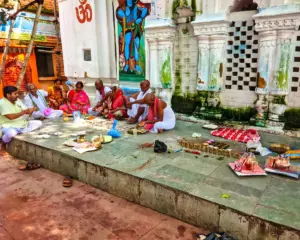
At Prayagraj, the recitation of sacred texts during puja ceremonies performed at the Triveni Sangam is a quintessential Vishuddha practice. The pandits of Prayag are trained in the art of Vedic recitation — their voices carry the accumulated power of disciplined practice across generations. When you book a pandit service for a puja or ancestral rite, you are engaging with this living tradition of sacred sound. Explore our Asthi Visarjan services at Prayagraj and comprehensive Pind Daan guide to understand how sacred rites engage the subtle body.
The Importance of Snan (bathing) in Hindu mythology is also deeply connected: the act of immersion in sacred waters while chanting the appropriate mantras creates a simultaneous purification of the physical and the energetic bodies, with the Vishuddha playing a pivotal role. Read more: The Importance of Snan in Hindu Mythology.
Signs and Symptoms of a Blocked Vishuddha Chakra
The Vishuddha Chakra, when blocked or imbalanced, makes itself felt across multiple dimensions of experience — physical, psychological, relational, and spiritual. Understanding these signs is the first step toward healing.
Physical Symptoms
- Chronic sore throat, laryngitis, or frequent throat infections
- Thyroid imbalances — hypothyroidism or hyperthyroidism
- Stiffness, tension, or pain in the neck and shoulders
- Difficulty swallowing (dysphagia)
- Hoarseness or loss of voice without clear physical cause
- Jaw pain, clenching, or temporomandibular joint (TMJ) disorder
- Tinnitus (ringing in the ears)
- Dental and gum issues
Psychological and Emotional Symptoms
- Difficulty expressing feelings honestly, even when you know what you feel
- Fear of speaking in public or expressing your true opinions
- Habitual dishonesty — telling people what they want to hear rather than the truth
- Feeling chronically misunderstood or unable to articulate your inner world
- Social anxiety related to communication
- Excessive talkativeness or verbal aggression (overactive Vishuddha)
- Creative blocks — especially in writing, singing, or any expressive art
- Inability to listen deeply — talking over others, interrupting
Spiritual Symptoms
- A sense that your prayers and mantras feel empty or mechanical
- Inability to access higher intuition or inner guidance (the voice of conscience feels muffled)
- Difficulty maintaining integrity between inner values and outer actions
- Feeling spiritually inauthentic — performing devotion without genuine connection
Healing and Activating the Vishuddha Chakra: A Complete Sadhana
The path of healing the Vishuddha is fundamentally a path of truth — satya in all its dimensions. The classical yogic texts and the Vedic tradition offer multiple practices, which together form a holistic sadhana (spiritual discipline) for awakening this centre.
1. Mantra Japa: The Power of HAM
The bija mantra of the Vishuddha Chakra is HAM (pronounced “hum” with a slight nasalisation). This single syllable contains within it the vibrational essence of the entire Akasha element and the totality of the throat centre’s energy. The practice of HAM japa is described in detail in various Tantric texts as the most direct way to purify and activate the Vishuddha.
Method: Sit in a meditative posture (Sukhasana or Padmasana) with the spine erect. Bring your awareness to the throat region. With eyes closed and breath relaxed, begin mentally or softly repeating the mantra HAM — synchronising it with the breath. On the inhale, hear “HA” vibrating in the throat; on the exhale, hear “M” dissolving into space. Continue for 11, 21, or 108 repetitions. This practice, done consistently over 40 days, brings noticeable clarity to one’s speech and an increased sensitivity to truth in all situations.
Additional mantras associated with the Vishuddha tradition include the chanting of Om Namah Shivaya — particularly its second syllable “Na” which corresponds to the element of Akasha — and the full rendering of the Shiva Panchakshara Stotra. The recitation of the Saraswati Vandana is also a powerful Vishuddha practice, as Saraswati is the goddess of speech, learning, and arts — the divine expression of the throat chakra’s highest potential.
2. Pranayama: Ujjayi and Brahmari
Ujjayi Pranayama (the Victorious Breath) is the most direct pranayama for the Vishuddha Chakra. It involves a slight constriction of the glottis (the vocal tract) during both inhalation and exhalation, creating a soft, oceanic sound in the throat. This internal sound activates the entire throat region, stimulates the thyroid gland, and creates a profound meditative state. The Hatha Yoga Pradipika (2.51–53) praises Ujjayi as the destroyer of diseases of the throat and lungs.
Brahmari Pranayama (the Humming Bee Breath) directly stimulates the vagus nerve and the resonant cavities of the skull. By closing the eyes, ears, and nose with the fingers (Shanmukhi Mudra) and humming on the exhale, the practitioner creates a powerful vibration throughout the head and throat. The Gheranda Samhita (5.78) recommends this practice for developing a sweet voice and clearing the subtle pathways of the head.
3. Yoga Asanas for the Throat Centre
The classical asanas most effective for stimulating the Vishuddha Chakra are those that create either compression or extension in the throat and neck region.
Sarvangasana (Shoulderstand) — This “queen of asanas” brings a strong chin lock (Jalandhara Bandha) to the throat region, stimulating the thyroid gland and activating the Vishuddha. When held for 3–5 minutes with deep Ujjayi breath, it creates a profound purification of the throat centre. The Hatha Yoga Pradipika (3.78) considers Sarvangasana among the most beneficial of all postures for health and spiritual advancement.
Halasana (Plough Pose) — Performed following Sarvangasana, Halasana deepens the compression at the throat and extends the experience of Jalandhara Bandha. It is particularly effective for releasing chronic tension held in the neck and the unsaid words lodged in the throat.
Matsyasana (Fish Pose) — Often practised as a counterpose to Sarvangasana, Matsyasana does the opposite: it opens and extends the throat. This combination of compression (Sarvangasana) and extension (Matsyasana) is the classic therapeutic approach to Vishuddha healing in Hatha Yoga.
Simhasana (Lion Pose) — Kneeling with hands on thighs, inhale deeply, then exhale forcefully through the mouth with the tongue extended, eyes wide open, gazing at the Ajna point, and producing a loud “HAAAA” sound. This releases blocked energies in the throat, stimulates the cervical plexus, and is a traditional remedy for shyness and communication blocks.
4. Meditation on the Vishuddha
Classical Vishuddha meditation involves visualising the sixteen-petalled blue lotus at the throat, luminous and gently spinning. Within it, see the white circle of the full moon, the downward triangle glowing silver-white, and the white elephant Airavata standing at its centre — its seven trunks raised in blessing. At the heart of the lotus, see the white bija mantra HAM radiating brilliance.
As you hold this visualisation, hear or mentally chant HAM with each breath. Allow yourself to notice any thoughts or feelings that arise about speaking your truth — things you have left unsaid, ways you have not honoured your inner knowing through your outer speech. Compassionately witness these patterns without judgement. With each exhale, release one layer of what no longer serves your authentic expression.
5. The Practice of Truthful Speech: Satya in Daily Life
Of all the practices for the Vishuddha, the most challenging and the most transformative is the daily practice of satya — truthfulness. Patanjali lists satya as the second of the five Yamas (ethical restraints) in the Yoga Sutras (2.36): “Satya-pratishthayam kriya-phalasrayatvam” — “When one is firmly established in truth, the fruits of action rest upon them.”
This is not merely about not lying — it is about aligning every utterance with genuine inner reality. It means speaking kindly but honestly. It means choosing silence when speech would be harmful (another dimension of Vishuddha — the wisdom of not speaking, which is as important as the wisdom of speaking). Traditional teachers suggest keeping a “speech diary” — noting at day’s end any gap between what you said and what you truly felt, meant, or knew. Over time, this practice closes that gap and the Vishuddha naturally opens.
6. Sound Healing and Music
The Indian classical music tradition has understood for millennia that sound directly heals the subtle body. The ragas corresponding to the Vishuddha include Bhairavi (associated with deep emotional expression and surrender), Yaman (clarity and openness), and the morning ragas that support truthful, fresh expression. Listening to these ragas — especially at dawn or dusk, the transitional times — naturally harmonises the throat centre.
Traditional devotional singing — bhajan, kirtan, and Vedic chanting — are among the most effective paths for healing the Vishuddha. When the voice is offered in sincere devotion, the ego steps aside, and the throat becomes a pure instrument of divine expression. This is why the practice of bhajan is so central to Hindu spiritual life — it is at once worship, meditation, and healing of the Vishuddha Chakra.
7. Dietary and Elemental Support
In Ayurveda and the chakra healing tradition, the Vishuddha resonates with the element of space (Akasha). Foods that support this element are those that create clarity and openness rather than heaviness or congestion. Tree-borne fruits (apples, pears, figs, mangoes, coconut) are traditionally associated with the Vishuddha, as trees grow upward into the expanse of sky. Pure, clean water is essential — the throat chakra is highly sensitive to dehydration.
Honey — particularly raw, unprocessed honey — has been used in Ayurvedic tradition for millennia as a throat tonic. It is considered a natural purifier of the vocal tract and a substance that enhances the quality of the voice. Ginger tea, liquorice (Mulethi), and Tulsi (holy basil) — all traditional Ayurvedic herbs — support the physical health of the throat, which in turn supports the energetic health of the Vishuddha.
The Vishuddha Chakra in the Context of the Complete Chakra Journey
The journey through the chakras is a journey from dense, earthly consciousness to the most refined states of spiritual awareness. The Vishuddha represents the fifth major evolutionary step in this ascent — the point at which the aspirant has worked through the survival concerns of the Muladhara, the creative and relational energies of the Svadhisthana, the personal power dynamics of the Manipura, and the love and compassion of the Anahata — and now faces the challenge of authentic expression and purification.
Explore the complete chakra series on Prayag Pandits:
- Muladhara Chakra — The Root Chakra
- Svadhishthana Chakra — The Sacral Chakra
- Manipura Chakra — The Solar Plexus Chakra
- Anahata Chakra — The Heart Chakra
- Ajna Chakra — The Third Eye Chakra
- Sahasrara Chakra — The Crown Chakra
The relationship between Vishuddha and the two adjacent chakras is particularly important. From below, the Anahata (Heart Chakra) sends upward the refined energy of love and compassion — when the heart is full of genuine love, the throat speaks from that love naturally. From above, the Ajna (Third Eye Chakra) sends downward the clarity of inner vision and intuition — when the third eye is open, the throat can speak that vision into reality. The Vishuddha is the bridge and the alchemist between heart and mind, feeling and knowing, love and wisdom.
Awakened Vishuddha: Fruits of the Developed Throat Chakra
The classical texts describe remarkable states that arise with the awakening of the Vishuddha Chakra. The Shat-Chakra-Nirupana states that one who meditates upon the Vishuddha becomes a great sage — eloquent, learned, and long-lived. The Shiva Samhita declares that such a yogi becomes completely free from disease and grief, and gains the power of prophetic speech.
At a practical, psychological level, a well-developed Vishuddha manifests as:
- The capacity to communicate with genuine clarity, warmth, and precision
- The ability to listen as deeply as you speak — true dialogue, not just alternating monologues
- Fearlessness in speaking truth, combined with the wisdom to know when and how to speak it
- Creative expression that flows freely — writing, singing, teaching, or any art that uses the voice or language
- A natural charisma and authority in speech that does not require force or manipulation
- The experience of silence as profoundly restful rather than uncomfortable
- A voice that others naturally find trustworthy and calming
In the spiritual dimension, a fully awakened Vishuddha brings the realisation that sound is the most fundamental creative force in the universe — that the universe itself was spoken into being. This is the teaching of the Vedic Shabda Brahman (sound as ultimate reality) and echoes the biblical “In the beginning was the Word.” When you understand this in your own experience — when your words begin to manifest your reality with increasing fidelity — you have touched the essence of Vishuddha Siddhi.
🙏 Awaken Your Spiritual Journey with Vedic Pandit Services
Affirmations for the Vishuddha Chakra
Affirmations are a simple yet powerful tool for reprogramming the subconscious patterns that block authentic expression. The following affirmations, drawn from the principles of the Vishuddha Chakra, can be repeated morning and evening — ideally while sitting quietly and placing one hand gently on the throat:
- My words carry the power of truth and compassion.
- I speak my truth with ease, grace, and courage.
- I listen deeply — to others and to my own inner voice.
- I express my creativity freely and without fear.
- My voice is a vehicle of divine will.
- I release all that I have left unsaid in fear or shame.
- I am purified in every breath I take and in every word I speak.
- The sacred sound of AUM vibrates in my throat, connecting me to all of creation.
Related Services by Prayag Pandits
- 🙏 Shanti Pooja — Starting from ₹35,000
- 🙏 Online Manglik Dosha Pooja — Starting from ₹11,000
- 🙏 Kaal Sarp Pooja — Starting from ₹11,000
Book Your Sacred Ritual
Authentic ceremonies performed by Veda-trained pandits at sacred sites across India.