



Veda-Trained Pandits
Experienced pandits guide the ceremony with care for your family’s tradition.
Pooja booking
Original price was: ₹10,999.00.₹5,100.00Current price is: ₹5,100.00.
Per pooja
Applicable taxes are shown in your booking. Optional additions are separate.
Exclusions
Thoughtfully arranged, personally guided
Experienced pandits guide the ceremony with care for your family’s tradition.
Stay in touch with our team for your booking details and ceremony arrangements.
See what your selected package includes. Optional additions are shown separately.
Share the date and timing that suit you. Our team confirms the final arrangements.
Experiences shared by our families
27 family reviews19 for this pooja · 8 from across our services
ખૂબ સારી સેવા. પંડિતજીએ બધું વ્યવસ્થિત કર્યું. સંતોષ થયો.
Booked this service for my uncle’s asthi visarjan. Everything was arranged from our pickup at the station to the ceremony at the ghat. Smooth and hassle-free experience. Dhanyavaad.
बहुत ही professional और भक्तिपूर्ण सेवा। सारी सामग्री included थी। Recommend करता हूँ।
We performed Asthi Visarjan at Prayagraj through Prayag Pandits. The ceremony was very peaceful and the pandit was extremely respectful during the entire process. The boat ride to the sangam was well arranged.
We had been carrying the asthi for months not knowing what to do. Prayag Pandits guided us through the entire process from courier to the actual visarjan. Very professional and caring team. Om Shanti.
We had been carrying the asthi for months not knowing what to do. Prayag Pandits guided us through the entire process from courier to the actual visarjan. Very professional and caring team.
हमारे नाना जी के पिंडदान के लिए यह बुक किया था। सब कुछ परंपरागत तरीके से हुआ।
Had a wonderful experience. The booking process was easy and the ceremony was conducted with full devotion.
पहली बार ऑनलाइन बुकिंग की थी, लेकिन अनुभव बहुत अच्छा रहा। पूजा पूरी विधि-विधान से हुई।
The team was very sensitive to our emotions during this difficult time. The pandit performed every ritual with care and explained the significance in simple language. Truly grateful for this service. Om Shanti.
Had a wonderful experience. The booking process was easy and the ceremony was conducted with full devotion.
ऑनलाइन अस्थि विसर्जन सेवा बहुत अच्छी है। हम विदेश में रहते हैं और आ नहीं सकते थे। वीडियो कॉल पर सब कुछ देख सके। पंडित जी ने सम्मानपूर्वक सारी विधि पूरी की।
प्रयाग पंडित्सची सेवा उत्तम आहे. सगळं व्यवस्थित झालं. नक्की पुन्हा बुक करेन.
अस्थि विसर्जन कराने के बाद पूरे परिवार को शांति मिली। प्रयाग पंडित्स ने सब कुछ बहुत अच्छे से संभाला। स्टेशन से पिकअप, घाट तक व्यवस्था, और पूजा – सब उत्तम था। Om Shanti.
Booked this service for my uncle’s asthi visarjan. Everything was arranged from our pickup at the station to the ceremony at the ghat. Smooth and hassle-free experience.
ऑनलाइन अस्थि विसर्जन सेवा बहुत अच्छी है। हम विदेश में रहते हैं और आ नहीं सकते थे। वीडियो कॉल पर सब कुछ देख सके। पंडित जी ने सम्मानपूर्वक सारी विधि पूरी की। 🙏
The team was very sensitive to our emotions during this difficult time. The pandit performed every ritual with care and explained the significance in simple language. Truly grateful for this service.
We performed Asthi Visarjan at Prayagraj through Prayag Pandits. The ceremony was very peaceful and the pandit was extremely respectful during the entire process. The boat ride to the sangam was well arranged. 🙏
Booked this service for my uncle’s asthi visarjan. Everything was arranged from our pickup at the station to the ceremony at the ghat. Smooth and hassle-free experience. Dhanyavaad.
Watching the pandit perform the rituals in real-time by the Falgu River, mentioning my father's name... it felt like we were truly there. Immense gratitude to the entire team.
Being in the USA, travelling to India just for Tarpan during Pitru Paksha was becoming very difficult. Prayag Pandits offered a well-coordinated solution.
I was skeptical about performing such a sacred ritual online from Canada. But honouring my parents in Kashi was important. They were very patient and answered all my questions.
Living in Singapore, we felt disconnected from these essential rituals. The live stream option for Tarpan at Prayagraj gave us a profound sense of connection and peace.
It was deeply important for us in Australia that the rituals were performed correctly. The ceremony reflected the authenticity we sought and was performed by a knowledgeable priest.
The Pind Daan at Kashi was handled carefully, with the pandit following every step diligently. Very reassuring.
Arranging Asthi Visarjan from Bhubaneswar seemed complex, but Prayag Pandits made it seamless. The pandit called us before the ceremony to explain every step. Very professional.
During Pitru Paksha, we booked Shradh at Prayagraj. The coordination was flawless - from date selection to the pandit assignment. Our family felt at peace after the ceremony.
YOUR EXPERIENCE MATTERS
Tell us about your ceremony and the support you received. Your email address will stay private.
From your first choice to your booking
Review your package and any available additions, then add it to your booking.
Enter your contact details, preferred date and time. Add ancestral details if you wish.
Our team confirms the arrangements and shares your coordinator’s details 24 hours before the pooja.
Follow the participation and joining arrangements described in your package and shared by your coordinator.
When a family from Odisha loses someone they love, the weight of duty settles in alongside grief. The tradition is clear: the mortal remains of the departed must be immersed in sacred water, at a place worthy of the soul’s liberation. For generations, Odia families have made this journey to Triveni Sangam at Prayagraj — the confluence of the Ganga, Yamuna, and the unseen Saraswati — because the scriptures they hold sacred name this place above all others as the destination for Asthi Visarjan. The Skanda Purana and the Padma Purana, both deeply revered in the Odia Hindu tradition, speak of Prayagraj in the most elevated terms — as Tirtharaj, the king of pilgrimage sites, and as the tirtha where the immersion of a loved one’s ashes most powerfully supports their liberation from the cycle of rebirth.
This package has been created specifically for families from Odisha — from Bhubaneswar, Cuttack, Rourkela, Sambalpur, Berhampur, Balasore, Puri, Keonjhar, and every district and town across the state. It exists because Odia families deserve more than a generic ceremony where no one in the team speaks their language, where the pandit has no familiarity with the specific customs of Odia households, and where the family is expected to navigate an unfamiliar city while carrying the weight of grief. our qualified pandit leads this ceremony and speaks Odia — a rare capability among pandits at Prayagraj, and one that changes the experience profoundly for families who have never performed this ceremony before.
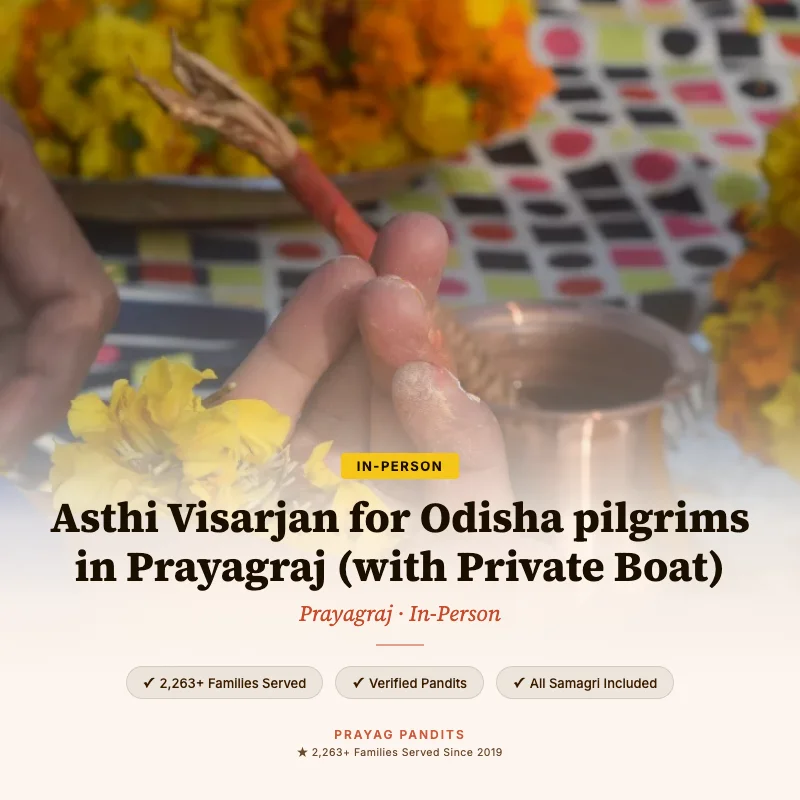
At the heart of this package is a private boat to the exact Triveni Sangam confluence point, an pandit performing Odia Vidhi Ceremony who guides the family step by step through every mantra and every ritual action, and end-to-end care that covers everything from your first question to the final prayers at the Sangam. Nothing is left for your family to arrange. Your duty to your loved one is fully honoured — in your own language, according to your tradition, at the most sacred confluence in all of Hindu scripture.
Why Odia Families Choose Prayag Pandits
The choice of Prayagraj over other sacred tirthas is not incidental — it is rooted in scripture and reinforced by centuries of Odia Hindu tradition. The Skanda Purana, one of the eighteen Mahapuranas most widely studied in Odisha, declares Prayagraj the foremost among all pilgrimage sites. The Padma Purana, another text deeply embedded in Odia religious culture, states explicitly that Asthi Visarjan performed at the Triveni Sangam delivers the soul of the departed to the highest realm. These are not incidental scriptural references — they are the foundation on which generations of Odia families have made this journey.
What makes Triveni Sangam categorically different from any other sacred river? The confluence of three rivers simultaneously — the Ganga, carrying the energy of purification; the Yamuna, carrying the energy of devotion; and the Saraswati, the hidden river carrying the energy of wisdom and liberation — creates a spiritual environment that no single river, however holy, can replicate. The Matsya Purana describes this triple confluence as a gateway through which the soul moves from the bondage of karma into the openness of liberation. When ashes are immersed at this precise point, they are received by all three divine energies at once. The soul’s journey forward is assisted by a force that is qualitatively beyond what any single sacred river, including the Ganga at Haridwar or Varanasi, can offer.
Beyond the scriptural grounding, there is a practical reality that shapes the experience of every Odia family who travels to Prayagraj: the need to be guided by someone who speaks your language and understands your customs. our qualified pandit is one of the few qualified pandits at Prayagraj who performs the Odia Vidhi Ceremony. This matters enormously. When the pandit explains the Sankalp — the formal declaration of intent naming the departed and the gotra — in Odia, the family’s elderly members can confirm the details correctly. When the steps of the ceremony are explained in Odia, every family member understands what is happening and can participate consciously rather than standing at the margins of a ritual being conducted in a language they cannot follow.
The private boat is the second decisive differentiator. At the Triveni Sangam, the sacred confluence point lies in the middle of the river — not at the ghat, but at the exact meeting of the two visible currents. Reaching that point requires a boat. Shared boats carry multiple families simultaneously, which means your ceremony may begin while another family’s ceremony is still in progress, and the personal attention of the pandit is divided. A private boat means your family, your pandit, and your ceremony are the only people at the confluence during your ritual. The moment the ashes enter the water belongs entirely to your family. To read more about the spiritual significance of this sacred place, see our guide: Triveni Sangam — Tirtharaj of Prayagraj.
Many families from Odisha who come to Prayagraj for Asthi Visarjan have never seen the Triveni Sangam before. The ceremony unfolds in unfamiliar surroundings, often on a day already charged with emotion. Understanding what to expect — in precise detail — helps the family arrive with clarity and confidence rather than uncertainty. Here is exactly how the day proceeds.
The ceremony begins at the ghat, typically in the early morning hours between six and nine o’clock, which is the most auspicious window for Pitr Karma at the Sangam. Our qualified pandit meets the family at a designated point and begins with a brief consultation in Odia — reviewing the gotra of the departed, confirming the names of family members performing the primary rite, and explaining the sequence of what will follow. This conversation happens in your language. Elderly family members can ask questions. Nothing proceeds until everyone understands what is about to happen.
The private boat is waiting. The journey to the confluence takes approximately fifteen to twenty minutes. On the water, our pandit begins preparatory prayers. The family can see the meeting point of the rivers as the boat approaches — the visible junction where the green-blue Yamuna current meets the Ganga is one of the genuinely moving sights of the Sangam, and arriving at it by private boat, accompanied by the sound of mantra, is an experience families consistently describe as deeply calming rather than overwhelming.
At the confluence, the ceremony follows a precise sequence, and the pandit explains each step in Odia as it happens. The Sankalp formally declares the purpose of the gathering and names the departed and their gotra. The Tarpan offers water and sesame to the ancestors. The Asthi Visarjan itself — the gentle immersion of the ashes into the waters at the exact meeting of the three rivers — is accompanied by the specific liberation mantras. Flowers are offered on the water. The entire experience at the confluence takes approximately sixty to ninety minutes. The family returns to the ghat with the knowledge that the ritual is complete.
From your first meeting with our pandit to the final prayers at the Sangam
Our qualified pandit meets your family at the ghat or your accommodation. In Odia, he explains the full ceremony sequence, records the gotra and name of the departed, and answers any questions from family members including elders. Everyone understands what is about to happen before a single step of the ritual begins.
Your family boards the private boat — reserved solely for you, with no strangers sharing the space. The pandit begins preparatory prayers during the fifteen-to-twenty-minute journey. As the boat approaches the confluence, the meeting of the Ganga and Yamuna currents becomes visible — a sight that marks your arrival at the most sacred point of the ceremony.
At the exact confluence, the Sankalp is recited — the formal declaration naming the departed, the gotra, and the family members performing the rite. This is conducted in Odia and Sanskrit, so every family member can follow and confirm the details. Tarpan follows: water offerings of Gangajal mixed with sesame and kusha grass, poured into the Sangam in the name of the departed and all ancestors.
The mortal remains are gently released into the confluence waters at the exact meeting point of the three rivers, accompanied by the complete liberation mantra sequence. Flower petals are offered on the water. The Sangam Poojan follows — prayers of gratitude and offering to the Ganga, Yamuna, and Saraswati as receivers of the sacred trust your family has placed in them.
The ceremony concludes with the pandit’s closing prayers — blessings for the departed soul’s onward liberation and for the peace and wellbeing of the living family. Photos of the ceremony are prepared and delivered via WhatsApp for family members who could not travel. Our pandit advises on follow-up observances before departure.
Prayagraj is well connected to all major cities in Odisha by train, which is the most practical way for most families to travel. Understanding the logistics before you leave reduces stress considerably on what is already an emotionally demanding journey.
From Bhubaneswar: The most direct connection is the Puri-Patna Express or the Bhubaneswar-Lucknow Express, both of which stop at Prayagraj Junction (earlier known as Allahabad Junction). Journey time from Bhubaneswar is approximately sixteen to eighteen hours. There are also connections via Bilaspur and Varanasi for families in specific parts of Odisha who find those routes more convenient.
From Cuttack: Trains from Cuttack to Prayagraj typically run via Bhubaneswar or Howrah and take seventeen to nineteen hours. The Shramik Express and the Purulia-Patna Express are commonly used by families from this region.
From Rourkela: The Ispat Express connects Rourkela to Prayagraj in approximately twelve to thirteen hours — one of the faster connections from western Odisha to Prayagraj.
From Sambalpur and Jharsuguda: The Sambalpur-Patna Express and the Hirakhand Express both pass through Prayagraj on their routes north. Travel time from Sambalpur is approximately fourteen hours.
From Puri: The Puri-Haridwar Utkal Express is a well-known route for families from the Puri-Bhubaneswar corridor, reaching Prayagraj in approximately sixteen hours.
By flight: Bhubaneswar’s Biju Patnaik International Airport has connections to Varanasi (BHO), which is approximately 120 km from Prayagraj, or to Lucknow (LKO), which is approximately 190 km. From either city, trains or road transport can bring you to Prayagraj. Prayagraj has its own airport (IXD) but direct flights from Bhubaneswar are limited — check current schedules.
Once in Prayagraj, the nearest railway station to the Sangam area is Prayagraj Junction (also called Allahabad Junction). Our team can provide guidance on accommodation near the Sangam, or for families who wish to complete the ceremony and return the same day, the morning train schedule allows this from Bhubaneswar.
Our qualified pandit has been performing Asthi Visarjan and Pitr Karma rites at the Triveni Sangam for eight years. He performs the Odia Vidhi Ceremony alongside Hindi, Sanskrit, and English — a rare combination among Prayagraj pandits that makes him the first choice for families travelling from Odisha. In over 3,000 ceremonies, he has guided Odia families through every step of the Odia Vidhi Ceremony with cultural sensitivity, ensuring that the ceremony is not merely witnessed but fully understood and consciously participated in by every family member present.
Book With Our Pandit
We had been carrying my mother-in-law’s ashes for almost a year. Travel restrictions and then family circumstances kept delaying the Asthi Visarjan. When we finally came to Prayagraj from Cuttack, we were unsure what to expect. Our pandit met us at the ghat and from the first moment, he spoke to my father-in-law in Odia. The relief on the old man’s face was immediate — he finally understood every word being said, every step being explained. On the boat, at the Sangam, watching the ashes flow into the water while the Pandit recited the mantras and translated them for us — I cannot express what that felt like. We came home knowing we had done right by her.The traditional guidance is within ten days of death, specifically after the completion of Dashagatra Kriya. However, in practice, many families — especially those who need to travel from Odisha or are coordinating large family gatherings — perform Asthi Visarjan weeks or months later. The ritual remains fully valid regardless of the gap, provided it is performed with correct intention and complete procedure. Please share the date of death when booking so the pandit can note it in the Sankalp. For families who have preserved ashes for a long period, Pitrupaksha (the sixteen-day ancestral fortnight, September-October) is an especially auspicious time to perform the rite. For a detailed discussion of timing, read our guide: Asthi Visarjan — All You Need to Know.
Yes. The basic Prayagraj Asthi Visarjan for Odia Families covers the core ceremony — pandit performing Odia Vidhi Ceremony, complete ritual, all samagri — but without the private boat component. In that package, the ceremony is performed at the ghat where the rivers first join, which is scripturally valid. This premium package adds the private boat journey to the exact midpoint confluence — the precise point where the Ganga and Yamuna currents visibly meet and the Saraswati joins — which represents the highest sacred point within the Sangam geography. For families who wish to reach that specific location for the immersion, and who want the exclusive privacy of a ceremony with no other family present, this package is the right choice.
Yes. For Odia families outside India — in the UAE, the UK, the USA, Canada, Australia, or elsewhere — or for families within India who cannot travel, we can perform the ceremony with a live video call via WhatsApp so the family can witness and participate in the Sankalp in real time. Our pandit conducts the ceremony at the Sangam while the family joins remotely. For comparison, see our complete guide to Asthi Visarjan across India and contact us directly to discuss the online ceremony option.
The private boat comfortably accommodates up to eight to ten family members in addition to our pandit and our coordinator. If your family group is larger, please let us know at booking and we will arrange a larger boat or a second boat. Elderly family members are regularly part of these ceremonies — the boat ride is gentle and stable, and our team ensures careful assistance during boarding and disembarking at the ghat. Please inform us at booking if any members have mobility limitations so we can make appropriate arrangements.
Asthi Visarjan can be performed throughout the year at Prayagraj. The most auspicious times are Pitrupaksha (September-October), Amavasya (new moon day every month), Makar Sankranti (January), and Purnima (full moon). For Odia families, Pitrupaksha is particularly significant as the ancestral fortnight devoted specifically to Pitr Karma. During Pitrupaksha, our pandit is highly in demand — we recommend booking at least three to four weeks in advance for this period. For the Triveni Sangam’s detailed spiritual calendar, read our Triveni Sangam guide.
Every ceremony we conduct carries our complete commitment — to the family, to the tradition, and to the sacred trust placed in us at one of life’s most significant moments.
ଆମ ପଣ୍ଡିତ ଶ୍ରୀ ସ୍ୱୟଂ କେଶ ର୍ୱାଣୀ ଧାରାପ୍ରବାହ ଭାବରେ ଓଡ଼ିଆ ଭାଷାରେ କଥା ହୁଅନ୍ତି। ଅସ୍ଥି ବିସର୍ଜନ ଙ୍କ ସଂକଳ୍ପ ଠାରୁ ଆରମ୍ଭ କରି ଅନ୍ତିମ ଲିବ ରେଶନ ମନ୍ତ୍ର ପର୍ଯ୍ୟନ୍ତ ପ୍ରତ୍ୟେକ ପଦକ୍ଷେପ ଓଡ଼ିଆ ଭାଷାରେ ବ୍ୟାଖ୍ୟା କରାଯାଏ। ଉତ୍କଳ ବ୍ରାହ୍ମଣ ଶ୍ରାଦ୍ଧ ପଦ୍ଧତି ଅନୁଯାୟୀ ଆପଣ ଙ୍କ ପ ରିବାରର ଗୋତ୍ର ଓ ଡ଼ିଆ ଉଚ୍ଚାରଣ ପରମ୍ପ ରାରେ ସଂକଳ୍ପ ରେ ଅନ୍ତର୍ଭୁକ୍ତ ହୁଏ।
Our qualified pandit performs the Odia Vidhi Ceremony — one of the genuinely rare capabilities among qualified priests at Prayagraj. Every step of the Asthi Visarjan is explained in Odia: the Sankalp records your family’s gotra in the Odia pronunciation tradition, Tarpan mantras are translated for the family in real time, and elderly members can ask questions and receive answers in their own language. For the full context on Odia ancestral customs and the specific Shraddha traditions of Utkala Brahmin households, read our Odia Shraddha Paddhati guide.
Families from Odisha who are considering performing both Asthi Visarjan and Pind Daan at Prayagraj can find our complete range of Odia Pitr Karma services at our Oriya-speaking pandits in Prayagraj page. If you are researching where Asthi Visarjan is traditionally performed within Odisha before making the journey to Prayagraj, our guide to Asthi Visarjan in Odisha covers all the state’s sacred tirthas and explains why many Odia families choose Prayagraj for the final immersion.