Key Takeaways
- Why Ganga? Why Kashi? The Supreme Sanctity
- The Sacred Procession: Steps of Asthi Visarjan at Varanasi (Kashi)
- The Deep Symbolism and Spiritual Significance
- Considerations for the Modern World
In This Article
Why Ganga? Why Kashi? The Supreme Sanctity
 Before we walk through the steps, let us briefly reaffirm why this confluence is uniquely powerful:
Mother Ganga: The River of Liberation
As scriptures like the Mahabharata and Puranas declare, Ganga is no ordinary river. She flows from the heavens (Swarga), purified by the touch of the highest realms. Her waters possess the inherent power to cleanse sins, purify all that enters them, and grant liberation (Moksha). She is the Tirtha incarnate, the pilgrimage in liquid form. Entrusting the asthi to Her is like placing the soul directly into the hands of a compassionate, divine Mother who guides it towards its ultimate destination.Kashi: Shiva’s City of Moksha
Kashi (Varanasi) is the Avimukta Kshetra, Lord Shiva’s eternal city, imbued with His liberating grace. The entire city is a Mahashmashana, a great cremation ground not just for bodies but for karmic bonds. Performing any final rite here, including Asthi Visarjan, taps into this potent energy of release. The combination of Ganga’s purifying flow and Kashi’s liberating aura creates the most conducive environment for the soul’s peaceful transition. It is believed that asthi immersed in Ganga at Kashi remain there, granting eternal peace, until the final dissolution of the cosmos.The Sacred Procession: Steps of Asthi Visarjan at Varanasi (Kashi)
The process of Asthi Visarjan, while having regional variations, follows a core structure rooted in scripture and tradition, performed with reverence and guided by a qualified priest.Step 1: Asthi Sanchayan – The Collection of Sacred Remains
This crucial first step occurs after the cremation.Timing the Collection
Typically, the asthi are collected on the third day after cremation. However, depending on circumstances and traditions, it might also happen on the 7th, 9th, or sometimes even the day after the cremation if the pyre has cooled sufficiently. Consulting with the family priest or the authorities at the cremation ground is usual.The Ritual of Collection
The chief mourner (usually the eldest son or another designated male relative), often accompanied by other close male family members and the priest, returns to the cremation site.- Purification: The area where the pyre stood is sprinkled with Ganga water or a mixture of milk and water to purify it.
- Separating the Ashes: The ashes are gently sifted. The larger, identifiable bone fragments are carefully collected. Specific bones are often sought, such as fragments from the skull (representing intellect/consciousness), chest/ribs (representing life force/heart), hands and feet (representing action/journey). These vary slightly by tradition but represent the whole person.
- Washing the Asthi: The collected bone fragments are washed with Panchamrita (a mixture of milk, yogurt, ghee, honey, and sugar) or simply milk and Ganga water to purify them further. They are treated with utmost respect.
- Placing in an Urn: The cleaned asthi are placed into a clean container, traditionally an earthen pot (kalash or matka). This pot is then wrapped in a fresh, clean cloth, often white, yellow, or red depending on tradition and the status of the deceased (e.g., red sometimes for a married woman).
Step 2: The Journey to Kashi (If Applicable)
If the cremation took place outside Kashi, the family undertakes the journey to the holy city, carrying the sacred urn containing the asthi with great care and reverence. It is treated as carrying the presence of the departed.Step 3: Arrival in Kashi and Engaging a Priest
Upon arriving in Varanasi, or if the cremation occurred there, the next crucial step is to engage a local priest (Panda or Pandit) who is experienced in conducting the Asthi Visarjan rites according to the specific traditions. (To skip the hassle, one can book their pandit or whole pooja as a package via reputed platforms like ours.)- Finding a Priest: These priests can usually be found near the major ghats associated with rituals, such as Dashashwamedh Ghat, Prayag Ghat, Assi Ghat, or near the cremation ghats themselves (Manikarnika, Harishchandra). Families may have hereditary priests (Purohits) they consult.
- Importance of Guidance: The priest’s role is vital. They know the specific mantras, procedures, auspicious timings (if any are preferred), and the significance of each step, ensuring the ritual is performed correctly for maximum benefit to the departed soul.
Step 4: Preparations at the Ghat
Before proceeding to the river, certain preparations are made, usually guided by the priest.Sankalpa: The Sacred Resolve
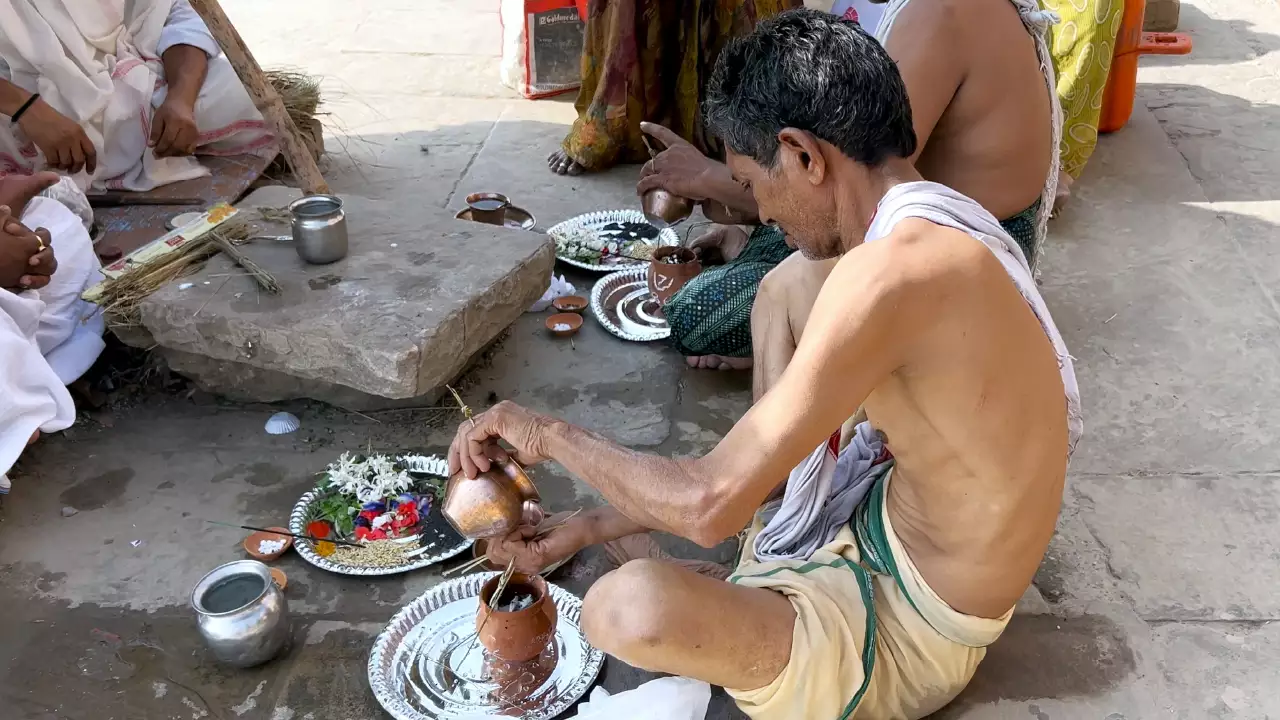
The Karta (the person performing the ritual, typically the chief mourner) sits. The priest guides them in making the Sankalpa. This is a formal declaration of intent, spoken aloud while holding water, rice, flowers, and Kusha grass in the hand. It typically includes:- The current date, time, and place (Kashi, on the banks of the Ganga).
- The Karta’s name and Gotra (lineage).
- The name and Gotra of the deceased relative for whom the rite is being performed.
- The purpose: “For the peace, satisfaction, and onward journey (or liberation) of the departed soul, I am performing this Asthi Visarjan rite in the holy Ganga at Kashi.” This sets the sacred intention for the ritual.
Purification of the Karta
The Karta often takes a purifying dip in the Ganga (Ganga Snan) or sprinkles Ganga water on themselves. They usually wear fresh, clean clothes (often a simple white dhoti).Brief Worship (Pooja)
 A small, brief pooja might be performed on the ghat:
- The urn containing the asthi is placed respectfully on a clean cloth or banana leaf.
- Offerings like flowers (often white), sandalwood paste (chandan), tulsi leaves, incense (dhoop), and a lamp (diya) may be offered to the asthi, treating them as a representation of the departed.
- Prayers might be offered to Lord Ganesha (remover of obstacles), Lord Vishnu (preserver, associated with Pitrus), Lord Shiva (presiding deity of Kashi), and Ganga Mata herself.
Step 5: Proceeding into the Ganga
This is the core part of the Visarjan.Hiring a Boat
Often, the Karta, close family members, and the priest hire a boatman (included in the package if booked online) to take them a short distance away from the ghat, towards the middle of the river stream. This is considered more potent as the current is stronger and the water deeper and purer away from the immediate bank.Mantras and Prayers in the Boat
As the boat moves towards the chosen spot, the priest typically chants Vedic hymns or specific mantras related to the Pitrus, Ganga, and liberation, creating a sacred atmosphere. The family members may engage in silent prayers or remembrance.Step 6: The Sacred Immersion (Visarjan)
 Once the boat reaches a suitable spot in the river, the final act takes place.
Final Offerings and Prayers
The priest may guide the Karta in offering some final prayers or sprinkling Ganga water on the urn.The Immersion Act
Guided by the priest who recites the appropriate mantras at the precise moment, the Karta performs the immersion. There are variations:- Sometimes the entire urn, with the asthi sealed inside, is gently released into the water.
- Sometimes the cloth is opened, and the asthi fragments are respectfully poured from the urn directly into the Ganga’s flow. The empty urn might then also be immersed or disposed of respectfully later. The method often depends on family tradition and the priest’s guidance. The act is performed with reverence, often facing south (direction of Pitrus).
Mantras during Immersion
Mantras chanted often invoke Ganga, requesting her to accept the asthi and grant peace to the soul. Prayers are offered for the soul’s liberation or smooth passage to Pitru Loka. For example, prayers might ask Ganga to carry the soul to Vishnu Loka or Shiva Loka.Offering Tarpan
Immediately following the immersion, the Karta may offer Tarpan – libations of Ganga water mixed with black sesame seeds – calling upon the departed ancestor by name and Gotra, saying “Triptayatam” (May you be satisfied). This provides further spiritual nourishment.Step 7: Returning and Concluding Rites
After the immersion, the boat returns to the ghat.Final Bath or Sprinkling
The Karta might take another purifying dip in the Ganga or sprinkle themselves with Ganga water.Dakshina to the Priest
The Karta offers Dakshina (included if booked a package online) to the priest for his services, along with perhaps some offerings like grains or cloth, as a mark of respect and gratitude, completing the ritual exchange.Departure
The family then departs, carrying the peace of having fulfilled this sacred duty in the holiest of places. Often, there’s a feeling of closure and relief, trusting that the departed soul is now under the care of Ganga Mata and Mahadev in Kashi.The Deep Symbolism and Spiritual Significance
 Performing Asthi Visarjan in Ganga at Kashi is rich with meaning:
Returning to the Source
Water is the source of life. Immersing the final physical remnants in the Ganga symbolizes the return of the bodily elements to the cosmic source, dissolving the individual form back into the universal whole.Ultimate Purification
Ganga’s sacred waters are believed to wash away any residual negative karmic imprints or subtle impurities associated with the departed soul and the process of death, facilitating a purer transition.Vehicle for the Soul’s Journey
Ganga is seen as a divine conduit. She lovingly carries the essence of the departed soul towards higher realms – Pitru Loka, Swarga, or even facilitates Moksha, especially when done in Kashi under Shiva’s grace.Severing Earthly Attachments
The final release of the physical remnants into the flowing river helps both the departed soul and the grieving family to relinquish attachments to the physical form, aiding emotional and spiritual closure.Completing the Antyeshti Samskara
This rite marks the formal completion of the funeral ceremonies, ensuring that all duties towards the departed have been fulfilled according to Dharma. This brings peace of mind to the living and satisfaction to the ancestors.Receiving Blessings
Properly performing this rite pleases the Pitrus, who in turn bestow blessings upon their descendants for their well-being, prosperity, and spiritual progress.Considerations for the Modern World
Following things should be taken care of:- Respect the Environment: While tradition is paramount, be mindful of pollution. Use biodegradable materials where possible (like earthen pots). Priests are increasingly aware of this.
- Emotional Preparedness: This is an emotionally charged ritual. Allow space for grief and remembrance alongside the performance of the rites.
- Trust the Process: Have faith (Shraddha) in the ritual, the power of Ganga, the sanctity of Kashi, and the grace of the Divine. This faith itself enhances the efficacy of the rite.
Conclusion: Finding Peace in the Eternal Flow
The immersion of asthi in the holy Ganga at Varanasi is the final act of selfless service and love we can perform for those who have passed from this world. It is a ritual steeped in millennia of faith, guided by sacred texts, and performed in a location where the veil between the earthly and the divine is exceptionally thin. By entrusting the last physical traces of our loved ones to the purifying embrace of Ganga Mata in the liberating city of Lord Shiva, we fulfill our sacred duty, ensuring their peaceful onward journey and invoking their blessings upon us. It is a profound gesture that brings closure, peace, and reinforces the eternal connection that transcends even death itself.May the souls of all ancestors find peace and liberation. Om Shanti, Shanti, Shanti.🙏 Book Asthi Visarjan Package
Best Time and Cost for Asthi Visarjan in Varanasi
Asthi Visarjan can be performed at Varanasi any day of the year during daylight hours. The most auspicious periods include Pitrupaksha (September-October), Amavasya (new moon days each month), and the ancestor’s death anniversary tithi. Basic Asthi Visarjan at Manikarnika Ghat starts at Rs 5,100; standard package with private boat Rs 10,599; premium 2-day including Pind Daan Rs 12,500. Book now.
What to Do After Completing Asthi Visarjan
After immersion: take a purifying Ganga bath, change to fresh clothes, perform Tarpan (water offering) for the departed, seek blessings at Kashi Vishwanath Temple, and maintain a sattvic diet for the remainder of the day. Families should continue with annual Shraddha during Pitrupaksha and regular Tarpan on Amavasya dates.
Book Your Sacred Ritual
Authentic ceremonies performed by Veda-trained pandits at sacred sites across India.