Key Takeaways
- Who performs the rites
- Neel Vrish Shraddha — the rite made for this
- What changes in the ritual itself
- The two days that cover everyone
In This Article
Nothing breaks. A person who died unmarried, or married but without children, is owed the same rites as anyone else, and the tradition names who performs them: the brother first, then the nephew, then the wider kin, and a sister or daughter where that is who is there. There is also a rite made specifically for this situation — Neel Vrish Shraddha, in which one pinda is set aside for exactly these souls — and it is the part most families have never heard of.
Who performs the rites
When someone dies without direct descendants the duty shifts outward through the lineage rather than lapsing. The closest available and willing relative performs it.
| Who | Order | When it falls to them |
|---|---|---|
| Brother | 1st | The primary substitute. Same parents, same lineage — usually the brother closest in age or in circumstance |
| Nephew (brother’s son) | 2nd | Where there is no brother, or the brother cannot perform it. He carries that branch forward |
| Father | Special case | Where a father outlives an unmarried or childless son. Against the natural order and hard to do, but permitted and sometimes necessary |
| Sister, or daughter | 3rd | A sister performs for a brother; a daughter, including an adopted or informally raised one, for a childless couple. Not a lesser offering |
| Paternal uncles and cousins | 4th | The sapinda circle, seven generations, and then the samanodaka circle at fourteen. Closest relation first |
| Maternal uncle, or his son | 5th | Where no paternal relative remains. The paternal line takes precedence, but the maternal line is not excluded |
| A purohit | Last | Where no relative survives or none is able. A ritwik performs it on the family’s behalf and the rite is complete |
On the sister and the daughter: our position is not that they step in reluctantly when no man is available. A daughter may perform pind daan, married or unmarried, and whether or not there are brothers — the Garuda Purana permits daughters, daughters-in-law and granddaughters, the Vishnu Smriti permits a daughter where no son is present, and the tradition’s best-known performance of this rite at Gaya is Sita’s. The same reasoning covers a sister performing for a brother. The full order is in who can perform pind daan.
The rites themselves do not change with the ancestor’s gender. An unmarried woman receives the same sequence as an unmarried man, performed by the same order of relatives.
Neel Vrish Shraddha — the rite made for this
This is the part worth knowing, and almost no family arrives already aware of it. The scriptures do not leave these souls to be caught incidentally by someone else’s shradh. They provide a named ceremony for them.
During Vrishotsarga — the release of a consecrated bull, which the Garuda Purana treats as necessary for lifting a soul out of the ghost state — a ceremony called Neel Vrish Shraddha is performed. The performer, ordinarily the brother, the nephew or the nearest eligible relative, prepares twenty-eight pindas of barley flour, sesame and sugar. One of them, the neel pinda, is dedicated specifically to ancestors who died without a wife and without children.
There is a second provision alongside it. During ordinary tarpan the performer also offers general satisfaction mantras — tripti mantras — using the gopuchchodak hand position, directed at any ancestor in the line who has lost their rites or died without wife and sons. Between the two, the tradition builds a deliberate safety net. The fuller answer is in what Neel Vrish Shraddha is, and the hand positions are in the tarpan vidhi.
What changes in the ritual itself
Less than families expect. The procedure is the ordinary pind daan vidhi — the same ten steps, the same samagri, the same mantras. Two things are handled differently.
The sankalpa is more specific. The declaration names the ancestor, their gotra, and their situation in terms — “for my unmarried brother”, “for my childless paternal uncle” — rather than leaving them to be covered by a general ancestral formula. This matters because the offering is being made by someone who is not the natural performer, and the sankalpa is what establishes the connection.
The offering is singular rather than collective. The focus stays on one soul, on the ekoddishta principle, instead of addressing three generations together as a parvana shradh does. Where there is reason to think the soul is unsettled — an unnatural death, or rites missed for years — tripindi shradh is the rite that applies, and a pandit will say whether it does.
The two days that cover everyone
Pitru Paksha matters more here than for any other kind of ancestor, because an ancestor with no descendants has nobody keeping an annual tithi for them. The fortnight’s offerings are made to sarva pitru, all the ancestors, and that includes the ones nobody is individually remembering.
Sarva Pitru Amavasya, the last day, is the one to use. It is designated for every ancestor whose death tithi is unknown, who died unnaturally, or who died unmarried or childless — the three categories that otherwise fall through. If you do nothing else in the year for such a relative, do tarpan on that day. This year it falls on 10 October 2026; the full calendar is on the shradh dates page, and the fortnight itself is covered in the Pitru Paksha guide.
Where it carries the most weight
Pind daan can be performed at home, and for most ancestors that is enough alongside the annual tithi. For someone with no descendants keeping that tithi, a tirtha does more work, because the offering is not being repeated every year by anyone.
- Gaya — the pre-eminent site, and the one to choose if you will make only one journey. Offerings here are held to reach generations rather than one named ancestor, which is precisely the value for a soul nobody is keeping an annual rite for.
- Brahma Kapal at Badrinath — on the Alaknanda beside the temple, and the tradition holds the rite need not be repeated after it.
- Prayagraj — at the Sangam, and the most reachable of the three by rail and air.
- Siddhpur in Gujarat, called Matru Gaya, which some traditions associate specifically with rites for those who died unmarried or childless. We do not perform there, but it is worth knowing it exists.
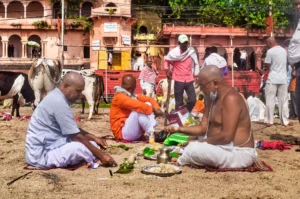
🙏 Pind Daan at the Triveni Sangam
- Performed by a brother, sister, nephew, daughter — or by our pandit on the family’s behalf
- Sankalpa composed for the exact relationship and circumstance, agreed before the day
- All samagri, ghat booking and dakshina included — nothing added on the day
- Also at Gaya and Varanasi, and online with a live video link
Performing your own rites, while alive
People ask us this about themselves, not only about relatives, and it deserves a straight answer: yes, you can. The Garuda Purana describes jeeva shradh, a person performing their own shradh during their lifetime, and it is offered precisely for those who are childless or who have reason to think nobody will perform the rites afterwards.
It is not a morbid thing to arrange and we do not treat it as one. People come to it in their seventies, often after a sibling has died and the family has thinned out, and they describe the same relief afterwards that families describe after a pind daan for someone else. The detail is in whether you can perform pind daan for yourself.
Why any of this is owed at all
The idea underneath every page on this site is pitru rina — the debt to the ancestors, one of the three debts the Dharmashastra holds a person is born carrying, alongside the debt to the gods and the debt to the sages. It is discharged by continuing the line and by performing the rites for those who came before.
Read narrowly, that framing is what causes the anxiety this page exists to answer: if the debt is discharged through descendants, what happens to someone who has none? The tradition’s own answer is the one set out above, and it is not grudging. The duty runs to the kutumba, the wider family, not to the son alone. The collective days exist for ancestors nobody is individually remembering. There is a named rite with a pinda reserved for them. And a person without descendants can perform their own.
Where a family has gone generations without performing any of this, the question sometimes raised is pitra dosh. A pandit will tell you honestly whether that applies to your situation, or whether what is actually needed is simply the shradh that nobody got round to.
Book Your Sacred Ritual
Authentic ceremonies performed by Veda-trained pandits at sacred sites across India.