925

Kaal Sarp Dosh Puja Trimbakeshwar: Vidhi, Cost & Booking 2026

Acharya Vishwanath Shastri · 25 min read
Key Takeaways
    In This Article

    Kaal Sarp Dosh Puja at Trimbakeshwar — Key Facts

    TempleTrimbakeshwar Jyotirlinga, Nashik district, Maharashtra
    Jyotirlinga Rank9th of 12 — the only three-faced Jyotirlinga (Brahma, Vishnu, Shiva)
    Puja Duration4–6 hours (full vidhi with havan and Rudrabhishek)
    Cost at TrimbakeshwarRs. 6,500 – Rs. 11,000 (depending on scope of rituals)
    Most Powerful Date 2026Nag Panchami — August 17, 2026
    Sacred Water BodyKushavarta Kund — source of Godavari River

    If all seven planets in your birth chart are trapped between Rahu and Ketu, Vedic astrology calls this Kaal Sarp Dosh — a planetary alignment that Puranic texts describe as creating repeated obstacles in career, health, relationships, and spiritual progress. Of all the places in India where this dosha is addressed through puja, Trimbakeshwar in Maharashtra holds a singular authority.

    This guide covers everything you need to know about performing Kaal Sarp Dosh Puja at Trimbakeshwar in 2026 — from the step-by-step Vedic vidhi and the specific mantras chanted at each stage, to realistic cost expectations, muhurat dates, and how to distinguish trustworthy pandits from the touts who operate near the temple gates. If you are considering this puja — whether you plan to travel to Trimbakeshwar or are exploring alternatives at Prayagraj or Haridwar — read this fully before booking.

    For a complete understanding of what Kaal Sarp Dosh is, its 12 types based on Rahu’s house position, and all available remedies, see our Kaal Sarp Dosh complete guide first.

    Why Trimbakeshwar for Kaal Sarp Dosh Puja?

    The connection between Trimbakeshwar and Kaal Sarp Dosh puja is not incidental — it is grounded in specific scriptural and geographic conditions that make this temple uniquely suited for Navagraha and serpent-related affliction remedies.

    The Skanda Purana’s Brahma Khanda describes Trimbakeshwar as one of the foremost kshetras for removing serpent curses (Sarpa Dosha) and planetary imbalances arising from Rahu and Ketu. The Puranic logic is straightforward: Kaal Sarp Dosh is essentially a Rahu-Ketu imbalance, and Trimbakeshwar’s Shiva is specifically propitiated here in His role as the master of serpents — the deity who wears the Nag as an ornament (Nagabharana) and who thus has complete authority over serpentine afflictions.

    The Padma Purana’s Uttara Khanda goes further, designating Trimbakeshwar as one of a handful of places where Sarpa Dosha Nivarana — the removal of snake-related ancestral curses — can be performed with full scriptural validity. Since Kaal Sarp Dosh shares its remedy architecture with Sarpa Dosha (both involve appeasing Nag Devata and performing Rahu-Ketu Shanti), this scriptural basis carries direct relevance.

    There is also a geographic dimension. Trimbakeshwar is the source of the Godavari River, India’s second-longest river, which the Skanda Purana calls “Ganga of the South” (Dakshin Ganga). The Kushavarta Kund at the temple complex is considered the actual origin point of the Godavari. Puranic texts consistently assign the highest ritual power to puja performed at river sources — places where sacred water emerges from the earth are considered to carry maximum potency for cleansing karmic afflictions.

    Finally, the three-faced nature of the Jyotirlinga itself — representing Brahma, Vishnu, and Shiva simultaneously — means that puja here receives the combined blessing of the Trimurti, which traditional texts describe as creating a condition for complete resolution of planetary karma rather than partial mitigation.

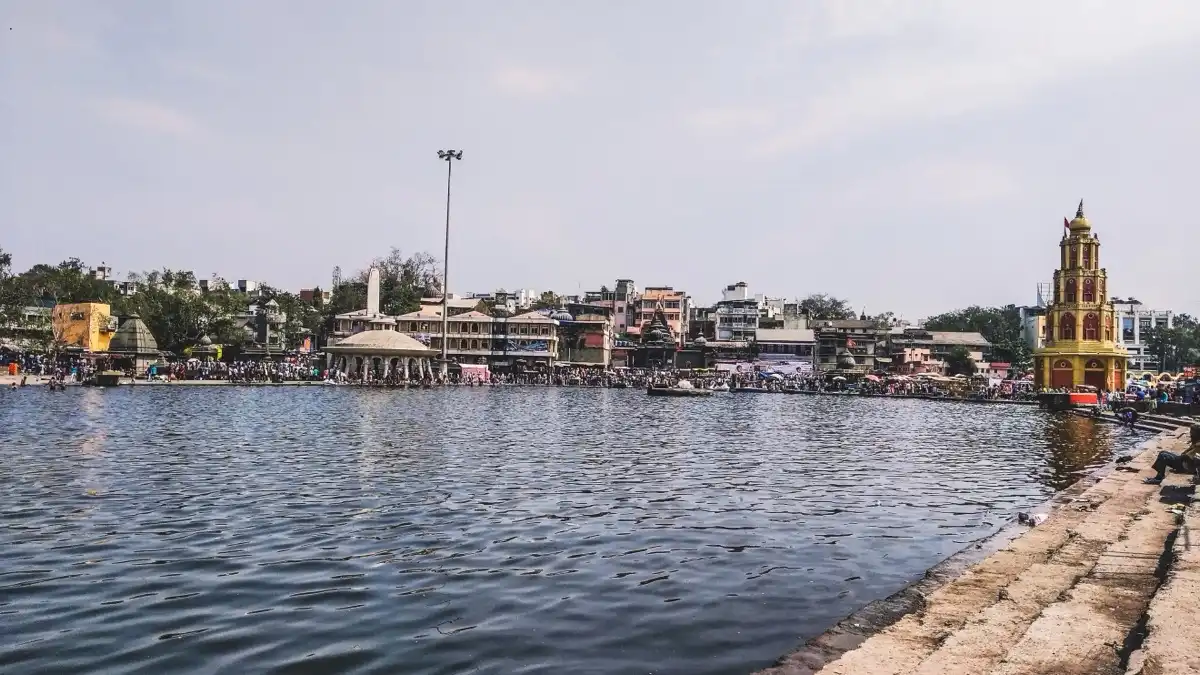
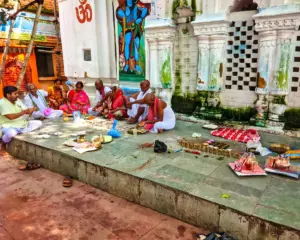
    Trimbakeshwar area in Nashik district — the sacred site for Kaal Sarp Dosh Puja
    Trimbakeshwar is located 28 km from Nashik city in Maharashtra, nestled in the Brahmagiri hills at the source of the Godavari River

    The Three-Faced Jyotirlinga — What Makes Trimbakeshwar Unique

    Of the 12 Jyotirlingas of India, Trimbakeshwar is the only one whose Linga carries three distinct faces rather than the single undivided column that characterizes all other Jyotirlingas. The name itself encodes this: Tri (three) + Ambak (eyed or faced) — the three-eyed or three-faced deity.

    The Shiva Purana’s Kotirudra Samhita explains this unusual form. When Brahma, Vishnu, and Shiva all manifested in this kshetra simultaneously — each claiming primacy — they merged into a single light column (Jyotirlinga) that retained the impression of all three faces. The three thumb-shaped faces visible inside the Brahma Kamala crown atop the main Linga represent Brahma (facing east), Vishnu (facing west), and Rudra/Shiva (facing south) — though the Linga itself is not a traditional pillar but rather three interlocked thumb-shaped protrusions (Angushtha-akar).

    This triune nature has a direct bearing on the efficacy of Kaal Sarp Dosh Puja. The dosha itself is described in the Brihat Parashara Hora Shastra as a condition where the soul’s unresolved karma (sanchit karma) from previous lives creates a serpentine encirclement of the natal chart. Resolving it requires addressing the karma at its root — ancestral, personal, and cosmic. The three-faced Shiva at Trimbakeshwar is understood to bless the devotee at all three levels simultaneously: Brahma as the creator-source addresses past-life karma, Vishnu as the preserver addresses present-life obstacles, and Shiva as the destroyer dissolves the dosha itself.

    The Brahma Kamala — the jeweled crown placed over the three faces — is only revealed to devotees on specific auspicious occasions and is considered among the rarest darshan experiences at any Jyotirlinga temple in India.

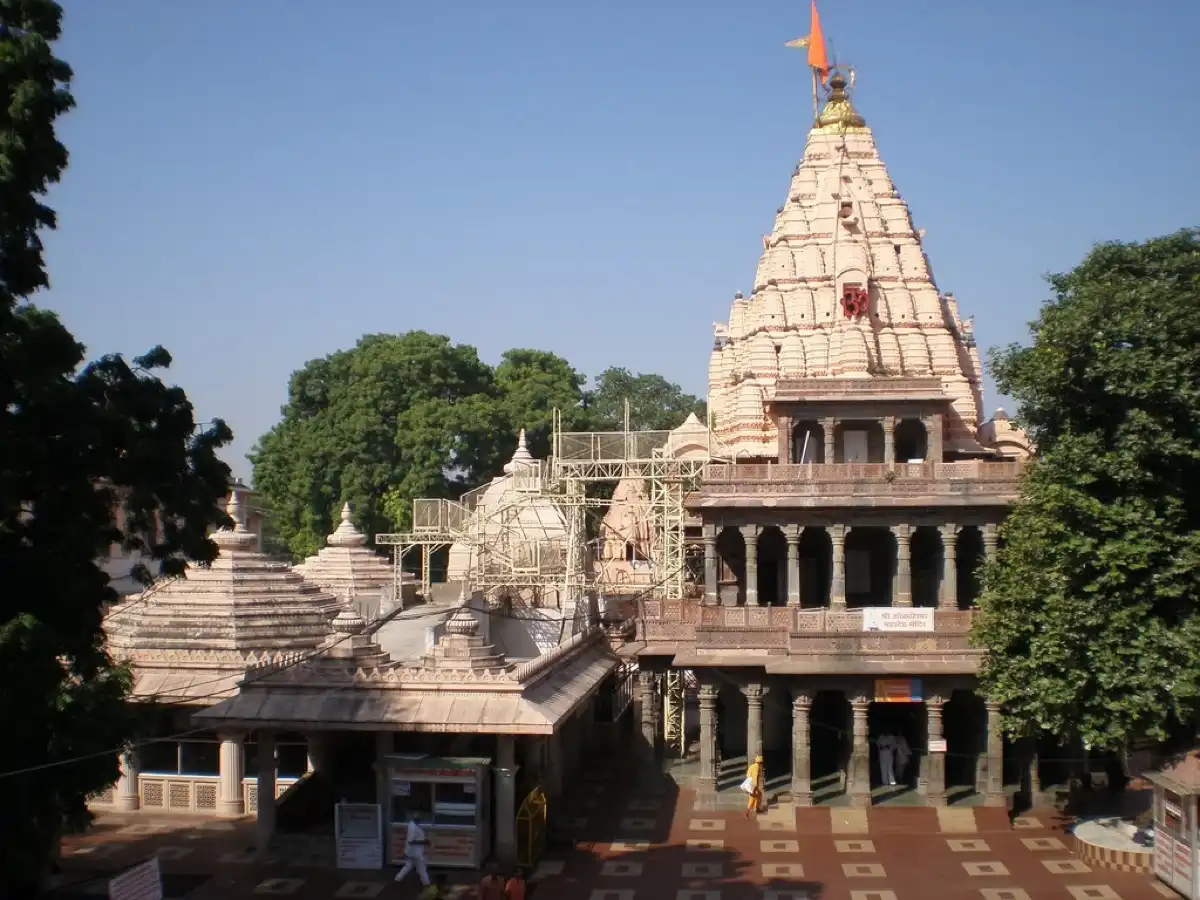
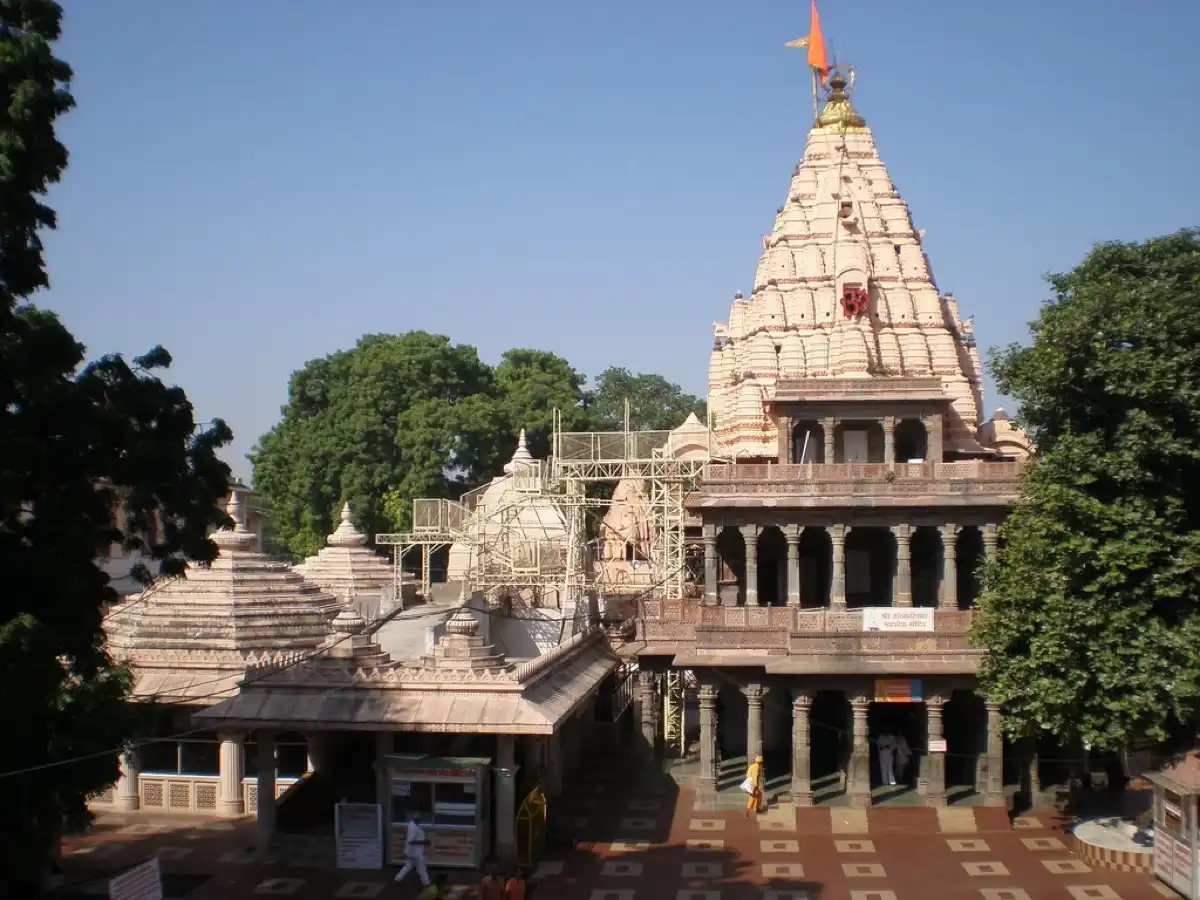
    Trimbakeshwar Jyotirlinga temple — the only three-faced Jyotirlinga among the 12 sacred shrines
    The Trimbakeshwar Jyotirlinga temple — its three-faced form (Trimurti Linga) is found nowhere else among the 12 Jyotirlingas

    The Role of Kushavarta Kund

    The Kushavarta Kund is not simply a bathing tank. It is the actual source of the Godavari River — a tank of roughly 20 meters by 15 meters whose waters, according to the Padma Purana, are charged with the combined spiritual merit of Ganga, Yamuna, Saraswati, Narmada, Sindhu, Kaveri, and Godavari herself.

    The name derives from the Kusha grass (Desmostachya bipinnata) — the same sacred grass used in Vedic rituals as the seat for priests and as a purifying filter for water offerings. The Skanda Purana narrates that Sage Gautama planted Kusha grass here to catch and hold the waters of the Ganga that he had brought to this location, creating a “vartani” (conduit or receptacle). The tank that formed around this became Kushavarta Kund.

    In the context of Kaal Sarp Dosh Puja, Kushavarta Kund serves a dual ritual role — a unique feature of the Trimbakeshwar puja that does not exist at Ujjain or other locations:

    • Opening purification: The devotee takes a holy bath (snan) in Kushavarta Kund before any ritual begins. This is not optional — it is the first mandatory step of the Sankalp process. The Puranic tradition holds that taking a dip here purifies the individual at the level of their subtle body (sukshma sharira), making the subsequent Sankalp and mantras maximally effective.
    • Closing immersion: At the conclusion of the puja, the silver or copper serpent idols (Nag idols) that were worshipped during the Nag Devata section are immersed in Kushavarta Kund. This act of visarjan (immersion) is understood to symbolically carry the appeased Nag Devata back into the divine waters, completing the circuit of propitiation.

    This dual use — purification at the start, immersion at the end — means that Kushavarta Kund acts as both the threshold and the seal of the entire puja. Pilgrims who come specifically for Kaal Sarp Dosh Puja should plan to arrive at Kushavarta Kund well before sunrise, as the early morning hours before temple opening are considered the most powerful time for the purificatory bath.

    Kaal Sarp Dosh Puja Vidhi at Trimbakeshwar — Step by Step

    The complete puja follows a six-stage sequence, each stage building on the previous one. A pandit who shortens this sequence is performing an incomplete vidhi — ask specifically which stages are included when confirming your booking.

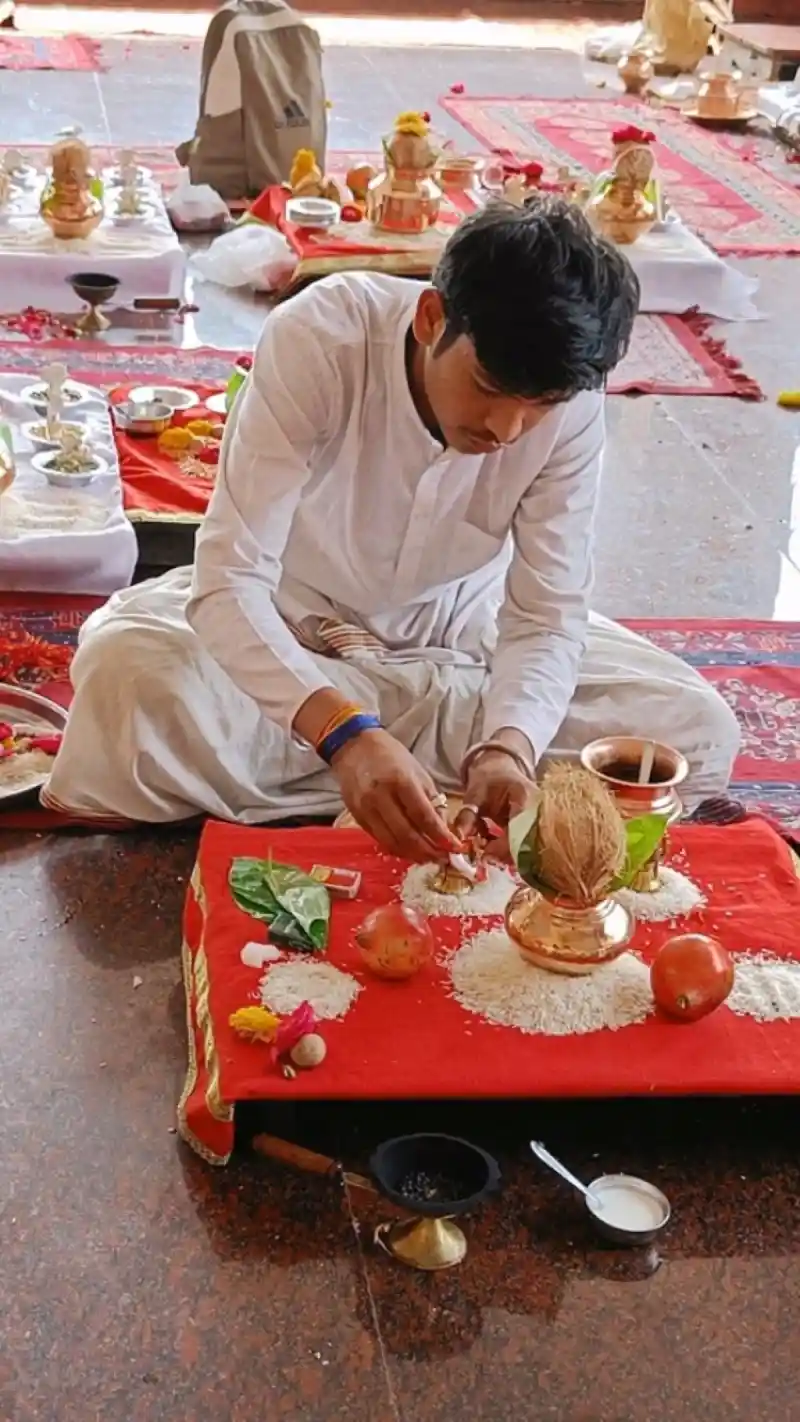
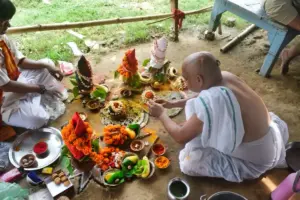
    Puja items and offerings arranged for Kaal Sarp Dosh Puja ritual — flowers, lamps, copper vessels
    Puja items for Kaal Sarp Dosh Puja — red flowers, copper vessels, black sesame, and silver serpent idols are the key ritual materials at Trimbakeshwar

    Step 1: Snan at Kushavarta Kund + Sankalp

    The puja begins before sunrise with the holy bath at Kushavarta Kund. After the bath, dressed in fresh clothes (preferably white or yellow), the devotee sits before the pandit who performs the Sankalp — the formal statement of intent. The Sankalp includes your full name, father’s name, gotra (ancestral lineage), current location (desh, kal, desha triplet), and the specific purpose: “Kaal Sarp Dosha Nivarana artham” (for the removal of Kaal Sarp Dosh). The Sankalp is not a formality — it is the legal-equivalent statement in Vedic ritual that activates the puja’s intent and links the ceremony specifically to the individual performing it.

    Step 2: Ganesh Puja + Kalash Sthapana + Navgraha Puja

    No Vedic puja begins without first propitiating Ganesha. The pandit performs a full Ganesh Puja with 16-step (Shodashopachara) worship, followed by Kalash Sthapana — the ritual installation of a sacred water pot (representing the presence of all seven sacred rivers and all 330 million deities) as the witness and container of the puja’s energy.

    The Navgraha Puja that follows addresses all nine planets as a group — not just Rahu and Ketu. This is important because Kaal Sarp Dosh weakens all planets caught in the Rahu-Ketu axis, and a proper remedy must restore balance across the entire planetary system, not just the two shadow planets. Each of the nine planets receives separate mantras and offerings in this section.

    Step 3: Nag Devata Worship

    This is the heart of the puja. Silver serpent idols (Nag idols) — or copper or clay depending on the package — are placed on a sacred surface and worshipped with:

    • Milk (dugdha abhishek) — representing purity and the nourishment given to serpents in forest tradition
    • Black sesame (kala til) — associated with Ketu and used specifically in shadow-planet remedies
    • Red flowers — representing Rahu’s color in the Vedic system
    • Sandal paste (chandan) — for cooling the “heated” energy of the afflicted planets

    The Nag Devata is invoked not merely as a serpent deity but as the cosmic serpent Shesha (also called Ananta) who forms the bed of Lord Vishnu — representing infinite time itself. Appeasing Nag Devata at this stage addresses the ancestral serpent curses that often co-exist with Kaal Sarp Dosh.

    Step 4: Havan with Rahu-Ketu Shanti Mantras

    A havan (sacred fire ritual) is performed with specific ahutis (oblations) for Rahu and Ketu. The fire is kindled from a combination of palash wood (Butea monosperma, sacred to Brahma) and samidha sticks. Each oblation is accompanied by a specific mantra and the addition of sesame, til-mixed ghee, and specific herbs known in Ayurveda to correspond to Rahu and Ketu’s planetary natures.

    The minimum number of ahutis for a proper Rahu-Ketu Shanti havan is 108 each — totaling at least 216 oblations. In an extended puja, this number goes to 1,008. A rushed havan with fewer than 108 oblations per planet is considered incomplete by traditional standards.

    Havan fire ritual — sacred flames during Rahu-Ketu Shanti havan for Kaal Sarp Dosh remedy
    The havan (sacred fire) during Kaal Sarp Dosh Puja — at Trimbakeshwar, the palash wood havan for Rahu and Ketu Shanti uses a minimum of 108 ahutis per planet

    Step 5: Pind Daan

    This step surprises many devotees who associate Pind Daan exclusively with Gaya or Prayagraj. At Trimbakeshwar, Pind Daan is included in the Kaal Sarp Dosh Puja sequence because many cases of this dosha carry an ancestral dimension — specifically, ancestors who were harmed by serpents, or ancestors whose death rituals were not properly completed. The rice-ball offerings (Pindas) made here are intended to address this specific category of ancestral karma that may be manifesting as the dosha in the descendant’s chart.

    For more context on the relationship between ancestral karma and planetary doshas, see our detailed posts on Pitra Dosh and what Shradh means and why it matters.

    Step 6: Rudrabhishek + Snake Idol Immersion

    The puja concludes with a Rudrabhishek — the ritual bathing of the Shiva Linga with a sequence of five sacred substances (Panchamrit): milk, honey, ghee, sugar, and curd — followed by pure Gangajal. During the Rudrabhishek, the Shri Rudram (the most powerful hymn to Shiva in the Krishna Yajurveda) is chanted either by the priest alone or in a group of priests (Rudrabhishek Yajna). At the conclusion of the Rudrabhishek, the silver Nag idols used in Step 3 are carried to Kushavarta Kund and immersed, completing the puja’s ritual circuit.

    Specific Mantras Chanted During the Puja

    Most competitor guides list the puja stages without sharing the actual mantras. This is a significant gap, because knowing the mantras allows the devotee to participate actively — even without Sanskrit fluency, following the mantra phonetically while holding the intention of the Sankalp is understood in Vedic tradition to amplify the puja’s effect. These are the specific mantras used in the Trimbakeshwar Kaal Sarp Dosh Puja:

    Ganesha Mantras (Opening)

    Devanagari:

    ॐ गं गणपतये नमः

    वक्रतुण्ड महाकाय सूर्यकोटि समप्रभ।
    निर्विघ्नं कुरु मे देव सर्वकार्येषु सर्वदा॥

    Transliteration:

    Om Gan Ganapataye Namah

    Vakratunda Mahakaya Surya Koti Samaprabha
    Nirvighnam Kuru Me Deva Sarva Karyeshu Sarvada

    Meaning: “O large-bodied one, radiant as ten million suns, remove all obstacles from my undertakings always.”

    Nag Devata Mantra

    Devanagari:

    ॐ कुरुकुल्ये हुं फट् स्वाहा

    ॐ नाग देवताय नमः

    Transliteration:

    Om Kurukulye Hum Phat Swaha

    Om Nag Devtaya Namah

    Meaning: The first is a Tantric seed-mantra invoking the protective aspect of serpent energy; the second is a direct salutation to the Nag deity. Together they are used to both invite and pacify serpentine energy.

    Rahu Beej Mantra

    Devanagari:

    ॐ भ्रां भ्रीं भ्रौं सः राहवे नमः

    Transliteration:

    Om Bhram Bhreem Bhroum Sah Rahave Namah

    Meaning: The Beej (seed) mantra of Rahu, chanted 108 times per havan cycle. “Bhram, Bhreem, Bhroum” are the three phonetic vibrations corresponding to Rahu’s planetary energy as described in the Graha Shanti mantra texts. “Sah” denotes the self in surrender. The mantra is a declaration of reverence toward Rahu that requests the planet to withdraw its obstructive influence.

    Ketu Beej Mantra

    Devanagari:

    ॐ श्रां श्रीं श्रौं सः केतवे नमः

    Transliteration:

    Om Shram Shreem Shroum Sah Ketave Namah

    Meaning: Ketu’s Beej mantra, the counterpart to Rahu’s. Since Rahu and Ketu are always directly opposite each other in a natal chart, their mantras are always chanted together — one cannot address one shadow planet without addressing the other.

    Shiva Mantras (Rudrabhishek)

    Om Namah Shivaya (Panchakshara Mantra):

    Devanagari: ॐ नमः शिवाय

    Transliteration: Om Namah Shivaya

    The five-syllable Panchakshara mantra — Na-Ma-Shi-Va-Ya — corresponds to the five elements (earth, water, fire, air, space) and the five acts of Shiva (creation, preservation, dissolution, concealment, liberation).

    Mahamrityunjaya Mantra (Full Text):

    Devanagari:

    ॐ त्र्यम्बकं यजामहे सुगन्धिं पुष्टिवर्धनम्।
    उर्वारुकमिव बन्धनान् मृत्योर्मुक्षीय माऽमृतात्॥

    Transliteration:

    Om Tryambakam Yajamahe Sugandhim Pushtivardhanam
    Urvarukamiva Bandhanaan Mrityormuksheeya Maamritat

    Meaning: “We worship the three-eyed Shiva, who is fragrant and nourishing. As the cucumber is severed from the vine (naturally, without force), may He liberate us from death into immortality — not away from immortality.” This mantra is from Rigveda 7.59.12 and is considered one of the most potent in the entire Vedic corpus for overcoming life-threatening and karma-bound obstacles — exactly the condition Kaal Sarp Dosh represents at its extreme.

    Nag serpent idol — silver and copper snake idols worshipped during Kaal Sarp Dosh Puja at Trimbakeshwar
    Silver and copper Nag (serpent) idols are worshipped during the Nag Devata section and then immersed in Kushavarta Kund at the conclusion of the puja

    Best Pandit for Kaal Sarp Puja in Trimbakeshwar

    Finding a genuinely qualified pandit at Trimbakeshwar requires care. The area around the temple has a well-documented problem with touts — individuals who approach pilgrims near the bus stand, in guesthouses, or at the Kushavarta Kund ghats, offering “special” puja packages at inflated prices, or conversely, offering suspiciously cheap rates for “5-minute” pujas that are ritual theater rather than genuine ceremony.

    Characteristics of a genuine Trimbakeshwar pandit:

    • Hereditary pandit (Vipra or Gramadevata Pujari lineage) registered with the Trimbakeshwar Devasthan Trust
    • Able to produce their Devasthan Trust registration number on request
    • Provides written confirmation of the puja stages included and the mantra count
    • Does not approach pilgrims at the bus stand or insist on cash-only arrangements
    • Is willing to perform the full 4-6 hour puja rather than a condensed version
    • Knows the Sankalp procedure and will take your full gotra and family details before beginning

    Red flags: Any quote below Rs. 5,000 for a “complete” Kaal Sarp puja is almost certainly a shortened version. Any pandit who tells you the puja takes “45 minutes” is not performing the traditional vidhi. The standard authentic puja with full havan and Rudrabhishek takes a minimum of 4 hours.

    We at Prayag Pandits do not perform puja at Trimbakeshwar — our services are at Prayagraj (Triveni Sangam) and Haridwar (Har Ki Pauri). We are sharing this guidance because we believe informed pilgrims make better decisions, regardless of which location they ultimately choose.

    Kaal Sarp Dosh Puja Cost in Trimbakeshwar

    Kaal Sarp Dosh Puja — Cost Comparison by Location

    Trimbakeshwar

    Rs. 6,500 – Rs. 11,000

    • Full 6-step vidhi with havan
    • Nag Devata worship + Pind Daan
    • Rudrabhishek + Kushavarta immersion
    • Most traditional for Nagbali
    • Requires travel to Nashik, Maharashtra

    Ujjain (Mangalnath)

    Rs. 5,000 – Rs. 9,000

    • Mars-birth-place authority (Matsya Purana)
    • Strong for Mangal Dosh + Kaal Sarp combination
    • Shipra River immersion at conclusion
    • See our Ujjain guide for full details
    • Requires travel to Ujjain, Madhya Pradesh

    Haridwar (Har Ki Pauri)

    Rs. 7,100

    • Prayag Pandits — verified, transparent service
    • Ganga ghat puja with full vidhi
    • Accessible from Delhi (220 km)
    • Video recording available for NRIs
    • Book Kaal Sarp Puja at Haridwar

    Important note on Trimbakeshwar costs: The range of Rs. 6,500 to Rs. 11,000 reflects genuine variation based on the number of priests involved, the material quality of the Nag idols (silver vs. copper vs. clay), whether Rudrabhishek is included, and whether Pind Daan is part of the package. Quotes below this range almost always involve ritual shortcuts. Quotes above Rs. 15,000 from unknown pandits near the bus stand are almost always inflated tout rates — negotiate politely and ask for a written breakdown before agreeing.

    How to Book Kaal Sarp Dosh Puja at Trimbakeshwar

    There are three reliable methods for booking the puja at Trimbakeshwar:

    Method 1: Trimbakeshwar Devasthan Trust

    The Shri Trimbakeshwar Devasthan Trust (established under the Maharashtra Religious Endowments Act) manages the official temple complex and maintains a list of registered pandits. Booking through the Trust guarantees that your pandit is registered, accountable, and follows the standard vidhi. The Trust office is located adjacent to the main temple entrance. For large groups or puja on specific muhurat dates, advance booking 2-4 weeks ahead is strongly recommended.

    Method 2: Advance Booking Through Verified Agents

    Several agencies in Nashik city (28 km from Trimbakeshwar) maintain ongoing relationships with registered Devasthan pandits and can arrange advance bookings with written confirmation. This method is especially useful for pilgrims traveling from outside Maharashtra who want guaranteed confirmation before arrival.

    Method 3: Arriving at the Temple

    For flexible travelers, arriving at the temple complex early morning (before 6 AM), proceeding directly to the Pandit Niwas (priest’s quarters) section rather than approaching anyone at the bus stand, and requesting the Devasthan Trust pandit-on-duty is a workable approach. Have your gotra details, full name, and father’s name ready.

    If you are looking to book a Kaal Sarp puja with verified pandits, transparent pricing, and video documentation for families abroad — Prayag Pandits offers this at both Prayagraj and Haridwar. Visit our online booking page or our NRI puja services page for details.

    Kaal Sarp Puja Muhurat and Dates 2026

    The puja can be performed throughout the year at Trimbakeshwar, but certain dates carry significantly greater ritual potency:

    Date / Occasion2026 DateWhy Powerful
    Nag PanchamiAugust 17, 2026The single most powerful day for Nag Devata worship — Kaal Sarp Dosh puja on this day is considered to carry the maximum effect of any day in the calendar year
    Maha ShivratriFebruary 26, 2026Shiva’s principal festival — Rudrabhishek on Shivratri at a Jyotirlinga temple is considered especially potent
    Shravan Month MondaysJuly 6, 13, 20, 27 and August 3, 10, 17, 2026Mondays are sacred to Shiva; Shravan Mondays at a Jyotirlinga represent the highest-potency Mondays of the year
    Amavasya (New Moon)Monthly — check PanchangAmavasya is associated with ancestral propitiation (Pitru Tarpan) and is considered auspicious for removing Pitru-related doshas including Kaal Sarp Dosh
    Guru Pushya NakshatraCheck Panchang quarterlyWhen Pushya Nakshatra falls on Thursday — one of the most universally auspicious combinations in Vedic astrology for any puja
    Any Monday / SaturdayWeekly throughout yearMondays for Shiva; Saturdays for Saturn — since Kaal Sarp Dosh often co-exists with Shani-related delays, Saturday pujas address both simultaneously

    Note on daily timing: At Trimbakeshwar, the most auspicious window for Kaal Sarp Dosh Puja is between 4:30 AM and 8:30 AM — the Brahma Muhurta and early morning hours when the temple is least crowded and the Shiva Linga darshan is most accessible. Afternoon pujas are valid but the morning window is traditionally considered superior.

    Trimbakeshwar vs Ujjain — Which Is Better for Kaal Sarp Puja?

    This is among the most-searched questions in this space, and it deserves a direct answer rather than diplomatic vagueness. Both temples have genuine Puranic authority — but they are strong in different ways:

    Choose Trimbakeshwar if:

    • Your Kaal Sarp Dosh involves a strong ancestral/serpent curse component (indicated by a 5th or 8th house Rahu, or by recurring ancestral dreams)
    • You also need to perform Narayan Nagbali Puja — which the Padma Purana and Dharma Sindhu say can ONLY be performed at Trimbakeshwar
    • You are from Maharashtra, Goa, or coastal Karnataka and travel logistics favor Nashik
    • You specifically want the Kushavarta Kund purification + immersion dual ritual

    Choose Ujjain if:

    • Your chart also shows a strong Mangal Dosh — Ujjain’s Mangalnath temple carries the Matsya Purana authority as the birthplace of Mars, making it exceptionally powerful for Rahu-Mars combinations
    • You are from central or western India and Ujjain is logistically closer
    • You want to combine the puja with a Mahakaleshwar Jyotirlinga darshan in the same trip

    For the full Ujjain analysis including cost table and muhurat 2026, see our dedicated Kaal Sarp Dosh Puja in Ujjain guide.

    A note on Prayagraj and Haridwar: Neither Prayagraj nor Haridwar carry the same Puranic authority as Trimbakeshwar or Ujjain specifically for Kaal Sarp Dosh. What they offer is different — the Triveni Sangam at Prayagraj is the world’s largest confluence of sacred rivers, and the Navagraha Shanti puja performed there carries the authority of Tirthraj Prayag (the king of all pilgrimages). For some individuals, particularly those with strong Pitru Dosh alongside Kaal Sarp Dosh, the combination of a river-confluence puja can be more effective than a temple-only puja. This is ultimately a question to discuss with your Jyotishi based on your specific chart.

    Kaal Sarp Puja Benefits

    The traditional texts do not make promises — they describe what a properly performed puja is intended to address. The Brihat Parashara Hora Shastra describes Kaal Sarp Dosh as creating four categories of difficulty: avarodhana (obstruction), bhaya (fear), vyadhi (disease), and virodhana (opposition from people and circumstances). The puja’s purpose is to dissolve each of these categories through the combined effect of Rahu-Ketu Shanti, Nag Devata propitiation, and Shiva’s grace.

    Specifically, devotees who perform a complete Kaal Sarp Dosh Puja with full vidhi at Trimbakeshwar report:

    • Reduction in the intensity and frequency of disturbing dreams (particularly dreams of snakes or being trapped)
    • Improvement in career momentum — projects that were repeatedly stalled begin moving forward
    • Reduction in unexplained health complaints, particularly recurring ailments that do not respond to standard treatment
    • Improvement in relationship stability, particularly in marriages affected by Kaal Sarp Dosh
    • A subjective sense of clarity and reduced mental anxiety

    These are not guaranteed outcomes — they are the traditionally described effects of a properly performed remedy. The Vedic position on planetary doshas is that puja creates the conditions for resolution; the individual’s own karma and choices complete the work.

    For a comprehensive understanding of related doshas and their remedies, see our guides on Pitra Dosh and Manglik Dosh, both of which frequently co-exist with Kaal Sarp Dosh and require separate remedies.

    Can This Puja Be Done Online?

    This is asked frequently, particularly by NRI devotees in the USA, UK, Canada, Australia, and Singapore who cannot travel to India. The honest answer has two parts.

    What can be done remotely: The Sankalp — which is your formal statement of intent and the step that links the puja specifically to you — can be conducted via video call with the pandit in Trimbakeshwar. The pandit performs the full puja on your behalf at the physical location, with your name and gotra included in every mantra. Photographs and short videos of the puja stages are sent to you. This is a widely accepted and scripturally valid practice — the physical presence of the yajmana (patron) at the puja is considered ideal but has always been understood to be impossible for people living at distance. The Sankalp via phone/video is the established substitute.

    What cannot be replicated: The Kushavarta Kund snan (purificatory bath) requires your physical presence, as it is a body-level purification. If you cannot travel, this step is omitted from the remote version of the puja. Additionally, the darshan of the three-faced Jyotirlinga — which traditional texts describe as itself a source of dosha reduction — cannot happen remotely.

    If the full physical experience is your priority but you cannot travel to Trimbakeshwar specifically, we offer Kaal Sarp Dosh Puja with complete documentation at Prayagraj (Triveni Sangam) and Haridwar (Har Ki Pauri). Both include video documentation sent to you, a post-puja consultation with the performing pandit, and transparent pricing. For NRI families managing ancestral rituals from abroad, our NRI puja services page covers the complete process.

    Book with Verified Pandits

    Kaal Sarp Dosh Puja — Prayagraj & Haridwar

    Prayag Pandits offers Kaal Sarp Dosh Puja at Triveni Sangam (Prayagraj) and Har Ki Pauri (Haridwar) with full Navagraha Shanti vidhi, transparent pricing, and video documentation for families abroad.

    • Verified, experienced pandits — since 2019
    • Full 6-step vidhi with Rahu-Ketu Shanti havan
    • Video recording included — ideal for NRI families
    • Starting at Rs. 7,100 (Haridwar) / Rs. 11,000 (Prayagraj)
    • WhatsApp support: +91-77540 97777

    Frequently Asked Questions

    How much does Kaal Sarp Puja cost at Trimbakeshwar?

    The market rate for a complete Kaal Sarp Dosh Puja at Trimbakeshwar ranges from Rs. 6,500 to Rs. 11,000 depending on the scope of rituals included. A full puja (6 stages including havan, Pind Daan, and Rudrabhishek) costs Rs. 9,000-11,000 through registered Devasthan Trust pandits. Shorter packages without havan or Rudrabhishek are available for Rs. 6,500-7,500. Quotes below Rs. 5,000 almost always indicate ritual shortcuts. Quotes above Rs. 15,000 from touts near the bus stand are inflated — insist on a written breakdown before agreeing to any price.

    Which is the best pandit for Kaal Sarp Puja in Trimbakeshwar?

    The most reliable approach is to book through the Trimbakeshwar Devasthan Trust office located at the main temple entrance. Trust-registered pandits are accountable under the Maharashtra Religious Endowments Act and follow standard vidhi. Ask any pandit for their Devasthan Trust registration number before booking. Avoid pandits who approach you at the bus stand, at your guesthouse, or near Kushavarta Kund ghats — these are typically touts rather than registered temple pandits. A genuine registered pandit will not need to solicit clients in public areas.

    Can Kaal Sarp Puja be done online at Trimbakeshwar?

    Yes, with some limitations. A registered pandit at Trimbakeshwar can perform the puja on your behalf after taking your Sankalp (name, gotra, intent) via phone or video call. The puja is performed fully at the temple, with photographs and video sent to you. The Kushavarta Kund snan (purificatory bath) cannot be done remotely — this step requires physical presence. If you are based abroad and want a fully documented remote puja at a sacred ghat, Prayag Pandits offers Kaal Sarp Dosh Puja at Prayagraj and Haridwar with complete video documentation specifically designed for NRI families.

    What is the muhurat for Kaal Sarp Puja in 2026?

    The most powerful date for Kaal Sarp Dosh Puja in 2026 is Nag Panchami on August 17, 2026 — this is the single most auspicious day for Nag Devata worship across the entire year. Other strong dates include Maha Shivratri (February 26, 2026), Shravan month Mondays (July 6, 13, 20, 27 and August 3, 10, 17), and every Amavasya (new moon). The puja can be performed on any day of the year at Trimbakeshwar — the above dates simply carry additional potency. The daily muhurta window at Trimbakeshwar is 4:30 AM to 8:30 AM (Brahma Muhurta through early morning).

    Is Trimbakeshwar or Ujjain better for Kaal Sarp Puja?

    Both have genuine Puranic authority but for different reasons. Trimbakeshwar is stronger when the dosha involves a serpent-curse ancestral component (Rahu in 5th or 8th house, ancestral snake dreams) and when Narayan Nagbali Puja is also needed — the Padma Purana’s Uttara Khanda says Nagbali can only be performed at Trimbakeshwar. Ujjain is stronger when the chart shows a combined Kaal Sarp + Mangal Dosh, given Mangalnath’s Matsya Purana authority as Mars’ birthplace. Both are valid choices — the deciding factor should be your specific chart features and travel logistics, ideally discussed with your Jyotishi.

    How long does the puja take at Trimbakeshwar?

    A complete Kaal Sarp Dosh Puja at Trimbakeshwar takes 4 to 6 hours for the full six-stage vidhi. This includes: the Kushavarta Kund snan (30-45 min), Sankalp + Ganesh Puja + Kalash Sthapana (45-60 min), Navgraha Puja (45 min), Nag Devata worship (45 min), havan with 108+ Rahu-Ketu ahutis each (60-90 min), Pind Daan (30 min), and Rudrabhishek + idol immersion (45-60 min). Shorter “express” pujas without havan or Pind Daan can be completed in 90 minutes but are not the complete traditional vidhi.

    What are the benefits of Kaal Sarp Puja at Trimbakeshwar?

    The traditional texts describe the puja as addressing four categories of Kaal Sarp Dosh effects: obstruction (avarodhana), fear (bhaya), disease (vyadhi), and opposition (virodhana). Devotees commonly report reduced frequency of disturbing dreams involving snakes or entrapment, improvement in long-stalled career projects, reduction in unexplained recurring health complaints, and greater relationship stability. Trimbakeshwar specifically adds the benefit of the three-faced Jyotirlinga darshan — described in the Shiva Purana as carrying the combined grace of Brahma, Vishnu, and Shiva — and the Kushavarta Kund purification which addresses the subtle-body level of karmic afflictions.

    What documents or details are needed for the puja?

    For the Sankalp (formal statement of intent that personalizes the puja), you will need: your full name (as per horoscope, not necessarily official documents), your father’s full name, your gotra (ancestral lineage name — if unknown, use “Kashyap Gotra” as the Vedic default), your current city and country of residence, and the specific dosha you are seeking to address. No government ID is required for the puja itself. If you are performing the puja for a deceased family member (as part of ancestral dosha clearing), bring the deceased’s name, gotra, and approximate death tithi if known. You do not need to bring a copy of your horoscope to Trimbakeshwar — the pandit will ask for the above details verbally during Sankalp.

    Share

    Book Your Sacred Ritual

    Authentic ceremonies performed by Veda-trained pandits with video proof at sacred sites across India.

    2,263+ families served Video proof included Since 2019
    About the Author
    Acharya Vishwanath Shastri
    Acharya Vishwanath Shastri Vedic Ritual Consultant, Prayag Pandits

    Acharya Vishwanath Shastri is a Vedic scholar and practising Teerth Purohit based in Varanasi (Kashi). He holds a Shastri degree in Vedic Studies from Sampurnanand Sanskrit Vishwavidyalaya, Varanasi — one of the oldest Sanskrit universities in India — with specialisation in Karmakanda (Vedic rituals) and Jyotish Shastra (Vedic astrology).Born into a family of Kashi Brahmins with an unbroken tradition of performing ancestral rites at the Manikarnika and Dashashwamedh Ghats, Acharya Vishwanath has been conducting Shraddha, Pind Daan, Asthi Visarjan, Tarpan, Narayan Bali, and Kaal Sarp Dosh Nivaran ceremonies for over 18 years. He has personally officiated rituals for more than 1,500 families from India and abroad.His writing draws on direct study of the Garuda Purana, Brahma Purana, Skanda Purana, Manusmriti, and the Dharmashastra tradition — not secondary summaries. Every scriptural reference in his articles is verified against the original Sanskrit texts he studied during his six-year Shastri programme.Acharya Vishwanath serves as the senior ritual consultant at Prayag Pandits, guiding families through ancestral rites across Varanasi, Prayagraj, Gaya, and Haridwar. He is available for consultation on WhatsApp at +91 7754097777.

    2,263+ families served · Operating since 2019
    Share
    Continue where you left off?

    Your Booking

    🙏 Add ₹0 more for priority scheduling

    No rituals selected yet.

    Browse Pooja Packages →
    Need help booking? Chat with us on WhatsApp