
Key Takeaways
- What Kaal Sarp Dosh is
- How to tell whether your chart has it
- The 12 types of Kaal Sarp Dosh
- Why a list of symptoms is not a diagnosis
In This Article
Kaal Sarp Dosh is read in a birth chart when all seven planets from the Sun to Saturn fall inside the arc between Rahu and Ketu. There are twelve types, each named for the house Rahu occupies. The traditional remedy is the Kaal Sarp Dosh Nivaran Puja, which takes three to four hours and costs from ₹7,100 with us.

What Kaal Sarp Dosh is
Rahu and Ketu are the two lunar nodes — the points where the Moon’s path crosses the Sun’s. They are not bodies, they are positions, and they always sit exactly opposite one another, six houses apart, in every chart ever cast. That fixed opposition divides the chart into two halves.
If all seven of the remaining planets — Sun, Moon, Mars, Mercury, Jupiter, Venus and Saturn — fall into the half that runs from Rahu round to Ketu in the direction of Rahu’s motion, the chart is read as carrying Kaal Sarp Dosh. Kaal is time. Sarp is serpent. The image the name carries is of the whole chart held in the serpent’s length, Rahu at the head and Ketu at the tail.
The Bhagavata Purana tells it through the churning of the ocean. When the nectar of immortality appeared, an asura named Svarbhanu slipped in among the gods and swallowed a share of it before Vishnu, in the form of Mohini, saw through the disguise and severed his head. Because the nectar had already passed his throat, both halves lived on — the head as Rahu, the body as Ketu. They move through the sky as shadows: one swallowing what it can never keep, the other holding what it cannot taste.
How to tell whether your chart has it
This is a calculation, not an impression. Find Rahu and Ketu in the chart. Then check whether every one of the seven planets sits in the arc from Rahu to Ketu. If they all do, the dosha is present, and the house Rahu occupies gives it its name. If even one planet falls on the far side, the reading is Anshik — partial Kaal Sarp Dosh, which the texts treat as a reduced form.
Astrologers differ on the edge cases, and it is worth knowing that before you accept a verdict. A planet sitting exactly with Rahu or Ketu is counted by some schools and not others. Some read the arc by house, some by degree, and a chart can qualify on one method and fail on the other. If you are told you have this dosha, it is reasonable to ask which method was used and to have a second astrologer cast it. A kundali reading is the only thing that settles it.
The 12 types of Kaal Sarp Dosh
There are twelve, one for each house Rahu can occupy, and Ketu is always six houses along. The name tells you the placement, and the placement tells you which pair of houses the classical texts read the configuration against.
| Type | Rahu → Ketu | Houses it is read against |
|---|---|---|
| Anant | 1st → 7th | The self, and marriage |
| Kulik | 2nd → 8th | Wealth, family, speech |
| Vasuki | 3rd → 9th | Siblings, courage, fortune |
| Shankhpal | 4th → 10th | Home, property, career |
| Padma | 5th → 11th | Children, study, gains |
| Mahapadma | 6th → 12th | Opposition, health, loss |
| Takshak | 7th → 1st | Marriage, and the self |
| Karkotak | 8th → 2nd | Sudden change, inheritance |
| Shankhachood | 9th → 3rd | Fortune, father, education |
| Ghatak | 10th → 4th | Career, authority, home |
| Vishdhar | 11th → 5th | Income, networks, children |
| Sheshnaag | 12th → 6th | Loss, health, liberation |

1. Anant — Rahu in the 1st, Ketu in the 7th
The first house is the self; the seventh is partnership. The classical reading sets the two against each other — an unsteady sense of one’s own standing, and marriage that arrives late or does not settle easily.
2. Kulik — Rahu in the 2nd, Ketu in the 8th
The second house holds accumulated wealth, family and speech; the eighth holds sudden events and inheritance. The texts read this as money that is earned but not retained, and disputes that come through the family rather than from outside. It is one of the three types usually called severe.
3. Vasuki — Rahu in the 3rd, Ketu in the 9th
The third house is courage, siblings and communication; the ninth is dharma and fortune. Read together, the tradition describes strain with brothers and sisters, and setbacks that arrive through people already close rather than through competitors.
4. Shankhpal — Rahu in the 4th, Ketu in the 10th
The fourth house is home, mother and property; the tenth is career and public standing. The classical reading is of frequent moves, difficulty holding property, and recognition at work that comes slowly even where it is earned.
5. Padma — Rahu in the 5th, Ketu in the 11th
The fifth house is children, intellect and creative work; the eleventh is gains and networks. The texts read this as effort in study or creative work that does not match its results, and persistent worry about children.
6. Mahapadma — Rahu in the 6th, Ketu in the 12th
The sixth house is opposition, debt and illness; the twelfth is loss, foreign lands and liberation. The tradition describes hidden opposition rather than open conflict, and drains that seem to arrive from several directions. The same sixth-house Rahu is also read as giving unusual stamina — the capacity to outlast.
7. Takshak — Rahu in the 7th, Ketu in the 1st
The reverse of Anant: Rahu on marriage, Ketu on the self. This is the type most often named for conflict within a marriage, and for losses through speculation. The second of the three usually called severe.
8. Karkotak — Rahu in the 8th, Ketu in the 2nd
The eighth house is transformation and other people’s resources; the second is family wealth and speech. The reading is of sudden reversals rather than slow decline, a short fuse under accumulated pressure, and ancestral property lost to disputes.
9. Shankhachood — Rahu in the 9th, Ketu in the 3rd
The ninth house is fortune, dharma and the father; the third is courage and communication. The classical description is of luck that arrives late or not at all, obstacles in higher education, and a habit of saying a great deal while conveying little.
10. Ghatak — Rahu in the 10th, Ketu in the 4th
The tenth house is career and authority; the fourth is home and emotional security. The texts read this as position gained and then lost through conflict with superiors, legal trouble arising out of work, and a home life that pays for the career. The third of the three usually called severe.
11. Vishdhar — Rahu in the 11th, Ketu in the 5th
The eleventh house is income and networks; the fifth is children and creative work. The reading is of prosperity in bursts followed by sharp reversals with no steady line through them, networks that are wide but shallow, and travel that is required rather than chosen.
12. Sheshnaag — Rahu in the 12th, Ketu in the 6th
The twelfth house is loss, foreign lands and liberation; the sixth is health and daily work. The tradition describes litigation, debt that accumulates without obvious mismanagement, and disturbed sleep. It is also the type most often said to turn, once remedied, towards genuine spiritual attainment — the twelfth house read as a gateway rather than a drain.
Kulik, Takshak and Ghatak are the three usually called the most severe. That ranking is a starting point, not a verdict. What the configuration actually amounts to depends on the strength of the individual planets caught inside the arc, whether any of them is exalted or in its own sign, and which mahadasha the chart is running. A strong Jupiter inside the arc reads very differently from a weak one. Any astrologer who tells you the severity from the type alone has not read the chart.
Why a list of symptoms is not a diagnosis
Families usually reach us after a long stretch of difficulty — a career that will not move, a marriage that keeps being deferred, money that never quite accumulates. Those are real and they are hard, and we are not going to tell you they prove anything about your chart. They are also the most common difficulties there are, and they have ordinary causes far more often than astrological ones.
Kaal Sarp Dosh has a test, and it is the only one that applies: the position of seven planets relative to two nodes. It can be checked in a few minutes by anyone who can read a chart, and the answer does not depend on how your year has gone. If someone offers to diagnose it from your circumstances, or works down a list of symptoms before asking for your birth details, they are not doing astrology.
Where the chart does carry the configuration, the Rahu–Ketu axis is traditionally associated with inherited karma as much as personal karma. That is why the sankalp at the start of the rite names the lineage and the gotra and not only the individual, and it is the reason families often ask for the puja on behalf of a whole household.
The Nivaran Puja, step by step
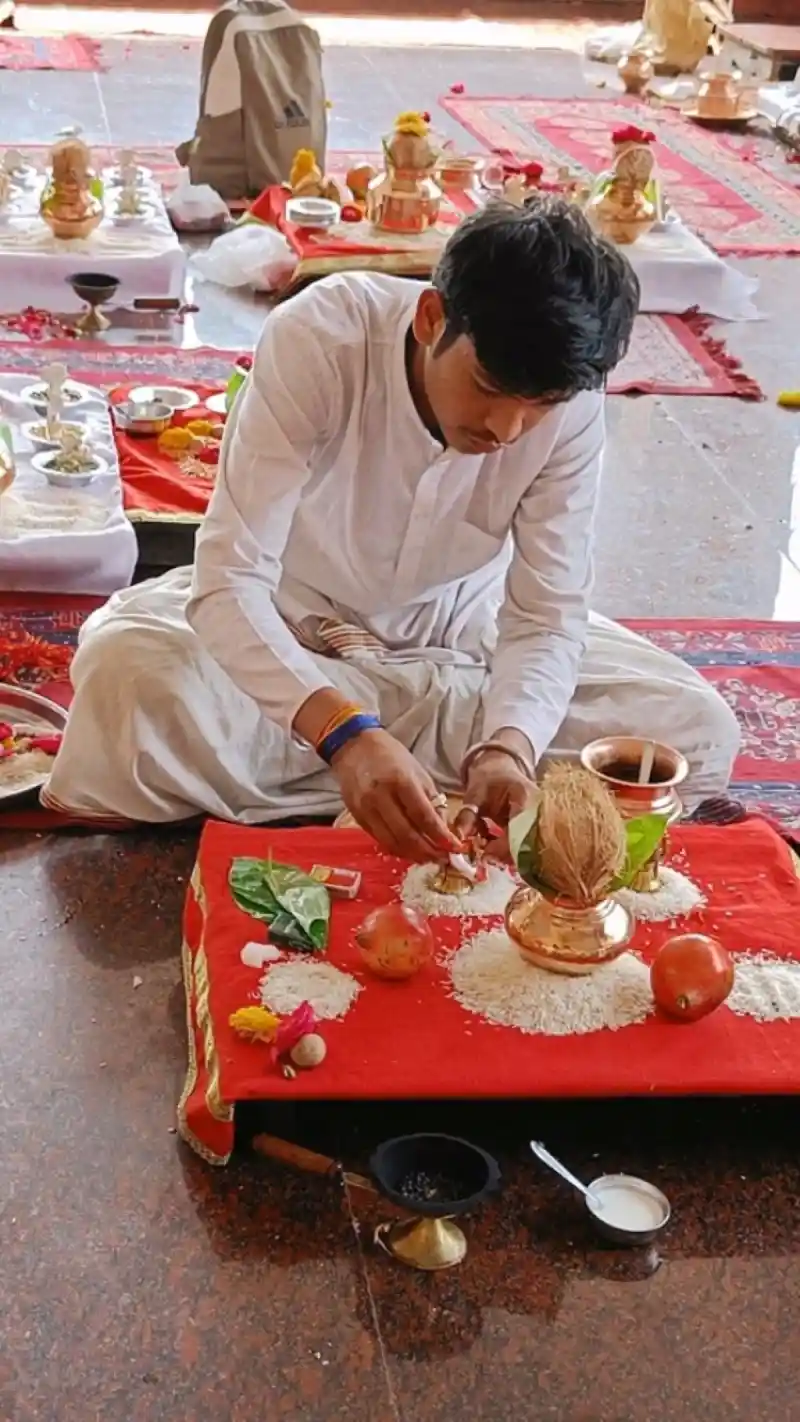
The Kaal Sarp Dosh Nivaran Puja is a sequence, not a single mantra. The full vidhi runs three to four hours and moves through seven stages.
- Sankalp. The formal statement of intent — the name, the gotra, the lineage and the specific purpose of the rite, spoken before the fire is lit.
- Kalash sthapana. The sacred vessel is established, standing for the waters of all the tirthas, which turns the ground into ritual space for the duration.
- Ganesh puja. Taken first, as in any Vedic rite, for the removal of obstacles to the ceremony itself.
- Navgraha puja. All nine planetary forces are addressed together before the work on Rahu and Ketu begins, so that the specific pacification rests on a settled chart.
- Nag Devata worship. The distinctive stage. Serpent idols in silver, copper or clay are placed and offered milk, black sesame for Ketu, red flowers for Rahu, and sandal paste.
- Havan. The fire offering, with the Rahu beej mantra (Om Bhraam Bhreem Bhraum Sah Rahave Namah), the Ketu beej mantra (Om Sraam Sreem Sraum Sah Ketave Namah) and the Mahamrityunjaya mantra.
- Rudrabhishek, and immersion. The linga is bathed in panchamrit — milk, honey, ghee, curd and Gangajal — and the serpent idols are immersed in the river at the close.
The person the puja is for should be present where that is possible, and a spouse or close family member alongside them. Where it is not possible, the rite is performed in their name and gotra over a live video link, which is how most of our NRI families arrange it.
Where the puja is performed
Four places carry a settled tradition for this rite. Trimbakeshwar has the longest codified one; Ujjain is the one most families ask us about. We perform the puja at Prayagraj and Haridwar, and we are not going to pretend otherwise about the other two — both have their own pandits, and we have written up how to arrange it with them.
Prayagraj — Triveni Sangam
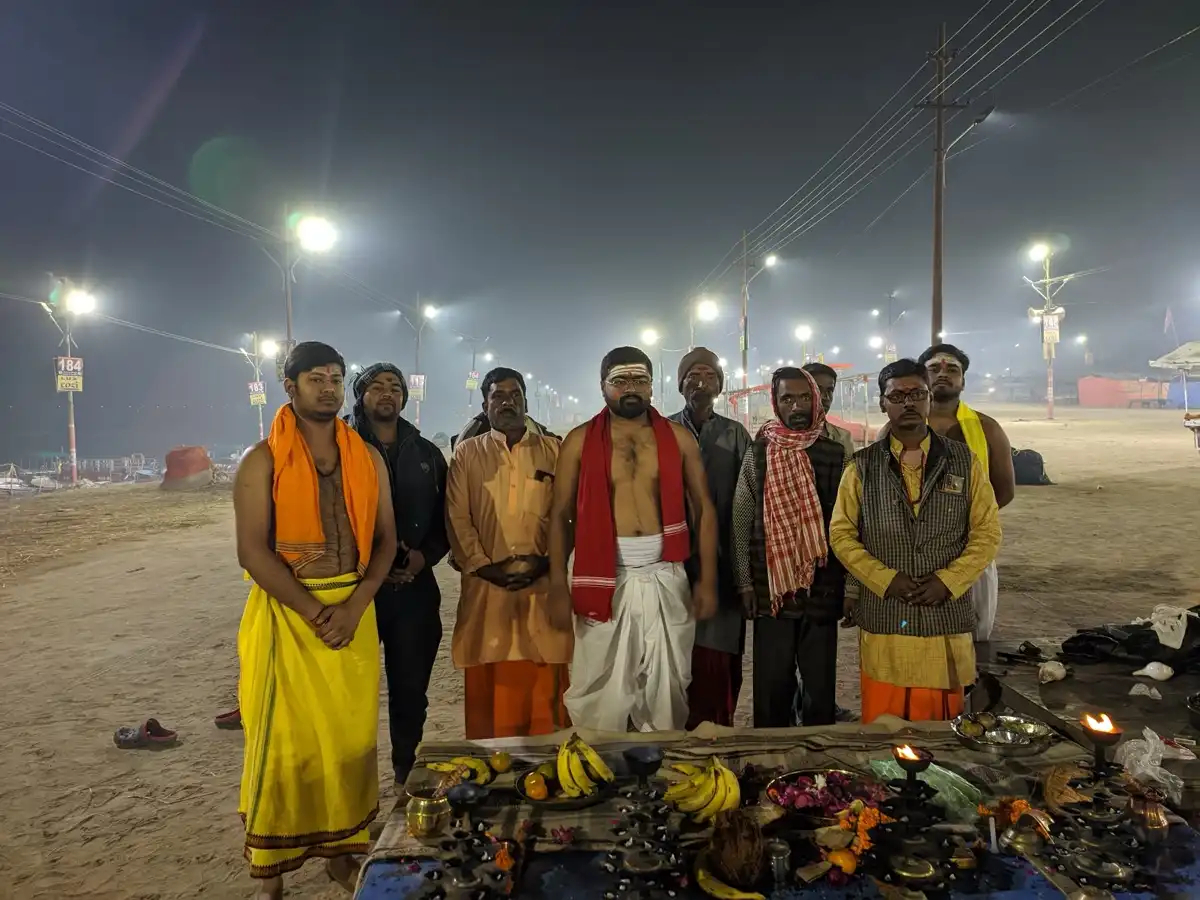
At the confluence of the Ganga, Yamuna and Saraswati, the Nivaran Puja is performed alongside Navgraha Shanti, which makes it the most complete planetary pacification of the four. Prayagraj’s standing as Tirtharaj is the traditional reason — merit earned here is held to carry the merit of all tirthas. This is where our pandits are, and it is the package we run most often.
Haridwar — Har Ki Pauri
Haridwar is one of the four places where the nectar from the churning is said to have spilled, which is a direct connection to the episode that produced Rahu and Ketu in the first place. At Har Ki Pauri the rite is performed with the Ganga running alongside, and the offerings go into the current as the havan closes. The Haridwar package is our lower-priced option.
Ujjain — Mangalnath, and the serpent shrine
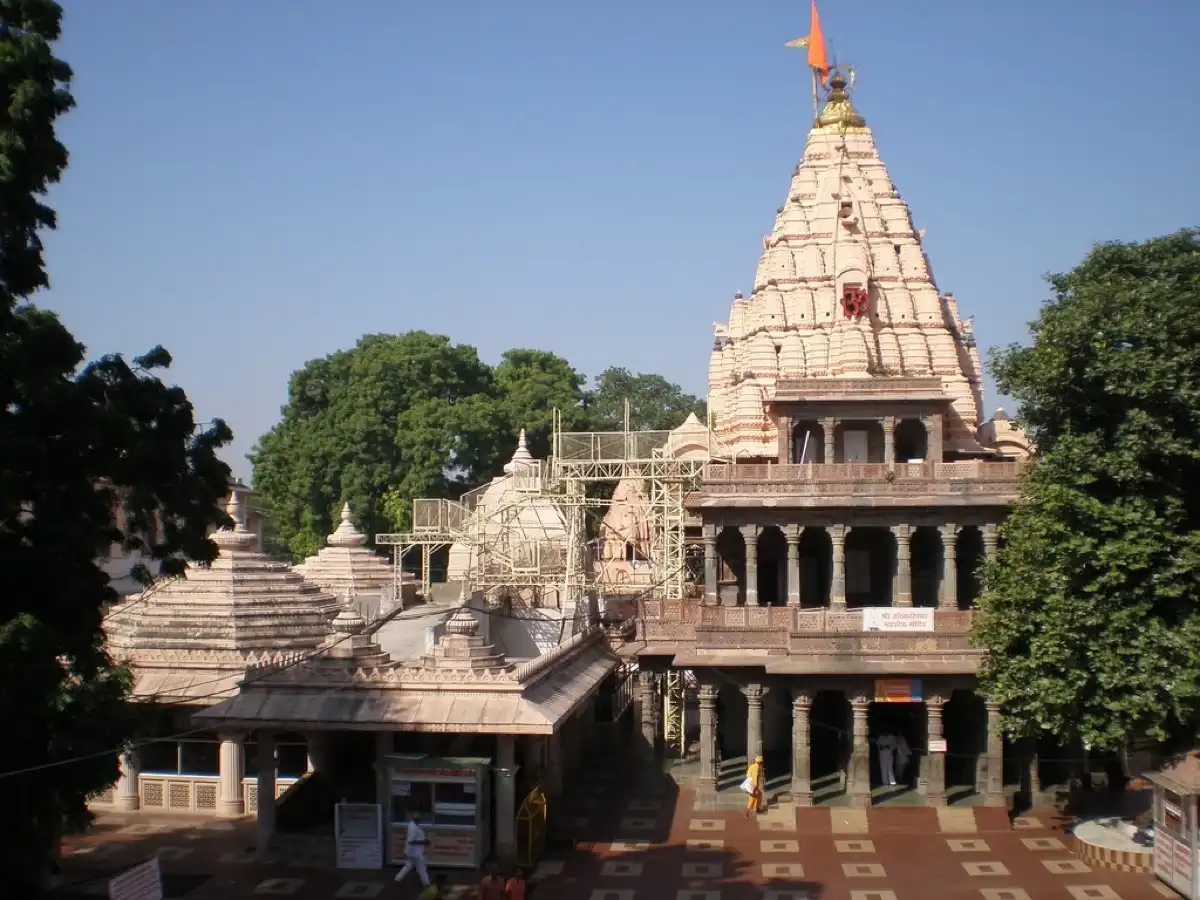
Ujjain’s claim rests on time itself. The prime meridian of classical Indian astronomy ran through the city, and Mahakaleshwar is Shiva as the lord of time — which is the natural address for a dosha whose name begins with kaal.
In practice the rite is performed at Mangalnath Temple, on the bank of the Shipra, where the temple’s own pandits conduct it in the courtyard and havan area, with the bathing ritual at Ram Ghat beforehand. Mangalnath is Mars’s own site rather than a serpent shrine, and its energy is read as an ally in cutting through the configuration rather than as the thing being addressed. Our Ujjain guide has the address, the timings and what to check before you book.
The serpent shrine proper is Nagchandreshwar, on the uppermost floor of the Mahakaleshwar complex, where Shiva is seated on a ten-hooded serpent. It is worth knowing about before you plan a trip, because of when it is open.
The Nagchandreshwar shrine above Mahakaleshwar is unsealed for twenty-four hours on Nag Panchami — the fifth day of the bright half of Shravan, which falls in July or August — and stays shut for the rest of the year. Tens of thousands come for that darshan and the queues have caused crushes. If seeing it matters to you, plan the trip around that date and expect a long wait. If what you want is the puja, you do not need the shrine: the rite is performed at Mangalnath and Ram Ghat on any suitable day.
Trimbakeshwar — Nashik
Trimbakeshwar holds the longest codified tradition for this rite, and many Vedic scholars treat it as the first choice. Its jyotirlinga is the only one of the twelve with three faces — Brahma, Vishnu and Shiva together — and the temple stands at the source of the Godavari, with the Kushavarta Kund inside the complex for the opening bath. The Trimbakeshwar vidhi also includes Pind Daan, on the reasoning that the Rahu–Ketu axis carries an ancestral component as well as a planetary one. Our Trimbakeshwar guide sets out the six stages and how to arrange it with a registered pandit there.
What it costs
| Location | Price | What it covers |
|---|---|---|
| Prayagraj, Triveni Sangam | ₹11,000 | Full vidhi with Navgraha Shanti, live video, prasad couriered. Was ₹15,000 |
| Haridwar, Har Ki Pauri | ₹7,100 | Full vidhi on the Ganga ghat, live video, prasad couriered. Was ₹9,100 |
| Ujjain, Mangalnath | not offered | Arranged with the temple’s own pandits — see our Ujjain guide |
| Trimbakeshwar | not offered | Arranged with the Devasthan Trust or a registered pandit there |
Both of our packages include the full samagri — serpent idols, red flowers, ghee, black sesame and the panchamrit ingredients — the dakshina for the officiating pandit, a live video link for families who cannot travel, prasad couriered within India and abroad, and a written record of the sankalp details. There is nothing to add on the day.
🕉️ Book Kaal Sarp Dosh Nivaran Puja
- Navgraha Shanti and the Rahu–Ketu beej mantra havan
- Nag Devata worship with silver or copper idols
- Live video link on WhatsApp or Zoom
- All samagri and pandit dakshina included, prasad couriered
Kaal Sarp Dosh and the other doshas
A chart often carries more than one, and the distinction matters because the remedies are different and the order they are performed in is not arbitrary.
Manglik Dosh comes from Mars in the 1st, 4th, 7th, 8th or 12th house, and its classical reading is about marriage. Kaal Sarp Dosh is the Rahu–Ketu enclosure, and it is read across the whole chart. Both can be present at once — Rahu in the seventh is Takshak, and Mars in the seventh is manglik, and a chart can have both. Where they are, the Kaal Sarp rite is usually taken first because it addresses the wider configuration, and the Manglik remedy after. Our Manglik Dosh guide covers what that reading does and does not support.
Pitra Dosh is a different thing entirely, though the two get confused because the difficulties described overlap. It is read from an afflicted Sun — a Sun–Rahu conjunction, or the Sun in the ninth under malefic influence — rather than from the nodal enclosure, and it points to ancestral rites left incomplete. Where both appear, the usual advice is to settle the ancestors first with Pind Daan or Tripindi Shradh and then take the Kaal Sarp rite. Our Pitra Dosh guide sets out how that reading is made, and the sequence of Hindu death rituals explains what completing them involves.
Daily practices alongside the rite
The Nivaran Puja is the primary remedy. These are observances that sit alongside it, particularly during a Rahu or Ketu mahadasha, and they are supplements rather than substitutes.
- Nag Panchami. The fifth day of Shravan Shukla Paksha is given to Nag Devata. Milk offered at a Nag shrine or a Shiva linga on that day is the observance most directly connected to this dosha.
- The beej mantras. The Rahu mantra 108 times on Saturdays, the Ketu mantra 108 times on Tuesdays. The point is not to suppress Rahu and Ketu, which is not possible, but to keep a conscious relationship with them.
- Monday offerings. Water, preferably Gangajal, or milk poured over a Shiva linga on Monday morning with the Mahamrityunjaya mantra — a classical Rahu observance resting on Shiva’s authority over the shadow planets.
- Feeding ants with flour and sugar on Saturdays. A folk observance: ants move unseen and underground, which is read as Rahu’s own quality, and Saturday is Rahu’s day.
Gomed for Rahu and cat’s eye for Ketu are the classical stones, and you will find both sold on the strength of a dosha reading alone. A gemstone strengthens the planet it belongs to. If that planet is badly placed in your chart, strengthening it makes things worse, not better — and these are not cheap stones. Nobody should prescribe one without having read your full chart, and no honest astrologer will prescribe one from the name of a dosha.
Common questions
Which temple in Ujjain is used for this puja?
Mangalnath Temple, on Mangalnath Road beside the Shipra, about four kilometres from Ujjain Junction. Its own pandits perform the rite and the temple office registers devotees for a slot. The serpent shrine, Nagchandreshwar, sits above Mahakaleshwar and opens only on Nag Panchami, so it is not where the puja is arranged.
Can Kaal Sarp Dosh be removed completely?
The placement in a natal chart does not change — Rahu and Ketu were where they were at the moment of birth and will stay there. What the rite is understood to address is how that configuration expresses itself. Anyone who tells you a dosha has been erased is overstating what the tradition itself claims, and we will not say it.
How long does the puja take?
Three to four hours for the full vidhi with the havan and Rudrabhishek. At Trimbakeshwar, where Pind Daan is included, it runs four to six. A ceremony offered to you in forty-five minutes is not this one.
Can it be done without travelling?
Yes. The sankalp is taken in your name and gotra, you watch the whole ceremony on a live link, and the prasad is couriered afterwards. Most of our overseas families arrange it this way. You can book online or send us the birth details on WhatsApp and we will tell you what the chart shows before you pay for anything.
Book Your Sacred Ritual
Authentic ceremonies performed by Veda-trained pandits at sacred sites across India.



