Blog

Kankhal Ghat Haridwar: Complete Guide to Sacred Rituals, Pind Daan and Asthi Visarjan

Prakhar Porwal · 24 min read
Key Takeaways
    In This Article

    Kankhal Ghat Haridwar — At a Glance

    • Location: 4 km south of Haridwar Junction, on the Ganga’s eastern bank
    • Sacred status: One of the Panch Tirth of Haridwar; mentioned in Vayu, Skanda, and Shiva Puranas
    • Primary rites performed: Pind Daan, Tarpan, Asthi Visarjan, Narayan Bali, Shradh
    • Key site: Sati Kund — where Sati’s body fell after immolation at Daksha’s yajna
    • Best time to visit: Dawn snan (sunrise), Pitrupaksha (Sep-Oct), Mahalaya Amavasya
    • Nearest railway station: Haridwar Junction (Haridwar Main)

    Kankhal is not the Haridwar that pilgrims photograph. It has no floodlit ghats, no evening Aarti with a thousand oil lamps, no loudspeakers. What it has is something older and quieter — the weight of a story that the Puranas say happened here before recorded time, at a spot where a god’s daughter chose death over dishonour, and where that death made the ground permanently holy.

    Every family that comes to Kankhal to immerse the ashes of someone they loved is, knowingly or not, standing at that same spot. The Ganga here carries not just the ashes forward but, according to the Shiva Purana, the accumulated merit of Sati’s own transcendence. This is why teerth purohits have directed families to Kankhal for asthi visarjan for centuries — not because the logistics are convenient, but because the theology demands it.

    This guide draws on the Vayu Purana, Skanda Purana, Shiva Purana, and Garuda Purana to explain why Kankhal holds this status, and gives you the practical detail you need to perform Pind Daan, Asthi Visarjan, or Tarpan here with proper vidhi.

    What Is Kankhal? Haridwar’s Oldest Sacred Quarter

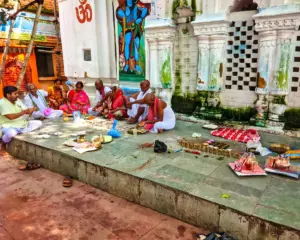
    Ganga at Kankhal Haridwar — sacred ghat for Pind Daan and Asthi Visarjan
    The Ganga at Kankhal, Haridwar — one of the Panch Tirth and the city’s oldest sacred quarter

    Kankhal is a quarter of Haridwar, not a separate town, though it feels like one. It sits roughly 4 kilometres south of the main railway station, separated from the commercial core of Haridwar by the quieter rhythm of an older city. The ghats here are narrower, the lanes more worn, and the priests who work them have family lineages stretching back twelve and fifteen generations.

    The Vayu Purana names this place Kanakhala and identifies it as the site of Daksha’s Ashvamedha sacrifice — an event attended, the text says, by the Adityas, the Vasus, and all the orders of the Rudras. That a yajna of this cosmic scale was placed at Kankhal, rather than at the more prominent Har Ki Pauri further north, tells us something important: Kankhal’s sanctity is not derived from Haridwar’s fame. If anything, the argument runs the other way. Haridwar is sacred partly because Kankhal is within it.

    The Skanda Purana describes Kankhal as a “famous and splendid holy centre on a charming peak near Gangadvara” — Gangadvara being the Puranic name for Haridwar, meaning the gate through which the Ganga enters the plains. The same text records that Shiva himself resides in Kankhal in his Ugra (fierce) form, and that this Ugra manifestation is the original from which the celebrated Ugra deity of Varanasi was later established.

    Kankhal is also one of the Panch Tirth of Haridwar — the five sacred river crossings that together constitute the full pilgrimage circuit of the city. The other four are Har Ki Pauri, Kushavarta Ghat at Rishikesh, Neel Dhara, and Saptrishi Ashram. A pilgrim who performs Shradh or Pind Daan at all five tirthas in sequence is said to earn the merit of the entire Gaya pilgrimage without leaving the Haridwar region. For families who cannot travel to Gaya, this theological equivalence is the reason Haridwar — and Kankhal specifically — remains a fully valid alternative.

    Administratively, Kankhal falls within Haridwar district, Uttarakhand. It has its own post office, market lanes, and a distinct community of Teerth Purohits and Kanhaiyya Brahmins who have served as hereditary ritual specialists here for generations. If you are visiting Haridwar for ancestral rites, your pandit will almost certainly bring you here rather than to Har Ki Pauri — and now you know why.

    Daksha’s Yajna and Sati’s Sacrifice — The Story That Made Kankhal Sacred

    Daksh Mahadev Temple Kankhal Haridwar — goat-headed deity and site of Daksha yajna
    The Daksh Mahadev Temple at Kankhal marks the site where Daksha’s yajna destroyed Sati

    The story the Shiva Purana tells at Kanakhala is one of the most consequential in the entire Puranic canon. Daksha, lord of the Prajapatis and Sati’s father, organized a great yajna at this site. He invited every god, every rishi, and every celestial being. He did not invite Shiva — his son-in-law — and he did not invite Sati.

    Sati heard of the yajna from Narada and insisted on attending despite Shiva’s warning that going uninvited to her father’s ceremony would bring her nothing but grief. She arrived at Kanakhala to find that Daksha had deliberately left no ritual share — no havishya, no seat, no acknowledgement — for Shiva. When she confronted her father, he insulted Shiva directly before the assembled gods: calling him an ascetic of low birth, a wanderer with matted hair who consorted with ghosts and smeared himself with ash from funeral pyres.

    Sati could not bear it. The Shiva Purana records that she did not burn herself in ordinary fire. She entered Yoga-agni — the internal fire of yoga — and immolated herself at the sacrificial altar itself. She died asserting her identity as Shiva’s consort against her father’s contempt.

    When Shiva received word of Sati’s death, he created Virabhadra — a being of such destructive power that the Puranas describe his emergence as causing the earth to shake and the sky to crack. Virabhadra descended on Daksha’s yajna at Kanakhala, destroyed the sacrifice, scattered the gods, beheaded Daksha, and blinded Bhaga and Pushan. The yajna, that most ordered of sacred acts, was reduced to ash and chaos.

    Later, through the intercession of Brahma, Shiva agreed to restore what had been destroyed. Daksha was revived — but with a goat’s head, because his original head had been thrown into the yajna fire. This is the direct scriptural explanation for why the principal deity of the Daksh Mahadev Temple at Kankhal is depicted with a goat’s head. Every family that visits the temple to pray before performing Pind Daan or Asthi Visarjan is standing at the site of this event.

    The Shiva Purana draws a direct line from this story to Kankhal’s ritual authority: the ground where Sati immolated herself has been permanently charged with a quality of transcendence. Her death was not ordinary death. It was an act of perfect spiritual will. And the Ganga that flows past this spot carries, the tradition holds, a trace of that transcendence — which is why water taken here for Tarpan or used in Asthi Visarjan is considered especially powerful for liberating the soul of the departed.

    Sati Kund — Why It Is the Preferred Ghat for Asthi Visarjan

    Sati Kund Kankhal Haridwar — significance for asthi visarjan and final rites
    Sati Kund at Kankhal — considered the most powerful site in Haridwar for Asthi Visarjan

    Sati Kund is a sacred water body at Kankhal that tradition identifies with the spot where Sati’s body fell — or in some accounts, where she performed her yoga-agni immolation. The kund is adjacent to the main ghat area and forms the ritual heart of Kankhal’s pilgrim circuit.

    For Asthi Visarjan — the immersion of the cremated remains of the deceased — Kankhal and specifically the Sati Kund area is considered the single most auspicious location in Haridwar. The logic is grounded in Puranic theology rather than custom alone. Sati, as a divine being, achieved the highest form of transcendence possible: she departed her body through yoga-agni by pure spiritual will, at a moment of dharmic confrontation. In doing so, the tradition holds, she purified the very ground and water of Kankhal with the residue of that transcendence.

    When a family immerses the ashes of their departed ancestor in the waters at Sati Kund, they are placing those remains in water that has been sanctified by the same transcendence Sati achieved. The theological implication — stated explicitly in the commentary tradition on the Shiva Purana — is that the soul of the departed benefits from this proximity. The water does not merely carry the ashes away; it receives them into a field of accumulated punya (merit) that facilitates the soul’s onward journey.

    This is not a belief system unique to Kankhal. The same logic underlies why Prayagraj’s Triveni Sangam is considered superior for asthi visarjan to a plain riverbank — the Sangam has accumulated merit through its own history of countless sacred acts. Kankhal has accumulated the specific merit of Sati’s sacrifice. Among the ghats of Haridwar, no location carries this specific theological weight.

    Practically: the Sati Kund area is quieter than Har Ki Pauri, accessible by auto-rickshaw from the main ghats, and the teerth purohits who serve here are experienced in conducting Asthi Visarjan with the full traditional sequence including Sankalpa, Pinda offering, and the final Tarpan. The Asthi Visarjan service at Kankhal takes approximately two to three hours for a complete ceremony.

    Kankhal Shamshan Ghat — What Families Need to Know

    The shamshan (cremation) ghat at Kankhal is a working site, not a heritage landmark. Families who travel to Haridwar after a death at home, carrying the body for last rites, will typically arrive here. The ghat is managed by the municipal board and operates throughout the day, with wood and ghee available for purchase on-site.

    A few things families should know before arriving:

    • Asthi Sanchayan timing: The collection of cremated remains (asthi sanchayan) typically takes place on the third day after cremation. Families who cremate at Kankhal will return on the third day to collect the ashes from the river bed near the ghat before performing Asthi Visarjan.
    • Teerth Purohit presence: Hereditary teerth purohits are present at the shamshan ghat and will approach families to offer their services. These are legitimate ritual specialists whose families have served at Kankhal for generations. A good purohit will know your ancestral region (janapada) from your gotra and conduct the ceremony accordingly.
    • Timings: Cremations can be performed at any hour, though dawn and late evening are traditionally preferred. For ritual reasons, Brahma Muhurta (approximately 4:00 AM to 5:30 AM) and the period just before sunset are considered auspicious for the funeral fire.
    • What to bring: Relatives of the deceased should bring tulsi leaves, sesame seeds (til), kusha grass, and Gangajal if they have it. All other ritual materials — wood, ghee, camphor, flowers — are available locally at Kankhal’s market lanes within walking distance of the ghat.
    • Connection to Narayan Bali: If the deceased died by accident, suicide, drowning, or any form of untimely or unnatural death (akal mrityu), the Hindu death ritual tradition requires Narayan Bali puja in addition to the standard Antyeshti. Haridwar is one of the accepted sites for Narayan Bali Poojan — your teerth purohit will advise you on whether this applies.

    The shamshan ghat at Kankhal is not physically the same as the Sati Kund asthi visarjan site — they are nearby but distinct. The shamshan is for cremation. The visarjan of the collected ashes happens at the Sati Kund ghat area, usually on the third day or during the thirteen-day ritual period.

    Which Day Is Best for Asthi Visarjan at Kankhal?

    The Garuda Purana specifies that asthi visarjan should ideally occur on the third, fifth, seventh, or ninth day after cremation — or at the latest, before the annual Shradh (Pitrupaksha). Any day other than the new moon (Amavasya) of Ashwin is acceptable, though Mahalaya Amavasya — the final day of Pitrupaksha — is in fact considered the most powerful day of the year for this rite. If you are planning asthi visarjan during Pitrupaksha, Kankhal during Pitrupaksha 2026 (September 26 to October 10) will see particularly experienced ritual specialists available around the clock.

    Pind Daan at Kankhal Haridwar — Complete Procedure

    Pind Daan at Kankhal Haridwar — procedure, timing and significance
    Pind Daan being performed at Haridwar — the ritual connects living descendants to departed ancestors

    The Garuda Purana’s kshetra-mahatmya section names Kankhal explicitly as a site where Shraddha yields “everlasting merit” — using the word akshaya, which carries the same weight as the more famous akshaya-punya attributed to Gaya. The text goes further: it places a second Kanakhala within the Gaya Kshetra itself, suggesting that the merit of performing Shraddha at Gaya and at Kankhal-Haridwar derive from the same spiritual source. This is the doctrinal basis on which teerth purohits have, for centuries, told families that Pind Daan at Haridwar’s Kankhal is a legitimate and complete substitute for the Gaya pilgrimage.

    For families who cannot reach Gaya — whether due to distance, age, health, or cost — this is significant. Kankhal is reachable from Delhi by overnight train. Gaya requires a separate journey through Bihar. The theological equivalence, endorsed by multiple Puranic sources, means that Kankhal is not a compromise option but a full and valid choice.

    Step-by-Step Procedure for Pind Daan at Kankhal

    Step 1 — Snan (ritual bath): The ceremony begins before sunrise with a bath in the Ganga at the Kankhal ghat. The officiating family member — typically the eldest son or nearest male relative — bathes with the intention of ritual purity (shuddhi-sankalpa).

    Step 2 — Sankalpa: The teerth purohit leads the yajamana (the person performing the ritual) through the Sankalpa — a formal declaration of intention that names the deceased, their gotra, the relationship of the performer to the deceased, the current date, the tirth, and the specific rite being performed. The Sankalpa is recited in Sanskrit, and your purohit will guide you through the responses. This is not a formality; it is the legal and spiritual document of the ceremony, establishing the connection between the living and the dead.

    Step 3 — Pinda preparation: Pindas — offerings shaped from barley flour, sesame, and Gangajal — are prepared according to the vidhi. The Garuda Purana specifies that pindas should be the size of a bilva (wood apple) fruit and should be made without the use of iron vessels. The number of pindas depends on the number of generations being addressed: typically one for the immediate deceased, one for the father’s father, one for the father’s father’s father, one for the mother’s line, and additional pindas for any family members who died without receiving Shraddha.

    Step 4 — Tarpan: After the pinda offering, Tarpan is performed — offerings of water mixed with sesame and kusha grass poured from the cupped right hand (the palm facing down, which is specific to Pitru Tarpan as distinct from Deva Tarpan where the palm faces up). Each ancestral name is invoked separately.

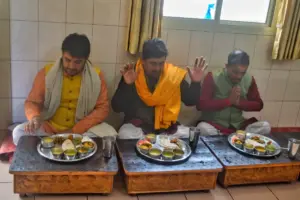
    Step 5 — Brahmin Bhoj: The Shastras are explicit that Pind Daan without the feeding of Brahmins (Brahmin Bhoj) is incomplete. The merit generated by the pinda offering reaches the departed soul through the Brahmin who receives food in their name. In Haridwar, Brahmin Bhoj is arranged by the teerth purohit and typically includes dal, rice, sabji, roti, and kheer. The number of Brahmins is traditionally one for each deceased family member addressed, with a minimum of one.

    Step 6 — Visarjan of pindas: The prepared pindas are finally immersed in the Ganga. At Kankhal, families typically carry the pindas to the Sati Kund area for visarjan, connecting the Pind Daan with the sanctity of that site.

    The entire ceremony from snan to visarjan takes three to four hours. If Brahmin Bhoj is included, allow a full half-day.

    Book Pind Daan at Kankhal Haridwar

    Pind Daan in Haridwar

    Starting ₹7,100

    Complete ceremony at Haridwar’s sacred ghats including Sankalpa, Pinda, Tarpan, and post-ritual guidance. Performed by experienced Teerth Purohits.

    Pind Daan + 5 Brahmin Bhoj

    ₹24,999

    Complete Pind Daan with the feeding of five Brahmins — the most meritorious form of the ceremony as specified in the Shastras. Includes documentation for the family record.

    Asthi Visarjan at Kankhal Ghat — Step-by-Step Guide

    Asthi Visarjan at Kankhal Haridwar — complete procedure at Sati Kund ghat
    Asthi Visarjan at Kankhal — the immersion of cremated remains in the sacred waters near Sati Kund

    Asthi Visarjan — the immersion of the collected cremated remains of the deceased in sacred water — is one of the sixteen essential Antyeshti Samskaras (final rites). The Garuda Purana is specific that this rite must be performed in a recognised tirth, not in any body of water, because the spiritual efficacy of the immersion depends on the accumulated punya (merit) of the sacred site.

    At Haridwar, the Kankhal ghat — specifically the Sati Kund area — is where this rite should ideally be performed. The procedure is as follows:

    What to bring: The collected ashes (asthi) should be kept in a clay or copper pot, never plastic. Bring til (sesame), kusha grass, flowers (particularly white flowers: white lotus, white chrysanthemum, or mogra), Gangajal if you collected it at the cremation site, and a length of new white cloth. Your purohit will provide additional materials on-site.

    Timing: The Garuda Purana favours the period between Brahma Muhurta (pre-dawn) and mid-morning for asthi visarjan, with dawn considered most auspicious. Early morning ceremonies at Kankhal are quieter and allow more time with the purohit. Avoid the solar noon period (Rahu Kaal) and after sunset if possible.

    Procedure:

    1. Arrive at the ghat. The purohit will meet you at the ghat steps. If you have arranged the ceremony in advance, he will be expecting you.
    2. The clay pot containing the ashes is placed on kusha grass on the ghat. A Sankalpa is recited naming the deceased, establishing the ritual context identically to the Pind Daan Sankalpa above.
    3. The purohit performs Panchamrit Abhishek on the pot — anointing it with milk, curd, honey, ghee, and sugar — followed by a Gangajal purification.
    4. Tarpan is performed: water with sesame and kusha is offered three times from the cupped right hand for each ancestor named.
    5. The family walks into the Ganga to knee or waist depth. The eldest son (or nominated ritual performer) holds the pot and, after the final mantra recitation, upturns the pot so the ashes enter the river completely. The pot itself is also immersed and released.
    6. After immersion, the family performs a second Tarpan standing in the river, then returns to the ghat for the final Sankalpa closure recited by the purohit.
    7. Flowers and any remaining ritual materials are offered to the river.

    The entire ceremony takes one to two hours. For families performing Asthi Visarjan for multiple deceased family members on the same visit, allow additional time.

    Book Asthi Visarjan at Kankhal Haridwar

    Asthi Visarjan in Haridwar

    ₹7,100

    Complete Asthi Visarjan at the Kankhal ghat with Sankalpa, Tarpan, and pinda offering. Performed by experienced Teerth Purohits at the Sati Kund area.

    Online Asthi Visarjan Haridwar

    ₹7,100

    Cannot travel? Our purohits perform the complete Asthi Visarjan ritual on your behalf with live video streaming. The ashes are collected from you by courier and immersed with full vidhi at Kankhal.

    Tripindi Shradh and Narayan Bali at Kankhal

    Beyond Pind Daan and Asthi Visarjan, two other ancestral rites are regularly performed at Kankhal and deserve specific mention for families where these rites are prescribed.

    Tripindi Shradh

    Tripindi Shradh is prescribed when a family has missed performing the annual Shradh for three or more consecutive years for a departed ancestor. The Vishnu Purana specifies that ancestors who do not receive Shraddha for three years become “unsatisfied souls” (duratma pitrus) who begin to disturb the living family through illness, marital discord, business failure, and repeated unexplained misfortune. Tripindi Shradh addresses this accumulated debt in a single extended ceremony.

    Kankhal is a fully accepted site for Tripindi Shradh. The ceremony takes a full day and requires an experienced purohit who knows the extended Vishnu Puja, Rudra Puja, and the three-pinda sequence specific to this rite. Families who suspect Pitra Dosh from missed Shradha obligations are advised to perform Tripindi Shradh at Kankhal or Prayagraj before the next Pitrupaksha begins.

    Narayan Bali

    Narayan Bali puja is prescribed specifically for ancestors who died by accident, suicide, drowning, snake bite, fire, lightning, or any form of premature or violent death (akal mrityu). The Garuda Purana’s Pretakalpa section is unambiguous: such souls cannot progress normally through the post-death journey and require this specific rite to release them. Standard Pind Daan and annual Shraddha are insufficient for such cases.

    Haridwar is one of the accepted Narayan Bali sites. The Narayan Bali puja at Haridwar is a two-day ceremony involving the construction of a symbolic body from wheat flour (atapatta), Vishnu puja, specific mantras from the Garuda Purana Pretakalpa, and the final Sapindikarana that elevates the preta (unsatisfied ghost-state soul) to the status of a properly received Pitru. Your teerth purohit will assess, based on the circumstances of the death, whether Narayan Bali applies in your case.

    Pitru Tarpan at Kankhal — The Daily Ancestral Offering

    Pitru Tarpan — the daily or periodic offering of water with sesame and kusha grass to the ancestors — is the simplest and most accessible form of ancestral worship. The Manu Smriti specifies that a householder who performs Tarpan daily at a sacred tirth accumulates merit equivalent to a full Shraddha ceremony each time.

    At Kankhal, Tarpan is typically performed in the early morning at the main ghat steps. The ritual takes fifteen to twenty minutes with a purohit’s guidance. Families visiting Haridwar who do not have time for a full Pind Daan ceremony can perform Tarpan at Kankhal as a meaningful and complete ancestral rite in its own right.

    During Pitrupaksha — the fifteen-day ancestral fortnight that falls in the Krishna Paksha of the month of Bhadrapada (September-October) — Tarpan at Kankhal is performed from dawn until mid-morning continuously by hundreds of families. If you are visiting during Pitrupaksha 2026 (September 26 to October 10), arrive before 7:00 AM to perform Tarpan with the full ritual atmosphere of the season.

    Other Sacred Sites Near Kankhal — Daksh Mahadev, Harihar Ashram and Sri Yantra Mandir

    Daksh Mahadev Temple Kankhal — goat-headed Shiva and sacred mandir near Kankhal ghat
    The Daksh Mahadev Temple at Kankhal — a mandatory visit after performing Pind Daan or Asthi Visarjan at the ghat

    Kankhal’s ritual geography extends beyond the ghat itself. Three sites within walking distance of the main ghat are worth understanding before you visit.

    Daksh Mahadev Temple

    The Daksh Prajapati Temple — commonly called Daksh Mahadev — is the direct physical memorial of the yajna story described above. It stands at the site that tradition identifies as the location of Daksha’s sacrifice, less than a kilometre from the main ghat. The principal deity is Shiva in the form of Daksha — depicted with a goat’s head, consistent with the Puranic account of Daksha’s resurrection.

    The temple also houses a murti of Sati in the posture of yoga-agni immolation and a large image of Virabhadra, the destructive emanation Shiva created in his grief. For families visiting Kankhal for last rites, darshan at Daksh Mahadev before or after the ritual is considered both traditional and auspicious. The temple opens at 5:30 AM and remains open until 9:30 PM with a midday break from 12:00 to 4:00 PM.

    One practical note: the area around the temple has a dense market of puja samagri (ritual supply) shops. All materials needed for Pind Daan or Asthi Visarjan — til, kusha, pinda flour, flowers, clay pots — can be purchased here at standard rates. Avoid buying ritual materials from individuals who approach you uninvited at the ghat itself, as prices there are typically inflated for out-of-town families.

    Harihar Ashram

    The Harihar Ashram, associated with Swami Omkarananda Saraswati, is one of the larger spiritual institutions at Kankhal. It maintains a ghat on the Ganga and provides accommodation for pilgrims at modest rates. The ashram is particularly useful for families who arrive in Haridwar without prior accommodation arrangements — its rooms are clean, simple, and located walking distance from both the shamshan ghat and the Sati Kund area.

    The ashram also maintains a tradition of daily Ganga Puja at its ghat. Families performing Asthi Visarjan often choose to stay here for the three days between cremation and asthi sanchayan, as it allows proximity to both the ghat and the temple circuit of Kankhal without the noise and commercial atmosphere of the Har Ki Pauri area hotels.

    Sri Yantra Mandir

    Less well known outside Haridwar, the Sri Yantra Mandir at Kankhal is a Shakti temple whose presiding deity is associated specifically with the Sati narrative. The temple maintains the Sri Yantra — a geometric manifestation of the goddess — as its primary object of worship rather than an anthropomorphic murti. It is a quieter, more contemplative space than the Daksh Mahadev Temple and is favoured by families who wish to perform private prayer after completing the asthi visarjan rites.

    How to Reach Kankhal from Haridwar Railway Station

    The journey to Kankhal from Haridwar railway station is straightforward and takes approximately fifteen to twenty minutes by road.

    From Haridwar Junction (Haridwar Main Railway Station)

    • By auto-rickshaw: Auto-rickshaws are the standard transport for this journey. The fare should be between ₹50 and ₹80 for the 4-kilometre ride. Fixed-fare autos are available from the prepaid auto stand outside the railway station. Tell the driver “Kankhal ghat” or “Daksh Mahadev” — both are equally understood.
    • By e-rickshaw: Shared e-rickshaws run along the main road toward Kankhal for ₹10-15 per person. Slower than auto but economical for solo travellers.
    • By cycle-rickshaw: Available near the station for ₹40-60. Good option if you are travelling with heavy luggage or puja materials and prefer a slower pace.
    • On foot: The walk from Har Ki Pauri to Kankhal along the Ganga bank is approximately 3.5 kilometres and takes about 45 minutes. The path follows the river and is pleasant in the morning hours. Not recommended for elderly travellers or those carrying ashes.

    From Delhi

    • By train: The Shatabdi Express from New Delhi (departs 06:45) reaches Haridwar in under four hours. The Jan Shatabdi, Dehradun Express, and multiple slower trains also run this route. Overnight trains from Delhi depart between 21:00 and 23:00 and arrive at Haridwar by 4:00-6:00 AM, which is ideal if you want to perform early morning rites at Kankhal.
    • By road: The Haridwar-Delhi highway (NH-58 / NH-334) is approximately 230 kilometres. By private car, the journey takes 4-5 hours. UPSRTC and private buses run from ISBT Kashmere Gate; the journey takes 5-6 hours depending on traffic.

    Local Orientation at Kankhal

    Kankhal’s ritual sites are all within a compact area of about one square kilometre. From wherever you are dropped in Kankhal, the following landmarks are within walking distance of each other: the main ghat steps (where Tarpan and Pind Daan are performed), Sati Kund (for Asthi Visarjan), Daksh Mahadev Temple, Harihar Ashram, and the puja market. A visit to all these sites on a single morning is manageable before noon.

    Kankhal is a residential neighbourhood alongside a pilgrim destination. Unlike Har Ki Pauri, it does not have the commercial density of Haridwar’s tourist centre. Accommodation options are simpler — ashram rooms, dharamshalas, and small guesthouses rather than hotels. For families staying multiple days for post-cremation rites, the dharamshalas near Daksh Mahadev Temple are the standard choice and cost between ₹300 and ₹800 per night.

    When to Visit Kankhal for Ancestral Rites

    Kankhal receives pilgrims for ancestral rites throughout the year, but certain periods are considered especially powerful.

    Pitrupaksha (Sep-Oct): The fifteen-day ancestral fortnight, known as the Shradh Paksha, is the primary season for Pind Daan and Tarpan at Kankhal. During Pitrupaksha 2026 (September 26 to October 10), the ghat at Kankhal operates from before dawn until late evening with experienced purohits conducting back-to-back ceremonies. This is when the largest number of families visit — particularly on Amavasya days and on Matru Navami (October 4 in 2026) for those who have lost their mother.

    Mahalaya Amavasya: The final day of Pitrupaksha is Sarva Pitru Amavasya — the day when all ancestors, regardless of their tithi of death, can receive Shradh and Tarpan simultaneously. At Kankhal, this day sees concentrated activity from dawn onwards. For families uncertain of the death tithi of older ancestors, this is the most reliable day of the year to perform Tarpan.

    Ekadashi and Amavasya throughout the year: Beyond Pitrupaksha, the new moon (Amavasya) of each month is considered appropriate for Tarpan and Pind Daan. Somvati Amavasya — Amavasya falling on a Monday — is particularly auspicious and draws larger numbers to Kankhal.

    Maghi Purnima and Makar Sankranti: The full moon of Magh (January-February) and Makar Sankranti (January 14) are considered powerful days for Tarpan at Haridwar’s ghats. The sacred quality of the Ganga is said to be especially concentrated on these days.

    After a death in the family: There is no inauspicious season for performing Asthi Visarjan or the initial post-death Pind Daan. These rites should be performed as promptly as the family can manage — within the thirteen-day ritual period after death if possible, and certainly before the first year’s anniversary if the family needs additional time to travel.

    Book Your Ritual at Kankhal with Prayag Pandits

    Trusted Teerth Purohits at Kankhal Haridwar

    Our purohit network at Kankhal includes families with documented lineages at the Sati Kund ghat and the Daksh Mahadev Temple circuit. We conduct Pind Daan, Asthi Visarjan, Tarpan, Tripindi Shradh, and Narayan Bali with the complete traditional vidhi — no shortcuts, no rushed ceremonies.

    • WhatsApp confirmation within 2 hours of booking
    • Purohit coordinates directly with your family on arrival timing
    • All ritual materials arranged; you bring only yourself and the ashes
    • Online options available with live video for families who cannot travel
    • Services conducted in Hindi, English, and regional languages

    Frequently Asked Questions

    What is Kankhal Haridwar famous for?

    Kankhal is the oldest sacred quarter of Haridwar and one of its Panch Tirth. It is famous as the site of Daksha's yajna where Sati immolated herself, making the waters of Sati Kund especially powerful for Asthi Visarjan. The Daksh Mahadev Temple here has a goat-headed deity, consistent with the Shiva Purana account of Daksha's resurrection. Kankhal is the primary location in Haridwar for Pind Daan, Tarpan, and Asthi Visarjan due to its Puranic associations with death transcendence.

    Which ghat is best for asthi visarjan in Haridwar - Har Ki Pauri or Kankhal?

    For Asthi Visarjan, Kankhal is considered more appropriate by traditional teerth purohits. The Sati Kund area at Kankhal is where Sati's body fell after her yoga-agni immolation at Daksha's yajna, permanently charging these waters with the quality of transcendence. The Garuda Purana favours tirths associated with divine liberation events for Asthi Visarjan. Har Ki Pauri is powerful for general pilgrimage and bathing but its primary association is with living devotion rather than ancestral liberation. Most experienced purohits directing families for Asthi Visarjan in Haridwar bring them to Kankhal Sati Kund rather than Har Ki Pauri.

    How far is Kankhal from Haridwar railway station?

    Kankhal is approximately 4 kilometres from Haridwar Junction (the main railway station). Auto-rickshaw takes 15-20 minutes and costs between 50 and 80 rupees. Shared e-rickshaws run for 10-15 rupees per person. The walk along the Ganga bank from Har Ki Pauri takes about 45 minutes. Auto-rickshaws are available at Haridwar station even at 4:00-5:00 AM for families arriving by overnight train for early morning rites.

    What is the significance of Daksh Mahadev Temple for last rites?

    The Daksh Mahadev Temple at Kankhal stands at the site of Daksha's yajna — the event that caused Sati's death and Shiva's grief. For families performing last rites at Kankhal, visiting Daksh Mahadev is traditional and auspicious because the temple memorialises the original death-transcendence event that makes Kankhal sacred for ancestral rites. The presiding deity is Shiva in the goat-headed form of Daksha, consistent with the Shiva Purana account of Daksha's resurrection. Shiva as Mahakala governs the transition between death and the ancestral realm, making darshan at this temple especially meaningful before or after Pind Daan or Asthi Visarjan.

    Can asthi visarjan be done at Kankhal Sati Kund?

    Yes, Sati Kund at Kankhal is the primary and most theologically significant site for Asthi Visarjan in Haridwar. The immersion of cremated remains at Sati Kund is a continuous tradition maintained by hereditary teerth purohit families. The procedure involves entering the Ganga up to knee or waist depth and immersing the ashes with Tarpan and Sankalpa recitation. Online Asthi Visarjan is also available for families who cannot travel, where ashes are collected and immersed at Sati Kund with live video documentation.

    Share

    Book Your Sacred Ritual

    Authentic ceremonies performed by Veda-trained pandits with video proof at sacred sites across India.

    2,263+ families served Video proof included Since 2019
    About the Author
    Prakhar Porwal
    Prakhar Porwal Vedic Ritual Consultant, Prayag Pandits

    Prakhar Porwal is the founder of Prayag Pandits, a trusted platform for Vedic rituals and ancestral ceremonies. With deep roots in Prayagraj's spiritual traditions, Prakhar has helped over 50,000 families perform sacred rituals including Pind Daan, Shradh, and Asthi Visarjan across India's holiest cities.

    2,263+ families served · Operating since 2019
    Share
    Continue where you left off?

    Your Booking

    🙏 Add ₹0 more for priority scheduling

    No rituals selected yet.

    Browse Pooja Packages →
    Need help booking? Chat with us on WhatsApp