Key Takeaways
- What to share before the ceremony
- Why Gaya
- How Tharpanam differs from northern Tarpan
- Masikam, and when Gaya fits
In This Article
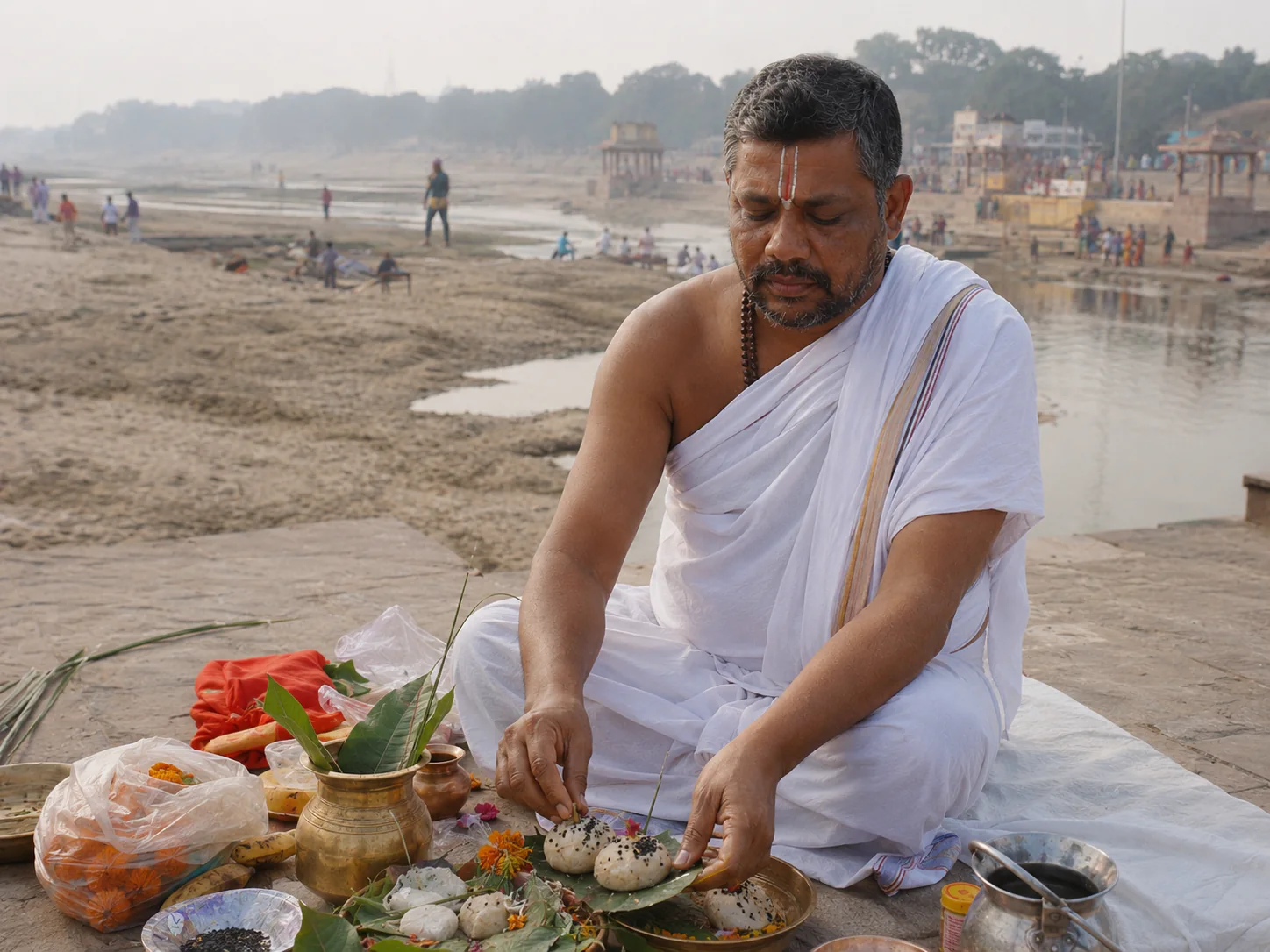
Tamil families perform Tharpanam (தர்ப்பணம்) on the Apastamba or Baudhayana sutras rather than the northern Ashvalayana or Parashara, and the differences are real ones — the darbha ring, the stance, the mantra sequence. This page is about what a Tamil family should settle before a Gaya yatra, and what to tell the pandit so the rite is performed on your own paddhati.
What to share before the ceremony
- Tamil as the ceremony language. Select it when booking, and the coordinator confirms availability for your date.
- Your sutra — Apastamba for most Iyer families, the Baudhayana variation for Iyengar families.
- Your gotra, spelled out in Roman script for the sankalpa.
- Iyer or Iyengar, and any paddhati detail your family Vadhyar has given you.
- The ancestors — names, relationship and approximate year, three generations on both sides if you have them.
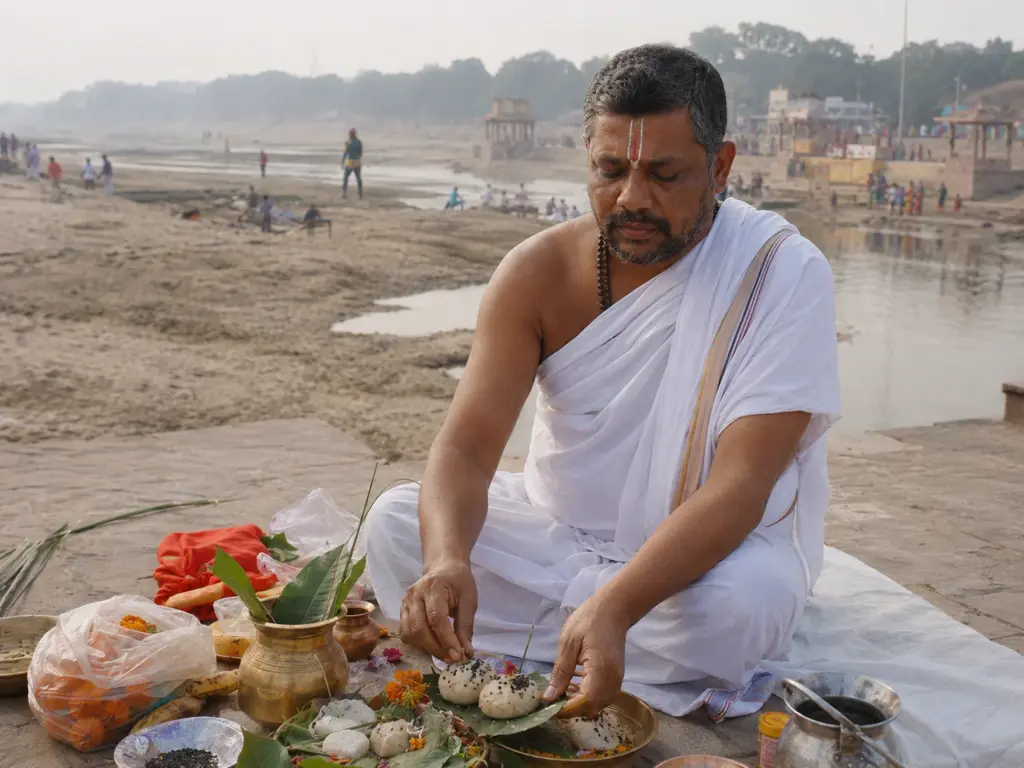
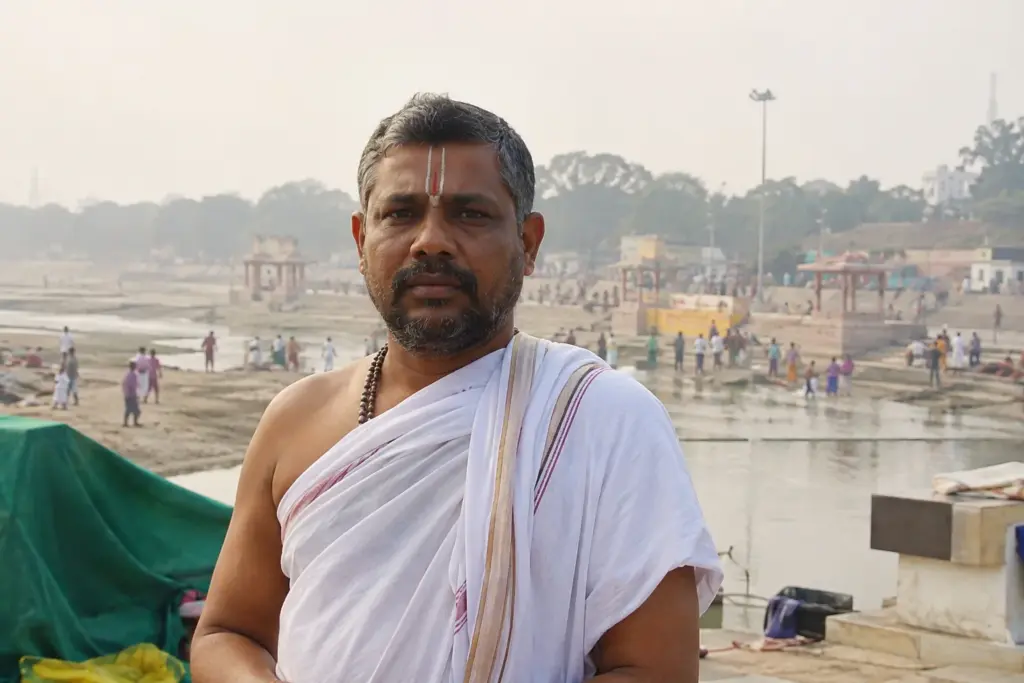
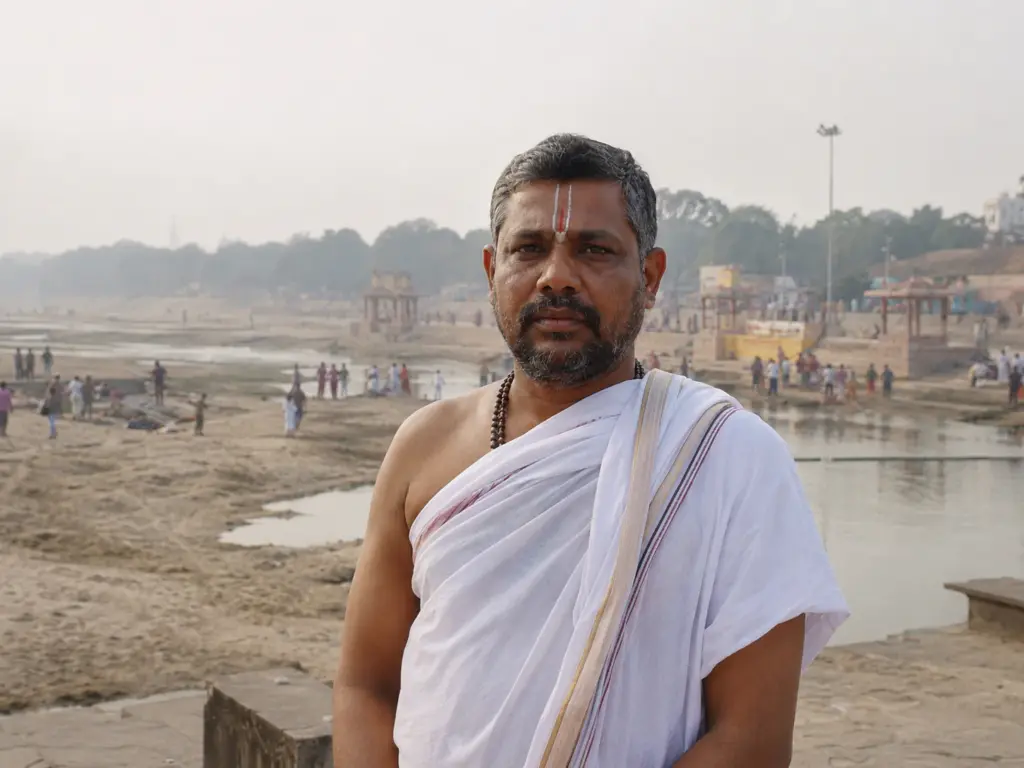
Meet a Tamil-speaking Pandit Ji in Gaya
- Select Tamil as your preferred ceremony language.
- Share your ritual, gotra and family-tradition details in advance.
- The Pandit Ji and ceremony date are confirmed before arrival.
Why Gaya
The Agni Purana puts it directly: a man discharges pitru rina, the ancestral debt, when he travels to Gaya, stands at the Vishnupad vedi and offers a pinda with kusha and til in hand. Other acts of piety, however generous, are not held to do the same work.
The story behind it is Gayasura’s. The asura’s devotion earned him a boon that made his body the holiest place in creation — so holy that anyone who saw or touched him was liberated, which emptied Yama’s realms and stalled the law of karma. Vishnu asked for his body as the altar for a yajna, and when it stirred he set his foot on the slab to hold it still. Gayasura’s last request was that rites performed at the spot carry liberation, and it was granted, with Vishnu, Shiva and Brahma held to reside there together. That is why Gaya is called Pitru Tirtha — the tirtha that exists for the ancestors.
The Garuda Purana places Gaya alongside Prayagraj and Kashi as the three supreme tirthas for these rites. The Skanda Purana adds the part that matters for families whose people left Tamil Nadu: that ancestors who never received proper rites — who died in accidents, in foreign countries, or without children to perform their shradh — can be liberated through a sincere Gaya offering. For families with ancestors who went to Sri Lanka, Malaysia, Singapore or South Africa during the colonial migrations, that is often the whole reason for the journey.
The Brahma Purana states the obligation plainly: the man who does not perform shradh causes his Pitrs to fall from their abode, and by their fall he himself falls. What a Tamil family inherits is not only the land and the name but the pitru rina along with them.
How Tharpanam differs from northern Tarpan
Tharpanam comes from the Sanskrit tarpana, to satisfy. The Vedic basis is the same as the northern rite — both follow the Grihya Sutras — but the Kalpa Sutra differs, and the sutra governs the sequence, the mantras and the physical actions. These are not cosmetic differences, and a pandit who does not know them will perform a rite your family will recognise as not quite theirs.
- The sutra. Most Iyer families follow Apastamba; Iyengar families the Vadama or Vatakalai variation of Baudhayana. Northern brahmins generally follow Ashvalayana or the Parashara tradition. Which mantras are recited, in what order, and how many times, all follow from this.
- The darbha ring. In the Apastamba tradition a ring of darbha grass — the pavitram — is worn on the right ring finger throughout, as the conduit by which the water reaches the Pitrs. Northern practice holds kusha between the fingers and observes the ring less strictly.
- Sesame. Ellu, black sesame, is mandatory. The Apastamba position is explicit that water offered without it reaches the Pitrs as blood rather than nourishment. The northern tradition shares the injunction; Tamil practice applies it absolutely.
- Stance and direction. Both traditions face south, towards Yama’s quarter. Apastamba prescribes standing with both knees slightly bent rather than sitting, with the water poured through the pitru tirtha — the space between thumb and index finger.
- Recitation. The Pitru mantras carry the vowel elongation and cadence of the Apastamba tradition, which sounds different from the same mantra in a Kannada or north Indian voice.
Our dedicated guide to Pithru Tharpanam for Tamil families has the full procedure and the mantras in Tamil script.
Masikam, and when Gaya fits
Masikam (மாசிகம்) is the monthly ceremony through the first year after a death, performed on the same lunar tithi each month for twelve months — the Tamil form of what northern families call Masika Shradh. Our note on Masikam covers the procedure and the difference between Oona Masikam and the regular rite.
The connection to Gaya is often misunderstood, so it is worth being precise. The twelve Masikams and the first-year Abda Abdika shradh discharge the ongoing monthly obligation — sustaining the soul through its passage from Preta to Pitr. The Gaya Pind Daan does something else: it is held to grant permanent liberation. It does not replace Masikam and Masikam does not substitute for it.
Before or after the twelve Masikams? The Garuda Purana’s position is that Gaya Pind Daan can be performed at any time — before, during or after the cycle — without losing efficacy. Many Tamil families go after the first-year Abda Shradh or Pithru Kaaryam, treating the yatra as the close of the first year’s obligations.
Can Masikam be performed at Gaya? Yes, and performing it at a tirtha is held to multiply its merit. If your Masikam tithi falls during the visit, the pandit can perform the monthly ceremony at the Phalgu ghat before the Pind Daan — but tell us at booking so he comes with the monthly sankalpa prepared.
Iyer and Iyengar customs
Iyer families, Smartha tradition
Shiva as the supreme deity within the Panchayatana, with the rites following Apastamba or Ashvalayana depending on the shakha. The annual ceremony is the Abda Abdika, or Thivasam, on the death tithi.
- Sesame, barley and the darbha pavitram throughout
- The officiating priest is the Vadhyar
- The closing includes feeding crows — kakam — held to be Yama’s messengers and to carry the offering to the ancestors
- Karumathi on the sixteenth day clears the death-pollution and ends the mourning period
- Gotras commonly found: Bharadwaja, Kashyapa, Atreya, Harita, Vatsa, Kaundinya, Vashishtha, Shandilya, Vishwamitra, Agastya
Iyengar families, Sri Vaishnava tradition
Vishnu-Narayana as supreme, and the rites take a distinctly Vaishnava character — tulsi used throughout, with Vishnu Sahasranama recitation accompanying the shradh.
- Tulsi offered to the brahmin who represents the ancestor — particular to Vaishnava families
- The gotra recitation in the sankalpa follows the Baudhayana format
- Observance on the death tithi and on Ekadashi
- Gotras commonly found: Koundinya, Parasara, Atreya, Vatsa, Vishwamitra
Gaya carries a particular weight for Iyengar families, since the main offering is made at the footprint of Vishnu himself. Our note on the Vishnupad temple covers it.
The Gaya sequence
Gaya holds forty-five vedis across its lanes, ghats and hills. Most families complete the essential set in a full day with a dedicated Teerth Purohit. Our step-by-step guide to the vidhi has the whole procedure; this is the shape of it.
What the Karta brings
- Black sesame — ellu — at least half a kilo
- Darbha or kusha grass. It is available at Gaya, but bringing some from your own temple keeps the continuity
- A copper vessel or lota for the water offering
- A white dhoti; the Karta performs the whole ceremony in traditional dress
- The written list of ancestors, and the gotra in Roman script
The Karta fasts, or eats once, on the day before.
The vedis
Vishnupad temple first, where the footprint is enshrined, with the full sankalpa naming the Karta, his gotra, his father and grandfather, and the purpose. Then Akshayavat, the banyan in the courtyard where Sita offered the pinda for Dasharatha and his spirit came to receive it — our note on the Akshayavat explains why the rite is not complete without it. Brahma Kund, the tank where Brahma performed the yajna on Gayasura’s body. Rudrapada, Shiva’s footprint at Gaya, which carries particular resonance for Iyer families.
Tharpanam at the Phalgu
In the afternoon, at the ghat. The Karta stands in the water or at its edge, wears the darbha ring on the right hand, and pours the til-mixed water facing south while the pandit recites the Pitru Tharpanam mantras — in the Apastamba invocation for families following that sutra.
Worth knowing at the river: the Valmiki Ramayana records Sita offering the pinda for Dasharatha here with sand from the bed when the ritual items were not to hand. Tamil households know that moment through the Kamba Ramayanam, Kamban’s ninth-century rendering. Standing at the Phalgu connects the rite to your own literary tradition, not only to a northern one. Our note on the Falgu tells the full story.
Mangala Gauri and Pretashila
Mangala Gauri, a Shakti Peetha within Gaya, matters when the rites are for female ancestors — mothers, grandmothers, aunts, sisters — and Tamil tradition offers a separate pinda here for the female line. Pretashila, the hill outside the town, takes the final pinda; the Garuda Purana calls it the point of departure, after which the soul is held to have passed beyond the Preta realm. The pandit then performs the closing Uttara Puja and the Karta bathes to complete the purity requirement.
Karumathi and Sapindi Karana
Tamil families observe Karumathi on the sixteenth day, which ends the death-pollution and declares the household ritually pure — the equivalent of the northern Shodasah Karma, and the point at which the departed is held to have separated from the household.
In the broader tradition the corresponding rite is Sapindi Karana, on the twelfth day, which raises the ancestor from Preta to Pitr. Tamil practice generally places that elevation at the sixteenth day, through the completion of Karumathi. Our guides to Chautha, Uthala and Terahvin and to Hindu death rituals cover the northern sequence, and Apara Karma covers the Tamil one.
After Karumathi come the monthly Masikams, then the Pithru Kaaryam on the death tithi once the full lunar year has passed. That is the point many Tamil families choose for the Gaya yatra.
Getting to Gaya from Tamil Nadu
By train
The usual choice. Several weekly trains run from Chennai Central to Gaya Junction, direct or via Patna, taking roughly 32 to 38 hours — sleeper and 3AC are what pilgrimage groups book, and book early. Faster: fly to Patna and take a train or taxi onward, 110 km and about two and a half hours by road.
Many families route through Varanasi instead — Chennai to Varanasi is about 36 hours, and Gaya is 250 km on from there, four to five hours by road or three by Intercity. It makes a sensible pairing: Kashi for asthi visarjan or pitru puja, then Gaya for the Pind Daan.
By air
Gaya International (GAY) has seasonal connectivity, and Chennai–Gaya routes have operated during Pitru Paksha — check current schedules, because they change. Via Kolkata is about three and a half hours with the connection, via Delhi about four. Chennai–Patna is more frequent, with Gaya 110 km on by road.
From Coimbatore, Madurai, Trichy or Salem, connect to Chennai by train or flight. Pondicherry is three hours to Chennai by bus.
When to go
- Thai Amavasai, in the Tamil month of Thai, falling in January or February. Cool weather at Gaya, manageable crowds, and an Amavasai that carries elevated merit in the Tamil calendar.
- Aadi Amavasai, in the Tamil month of Aadi — one of the most important Tharpanam days for Tamil brahmins. Performing it at the Phalgu combines the tirtha with a date that is specifically yours.
- Pitru Paksha, the fortnight in September or October, with Mahalaya Amavasai on the final day — the strongest day of the year for Tharpanam anywhere, and more so at Gaya. Very crowded; book trains and accommodation three to four months ahead.
Amavasai dates move each year, so confirm against a Tamil panchangam before booking travel.
Booking
| Package | Price | What it covers |
|---|---|---|
| Pind Daan in Gaya | ₹7,100 | Vishnupad and the Phalgu ghat, around 30 to 45 minutes |
| Pind Daan Gaya Platinum | ₹11,000 | The extended circuit of vedis |
| Online Pind Daan in Gaya | ₹11,000 | Performed on your behalf with a live video link |
| Pitru Paksha special, three days | ₹31,000 | The full circuit during the fortnight |
🙏 Book Gaya Pind Daan with Tamil as your language
- Tamil selected as the ceremony language
- Sankalpa prepared on your sutra and gotra
- Iyer or Iyengar paddhati accommodated
- Pandit Ji confirmed before the ceremony
Procedures vary by family tradition. Share your gotra, the ancestors’ names, your Vadhyar’s guidance and any paddhati requirement before the sankalpa is prepared.
Does annual shradh continue after Gaya?
Yes. The Garuda Purana’s position is that the Gaya Pind Daan confers liberation for the ancestor it was performed for, while the annual Pithru Kaaryam continues independently — as filial devotion, and as nourishment for the Pitru world generally, which benefits all the ancestors and not only the one liberated.
The annual ceremony is kept on the Pithru Thivasam, the death tithi in the Tamil calendar, at home with the family Vadhyar, with brahmin bhojan and dakshina. Our guide to Barsi, the one-year shradh covers the northern parallel, and the complete shradh guide sets out what each ceremony is for.
Where the Vadhyar or astrologer has identified a need for Narayan Bali or Tripindi Shradh from the circumstances of the death, those are separate rites with their own timing.
If Gaya is not possible this year
The Vishnu Purana places Prayagraj alongside Gaya and Kashi in the same triad, and Tharpanam at the Triveni Sangam during Pitru Paksha or on an amavasya carries the Sangam’s own standing. Families often perform at Prayagraj and return for Gaya in a later year, treating the two as complementary rather than interchangeable. Our Pitru Tarpan guide covers the Prayagraj ceremony.
For a cross-community view, our guide to Pind Daan at Gaya for Bengali families covers a tradition that shares the same scriptural bedrock and differs in its paddhati.
Common questions
Will the pandit know the Apastamba sequence?
Tell us your sutra at booking and we pass it to the Teerth Purohit before you arrive, so the sankalpa is prepared on it. If we cannot arrange a pandit for your paddhati on your date, we will say so rather than take the booking.
Should Gaya come before or after the twelve Masikams?
Either. The Garuda Purana does not tie Gaya to the Masikam cycle. Most families go after the first-year Pithru Kaaryam.
Can Tharpanam be performed in Tamil?
The mantras are Sanskrit, as they are everywhere. What Tamil as the ceremony language means is that the pandit explains, instructs and takes the sankalpa with you in Tamil, and recites in the Apastamba cadence.
Can Masikam be done at Gaya?
Yes, if the tithi falls during your visit. Say so at booking so the pandit brings the monthly sankalpa.
Arranging it
Tell us the rite, the date, your sutra, your gotra, the ancestors it is for and that you want Tamil as the ceremony language, and we will confirm the Pandit Ji and the total before anything is paid.
Book Your Sacred Ritual
Authentic ceremonies performed by Veda-trained pandits at sacred sites across India.



